Sunday, February 12, 2012

The Hanged Man (CinemArchetypes #4)


 "He who can understand that the story of his higher nature as embedded in this symbolism will receive intimations concerning a great awakening that is possible, and will know that after the sacred Mystery of Death there is a glorious Mystery of Resurrection." - A.E. Waite - The Pictorial Key to the Taro
I'm not sure Jung ever thought of the Hanged Man as a psychedelic space cowboy seeker the way I do, but certainly he recognized the alchemical properties of the tarot and other processes of divination, and if the hanged man represents stasis, well, there's a good and bad element to that, and both aspects are entwined in any good psychedelic experience. While hanging upside down, frozen in space and time as the world revolves beneath your head, aren't you in fact moving? If you can hover suspended in one place, truly not moving from a fixed point in space, will you not eventually circumnavigate the earth as it revolves beneath you? and eventually it will revolve away from you altogether?

And the hanged man and I have so much in common! For one, it's the way I sleep, one leg folded at the knee behind the other and it took me awhile to realize hey - I'm the hanged man, and only the hanged man would take so long to realize hey, he is the hangman. And like the hanged man I took it as a compliment when my dad told me I had perfected the age of 28. I had decided 28 was the age to be, and just froze there, he said. And that may still be true, but in doing so haven't I gained my soul, perhaps, at the loss of the world? To inverse Scarface, What won't a man have if he should lose the world but gain his soul? 

The hanged man is neither here nor there, nor now nor then. He exists in many doorways. He is the threshold lingerer. He is not quite the shaman or the knave, neither awake nor asleep. Faced with any fork in a road he won't pick one less or more traveled but instead climb the nearest tree and hang there, creating his own weird path, the third option - no path at all.

But this path of inactivity often leaves him trapped, shut out of his own process. For example, absinthe and hashish may be his tool to make contact with the land beyond the veil, but then suddenly the absinthe and hashish just use him, and he's just a drunk burnout shut out of the deal. The hash and absinthe come back from behind the veil and are like "Dude, that was awesome, too bad Dingus here is too burned out and drunk to see it! Burn!" So now he's a burnt-out 48 year-old drunk working in a guitar shop and dating a 19 year-old community school dropout who smokes all his weed. While he's brave in that he risks his life and sanity in pursuit of the unknown, he's running across a bridge to nowhere as the bridge falls away behind him. All out of bridge he goes leaping finally into the air in slow motion and suddenly the young girl watching him presses pause on her DVR, and there he freezes while she goes and feeds the fucking cat!

And ask not what the cat eats...


A common problem of we hanged man acid casualties is we've seen too much too fast and now just don't give a shit about water slides and trips to Yellowstone and spring. Instead of climbing the mountaintop we just sit around, because, hey we already have been up there, and yeah, it's awesome but the air is too damn thin. And now here we are in our empty theaters, looking out the window at the one place all the magic and illusion was to prevent us seeing, that foreign film screening room from which no moviegoer returneth.

Simultaneously enlightened and flash frozen in adolescence, we know what's behind the wizard's curtain. We 'get' the cosmic joke (an accept it's at our expense). The sting we felt when first hearing the watery, whispery mocking laughter of the demons devouring us has long faded; there's nowhere new to go but through the mortal coil exit door. We're not suicidal, just jet-lagged from the cosmic shortcuts. We're fine hanging in the threshold, pretending the big projected green head shouting oaths about witch's brooms is legit. We play along so the wizard will float us some cash and let us harvest as many poppies as we want from his big pink field.

We know the myths and we're proud to assume any archetypal role that's needed: prince, ogre, lover, monster, or sage. But our own self, the hanged man, remains frozen three minutes from "The End". We couldn't wait to see how our life movie ended, so we FF-ed ahead, foolishly thinking we could go back to where we left off. Turns out we can't rewind, so here we twist, frozen, hung, waiting for the world to catch up so we can all exit together through the credits. We shot for the moon and now are marooned there, all alone, getting blunted watching Rocketship X-M. For god there is no zero, but we lament the lack thereof for the benefit of the Mr. Kite hidden microphones.

We rant against the non-dying of the light, but we like it this way, and never doubt otherwise.

And after all, all is vanity. 

1. Kier Dullea as Bowman - 2001: A Space Odyssey (1968)

The last segment of Kubrick's film is almost intentionally confusing to the laymen, but probably very 'logical'  to the acid heads who flocked to see it in its original release at the height of the psychedelic era (and they year LSD was officially and for no real reason made a schedule 1 illicit substance, thus instantly ending countless research and successful therapies). What the hanged man comes to understand is that outer space and one's own unconscious mind are in fact the same thing, that outer is inner, and if you see something it exists through your seeing of it. Nothing is real, and nothing to get hanged about, but you may as well hang, Johnny, hang.

2. William Hurt as Prof. Jessep - Altered States (1980)

Director Ken Russell re-imagines hallucinatory transmutation on a physical level, missing perhaps the point entirely, literalizing like a fundamentalist...in telling the story of Adam and Eve he'd no doubt show a naked hunk actually tearing out one of his own ribs and having a full grown woman morph out of it, with geysers of blood and latex. Similarly, Jessup transforms into a guy running around with dogs, then later morphs into a big half-blob, half-man! He's gone "too far" and is having crazy flashbacks! Only Blair Brown's love can save him now! To the hardcore 'heads in the house, this is what's known as 'showboating.' Wavy Gravy could have talked Jessup back into a human form in five minutes at a Woodstock chill-out tent. Dude, you make your own reality, especially if you manage to snag a grant and a course release. To take drugs and lie around in body temperature saline solution like a lazy bum and then announce God doesn't exist doesn't make you pretentious as long as someone's monitoring your EEG, apparently...  8/09 (more)

3. Peter Weller as Bill Burroughs - Naked Lunch (1991)

Bill's very nature reflects the inextricable union of life and death: he works as an exterminator, but gets high on his own bug powder. Both Cronenberg and Burroughs are unafraid to look death in the eye and see it as merely temporary (like life), the tunnel portion of an endlessly looped carnival ride. The topography is changed just a little after each journey into the Stygian darkness, but memories of past events warp to accommodate new information. And then Benway appears with a trial prescription like Glenda the Good Witch, with a new pair of rubier slippers to celebrate your completing the first level of Oz. But each pair has a price: like Moira Shearer you can't stop dancing once you put them on. For every bridge deeper into the Interzone another universe of possibility dies behind you. What Buckaroo Banzai didn't realize about the 8th dimension is that you don't need a fast car driving into a rock to get there, you just need a taste of Dr. Benway's patented black centipede syrup, and a deadpan facade. Wherever you go, there you are, but then, also there you aren't... so best take your time...'.- 12/09 (more)

4. Belmondo in Pierrot Le Fou (1965)

To my mind, nothing's more romantic or ballsy than walking out on your whole staid bourgeois life for a wild card babysitter who drives too fast, calls you Pierrot and admits she can't be trusted. But then of course, time sneaks around the end zone and drags you down, but you knew it was coming, and it's to your credit you barely tried to stop it. It's heroic watching Ferdinand heroically keep his Groucho Marx-ish elan and surrealist edge while Anna Karina runs him ragged. 

 In the end he even assumes a certain kind of Duck Soup Groucho pose, by wrapping dynamite around his head, the only conceivable way he can wreak any kind of victory from the shambles he's made of his life just by following Elliot's Wasteland edict "The awful daring of a moment's surrender / which an age of prudence can never retract / for this and this alone have we existed."


5. Albert Finney as Geoffrey Firmin -- Under the Volcano (1984)

"Theresh nothing betterr.. to sober one uhpp... than beer!" that's a line my friends and I would quote amongst ourselves when surrendering to the grim alcoholic gallows humor of this John Huston adaptation of the "towering" Malcolm Lowery novel (which I've never been able to get more than 5-28 pages into) about the last days of a British consul in Mexico in the 1930s. We'd talk in Albert Finney's eloquent slur for days on end, digging that our mirth was rooted in a violently escalating alcoholism, a black humor joke where we were the punch line. And we wouldn't have it any other way, baby. Neither would Albert Finney, who regularly reaches out for the shimmering Jacquelyn Bisset like a mirage and then shrugs her off like the last temptation of a booze-crucified saint before resuming his wide-eyed stare into the awful abyss.  (7/09)

6. Mick Jagger as Turner in Performance (1968)

Always an interesting screen presence, here Mick relishes the chance to play a darker, more genuinely Satanic version of himself. According to Faithful, Jagger really wasn't into Satanism and black magic per se, he just liked to pose in the clothes and use it as excuse for shamanic gyrations. Under the warlock-ish spell of (director) Cammell however, Jagger lets loose into some terrifying and funny places. At one point just shaking a stick to one of Jack ("The Lonely Surfer") Nitzsche's instrumental tracks (which Turner is supposed to have written), you get a sense of how truly sublime and mind-altering Mick's snake charmer dancing is. Later he even plays guitar and sings Robert Johnson's "Come on in my Kitchen" and if you never understood what Johnson's blues had to do with the devil, now you know. Mick may not be the devil, but he's a hell of a good recruiting officer. There's got to be some sinister reason he and Keith are still alive, kicking, and--even in their withered shells--still super sexy. (7/09)

7. James Stewart in Vertigo (1958)

Looking into Medusa's face is best done via a rear-view mirror or a quick coy glance, like one gives a hot lady or gentlemen going the other direction in the subway rush. If you gawk, you shall be ensnared, petrified, arrested. As Scotty stares too long, he winds up a statue, which gradually crumbles and melts like the end of MYSTERY OF THE WAX MUSEUM. (9/10 - more)


 8. WC Fields in Never Give a Sucker and Even Break (1941)
The chickens have pretty legs in Kansas.
That is really is not a joke,
Wanna roll me for my poke?
Chickens have pretty legs in Kansas.


9. Jack Nicholson as R.P. McMurphy - One Flew Over the Cuckoo's Nest (1975)

The big tragedy in this film isn't that Nurse Ratchet is mean it's that McMurphy would rather strain against the bars than run in the sun. Inches from a clean get-away he pauses at the door and makes a big to-do of getting his stuttering mentee laid and then winds up drunkenly crashing on the common area couch. Of course the prostitutes who've been brought in don't get a vote on whether or not bed freaky mental patient virgins, but feminism was never Kesey's strong point. That kind of pimping may have been read as heroism once but over time McMurphy just seems like one of the more embarrassing anachronisms of the pre-feminist era. Outside the walls of the institution he'd just have a walk on part in the war instead of a lead role in a cage which is what he's got let's face it Charlie.

I do approve of Kesey's drug use though, and he himself is an archetypal hanged man. A once promising literary genius who let himself lapse into trippy non sequitors, he fits most of what I've been writing here about that 'seen too much of the infinite to focus in on a long term project' vibe so essential to the hanged man.

10. Grant Williams as Scott Carey - The Incredible Shrinking Man (1957)

The shrinking is a fine metaphor for drug addiction, as the world does seem to shrink, until you're alone in what seems like a gigantic basement even if it's just your bedroom, every drop of water dripping from the kitchen sink echoing like a sonic boom in your swollen temples. Carey's eventual realization he'll survive no matter how small he becomes is a 'when you're falling, dive' mantra ala Joseph Campbell. Or to paraphrase Dylan, for god there is no zero, and zero is no 'is' at all.

11.Roy Scheider as Joe Gideon - All that Jazz (1979)

"... like a great older brother or cool father, Scheider showed strength without bullying, grace without mincing, and style without pomposity. Most of all, in Joe Gideon's tired eyes we saw a reflection of what's best in ourselves: a hard-won universal love and Cheshire cat grin that only got wider even as he danced the mashed potato into the hungry jaws of death. All who needed sustenance were welcome to follow his warm light through the darkened terrors of the deep. We did, we do... we will." (2/08)

12. Peter Fonda as Captain America - Easy Rider (1969)

"We blew it.

 Other Nominees: The entire cast of characters in  Two Lane Black-Top; every character in every movie by Robert Altman and Paul Thomas Anderson (not including Punch Drunk Love); Jett Rink, Matt McConaughey in Dazed and Confused, John Barrymore and John Gilbert in the sound era, Don Birnim in The Lost Weekend, and Jeff Goldblum in The Fly.

Wednesday, February 08, 2012

The Rutting Season: Boardwalk Empire, Game of Thrones


The new DVD set of Boardwalk Empire provides a chance for the HBO-less (like me) to finally see if Steve Buscemi can really pull off being a mob kingpin mayor (PS - he can't). Didn't anyone try and direct him? He looks and acts like a hermit crab bewildered at the loss of his shell. The real Nucky was presumably tough. Look at his shark eye stare (in pic below/left). There's only one or two actors in the whole series who seem genuinely menacing, who could ever convincingly threaten (naturally they're the unknowns): Stephen Graham, a terrifying but adorable Al Capone; Vincent Piazza, a poison breeze as Lucky Luciano; Michael Stuhlbarg, growing larger with every inhale as Arnold Rothstein ("ever since Rothstein 'cough' fixed the world series...'cough'")

the 'real' Nucky
 But the 'main' protagonists are a bore. Somewhere one of the show's creators felt there needed to be some moral lip service, so Nucky helps A poor widow and attends temperance meetings; dirty rat layabout Michael Pitt occasionally goes home to make idle promises to his wife and kids; obsessive fed Michael Shannon's bug-eyed mask of a face clamps down in self-righteous lock around his anti-booze assignment; self-appointed narc Kelly Macdonald (the Irish widow / temperance league member / all-around 'saint') flinches at every loud noise (she could use a freaking drink) and sleeps angelically with her two children instead of carnally with her lout husband, in such a icky faux-Fordian blarney way as we're forced to wonder what seedy motive is behind it all: is it male jealousy over the perfect bond between infant and mother or is she sanctifying herself in religiously sentimental poses to put the husband off his night's rutting?

And then, on the other side, the premature baby Buscemi, underloved, raised in an incubator, seeing in Macdonald a kind of moral mother he never had. So while Goodfellas was about brotherhood and Godfather was about becoming the Dark Father,  Boardwalk Empire is about being an infant all over again, i.e. gettin' boozed up at the teat whorehouse then feeling bad about it when mom drags you to church the next day. And that's all. 


Ah Margaret, and of course her husband beats her, for all saintly mothers are beaten by their drunk Irish laborer husbands in these sagas--so that Nucky can be saintly by thrashing him (via remote control) near to death-- and a whore gets cut up because Michael Pitt is sleeping with her (so his cocky idiocy is paid for by female suffering, as usual) and we're forced to behold concave Buscemi wheezing his way through doggy-style sex with La Huerta like he's Red Hot Ryder in 1944'a "Buckaroo Bugs." There are endless elaborate adult-themed strip shows in old theaters with far too little cigar smoke and talk of whores even when whores are not present. Just women. Who deserve more respect. Just for surviving and putting up with all these lout's infantile asses.

This is the kind of show HBO specializes in, giant violent grown male toddlers rutting via smash cuts that preclude all foreplay, delivering sudden tableaux of rough sex and domestic violence in attractive period settings, all but daring us not to wince in embarrassment as women are all either naked floppy-breasted prostitutes or floppy hat-wearing saints. Sure maybe that's how it was, in the post-code movies anyway, but these people's lives have lots of incidents they can pick from--why not go the Mad Men season one route and really get into the nuts and bolts of the business side of bootlegging? There is some of that, but none of it feels researched or lived-in, when you unwind the fancy ribbons, the non-sex incidents have no purpose other than to build up to brutal misogynist violence or more mutually demeaning rear guard rutting (which amounts to the same thing). An equal opportunity offender, if we meet a black bootlegger and see his operation, we can be sure it's only so he can be killed or tortured, his whiskey still burned down, in the next scene, in racially-motivated violence. Why else? Black characters exist for only this purpose in period HBO shows, Anything more complex would be too complicated.... But more complicated for whom, HBO? 'Adults?' They can't really say "adults only" for shows like this, now can they? Only "Parental discretion is advised" - and as HBO illustrates, they are nowhere near the same.

Marty Scorsese directs the first episode like he's still trying to capture that old Goodfella's momentum, but as usual of late he's mired in sumptuous period detail (what happens when you let your art director and cinematographer have too much input) and his insecure streak manifests in not one but TWO suspense-deadening multiple violent scene crosscut climaxes, the sort that were new and weird in the first two Godfather films, but have grown awfully trite since in the intervening dead horse kicking decade/s. Even if Scorsese scores these murders and gunfights to a vaudeville comedy routine replete with drum rolls or a tacky 20s novelty song instead of 60s rock, it's still old and overdone and doesn't work, just like it hasn't worked even for Coppola since he drew from the hell three times too many for Cotton Club.
 

Now, I only watched five episodes so far, but how much is enough?  I stopped because I hated freaking Margaret Schroder's smug decision to rat out the St. Patrick's green beer keg stash to the feds in E5. I subscribe to the Over the Edge credo that a kid who tells on another kid is a dead kid, and so she should have been the one who should have got cut up, not that sweet-ass Pitt-lover. And then there's the Buscemi miscasting. He can be mildly impressive, but when he has to deliver lines like "I could have you killed!" he sounds like even he doesn't believe it.


In other HBO News, confirming my dark fears, Game of Thrones is just like Boardwalk Empire and Rome before it, existing in the murky realm where all the violent sexual ravishings that have occurred off-camera in every costume period movie made prior to 1970 finally explode from under their shaggy peat moss burial kilts and into their rutting medium shots. The go-to position in all these HBO series is doggy style, for maximum doggy-style shock-erotic value. On this dark channel, the strong survive and the strong don't woo --they bend their bride over and let fly while all their friends are still drooling in the corners like the no-good brothers in Ride the High Country). God knows how these women ever managed to become lubricated. And as Leonard Maltin notes of Watchmen: "deliberately extreme violence and sexuality seems pointless in this stylized but overly long comic book saga." That could surely apply to every show HBO ever made.

I know, I know: the missionary position is not friendly to the voyeur as the sexual displays occur sandwiched between two wall-like backs but the doggy style is very public and bawdy, and very much about power and submission: the man triumphantly ruts away from a kneeling position, both hands free so he can wave to the cheering throngs or sign important documents using her back as a writing surface; the woman, facing forward, all but paraded in chains down the streets of Carthage, head bowed in submission, the way sleazy HBO and misogynistic jack-o-napes like Scorsese and George R. Martin like it.

Plus, the HBO modus operandi for delivering these sex scenes is the genuinely ingenious use of 'uncanny Oedipal shock'. Instead of the long, tedious build-up to softcore action set to smooth, slow soulful muzak like we used to get in late night Cinemax, these HBO sex scenes do what I call the "smash cut rut" - where the boy and girl meet casually in some public space along the "Hey, Cheryl. How's things?" variety and then smash cut to anout five seconds before the man comes, from behind, camera forward, so we can see the nonplussed/exploited OR passionate/frustrated look in the eyes of the woman but not have to see the dead-eyed animal emptiness in the man's. The cut is so jarring, so contrary to our expectations, it takes a second or two for our objecting/objectifying defenses/senses have time to activate. The effect is jarring, like accidentally walking in on your parents, or accidentally opening the door on a massive coke-fueled orgy while trying to find your coat to leave a party, or being suddenly sexually groped on a bus stop or book store, where it takes a few seconds to realize even what just happened and for the shame and fury (or playa regret) doesn't have time to come roaring up before it's far too late to do anything about it. 


I don't mean to sound too militant feminist, but this raunchy HBO sudden shock sex stuff poses a problem for me because it is so well acted, so artfully and so skillfully rendered.  What on the page is a lewd fantasy imagined in the privacy of one's mind becomes a traumatizing 'adult' reality. It's not 'real' in a novel. I haven't read either the Game of Thrones's or Girl with a Dragon Tattoos, but I imagine they probably come off much less traumatic and degrading in the privacy of the printed page. The French know these things and as Acidemic's French correspondent Severine Benzimra writes:
Sexual scenes aren't supposed to, on this side of the ocean, attract the audience. They represent a part of the life of the character that it is necessary to represent. They aren't meant to excite. Sexual excitation is linked to imagination, which can't be provided by all-audience movies (meaning not the audience of pornographic/erotic movies). This is an idea on which French people wildly discuss and disagree. Most French people would tell you that the image neutralizes the imagination in this field and suggest you to read, or ask someone to read you erotic littérature.
I feel these kind of things should always be poorly acted, or narrated in an affectless tone by one woman to another in the privacy of a Fårö boudoir. Writ in vivid Blu-ray they are simultaneously indulgent and a reprisal against indulgence. They are where the consumerism's frenzied promise of bling and commodified sex and indentured bitches sippin' Cristal go-- not to die but to see the ugly traumatic exterior of such an ugly, antiquated macho fantasy. From the inside out it's all Playboy hot tub fantasy, from the outside in it's tawdry and mutually demeaning. 

This is why a good moral center is so essential for sports teams. We only have to look at the whole Joe Paterno situation to see how the hierarchy of a team mentality can obliterate the feeling of responsibility to the larger society... that's why I'm glad Eli Manning is such a good boy! He-a-writes-a home-a to-a his-momma! That's why I blame HBO. 

 Some things are better as dreams --this we know, we decadent shaggy artists. We know because we tried it all, every pose, every drug, and even when it led us nowhere but depression and despair we kept doing it, til the wheels fell off. And then, finally, we realized art was the only thing that didn't hurt someone else (or ourselves) and leave us feeling skeevy at the end of the day. Despite our libertine credo, our belief it was only social conditioning that made us feel cheap, feeling shitty about it five years too late is who we are. Game of Thrones and Boardwalk Empire (and even Mad Men) point to a deep-set oral fixation in our country... we're looking back into past for our lost sexual freedoms, because we sure can't find them in the world of today... and this allows us to forget that we lost them on purpose, and deliberately hid them so we couldn't just go back and find them during our later addict mood swings.


Now if a girl likes these sex/rape scenes in these HBO shows, that's fine, let them be turned on. They're allowed to. But I scoff at the argument that it's not sexist since later the girl gets even or rapes back or learns to control her lusty mate to win a kingdom. And we who haven't read the Throne books or seen more than one episode have a right to our shocked response. I liked this response from Carla DiOrio James on Think Progress:
Rather, holding the subject in a deeply personal space, I worry what good these images can do in the collective subconscious of American males. Since the spike in sexually violent images of our Hollywood culture in the 1980's, date rape has spiked accordingly. This spike has not been proven as dramatically in any other country as it has in the US, where male sexuality has become increasingly linked to hyper-violent images.
In some crappy Jess Franco or Jean Rollin movie, rape and sadistic torture can be titillating mainly because it is so fake-looking. In a 70s sex-horror movie, the whip bounces harmlessly off a girl's back leaving a slight trace of pinkish food coloring that's supposed to be blood. The scenes scan as liberating, even paradoxically joyous, because the trauma isn't 'real', and therefore a sense of play coheres - pain and death burlesqued to ease the anxieties of our age. As the great Joseph A. Ziemba of Bleeding Skull wrote in his review of The Possessed: "Blood and mean-spirited torment become instantly hilarious when the torturer can’t keep his wig on."  But etched so vivid by the expert and well-funded HBO craftsmen and acted by solid professionals giving it their all, the rough trade rutting and demeaning sexual servitude of Boardwalk Empire and Game of Thrones are just sad signs that HBO has finally exhausted the stash of sleazy taboos it looted from its now destitute grindhouse neighbors, and it still / hasn't found / what it's looking for. God knows what it will overdo next. What else is even left, outside of being real, real gentle?


Sunday, February 05, 2012

Horror of Women Month: 13 Haunted Girls


With the popularity of The Girl with the Dragon Tattoo franchise and the #1 box office of Underworld: Awakening the other weekend perhaps Hollywood will notice and bring us more crazy cold blooded killer women in black, and maybe this time less dopey journalists hanging around saying, "Lisbeth, you can't kill people just because they've murdered and tortured women" or snot-nosed cops saying "Kate, not all humans are bad!" WRONG!

I've made a few horror of women lists already, but this is ANOTHER one, with Lisbeth Salander in mind, as well as women who challenge the gaze's desire through their beauty and ambiguity and knife skills, and characters that blur the line between victim and killer, child and monster, red herring and great red shark.

1. Lili Taylor as the Vampire Doctoral Candidate in The Addiction
1995 - dir. Abel Ferrara
***
It's a crime that this intellectual, druggy, black and white film from druggy intellectual Abel Ferrara isn't out on DVD. Who the hell did he mortgage the rights to, Studio Canal? The story finds NYU doctoral candidate Taylor falling into vampirism thanks to Annabelle Sciorra, who says "Tell me to leave" before biting her right in the club bathroom. Heroin metaphors and Nazi concentration camp stock footage follow, with about eight ponies of Nietzsche under it. After her successfully defended dissertation, Taylor throws a big faculty-and-colleagues party at her pad, filling it with her new colleagues as well as the street urchins she's fanged along the way. Booze is drunk, and "other."

You can smirk if you want at the earnest philosophy but doctorate students defending their theses really do talk that way and Taylor lends a great dusky New Yorker whisper to her philosophical discourse narration. In a cameo as the head vampire who gives her clues on what writers she should be reading, Christopher Walken appears, citing Burroughs in particular. It's that kind of movie, the kind that reads Naked Lunch and isn't afraid to show you the cover. It's Abel's and screenwriter St. John's most uninhibitedly refracted screenplay, a bit like Godard but with none of Godard's more wearying sociological interest, just Nietzsche and Nazis and junkies instead. So where is it?

2. Margaret O'Brien as Tootie in Meet Me in Saint Louis
1944 - dir. Vincente Minelli
****
Just because you're young and adorable doesn't mean you can't be "the most horrible." Satan bless gentle Vicente Minnelli for allowing O'Brien's unassimilated chthonic malevolence to grow unblemished or checked by dorky MGM-enforced sanitization. Hers is the pre-Lolita Kali energy; her dangerous mission, to attack the grouchy neighbor with flour on Halloween, has just the right amount of dread to be overcome. Possibly anti-semitic vehemence is undercut by the neighbor's appropriately mock-outraged reaction. And for her part, O'Brien conveys the mix of dangerous glee and the sudden emergence of her first empathic feeling, sadism's awful realization of self, with peer pressure the rocket fuel to go on anyway. Rivalry and peer pressure.... Would man have landed on the moon without it?

3-4. Valda Hansen and Jeannie Stevens in The Night of the Ghouls
1959 - dir. Edward D. Wood
* (**** for Wood fans)
This is truly the “Twilight Time” picture for Wood and his shaggy crew. It makes previous defeats seem like exalted victories, but once 16 year-old Valda Hansen (dig the awesome use of frame in the middle shot and atop) as “The White Ghost” appears in her beautiful white gown, crazy nails and long blonde Lillian Gish wig, with cut bangs, like the collapsing point between a blonde Vampira and Dolores Fuller, all is well. When Hansen acts in close-up it’s like watching a whole dramatic theater group in action —her eyebrow twitches, eyes bulge, gesturing spider fingers,and a mouth flashes long beautiful canine teeth, all like separate entities.

The nervous, whiny cop so touchingly played by Paul Marco in all three of Wood's monster films, empties his cowboy revolver at her, and then another unarmed woman–the "The Black Ghost" played by Jeannie Stevens, a brunette who wears a dimestore crown and a black wig with Betti Page bangs. She's very out-of-place with the rest of the film. It's like there's some kid your mom makes you play with, who insists on inserting her Cleopatra Barbie into your threadbare action figure fantasia. But then Stevens shows up in a second role, as a weird prop closet mannequin in a Max Reinhart faerie wig with absurd punk rock bangs (bangs must have been really 'in' back in 1959) and suddenly the movie clicks into place. Finding her there in a dingy prop closet conjures the weirdness of early morning childhood flu nightmares, and all is well once again. (more here)

5. Amber Heard as Mandy Lane in All the Girls Love Mandy Lane
 2006 - dir. Jonathan Levine
***
It's hard to figure out what to write about this film, it gets everything right... but barely. It's almost Vertigo-esque, with what in his Hitch book Robin Wood called "lordly indifference" to the rules of revelation in suspense (not that I dare give away a single twist), and a good portrait of presumptuous douche bags getting annihilated. The lack of motivation for it all isn't an oversight, it's the icing on a very diverting cake. In style and drive-in aimlessness it makes a good addition to any post-modern grindhouse night, in good company with Death-Proof, Tucker & Dale Vs. Evil, Wild Things and is far better than Kevin Smith's Red State. A rarity: dialogue is spoken rather than shouted. Heard is very good with a whisper, almost seducing a frazzled druggy blonde in a sultry toss-away moment, and generally confusing the hormones of all involved.

6. Megan Fox in Jennifer's Body
2009 - dir. Karyn Kusama
***
Kusama's big breakout film was Girlfight, which may help explain the ease with which strong women characters come tumbling out of Jennifer's Body: "I have a lot of empathy for those girls who just can’t seem to find a place for their kind of energy, their kind of intensity," she said about Girlfight and that seems a good explanation for the strong sense of "perfect click" between screenwriter Diablo Cody's award-winning sass mouth and Kusama's colorful comic book moxy. They're not afraid to linger on a long close-up lesbian kiss or a gut-munching and have the hipster boy be the one who cries and pines at home while our heroine goes off and rips the joint up. (see more here)

7. Dakota Fanning in Hide and Seek
2005 dir. John Polson
*1/2
In her recent films Fanning seems a little blank, but Hide and Seek, while it may suck in a lot of ways, finds Dakota with the brakes off.  "With her jet black hair, pale skin, and wide blue eyes, she enters the realm of instant horror iconhood as the alternately frightened and frightening Emily." - I wrote for Muze, and yet you'll spot the plot twists a mile off, and wonder how many rewrites must have canceled each other out for such a crummy script.

8. Chloe Grace Moretz - Let Me In
2009 - dir. Matt Reeves
***1/2
The original vamp was genderless, feral, Romanian, darker complexioned than the Nordics around her; Moretz is more like a true shapeshifter, female in a way that overflows boundaries of even a single species, and then a vampire pit bull when she goes in for the kill. Moretz is clearly the ace of her age group in this list. She's fathomlessly adult, believably hundreds of years old, the way Kirsten Dunst never quite managed to pull off in Interview with a Vampire.
 (more here)

9. Fabienne Dali as La Bruja - Kill Baby Kill!
1965 - dir. Mario Bava
****
It takes a few viewings to really appreciate KILL BABY. It's not as highly regarded as some of Bava's other work, which is probably due to a history of bad prints and title changes, but in the beautiful remastering it has now it's my favorite, it's Bava's FOG, the sleeper, the stealth killer of his oeuvre. I suspect if BABY had a more apt title, maybe with 'black' in it, like BLACK MONDAY, it might be thought of in the same reverent tones as Bava's other blacks, SABBATH and SUNDAY. There are beautiful 'old master lighted' bowls of fruit, great wind effects, sedatives ("give her 20 drops") and an array of strange and wonderful women, including an Anna Magnani-ish bruja (Fabienne Dali), a terrified innkeeper's daughter (Micaela Esdra), a stylish and terrified med student named Monica (Erika Blanc)...and

10. Valeiro Valerio as Melissa Graps in Kill Baby Kill!
1965- dir. Mario Bava
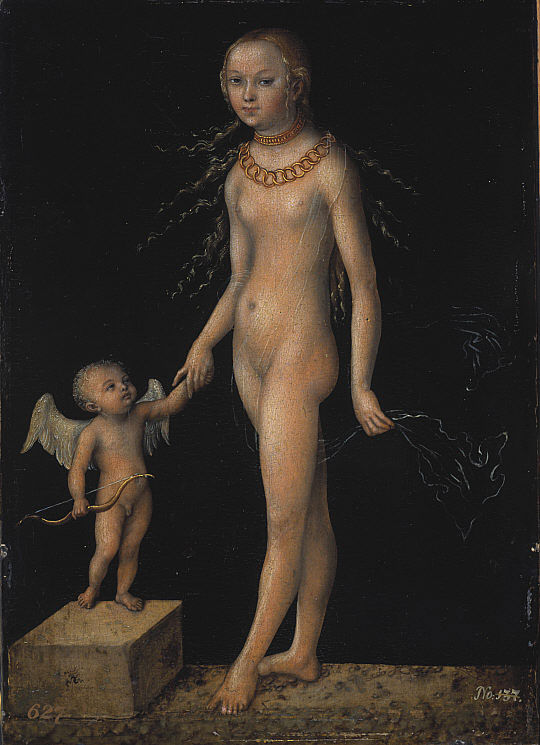
To tie the film even deeper into the neutered gender aspect of the original LET THE RIGHT ONE IN, the ghost girl at the heart of the tale is played by a very spooky boy, Velerio Valeri. S/he's so weird, like Italy's Victorian era version of THE BAD SEED times the SHINING's murdered twins divided by Norman Bates in "wouldn't hurt a fly" drag. Not at all inviting the way, say Moretz or Fanning were as blonde child monsters, Valeri's Graps seem frozen in time like one of those weirdly reptillian children in the renaissance century paintings of cupids  (mo' here)

Cupid by Lucas Cranach the Elder

11. Eihi Shiina as Asami in Audition. 
1999 - dir. Takeshi Miike
****
There are so very few movies where the woman is not only a killer, but a sick, twisted, sexually aberrant type of woman, that Audition would be awesome just for that, but it's also very well directed by that maestro Godard of gross, Takeshi Miike. It sucks you in with its tale of a lonesome widower pretending to hold auditions for an acting gig but really just looking for a girlfriend. He picks the wrong one! As a stand-in for the Japanese salaryman in all his hopelessly patriarchal expectations and double standards, he deserves it. Notes TWI: "the last half hour is so brutal, so grotesque, so disturbing, so violent that you should hang on only at your own risk." I disagree. It's delightful, hilarious, touching, sad, and very poetic and just. You may never look at 'saw wire' the same way again, but you never looked at it before anyway.

12. Beatrice Dalle - Trouble Every Day
2001 - dir. Claire Denis
***
Here's a glacial, mostly nonverbal film that offers no sense of joy or belonging, only the terror of imagining your own human carnal lust leading you to a grisly agonizing doom; the fate of being ripped apart by a maniacal lover. Such grisly potential forces us as viewers into weird moral positions, like a game of Twister devised by a coked-up pope, as the slow and relentless tug of sexual desire drags lonely people to their deaths like a very long, snaking chain tied to a dropping anchor.I wont spoil the particulars, but the key moment, the grisly highlight, is the sex/devouring scene of Dalle's with a horny neighbor kid who breaks into her locked room, and of course gets far more than he bargained for. Shots of the kids' accomplice downstairs waiting nervously for him, hearing the muffled screams of agony and his ambiguous reaction, reminded me a lot of a key scene, quite similar, in the original I SPIT ON YOUR GRAVE. And hey, that's a good thing. (more here).

13. Myrna Loy in 13 Women
1932 - dir. George Archainbaud
***
Imagine of Myrna Loy's character in MASK OF FU MANCHU went off to an ivy league American University, tried to join a sorority, and wound up being snubbed because of her race. That's kind of the backstory to the film you need to know, because knowing a best-served-cold special is on the way helps you endure sleep-inducing scenes of the ladies of the sorority (now 'grown' and led by Irene Dunne) meeting on sunny stage-bound verandas for tea and gossip. Loy meets with her devoted astrologer, Swami Yogadaci (the ever villainous C. Henry Gordon), on a much cooler set, meanwhile, to figure out how and when to assassinate said gossipy snubbers, or failing that, to kidnap and kill their children. Loy's the villain, ostensibly, but you'll be rooting for her all the way (unless you've never felt the sting of a snubbing yourself).
Ascetic Sensualist Junius Pond notes:
Myrna Loy’s evil mastermind [being a "half-Hindoo, half-Japanese" woman who came here from India, her name is "Ursula Georgi" of all things] has some long and sincere speeches about her isolation at school, and how irrational it was that “you whites and your Kappa society” refused to accept her.  The commercial failure of this movie might have to do with how this character, who looks like a stereotypical villain, gets to explain herself in an articulate way instead of just being a target for boos and hisses. 
Right on, the rubes hated complex motivations in their bad guys, and some still do! That in itself should let you know, 13 WOMEN is a film you'll want to see again and again, especially since parts of it are better than Nyqil, which then makes the weird Loy sequences all the more dreamlike as you gaze on them with one eye open.

That's the list! Admittedly random as it is, moving from girl to woman, to child to wolf killer, it can hopefully counterbalance the Super Bowl's testosterone and endless promos for Smash. 

PS - I know it's not 'Horror of Women' Month (see the top title), it's 'Women of Horror' Month! But sometimes dyslexia carries it's own peculiar relevance. Smash! 

Be sure to check out last February's 'Women of Horror' List!

Wednesday, February 01, 2012

CinemArchetype #3 - The Animus (the Daemon Lover)


"He gives the woman spiritual firmness, an invisible inner support that compensates for her outer softness." ~ Man and His Symbols ~ Carl Jung

 The Jungian archetype of the animus is a different beast, literally, than the ethereal anima. Like its feminine conscious twin it plays many parts - unicorn, daemonic lover or rapist, a symbol of the raw animal violence wrought upon a maturing girl's body by maturity, menstruation, sex, marriage, reproduction, and maturity. He can appear in dreams and films: as a lover, a son, a killer, a phantom, academic advisor, old Nietzschean shoemaker, father, brother, horse, pizza delivery boy, werewolf or a zombie prince, depending on the work you've done to exhume his corpse from the basement of your brain.

According to Jung, the animus-dominated female never questions the rightness of her opinion, presuming that her inner voice knows what it's talking about... because it's a man (standing in for her father or 'the' father) leading to difficulty with a real life man because if he has any balls he will object to beta male status, at the mercy of a phantom ideal. She will become like that hot blonde conservative Elizabeth Hasselbeck. But then Hasselbeck surprises us by being pro-gay marriage, so there you go. Progress!


This is not meant to be sexist. Anima-dominated men tend to believe everything their animas tell them, too. Mistaking the inner feminine voice for some kind of holy madonna, these poor chaps become sensitive new age males, and they shack up with animus-dominated girlfriends who boss them around (see: Blue Valentine), even though the women are contemptuous of them and end up going for the guy who ignores everything she says because he's either at a way more primitive or advanced level of psychological development, so in a sense can become a projection screen for her animus while at the same time allowing her to recognize that he is his own person.

Jung's caught shit for sexist animus analysis, but we must remember he was after all a man of his time, and was it he who was dissing animus-dominated women or was the dissing coming from Jung's own bossy anima? Luckily female Jungians like Maria Von Franz, Demaris S. Wehr, and Ann Belford Ulanov have picked up the big phallic baton of the animus. In fact, as I was reading them to research this post, I gradually had a nervous breakdown. Suddenly I realized everything I've ever written totally sucks and stuff, and my ideas are way off, and I'm too negative, and stuff. In other words, anima bullshit! Direct hit!

In approx. ascending child-->woman order: 


1. King Charles as 'The Pi"
National Velvet (1944)
"Because it represents mind and spirit, Spirit, the Animus is often expressed in an abstract manner. As many young girls know, our sexuality can be quite involved with the horse and the rider. Many young girls learn to masturbate while horseback riding."(Nancy Fenn)
2. The Scarecrow, Tin Man, Lion
Wizard of Oz (1939)

 Here the animus is just beginning to develop --as is where Dorothy should be at her age -- and so we find him not quite a lion, axe handle or horse and not yet a 'human' even in the case of the seven dwarfs, comically neutered and non-threatening. The dwarfs in Snow White and the tin man / lion / scarecrow / Toto /wizard all represent, if you will, the lollipop-gelded training wheels for the coming relationship with a more genuinely daemonic masculine energy, which is why they're so comical yet at the same time eerie --warnings not to try to grow up any faster than one's body, a refreshing return from the boy's birthday party to the stuffed animals upstairs, but not for long.

2.5: David Bowie as the Goblin King
Labyrinth (1986)

As the Goblin King, Bowie is half beast half prince, sexy and mysterious, sinister without being totally evil or hostile. His strength must be harnessed without becoming too dominated by it, in order for it to morph into the next state of healthy animus development.

"Jareth is in many ways a shadow cast by Sarah, reflecting her desires and fears, the worm inside the peach, the corruption behind the opulence of the ball. Human figures promenade around Sarah and Jareth, eerily playing at being goblins with masks that resemble death’s-heads and distorted faces." --Jess Elsaesser (Acidemic #3)
Here are some of Bowie/Goblin King's groovy animus song lyrics (note he's urging her, like any bad animus, to avoid real human love in favor of his dream lover pre-genital eroticism:
No one can blame you for walking away
Too much rejection
No love injection
Life can be easy
It's not always swell
Don't tell me truth hurts, little girl
'Cause it hurts like hell
But down in the underground
You'll find someone true
Down in the underground

--------
Everything I've done, I've done for you
I move the stars for no one
You've run so long
You've run so far
Your eyes can be so cruel
Just as I can be so cruel
Though I do believe in you
Yes I do
Live without the sunlight
Love without your heartbeat
I, I can't live within you
It's a lie of course that bit about not being able to live within you. He is already and solely within her, the architect of her dreams, developing and evolving his own prison/castle/labyrinth to keep her enchanted and dependent (for were she to grow/mature she would outgrow him, he'd dissolve to be replaced by the next phase's figurehead).

3. Robert Pattinson as Edward
The Twilight series

Edward is an excellent dream lover/animus for the next stage because he's not projected onto some other man, like a father or teacher, but on--essentially--a tree, a wall, a window shade, the waves of the Pacific. The hostile backlash against the series is even explained by the nature of the animus, as Jung notes: 
"Not all the contents of the anima and animus are projected . . . many of them appear spontaneously in dreams and so on, and many more can be made conscious through active imaginations. In this way we find that thoughts, feelings, and affects are in us which we would never have believed possible. Naturally, possibilities of this sort seem utterly fantastic to anyone who has not experienced them himself, for a normal person "knows what he thinks." Such a childish attitude on the part of the normal person is simply the rule, so that no one without experience in this field can be expected to understand the real nature of the anima and animus. . . . Those who do succeed can hardly fail to be impressed by all that the ego does not know and never has known." (more) 
 4. The Beast / Prince
Beauty and the Beast (various)
"Belle becomes prisoner to a hairy surly Animus who has imprisoned her weak and impotent father (symbolically showing that the old model of the masculine will no longer do, but the new one is still rather rough at the edges).  Through the transformative power of love, Beast is released from the spell of his karma (his previous narcissism that invited the witch’s spell that would teach him empathy) and Belle is able to unite with her idealized masculine.  The fact that in the Disney film Beast is way sexier than his transformed and tepid prince charming self speaks to the stultifying effects of Disney on true individuation, while hinting that the “Magic Kingdom’s” trickster often comes up with truly dynamic characters (but usually the “bad” or “evil” ones) and the sexiness of the “bad” is a great clue to the real workings of the animus." (Bruce - Vampires: chick magnet, mirror or animus?)

5. Bela Lugosi
Dracula (1931)

Dracula is not just a demon lover -- he is a corpse, a bat, a ghostly mist, a dog running across the lawn (unseen by the camera - hence all the more mystical) -- but the inescapable incubus. The men think some wolf's bane and garlic hung in Mina's window can keep her safe, and then they all go downstairs to the study to drink and talk, leaving her all alone at the other end of the vast mansion, vulnerable to a myriad of dream approaches, guarded only be an easily hypnotized maid. Of course this is annoying - why can't they just all take turns sitting up with her while she sleeps or have her sleep on the couch? It's likely a violation of some Victorian code for a man to be in the same room as a sleeping woman. But even if they all sat up around her bed, escape would be impossible, for the dream lover is patient, waiting in the coming dark of aeons, simmering in the shadows until the Victorian repression creates an explosion like a backwoods whiskey still.

6. Michael Myers - Halloween (1980)


I was traumatized at 13 just by the preview for this film when it first came out and even years later as a teenager it disturbed me too much to watch, even edited on TV. Now that I'm out of the danger zone (i.e. old and not a virgin) I watch Halloween all the time (on DVD) and it's finally apparent that Michael really loves Laurie Strode and just likes scaring her, chasing her around, letting her stab him with hangers and sewing needles, and of course killing all her friends as biblical payback for their surrendering to mindless hormonal desires instead of making popcorn and watching The Thing with her. And like Marlon Brando at the end of Last Tango In Paris (who tries to be an animus, and eventually crumbles to vampire dust), Michael is shot right at the moment his mask comes finally off and the invincible bogey man is revealed (for all his automaton shambling) to be just a disturbed boy who looks like Mark Ruffalo. 

In that sense he's the ideal animus during the bloody process of mutating from virgin into woman-- the time when Edwards and horses and five-speed vibrational tin woodsmen just won't cut it anymore -- but she's nervous about ripping all the way open. Myers is the nightmare fantasy projection of the fear felt by Irina in Cat People, that her animus might kill someone if she ever let it out of the basement. Myers also fits what  Maria Von Franz calls 'the dark animus' which wraps its host in "a cocoon of dreamy thoughts, filled with desire and judgments about how things 'ought to be', which cut a woman off from the reality of life." And we might add, justifies her animus's Old Testament 'correction' methods.

7. Marc Wahlberg in Fear (1996)
"It could of all been different Mr. Walker. You should have let nature take its course... " 
 When good anima projections go bad, look out. This clever-enough-to-be-dumb mix of Fatal Attraction, Straw Dogs, and Looking for Mr. Goodbar is, to my mind, the unofficial Halloween 2, wherein our gamin has matured past the penetration anxiety represented by Michael Myers and is experiencing the giddy dread associated with dissolving ego boundaries which the first flush of real sexual pair bonding can bring. Wahlberg does a great job as a jacked psycho wooer and it all makes a zippy reminder that there are no shortcuts to animus integration. If a guy seems too good to be true, he's usually neither. Check under the hood, and secretly follow him home to spy on his skater squat. 

The above quote shows the tricky deals the animus is all about -'this could have been paradise but you fucked it up, and now you deserve the hurt I'm going to bring.' Naive women buy into that and think they deserve their bruises. Smart women know this is all just head games; the tricky old animus will say whatever it knows you are afraid you want to hear. After all, it created the wanting and the fear. The woman's job is to sort through the ultimatums and judgments, and not to mistake churlishness for moral authority.

8. Clark Gable /Leslie Howard split - Gone with the Wind (1939)

Scarlett O'Hara's refusal to choose her more potently realized animus, wild beast tamer Rhett Butler (in order to pine for hopeless Ashley Wilkes) shows her refusal to move from, so to speak, Camp Edward to Camp Wahlberg. Butler is a true daemonic male, with strange deep sexual currents that overflow the borders and boundaries of Scarlett's fading antebellum world; Wilkes is the pale prince of the old order, the David Manners. It's not until she can actually have Wilkes that his effete meekness repulses rather than attracts her, and only then is she finally ready to engage the contradictory impulses of her 'realized' animus, Rhett. And of course, that's Rhett's cue to move out--as if gone from the unconscious to seek a fitting new screen for his projection (an anima or animus seldom projects on a 'present' lover) and of course that makes him doubly desirable--the best of both worlds, he's become unavailable like Wilkes used to be, but is still virile--and her determination to win him back shows a dawning self awareness, a decision to finally take responsibility for her own 'dance of intimacy' just as Rhett always has.

9. Voice of Forsythe: Charlie - Charlie's Angels 

If we EVER would have seen Charlie's face the show would instantly lose its mystique; it would be the equivalent of a sexual awakening for better or worse... (but) while Charlie remains unseen, the show stays in a perpetual pre-sexualized utopia. The girls are all basically nuns with Charlie as Christ. They are devoted to him as an ideal of mature manhood in the abstract. He is always kind, assured, generous, displaying wealth, power, connections, and a sense of cool that doesn't preclude him keeping a string of bimbos (always less attractive than the angels) that only we see traipsing past his desk as he concludes his phone calls. If the angels could only see Charlie's face, they'd be disillusioned, scrambling to find other screens for their animus projection. But by so assiduously avoiding their gaze, Charlie maintains his all-important air of mystery, and the angel's collective moon animus neither waxes nor wanes, keeping them safe from molestation even by the sleaziest thugs. (Thy Name is Charlie - 2006)

 
10. Vincent Cassel as Thomas Leroy in The Black Swan (2010)
"While Leroy seems at the outset to be somewhat of a sexist, ready to take advantage of Nina, he doesn't. He only appears as the manifestation of the animus archetype, having a dangerous potential, but ultimately, his interest is more in bringing out the best of Nina in the performance. It is because of her refusal in the face of his advance that she reserves for herself his respect (...) while he demonstates his higher aspect when Nina falls for his seduction by rejecting her and turning it into a lesson. Leroy urges her to begin to discover her sexuality and thusly her darker side, albeit not with him. While it may seem harsh treatment, this is symbolic of the very real potential of the animus to induce change and growth as well as guidance in the psyche of a woman. Dr. M.-L. von Franz states, 'But if she realizes who and what her animus is and what he does to her, and if she faces these realities instead of allowing herself to be possessed, her animus can turn into an invaluable inner companion who endows her with the masculine qualities of initiative, courage, objectivity, and spiritual wisdom.'" (L. Ray Haines)

11. Harvey Keitel in The Piano (1993)  
"As it happens we do not observe the fourth stage of animus development in The Piano because Ada does not reach it. This final phase parallels the advanced evolution of a man’s anima. In it men and women consciously develop and share contrasexual traits in their relationships, so that each can love both the dominant and the subordinate gender characteristics in their partners. The man can admit to his feminine elements, the woman to the masculine in her. This then represents from the woman’s perspective the final stage of animus development with which we began. It enables her to escape from the third stage, fixation in which can mean self-loss because she risks sacraficing the momentum of her own development by never going beyond the patriarchal definition of the feminine role. (The Piano, the animus and colonial experience 73)
12. Alphonse Ethier as Adolph Craig in Baby Face (1933)

Abused and pimped out by her beer hustling father since the age of 14, Stanwyck's 1933 pre-code heroine could be forgiven for having a pretty crappy animus but actually she has a great one in the awesome German cobbler who drops by dad's second floor speakeasy to drink beer and read Nietzsche. Before she kills (?) her no good father and leaves for the city, Adolph advises her to "use men!" Later he sends her a copy of Nietzsche's Thoughts out of Season with this passage underlined:
"Face life as you find it, defiantly and unafraid! Waste no energy yearning for the moon! Crush out all sentiment!" 
The censors didn't want young women finding out about this kind of power so they edited out the shot of the page in later versions and inserted a letter from Adolphe instead saying she'd misunderstood his teachings and was a big disappointment for being so ambitious and super slutty. HarumpH!

The point is, the 'real' version has been found and restored! Animus triumphant! Even if she ends up wasting energy yearning for moon-faced George Brent, Babs' goldigger still has a first class animus in her ruthless cobbler, the only man in her life who hasn't hit on her and who therefore she can trust. Sorry, but old Adolph Craig just wants to instill some genuine revolutionary insight into a girl who, if our nation had its way, would just stay in the coal country where she 'belonged' and obey her father's brutal pimp edicts. I would say in this case Babs chose her animus wisely. Use MEN!
Related Posts Plugin for WordPress, Blogger...