Friday, September 14, 2012

LOUIE ("Late Show: Part 2"): David Lynch and the Pupkin-Headed Teleprompter


Anyone at all concerned with comedy TV in this country knows that LOUIE (Thursdays at 10:30 on FX, parental discretion advised) is what matters in this moment. It's 'real' yo - it's how reality is, maybe. And if it ain't real then it's certainly surreal, especially after this week's episode. Before this it had always gone deep into the abyss of sexually frustrated, mildly overweight middle-aged white male angst within us all, now it goes further, to the Rupert Pupkin within us all. And of course I'm referring to Scorsese's itchy 1983 exercise in comedic torture, KING OF COMEDY, because Louie (the character) has a shot at replacing Letterman (the host) and of course he must follow that opportunity, even if it goes against the grain of his depressive sloth.


And in my apartment, LOUIE hits close to home, literally, as in they're always filming actorss the street at the "Community Bookstore & Cafe" and at our supermarket and on the streets immediately around our 7th ave and Garfield Apt. in Park Slope. In the arc they're filming he goes to the bookstore to pick up Parker Posey, who plays a cute employee who, we must diagnose if we're familiar with the type--is bi-polar. Having the bookstore so close conjures many thoughts: is Louie supposed to be living here in Park Slope? I thought he was on the Upper West Side! Why on earth would he come all the way out there just to go to a bookstore? I've been in there and it's very nice, but books are cheaper on Amazon, usually, so it's hard to buy things there, or anywhere, at all... any more.

This all has to do with the LOUIE episode with David Lynch by the way --I'm not just location dropping.  It's relevant. Bear with me.


At first the casting of David Lynch as "Jack Dahl" -- an ancient Tonight Show executive assigned with the  task of grooming Louie for the slot of Letterman's replacement-- seems like just a stunt - a freaky sign he's dreaming or something. But then he springs into action and you know this is serious: giving no advance warning, he starts timing Louie with a stopwatch while his agent holds up a cue card of a joke written during the Nixon administration, and Louie thinks the whole thing can't even be real and if he just acts bewildered and dumb enough he'll escape. He's been using this defense all through the show, and it's frustrating us. But Dahl refuses to even acknowledge it, and remains (intentionally?) oblivious to Louie's awkward reticence and feeble blamecasting about the datedness of the material. Also, Dahl announces, Louie will need to wear a suit. When Louie refuses, Dahl stares at him in bewilderment. that a suit would be the dealbreaker strikes him as absurd, a dumb whim no serious man would entertain, so he sends Louie off to a boxing gym for a well-deserved beating.

But during Louie's second visit to Dahl, it all starts to take shape. In the best scene, Dahl demonstrates the technique of standing before a curtain on camera and waving and gesturing to nonexistent audience members as an applause and laugh track plays. Whole books have been written about audio mimesis as utilized in Lynch's amazing MULHOLLAND DR. (at the Club Silencio), and the eerie ghosts of 20th century sound recording still echoing across time. So this scene bravely encompasses all those books and the Silencio in a single take.

Top - Louie / Bottom - Mulholland Dr.
Basically what this 'mimesis' is, as far as I can tell, is a study of how we let electronic reproduction take over for our own voices, becoming more and more aligned with the machine, so we become more and more like cold machines ourselves, our voices nearly always spoken in phones instead of in 'real time' - our music coming from iPods rather than live bands. It all adds up to make us alienated from the text of our own lives, to become passengers on the ship of ourselves while streams of ones and zeros do the talking to and for us. How do I know? I designed this poster for a guest lecturer at Pratt a few years ago and not to toot my own digitally-encoded horn but I'm good at seeming to know about weird new academic subjects without really knowing shit. (Shhh- I never go to the lectures I make posters for --shhhhh, why go hear someone actually speak when there's podcasts?)


One thing I do know: if you want to imagine David Lynch's acting in this LOUIE episode without seeing it, know that he was either consciously or unconsciously channeling the Weenie King (Robert Dudley) in PALM BEACH STORY! (in video below, FF to about halfway through).
So what Dahl is driving at in LOUIE is that hosting a show (especially on CBS) with tens of millions of viewers is a matter of  surrendering to a kind of mass hypnosis common denominator existence, like AVATAR in reverse. All your rough edges must be sanded away because you are being welcomed to the machine of non-specific demographic catch-all appeal, where you are reduced to ones and zeros and sent across vast cable distances and there is no place for modern slacker t-shirts and jeans when the men you have to impress still consider poodle skirts the height of sexy, as Lynch clearly does in MULHOLLAND DR.


Louie's TV talk show guest appearances reveal he's funny and perceptive and on point, so why not give us some of that guy, don't we--and Dahl--deserve it, in this season? LOUIE is still brilliant as a show, but as a character--as a semi-fictional version of himself--he's stagnating through a kind of dopey everyman cluelessness. Compare him to Seinfeld or Larry David who both kept their intellect as fictional versions of themselves on their shows and Louie is found wanting. He finds his comedy lately by breaking simple rules of common sense and intrinsic understanding of how to avoid unpleasant situations. An earlier episode found him sticking around a Florida hotel after already saying good-bye to the cool friend he made, never imagining it won't be awkward or pointless; calling the cops to find his lost daughter rather than checking her closet, where she goes to read all the time; agreeing to babysit some skeevy kid who likes to throw other people's stuff out the window (and other things too gross to mention); agreeing to help a truly insane woman on a trip to the brutal, soul-crushing, waking nightmare known as IKEA, then declining her proffered fellatio payment; accepting a fellatio offer from a drunken insane truck driver lady but not reciprocating; buying a motorcycle on a whim without a clue how to drive it, then crashing with nothing but a blank shrug as an apology to the lady stuck watching your kids; letting rival comedians (Chris Rock, Jay Leno) know he might replace Letterman leaving when he signed a confidentiality agreement not to tell anyone. No one this self-sabotaging and dumb could make it as far as Louie has, even the scaled down fame within the show. He'd never make it one week on the road with his helpless schmuck schtick, they'd beat the tar out of him in the parking lot, with good reason. They'd be doing him a favor, like Dahl is by having beat up in the gym.


Jack Dahl is the first character in Louie's show to be adequately annoyed by him. Hopefully next week Dahl will hook him up with some Adderall and Effexor. Clearly the casting of 'king of post-modern audio mimesis' Lynch in a role that requires him to wave to an invisible applause track for two minutes is genius, but one must ask why Louie CK reserves no genius for his own character. He is not Buster Keaton and he is not Cary Grant. He is not comely, yet he acts the way a comely maiden does... if he dropped his handkerchief he'd stand there helplessly, expecting a rescue from a tall dark rationalization. And that's not cool. Only young hot chicks can get through life in this kind of bubble, not middle-aged comedians with famous friends and TV deals - they clawed their way up for that shit, with brains, talent and relentless pursuit of bigger and bigger audiences.


So it begs the question: does Louie think we would identify with a character who won't even identify with himself? We would be paralyzed too in these surreal situations with Dahl and that's just one reason why we didn't pursue a show business career. I remember auditioning for a voiceover agent and since I wasn't able to snap into brilliance in a crowded office after waiting around for ten minutes and dealing with the subway to get uptown she declined representing me, since I was dizzy from lack of sugar and dry in the throat and hungover I flailed. I took it as a sign. My nerves just couldn't handle being expected to snap into brilliance on a dime. So instead I stay home gazing into a conglomeration of electricity, plastic and digital code shining in big rectangle, like the Evil Queen hallucinating Snow White in every crack, every glowing ball a mirror showing a deformed face I won't claim as my own. Ideally the guy in the mirror would claim it as his, but as LOUIE progresses, it's pretty clear not even he wants to own up to his puffy visage.

(see also Roger Cormier's Splitsider recap from which I borrowed yon images)

Wednesday, September 12, 2012

Creedence and Ivy's Eco-Terrorist Revue: TROLL 2 (1990), BATMAN & ROBIN (1997)


When it comes to environmentalism we're pretty short-sighted...we shout save the old growth! Save the endangered species! Save at least a handful of a dying species; ensure these few trees don't get cut, and then let the corporations do what they will to the rest. Man, it's way too complex to simply do a Noah on the outdated biological responses to gone environments. Watch it all from a plane, swooping over a city at night and you see the world on fire with electric light overcrowding, a cancer. Unchecked population growth and all its needs, its power and food addiction is turning us into Earth's fatal tumor.

But nature can be a bitch, too. It ain't very nice. Five minutes with a nature show will teach you that. Animals, plants and their pollenating bugs are nice and all but sometimes even they can kill you. And maybe they should. Who has a better right?

Mama to the rescue (not to rescue us, but to rescue Earth from us)! Two hot babes in critically panned but so-bad-their-good 90s anti-classics made a bold attempt to face the triffid, as it were. Dark funhouse mirrors to each other, TROLL 2 (1990) and BATMAN AND ROBIN (1997) eloquently bracket the entire tree-hugger experience via nerdy gurl horticulturists by day, who become dangerous but sexy eco-terrorists by night, the bulk of their powers stemming from witchy herbalist savvy and a connection to Gaia beyond man's ken. 

In TROLL 2 (1990), Deborah Reed plays Creedence Leonore Gielgud, bottle cap glasses-wearing, hair-in-a-bun, dentist-deprived horticulturist by day, sexy wild-eyed witch by night, using weird green food to transform humans into plants. Her mission: greenify humanity to feed her goblin children. In BATMAN AND ROBIN (1997) Uma Thurman plays a bottle cap glasses-wearing horticulturist, hair-in-a-bun horticulturist by day, who becomes a sexy, wild-eyed Earth elemental by night, using psychoactive plant powders to transform humans into a green inflatable-muscled henchman. Her mission: 'greenify' Gotham by eliminating its pesky human residents into mulch for her beloved plants.

In both films these earth elemental sirens represent the malignant, understandably misanthropic flip side of the plant world. They are both gorgeous, even in their nerd horticulturist disguises. Smitten males cannot resist them. They have a sense of humor. We're not necessarily encouraged to root for the idiots they slaughter, turn to troll food, or seduce into servitude.  

But the critics--a notoriously reactionary lot--  hated on both these films, missing the camp delight in their gonzo precepts, and the way a filmmaker might secretly root for the bad guys in their films. See them on a double bill and imagine these two lovely eco-terrorists working together! An unstoppably sexy eco-terrorist force! Imagine if Nolan had kept Poison Ivy for DARK NIGHT RISES! Played by Angelina Jolie, aided by a flock of third world child soldier flunkies? Our lives today would be completely different.

BATMAN AND ROBIN (1997) was poorly received in its initial theatrical run but, later, catching it in a Sunday afternoon stupor on cable, and having since seen TROLL 2 twice and most of BEST WORST MOVIE (the celebration of TROLL 2's cult audience, both are on Netflix streaming), it all finally made sense. Director Joel Schumacher's film simply fooled fans expecting more of the dark crusader who scowled through previous films. But Schumacher turns out to be more beholden to the original 1960s camp TV show more than the Gothic gloom of the Burton era. 

On the other hand, like Burton he's got a penchant for referencing past horror classics, only in this case it's not the gloomy German expressionism of Burton, but the classic weird Hollywood pre-codes like the 1934 Edgar G. Ulmer-directed horror classic THE BLACK CAT. Poison Ivy's big centerpiece charity auction attack also involves a clear homage to Dietrich's "Hot Voodoo" sequence in BLONDE VENUS (1932 - below). Tellingly, in each of these two influences, the 'good' people at the party are boring and/or petty, so we root for the ostensible villains, the fallen chanteuse (Dietrich), the smooth Satanist (Karloff) the strangely allied Lugosi.


Like Black Cat's plot where Karloff and Lugosi team up to to trap David Manners and Jacqueline Welles, here Ivy teams up with Mr. Freeze (Arnold Schwarzenegger) to kill all the people, with Freeze planning to ice down the whole planet, but seemingly willing to leave Ivy stretches of spare earth to grow on free of the concrete-pouring human apes. Gleefully shouting such lines as "Ice to see you!" in his comical accent (as per the similarly accented Otto Preminger in the TV show), stealing diamonds for his freeze ray, and keeping his dead wife floating in a see-through tank (like Karloff in Cat), he's a diabolical tribute to Germanic coolness. Poison Ivy lifts him out of his gloomy romantic funk and they stage a big set piece that involves Uma's referencing Dietrich's "Hot Voodoo"number during the tacky Ventures guitar instrumental version of "Poison Ivy,"  slowly slinking out of a hot pink gorilla costume, and hypnotizing all the men with lascivious dancing and pollen dissemination. Thurman's clearly having fun, looking great and adding to the pre-code resonance with a Mae West impression, with bad double entendres ( "my garden needs tending" and "some lucky boys are bound to hit the honey pot") to her holistic Dietrich chemical combo (she could be the love child of their alleged lesbian relationship during their shared stint at pre-code Paramount).


Like so many of the films and TV shows, Batman lives and dies by his villains: Jim Carrey saved the previous entry as the Riddler, but that version lacked a strong female presence and girl supervillains are where Batman comes into its own; DARK KNIGHT RISES would be lost without Anne Hathaway's Cat Woman, the 60s show would have been nothing without the super sexy Julie Newmar's. In BATMAN ROBIN, the black light graffiti CBGB's bathroom awfulness is saved by Uma, who captures some of Newmar's litheness in addition to West's sashay and Dietrich's de-evolution.  Rolling her eyes and carrying on about the plants of Mother Nature having their day, and her plans to rid Freeze and herself of the feathered and furry caped crusaders, Thurman is at least in on the joke as well as exhibiting some sign--lacking in all the other cast members--that she's actually seen some of the films Schumacher is referencing. Bane is ten times more fun in this issue as a hulking, mute inflatable Mexican wrestler under her control instead of a musclebound Marxist professor, and her plan for world domination is ten times cooler, if you'll forgive the expression, than Mr. Freeze's. It's actually something we could root for, for a change.

Alas, the 'good' end of the cast is a mixed bag: Clooney's a one-note Batman, fussing like an old queen over Robin's impetuous risk-taking (DC's buzzkill obsequiousness in evidence). Robin himself, with his buzzcut and oily complexion, is too old to still be a ward, and as Batgirl, Alicia Silverstone is exhibit A in why sometimes you need those special 'slimming' amphetamines in the picture biz (you think Josef von Sternberg wouldn't have kicked Dietrich off his set if showed up looking that dumpy? Instead Schumacher's abashed PC tact falls just short of even resorting to a bat mou-mou or a large cape/shawl). But at least Arnold does recall Otto Preminger, who brought Teutonic menace aplenty to his Freeze on the 1960s TV show, and his melancholy over his chilled wife Nora is palpable; tears freeze as they form on his cheeks in an echo of Bela's melancholy over his suspended animation wives in THE INVISIBLE GHOST, VOODOO MAN, CORPSE VANISHES and THE BLACK CAT (below).


But in order to savor all that high strangeness you have to embrace those Day-glo cityscape colors and huge shrugging Atlases that span hundreds of stories, skyscrapers placed atop skyscrapers with thin little roadways between them, like some kid is combining all his mismatched toys into one huge bi-level mixed-scale battlefield that starts on his bed, slides down books and strings and ends in his little sister's room along the cliffside of an armless plastic Shogun Warrior, this time an Art Deco Mount Rushmore sculpted down to the shoes + the little sister's contribution: cover everything in Day-Glo paint graffiti and turn on the Spencer's Gift black light. 

Come to think of it, Wayne manor is the only place in Gotham not lit by green glowing fire pots, and occupied by lounging thugs too colorful (electric lime and magenta) to be threatening. So what is there left, sans menace? There is only Miss Ivy -- Uma's best work, and that bookend to....


Creedence Leonore Gielgud in TROLL 2

Creedence and her troll underlings have a strict diet and the preparations for this constitute the bulk of their eco-terrorism. Rather than just wipe out humanity they long to turn them into Green Vibrance-style superfood. Why that's so complicated a process is merely one of the facets to this inexplicably beloved 'best worst movie'. Caught in a weird ironic limbo wherein they only eat humans but are strict vegans, these trolls have to turn the humans into plants before they can be properly digested, a long process involving getting the humans to eat some bright green food coloring, which causes them to quickly sprout branches and roots. And so the plant word has its revenge here, too,cand we deserve it a few times over. Creedence then is a bit like Magneto in the first X-MEN when he turns Senator Kelly into a mutant so he can see what it's like to be the hunted. Creedence turns humans into plants for, partly, the same reason, so they can see what it's like to be treated as an object--harvested, burned, smoked, made into newspapers and/or fried or boiled (like some kind of 'super carrot.') While meat may be murder, veganism is anti-human. Aren't most apes, after all, plant eaters? Think of the sprouts!

Keep your eye on the cob, human!

The best part of the film by a milem, Deborah Reed va-vooms the roof off in three different incarnations of Creedence: she's the librarian with bad teeth and Anne Bancroft shades; the wild-haired witch with even worse teeth and a from-the-diaphragm acting approach even Toshiro Mifune might find excessive; and the hot-to-trot TV movie seductress (with great teeth, all the better to castrate you with, my dear) who appears on the last living lunkhead's mobile camper TV screen as he sulks alone, parked way out in the middle of nowhere for no clear reason. It's like any lonesome teenager's fantasy has come true: babes are literally coming right out of the TV screen to 'do it' with him in his trailer. Now all he has to do, he thinks, is keep perfectly still... It's like getting a tattoo or getting a deer to come closer... He just stands there, terrified, and no doubt aroused, trying not to make eye contact while Creedence musses his hair and...


Not so fast. Creedence brings a phallic corn cob in her garter, which she shoves into the mouth of this doltish bro (his lack of response even to this is hilarious) prefiguring his conversion to vegetable and calling the whole issue of phalluses and penetration into turnaround (especially if you read a certain book by Faulkner). Luckily the corn is not green, if you'll forgive the expression. And--especially since the rest of the film is so aesthetically ugly. when Creedence turns hot and displays that stunning thigh (above) you may swoon like you're sixteen and frozen in desire mixed with fear yourself, to the point you feel that any word or action on your part will blow it for you --so you keep inhumanly still, like Jeeter Lester sneaking up on a bag of turnips....


In another great scene, one of the other bros is potted by Creedence and placed amidst the other foliage in her bookstore lobby. She's got quite an arboreal dell going on, showing she's made a lot more headway in her eco-terrorism campaign than Poison Ivy, who clearly made a mistake hooking up with the frigid Mr. F. Creedence thinks and acts locally, showing love for her monstrous children and ensnaring one dumbass human at a time, while Freeze and Ivy's project is so global it's doomed to failure.


Like poor Ivy in BATMAN AND ROBIN, Creedence too may lose out to the human species by the end, but there's no doubt whose side we're on as savvy viewers. Reed's acting varies wildly, careening from subtle to broad, whispery to shrieking, over-the-over-the-top wild, sometimes in the same sentence, or syllable, much to our admiration. Like the music of the Shaggs, she's so far off the mark she goes all the way around the loop, winning the race by running backwards. Lacking perhaps Thurman's formal training, Nordic alien DNA, and Buddhist scholar father /Timothy Leary-godfather calm, she's less pre-code Paramount campy and more genuinely insane. Reed doesn't know how to fake it, so she just becomes it.

Neither film ends with any kind of peace or happily ever after for our eco-terrorist heroines, as one might expect from a 'normal' mythic tale, but at the same time each has a final opened-up ending approach that gives us hope rather than despair. Poison Ivy is locked in a cell with Mr. Freeze, which seems very inappropriate for any jail system, even a co-ed supervillain asylum like Arkham. Does Schumacher even know how jails work? But they both are resourceful so we don't doubt they'll get out soon, if the box office demands (it doesn't, sadly) and as for Creeence, I shan't spoil it, but she's not going anywhere either. So eat your green jello and drink your green beer; smoke your green herb and inhale the green powder blown in your face. Then peel off your pink ape skin and stay awhile, dearie. Be rooted. Il mio divano è il tuo giardino.

Sunday, September 02, 2012

Dubious Comforts: PET SEMATARY, SURVIVAL OF THE DEAD and the RNC


"The person you put there isn't the person who comes back" 
- Jud Crandall (Pet Sematary)

Aunt Cecily: "Do you believe...the dead can come back to life?
Bob Hope: "You mean like the Republicans?"
- The Cat and the Canary (1939)

Like a bad dream of Republican 'small government,' Pet Sematary (1989) depicts the return to a simpler, more 'Christian' lifestyle, marred by slight problems like the non-regulation of big business, i.e. Paul Ryan's ideas of 'limited government' is behind, no doubt, the unregulated road in front of the family house, whereon trucks go speeding past sidewalkless residential streets without speed limit signs, cops, or punishment. The heavy toll in run-over pets and children is a small price to pay when the alternative is welfare socialism! Limits mean sacrifice: once you're run over, mutilated in war, deformed from disease, or otherwise unassimilable into the Norman Rockwell ideal it's only natural that you become abject and ostracized, shoveled under the loamy carpet or kept hidden in a back room and spoon-fed oatmeal by the terrified child who will grow up to be the mom in Pet Sematary. This is the deal of small government, warts and all means, inevitably, all warts.

Boys do love trucks...
Like the bankrupting of Medicare and Social Security via ever-longer life spans, Pet Sematary shows how the idealization of a 'real' America is continually undone through denial of death. King's motifs come tumbling out of America's chock full-o-skeletons closet in this film way more so than in most all other adaptations of his novels: population control (here in the form of animal spaying issues --the run-over cat is unable to get to heaven as he's 'incomplete'); child mortality (the run-over infant comes back to gleefully kill off the cast, all because dad can't handle the pain of losing him again); assisted suicide (that old invalid aunt twisted up on spinal meningitis, praying for a death which the doctors prevent); lynchings (neighbors once torched the house of a zombie and its dad); Native Americans (burial site desecration), and so on. The graveyard bringing whatever you bury there back to life, but with a demonic streak of voracious homicidal ill will, makes a nice right wing nutjob analogy to sending your good Christian-raised kid off to college and having him come back an angry vegetarian pothead feminist.


All this deep red state subtext doesn't mean (the film) Pet Sematary is somehow not bad. It is truly bad. But its badness is perhaps why it's able to deal with these skeletons straight on. If the film were any better it would have to deep-six the abject subtexts, simply because too many guys in suits would be watching, ensuring nothing controversial came back to bite them. Instead it seems like even the director wasn't paying much attention, so all the gooey truth stays intact, a bit like one of my favorite awful films Godsend, which is also about the horrid deals grieving parents might be willing to make in order to allay their grief. When there's nothing you can possibly to do to bring your dead son back, you can relax and know that--funeral expenses aside--no one's going to drain your bank account in for monkey's paw resurrection service. Since it's impossible to raise the dead, we can surrender to grief's kiln-like heat and be suddenly made pliable. If we have any other alternative we have to take it, and thus the medical community and its ancient burial ground kin make wheel-of-life spoke-jammers of us all.


As in Godsend, Sematary's small cast, low budget, bad acting, poor spelling, flat lighting, unimaginative camera movements, and clunky dialogue swirl combine to help the movie achieve "the sort of shallowness that brings depth" (1). And while in Godsend it was the shrill over-and-underacting of Robert De Niro and Greg Kinnear that made it all so unintentionally Ed Woodsian, in Pet it's the culminating glory of seeing a zombie demon kid attacking an old man like a rabid Baby New Year at the stroke of midnight (above). Any horror is leavened as the kid is clearly just having fun making mean faces. Grrr. 

"President Obama's promise is to begin to slow the rise of the oceans (pause for laughter) and to heal the planet (more laughter). My promise is to help you and your family."  --Mitt Romney (RNC 2012 acceptance speech)
The bodies must be burned immediately. People will have to forego the dubious comforts a funeral service will give." - Newscaster, Night of the Living Dead (1968)
When I heard the above unabashedly anti-environmental attitude from presidential candidate Mitt Romney, I instantly thought of it as the inverse of the announcer in the original Night of the Living Dead, telling viewers to "forego the dubious comforts a funeral will give." Romney would be announcing the reverse: "The health office insists we forego the comforts of funerals in order to halt the spread of this epidemic, but I say your deceased family comes first!" It matters not if Mother Earth dies while we're eating her, as long as we get a big enough piece before its all gone, because we have to share that piece with our family. Unwashed hordes of illegal Mexican zombies are already gnawing upwards from Mother's toes! Arabs are pulling out her entrails! The Asian markets are scooping up her brains. If we don't drag the carcass away from them fast we'll end up not just hungry but looking weak to our enemies, which is far worse. Don't they know we're tough? Grrrr!

For all our strength we're still a very, very young country
Not to say that's what the Republican ticket and Paul Ryan's Ayn Randiness necessarily represent. One must make allowances for bloc baiting, but it's interesting because we have to go back to the Monkey's Paw's 'careful what you say' word choice of our wishes, and avoid 'getting everything we want' which would mean either (for them) a return to a Handmaid's Tale kind of fundamentalist American patriarchal religious oppression or (for us), an overly permissive socialist Welfare State. Neither side really wants either of those options and so we must preserve our state of conflict at all costs. The trick is to realize this and move into a state of conscious awareness, like the Buddha of professional wrestling - it's just a fight. We need to remember that the fight is just for show, that we need the fight, need the show, for balance. A total victory would mean the end of the match, and riots in the crowded streets, so drag on, lads, drag on...


Both sides have forgotten that the real enemy is the media, whose obsession with repetition and bottom lines and computer game tie-ins has led to the idea that zombie movies are just heads blowing up and armies shambling through stairwells ala RESIDENT EVIL. Romero's films, and King's, on the other hand, understand that without the issue of family and the 'right to undie' or the 'right to unlife' there's no 'meat' to the story, which is why RES EVIL is--for all its mega budget and gloss and nonstop action--so uninvolving, and PET SEM is--for all its low budget badness--so trenchant. We have the mom letting her daughter gut her with a trowel in Romero's first film; the girl in the ghetto protecting her zombie husband from 'the man' and getting bit for her trouble in DAWN; and in Romero's most recent installment SURVIVAL OF THE DEAD, an old patriarch fighting for the idea that life is sacred even in death, that every dead baby has the right to crawl out of the earth and hunt its parents. These aspects are what matter, what lingers after the endless shots of exploding heads have faded from our minds, and which is why 99% of non-Romero zombie films suck so bad. 


Shot in 2009, SURVIVAL OF THE DEAD is less a sequel than a 'concurrent' story to the first two films: it takes place several weeks into the original zombie epidemic, and society is still in the midst of its collapse. Two crotchety Irish-American landowners occupy a small farm-based island off the New England coast, wrestling over the abortion-encoded issue of whether to shoot the undead or to just chain and train them to deliver mail or rake leaves. The poster girl for it all (above) is Kathleen Munroe, a hot Irish brogue-sporting lass in sexy black riding coat with sexy black riding gloves, long flowing hair and blazing blue eyes staggering around a lush green corral with a beautiful black steed she's supposed to eat instead of peoples --and both sides of the argument watching her, hoping she'll take a bite out of this gorgeous black creature. It's a great, twisted National Velvet of the Living Dead moment. The zombie movie has evolved here into something a bit more aesthetically pleasing than we expected, at least in this one image, until the bites start.


Another key in SURVIVAL and PET SEMATARY is the use of intertextual imagery - namely portraits and paintings which 'come to 'life' like the once-buried loved ones now unburied. Portraits are, as we learn from John Berger's "Way of Seeing," the proprietary gaze writ large, the establishment of a permanent record of one's existence and property, meant to last beyond death and age, the way stars in films of the 1930s still look vibrant and young even after their corporeal forms have long since turned to ash or moldering bones. There's a fine line between wanting to return to past glory and mere fear of death, and zombie movies are that fine line's ultimate erasure, the frozen preservation of impermanent flux. Cinematic mortality's dawning self-awareness is the ultimate compromise between the 'undead' photograph of a loved one coming to get you (Barbara) across the graveyard of memory and the real of our cursed plane with its spatial existence ever-threatened both from interior growth-decay and exterior dangers. To live you need to kill and eat smaller creatures and avoid being killed and eaten by bigger ones. But, in the movies, all death goes up onscreen, and so we, floating in the cheap seats, can live, even if for just this 90 minutes, in perfect freedom from bodily concern, bathroom breaks aside.


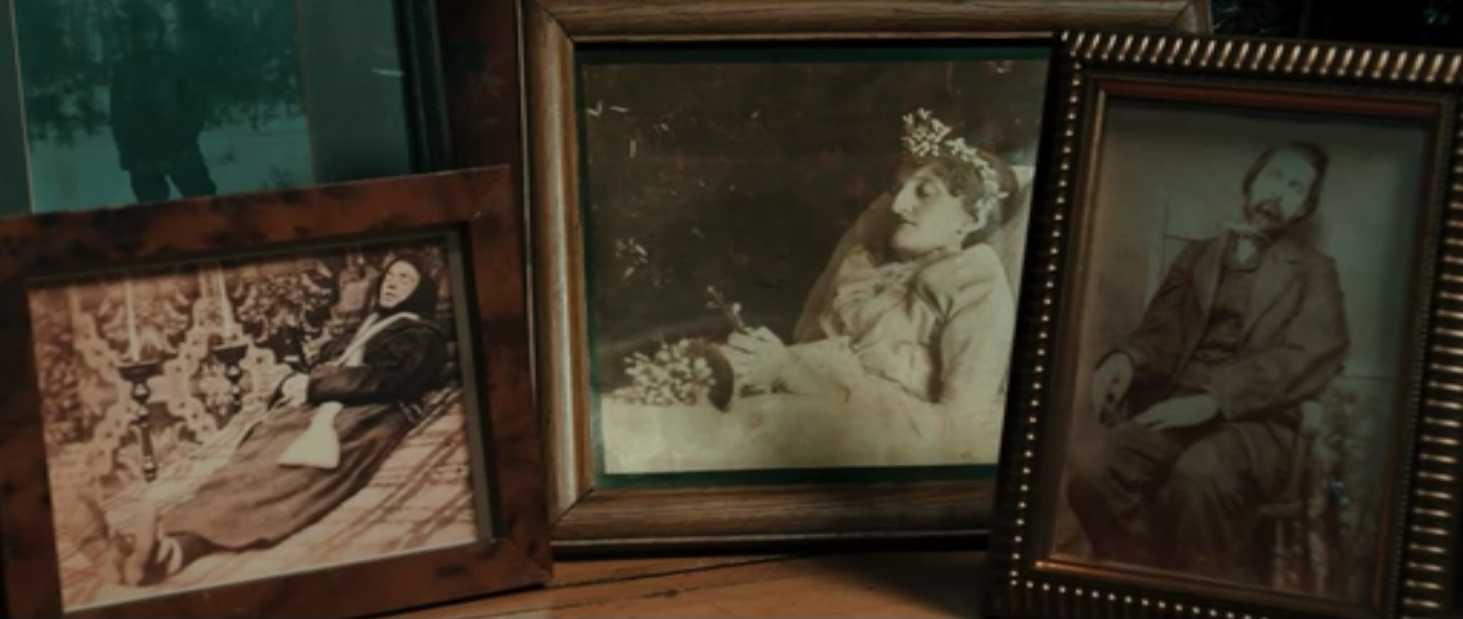
A key scene marking Romero's film as a critique of the conservative mindset involves the 'mixed race lesbian' from the National Guard who winds up abducted and forced to have dinner (prepared by a zombie wife [below left] literally chained barefoot to the kitchen stove) with the pro-(undead) life patriarch, who poses next to his John Wayne-ish portrait and end table filled with old photos of dead relatives (the old school tradition of 'post-mortem photography') and tries to woo her and her niche demographic over to his side, so maybe she'll extend an ankle for a shackle all her own one day. The dead people in the photos are great metaphors for the conservative slavishness to past cultural mores, the PET SEMATARY-ish longing to return to the land of rose-tinted exhumation. The patriarch here has almost no room in his heart for any living person at all. In death they are infinitely more receptive to the message of reverse-progress. Necrophilia is, in the end, all about control. An alive girl is nice and all that but...

"Sometimes death is better."

And yet, if once it all goes black you can go back, what returns? Babies, zombies, remakes, sequels --is that all there is? "Corporations are people, my friend," and corporations ruthlessly pursue self-interest, therefore successful films must be remade, and man must kill again and again just to eat the same meal he enjoyed last week. That's understandable. What's not is the assumption that grabbing it all for yourself is somehow a good thing for America. Demanding to be adored by the masses for your greedy self interest only seems ironic if you're not a rich insecure scion who's mad because he still lacks the nerve to tell the ghost of his dead father how much he hated him. That may be the ultimate irony of bipartisanship, that both sides are really angry at someone else, who's gone, and only their damned vampire photograph remains, and it can't bite back.

NOTES:
1. a compliment Godard once paid to 40s poverty row films from Monogram and PRC, which this film resembles -- See my piece on Monogram's Voodoo Man (1944)

Friday, August 24, 2012

It's here, it's mindbending, it's Acidemic #8


This issue: Brecht-Godard-Wood, linked circlets connecting the search for freedom through 'dislodging' cinematic signifiers and turning bare soundstages into ghost ships and surrealist basements. This year's stellar line-up batted down the plate and strewn orchids on the grave of logic.

If through the issue you notice very little Godard, know this: Godard is in all things whether we speak of him or no. There is no going straight from Brecht to Wood. I tried. But my own understanding of film studies comes roundabout through Godard's dedication to Monogram Pictures (whose Return of the Ape Man is discussed) at the start of Breathless. 

Ed Wood by Mick Baltes
Also in this mighty issue: Peter K. Tyson decodes the Brechtian intertexutality of Fassbinder's Lola; teenage Molly Marie Wright rages against the empty-headed CGI of the Total Recall remake vs. the paravegan grandeur of Troll 2. Intertextual frisson erupts as Thomas Duke challenges Roger Ebert's perception of 'flaws' in Edgar G. Ulmer's poverty row classic Detour; Chris Stengl exhumes Pauline Kael's 'lost' review of Plan Nine from Outer Space, and I lament the dryness of David Sterritt's Les Carabiniers commentary track. Film historian David Del Valle discusses the joys and inaccuracies of Tim Burton's Ed Wood while acclaimed Nuyorican poet Tracie Morris expresses her misgivings over Burton's Dark Shadows and praises the original 1,000+ episode TV show. We get insightful probes into the basement surrealism of both Val Letwon's The Ghost Ship (from Ethan Spigland), and Ed Wood's Glen or Glenda (from Budd Wilkins). Gregory Cwik discusses metatextual threads in horror via Cabin in the Woods, and I through Halloween.... and through the valley of the shallows of Brecht, we shall find Woodsy depth.

And we learn how Godard's Prénom Carmen explains the truth about UFOs, for, as the great Eros would say, "you didn't actually think you were the only inhabited planet in the universe? How can any race be so stupid?"


And check out Memento Mori, the staggeringly detailed historical action figure comic by our cover artist, Mick Baltes.
Related Posts Plugin for WordPress, Blogger...