Thursday, April 17, 2014

"A thousand dollar bill I was supposed to be bribed with" or "real between curtains" - John Huston and Bree Daniels--Gamblers (KLUTE, THE MALTESE FALCON)


Checking out The Maltese Falcon (1941) again--every time it's a different movie! Last time I wrote about it I saw it right after In a Lonely Place and was shocked by much that film's unflattering portrayal made Bogie and Astor each seem as monstrous and misshapen as Joel and the Fat Man. Mary Astor's twisted rococo hair styles made it scan like some Martian transmission from the bowels of one of my old-school delirium tremens. (see Bride of Bogartstein, Acidemic August 2011)

This time around, a slim three years later-ish, there was none of that but another facet, one equally rare in a noir or detective film: a concise expense account. The film is almost completely obsessed with it but not in a big brass ring way--though that is what "the Falcon" represents--but also in a hundred dollar way - the money never gets lower than hundred denominations but even that is unique in a movie. It starts with the two hundred given to Miles Archer and Spade by Brigid O'Shaughnessy ("you gave us too much money if you'd been telling us the truth and enough money to make it all right") and culminates in the envelope of ten thousand dollar bills with the delivery of the eventually worthless dingus. Spade gives the cops the thousand dollar bill (see title of this post) Guttman leaves with him for "his time and expenses," but pockets all the smaller denominations he's accrued along the way. After all, he has to keep the office running. Running around with these dregs then dumping the whole kitten-kaboodle in the lap of the law is his stock and trade.


Paradoxically--and this is something most movies don't understand-- if the money amounts were larger, they would be less relevant. It reminded me of the few times I ever did large (to me) drug deals, handing over five hundred dollars (a lot of money, at least to me) to a hippie I never met in a place that seemed dark and strange, where I was relying on the kindness of strangers not to just rip me off as they disappeared into their secret sanctum. There's an electric cord of adrenalin clear-headed focus associated with such sketchy cash outlays. When some big deal cokie brings a briefcase of thousands to a drug deal in a modern gangster film it paradoxically seems to mean a lot less than those smaller deals, refracting down to mere MacGuffin status by contrast --but in Falcon every hundred dollar bill has clout. A C-note buys Spade's loyalty, to a point, and it's never really clear whether he's just faking his lack of morals to solve his partner's murder or just faking his faking. This is a movie where even we don't get to see the hero's cards. Dashiell Hammett's dialogue is always realistic in the sense that detective work is a business and, like a lawyer, a fastidious record of retainers, per diems, and expenses must be kept (the radio show is all dictated by Spade to Effie as a report to be filed both with client and --if necessary--police).

So back to biz: After his second meeting with Brigid, Spade relieves her of another five hundred, compelling her to hock her jewelry (she says). Then he calls his lawyer when he gets back to the office: "I think I'm going to have to tell the coroner to go to blazes, Sid." He asks if he can hide behind his client's privacy, "what'll it cost me to be on the safe side?" another pause as Sid surely lays out an estimate (for filing injunctions, paying off inquest officials to temporarily misfile paperwork? We never know). "Well, maybe it's worth it. Okay go ahead."

These kind of details reflect a savvy gambler's awareness of how money predominates discussions when no one is copping to their real motives or who they really are, i.e. in a game of poker. Money talks while bullshit walks as it does in gambling or with Brigid and Sam's love affair, who can say if either is really in love with the other? Who knows what the other guys are holding? In most films, we're encouraged to forget we're watching actors play characters; even so, we still know we're not watching the truth. But not seeing the truth implies there is a truth, somewhere outside the frame -- the truth is actors are making a film and you're watching it and being able to forget that is restorative; but great movies like The Maltese Falcon call the idea that there is such a thing as truth at all into question. That's what separates great literature from 'fiction.' Great literature uses our willingness to lose our compass back to the truth against us, to lead us to some truth so great the barriers we'd set up against it melt like ice in the Tropics.


Huston, John --above all, an adaptor of that kind of great literature, and a gambler. A lot of film directors are gamblers by nature, borrowing money to try and break the bank, trolling through the world, collecting philosophies that help them deal with losing huge amounts of money--whether through a hand of poker or a roll of the wheel, the critics' whims or the public's fickleness. In Treasure of the Sierra Madre, Walter Huston's cracklin' pappy gold prospector and Tim Holt realize the entirety of a year's work on the mountain is lost in the Mexican desert wind as easily if shooting the works on a spin of the roulette wheel --and Holt is dejected but Pappy--played not incoincidentally by John's own (Walter Huston)--knows just what to do, laugh it up! God's joke on us! So laugh they do. And the fact that Holt is able to let go and shrug it off is the real 'treasure' he finds shows he's discovering what John himself has perhaps learned in his storied life. And in Maltese Falcon it's about being so good at bluffing, at seduction, at manipulation, that even we, your movie audience, don't know what you're holding. Hell, maybe even you don't. A busboy once told me how his wife was so good at reading tells that his only chance of winning was if he no longer even looked at his hand. He just took his chances and laid his money down. Now that's a deadpan gambler!

Not to be trite, but for real gamblers, like Huston, a fortune is something meant to be won and/or lost - its table stakes - the stakes get larger, the table grander- but it's still a game --and the measure of a man is not how much he keeps (how rich he gets) but how gracefully he can lose his skin on a toss of the dice, as per Huston's beloved Kipling. I know this poem of Rudyard's must be like holy gospel to old John H.:
If you can make one heap of all your winnings
And risk it on one turn of pitch-and-toss,
And lose, and start again at your beginnings
And never breathe a word about your loss;
If you can force your heart and nerve and sinew
To serve your turn long after they are gone,
And so hold on when there is nothing in you
Except the Will which says to them: 'Hold on!'

If you can talk with crowds and keep your virtue,
Or walk with Kings - nor lose the common touch,
If neither foes nor loving friends can hurt you,
If all men count with you, but none too much;
If you can fill the unforgiving minute
With sixty seconds' worth of distance run,
Yours is the Earth and everything that's in it,
And - which is more - you'll be a Man, my son!  
I've never been much of a gambler myself --if I win I turn arrogant. If I lose I turn ashen, my son. But  I ascribe to the Great McGonigle's 'never give a sucker an even break or smarten up a chump' philosophy--a good trimming can be as valuable as four years of NYU; if the chump be naive enough to be trimmed twice the education was wasted. Casinos create valuable service industry jobs and remain meccas for performers. And what's a bigger stakes gamble than filmmaking? A few million dollars is considered a low risk gamble compared to the titanic bloated budgets of normal multiplex fodder. If gamblers didn't know how to laugh off catastrophic losses, Michael Cimino would have wound up wearing cement shoes after Heaven's Gate. Shit, my son. He singlehandedly killed our once strong studio system! And he's still walking around... even making movies. They suck, don't look them up.


I also resonate with the gambler because I have addictions of my own, and knowing these I've been wary - casinos, like strip clubs, always seem very sad and suspicious to me, like pushy salesmen traps. The lap dance is okay to receive if part of some academic study, but I know if I surrender to its allure I'd wind up broke and pathetic within a matter of months and no closer to any kind of even semi-permanent fulfillment. Gambling too is okay for research and participation on some minor scale, to get a flavor for it so you can write about it later. Casinos wouldn't even be in business if a right-brained scattershot like myself could beat them.

But beating them is not really the point: Every true gambler is always either rich or broke, it keeps them on an even-keel. Huston was like that, filling his unforgiving minute with guts and glory-- and part of what makes his films work is that few other directors convey such an accurate vision of what it is to be broke enough to understand the sign of class that is giving up your last cigarette to a near-stranger when you can't afford another pack, or the victory of getting a peso coin handout twice from the same American tourist, or quietly benefitting from the two-day period involved in finding your partner's murderer, to the tune of approx. seven hundred dollars in the bargain:

Brigitte's initial retainer -         $200.
Brigitte's second cash outlay    $500.
Joel Cairo's 'small retainer' -     $200.
Less the lawyer fee for Sid to keep
her name out of it -- guestimate - ?? est. --minus $200.
-TOTAL $700!
--------------------
Solving two murders = priceless cred.

Lastly the thing that stuck with me this viewing was the impossibility of knowing whether or not Spade really loves Brigitte or is just a gent since he shagged her and any gent can feign being into a girl for at least 24 hours after shagged. We get his clear-eyed list of all the things that would go wrong if he trusted her and helped her dodge the rap --"Look at the number of them!" Bogie's eyes when he says that indicate he's mentally looking at the list and shuddering with withdrawal reptilian self disgust.

S - "Maybe you love me and maybe I love you"
B - "You know whether you love me or not!"
S - "Maybe I do."

Note that she doesn't even bother to wonder if her own feelings are real or if she's just scared to death because she too can register horror and reptilian self-disgust the way he can. Her tears fall so hot and fast you can see her whole persona begin to melt off, even if her make-up never runs. She's a great actress, is Astor, which perfectly suits the material. Not unlike Elizabeth Shue in Leaving Las Vegas or Jane Fonda in Klute, they convey the complexity of performance by dissolving the metatextual difference between good actresses who are sexy by nature (Astor loved sex as we well know from her infamous journal) and don't have to prove it, vs. bad actresses acting sexier while acting sincere (probably as the result of acting teacher input and relentless sincerity). As Mildred Plotka once put it, registering the "genuine" tragedy of sincerity is impossible-- "We're not people, we're lithographs. We don't know anything about love unless it's written and rehearsed. We're only real in between curtains."


in KLUTE, the triumph of Fonda's Bree is that though she doesn't really feel too attracted to Klute it's the very fact that he doesn't ask or need to be loved or adored that proposes the actorly challenge for her. It's his renouncement of any happiness for himself (including masochism or martyrdom) that ensures living in Bumfuck PA with this hangdog snoop will be like rehab, or prison, where she can no longer escape the fish bowl confessional that is finally looking at a too-long unregarded self. Such a choice seems like the last thing a girl of Bree's 'drinking wine in the dark and nursing a roach clip'-cool would find endurable. But she can at least realize that bored frustration is a unique paradise compared to the nonstop sexual twilight that is feigning genuine interest in unattractive and possibly psychotic guys. Klute demands no expression of even minimal interest on her part, and sees through all artifice as his job demands, so it's sincerity or nothing with him, a bit like the court-ordered rehab worker who believes not a word his scamming patients say, trusting only in the sanctity of their urine.

This kind of endorsement can come close to being a pro-sexist post-code patriarchy soap opera sanctification of woman's 'choice' to be a barefoot pregnant servant of any man who'll marry her.  Man can't force her, but if she chooses to renounce her freedom then she is the only girl in town who will know true happiness. That's kind of coercion through manipulation, force by a slyer name. Looking at these kinds of films now can make one feel dirty, like our most cherished ideas of self-sacrifice were being exploited like we're goddamned Viridiana or Candy Christian.

In the end, acting itself may be a form of prostitution, but there is one idea you can trust above all others --not steel, as it was for Conan; it's not even cash. It's that the best possible kind of secret agent doesn't even know he's an agent and that there is no discernible difference between a real person faking being in love and a fake person in love for real. If that's too harsh a truth then don't play poker, don't fall in love with your prostitute, and don't ever fuck with Roy Rogers' horse. Shit's POTENT, son. Love will not be trifled with. Fake it at Your own risk --but the payoff is all around us, choking the Earth with its relentless distracted appetites. One Tin Actress rides away... yeah, ride it.

Thursday, April 10, 2014

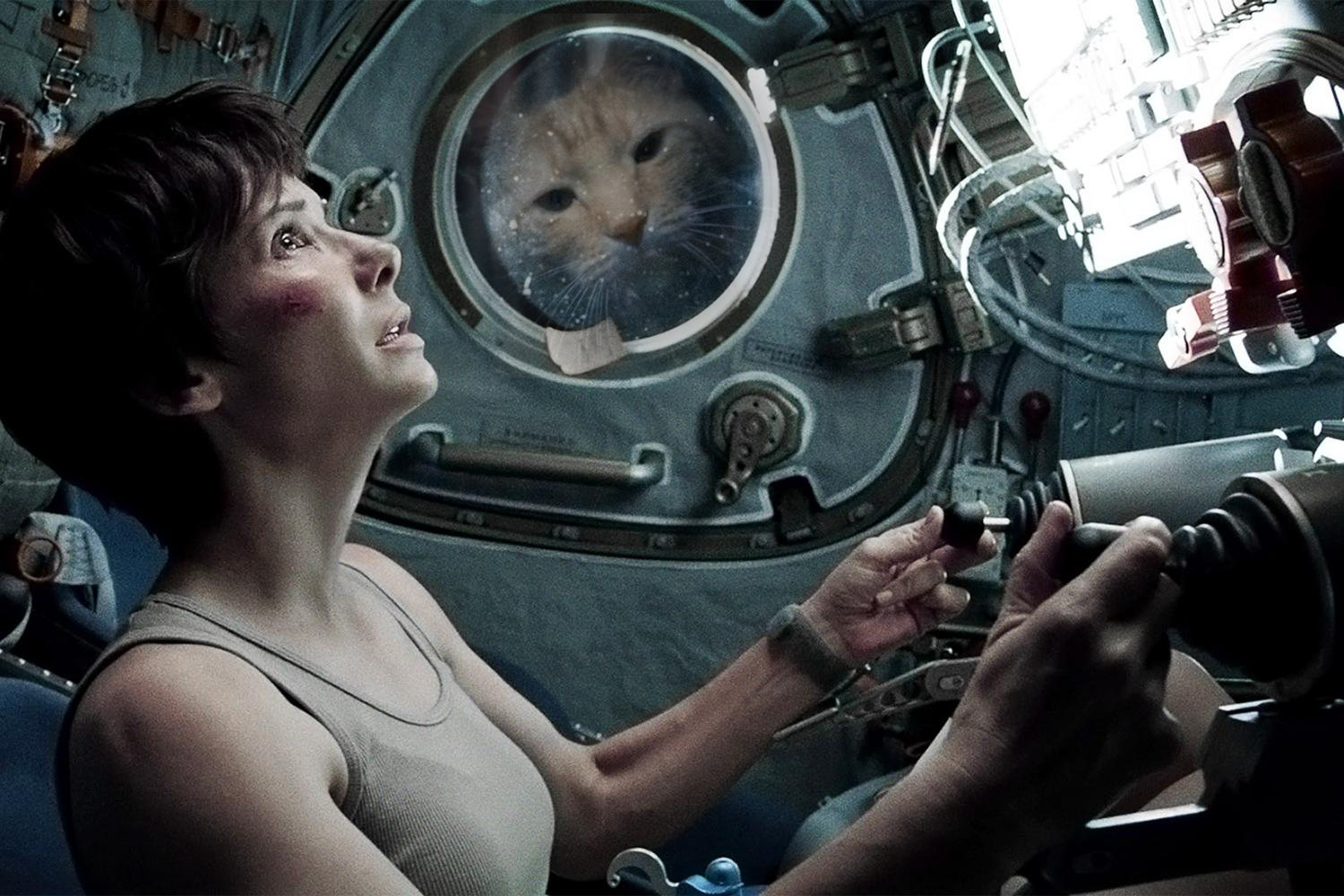
Prison of a Thousand Dimensions: GRAVITY, BUBBLE BOY, INSIDE LLEWYN DAVIS

"I sweat when they stuff me in the pressure suits
Bubble helmet, Flash Gordon boots
Nowhere up there in gravity zero (outer...space)
I need to breathe..." -- "Please Mr. Kennedy" (Inside Llewyn Davis
"I hate space!" --- Sandra Bullock as Ryan (Gravity)
"And then Pinocchio came out of his plastic bubble and touched the filthy little whore next door and died. The End!" --Mrs. Livingston (Bubble Boy)
Vinny Barbarino in the original
We used to call Syracuse the city with the concrete sky. We'd leave our parent's house in NJ Sunday to drive back up to school on a bright sunny day and then, cruising up Highway 81, lovely autumnal trees on all sides, clear blue sky for miles, just a small mass of twisting dark clouds ahead in the distance, up a giant hill miles and miles ahead, like a dark period at the end of a long sentence. Then we'd approach what looked like the climax of a dark apocalyptic horror movie --a dark stormy cloud mass completely contained over Syracuse. Pulling off the exit ramp all our mellow joy vanished by the time we hit Eerie Boulevard.
Syracuse, where the snow never melted, merely accrued like sedimentary layers of salt and frozen slush; any joy we could muster was a pale blue fire that we continually banked with all the drugs and booze fuel we could afford or handle; surrounded by plastic sheeting on the windows for insulation, layers and layers, the protective bubble of plastic coverings and mass quantities of bourbon, and blankets --an elaborate drug and scarf Jenga. Freshman year I had written often of the depressive yellow film that surrounded me like a plastic bubble, a feeling of isolation all the more painful in a crowd but a thousand times worse alone. Poems and poems I'd written about that yellow film. 


Those poems are long gone. My mom threw them out. But I don't need them now that their exact existential ennui is all over Gravity and Inside Llewyn Davis (both 2013), which I just saw, and which in turn resembles Bubble Boy (2001) which my sig other showed me last night. This is no coincidence! The three films might just as well be remakes of one another, bearing, like a draggy gravity, the same overall message: we're trapped in the 3-D space-and-time-suit that is the human body, the ego gridlock that is the mind, and the whims of an Old Testament warden that is the soul. All three components relentlessly drag us back into our orbit of desk, car, couch, and bed, no matter how high we fly outside the bubble in our fantasy escapes.

It is the penitentiary of our unrealistic hopes preventing us from reaching through the brass bars of expectations towards the gold ring. After all, we know that ring is an illusion.

Better we learn to love illusion itself, with no delusions it's anything but just that, pally.
On that note there's another film, not quite in the same league as these, Another Earth. It does have one good quote though, worth repeating, for it fits our micro-thesis:
"You know that story of the Russian cosmonaut? So, the cosmonaut, He's the first man ever to go into space. Right? The Russians beat the Americans. So he goes up in this big spaceship, but the only habitable part of it's very small. So the cosmonaut's in there, and he's got this portal window, and he's looking out of it, and he sees the curvature of the Earth for the first time. I mean, the first man to ever look at the planet he's from. And he's lost in that moment. And all of a sudden this strange ticking... Begins coming out of the dashboard. Rips out the control panel, right? Takes out his tools. Trying to find the sound, trying to stop the sound. But he can't find it. He can't stop it. It keeps going. Few hours into this, begins to feel like torture. A few days go by with this sound, and he knows that this small sound... will break him. He'll lose his mind. What's he gonna do? He's up in space, alone, in a space closet. He's got 25 days left to go... with this sound. So the cosmonaut decides... the only way to save his sanity... is to fall in love with this sound. So he closes his eyes... and he goes into his imagination, and then he opens them. He doesn't hear ticking anymore. He hears music. And he spends the sailing through space in total bliss... and peace." -- Rhoda (Britt Marling) - Another Earth
The ticking, man, Brit Marling, you must hear that all the time, by which I mean the clamor of your geekboy devotees: those of us in love with your heavenly hair but confused by your pretentious way too literal grad school high conceptual sci fi and skeeved by the anemic, whinnying hipster boys you stock your films with. So much potential, so weakly rendered... so ultimately anemic. Those shaggy dork boys need some sunshine, Britt! They're pale. They make the hipsters in Ti West movies seem Lee Marvin-level robust. They'd break like glass goblins with the gentlest of knuckle taps. I'd fight them for you, Britt Marling. You remind me of a beautiful if ditzy girl I loved in college. She's older now though, and plain (Facebook, the great curer of longing for old lovers).

Save us all from the beauty-remover that is age, Britt Marling!

But if you bear her ticking quote about old Yuri up in space in mind with the upper deck Llewyn Davis ditty atop, recorded in the same approx. early 60s time zone as Britt's Another Earth anecdote WOULD have taken place, you realize there's more going on here than either film quite grasps. There's a very real trepidation about being next in line to be shot into space for both these films or--in Gravity's case--being stuck there. Britt only wants to go up in space because she killed a kid with her drunk driving; Sandra Bullock goes to space because a drunk driver killed her kid. Meanwhile I'd spoil the plot to explain whose drunk driving and who or what they hit in Llewyn, but either waywithout shame or grief to propel them, there seems no real reason for these characters to ever escape our orbit. In other words: a kid run over by a drunk driver = Point me at the sky and press the trigger. 

But sad for them that the Coens can't imagine what else folk singers were for if not to express trepidation about having to die for their country. And in 1961's folk craze there's still no Vietnam to name Llewyn's generation. Vietnam,  the war that made Milwaukee famous, that made Walter crazy with PTSD-by-proxy, that gave Dylan's protests songs resonance for a young male populace pinioned by American flag pitchforks at the border between Canada and Cambodia. Without a war to name them, the West Village scenesters of Inside Llewyn Davis can only hide under misty white smoke and dark green corduroy; the lighting perfect in its filtered dinginess, like what it must feel like walking through an unlit folk museum in the middle of the day while slowly going color blind. Aurally, there's way too much quiet and too much resonance in every dripping faucet. Old Llewyn can hike his guitar all over wintry creation, throw it in trunks and plop it on hard stages, then whip it out and boom it's perfectly tuned and the sound resonates like you're listening to yourself through earphones with a good condenser mic. Ne'er does he have to play over clinking cups or drunkards. This land was made for being able to whisper at a crowded bar and still be heard from across the table.

In other words, the Coens have clearly never played open mic nights at West Village bars. Maybe they've never even been to one.

On the other hand, it's the best film about elliptical orbits since The Werkmeister Harmonies!


Gravity has orbits too, and since there's nothing to slow you once you start moving, just bumping into someone can send you rolling along in an infinite somersault, until you're sure you're going to just hyperventilate up your remaining oxygen and die still somersaulting endlessly out into deep space, endlessly, endlessly, oxygen draining from your panicked huffing --until George Clooney comes to your rescue, time and again. Gravity's harrowing near death escapes, space station leap-frogging, and immanent metaphysical evaporation conjure The Swimmer, but it's just another orbit of cramped coffins. The average American's stations of the cross--bed, bathroom, breakfast, car, cubicle, car, couch, bathroom, bed--are interlocked space modules, which Bullock swims through in various space suits and in her Ripley "Lucky Lucky Star" brand underwear. But most of all she finds orbits. Everything that flies past her is coming back around maybe twice as fast in a few hours to her exact spot, Earth's outer layers, its travel routes, apparently narrower than subway tracks.

Such interlocking elliptical orbits are the Coens stock and trade, as folk musician Llewyn Davis says after "Hang Me Hang Me," the number that opens and closes the film and we have to wonder if it's the same night: "it was never new and it never gets old." In Gravity, Ryan seeks a space ship or vehicle to escape her orbit, but Llewyn Davis is the space ship, his old is new just like any musician playing the same song night after night until he needs to suss out new ways to divert himself within it or go crazy. He can't escape an orbit he doesn't admit exists, because it would mean acknowledging the ceaseless ticking of Britt Marling's spaceship's funeral clock. He's learned to sing over it.

"There's no success like failure,
and failure's no success at all" -Dylan ("Love Minus Zero / No Limit")
Llewyn would rather quit than make any artistic compromise that might jeopardize his folk failure. The basement clubs he plays in resemble (no doubt intentionally) medieval dungeons. Thin spotlights coming in from above and the side like stray rays of sunshine down into Poe's pendulum pit. Roger Corman's adaptation of that story was, incidentally, made in 1961, the year Llewyn is set, and there is no doubt the Coens are champing at the bit for the days of Roderick Usher. Maintaining the 1961 illusion with something of AIP's witty/macabre surfin' sensibility would have been nice, but instead the Coens cram in unlikable anachronisms: a pervy Weinstein-esque cafe owner seems to exist solely to rob the folk scene of every last ounce of solidarity, as if the Coens don't know the difference between a 1961 coffee house and a sleazy strip club, albeit one where no one ever talks, or even whispers, during slow dances, and crowd murmur never seems to occur. People rarely talk in Coen films and their dialogue certainly doesn't overlap, the Coens default to the kind of Kubrickian isolation that worked in Fargo but is impossible in NYC (which was why Eyes Wide Shut's NYC rang so false), forcing us to wonder: are they making movies about alienation BECAUSE they hate crowded ensemble cast naturalism, or the other way around?

As a result of all this they make Llewyn into a kind of bearded Susan Alexander Kane, driven by an inner Orson, seeking a gig while steadfastly refusing to compromise or be interesting. There is, after all, only one Oscar Levant. So why would anyone hire a bitter nameless hack like Davis? As Don Draper would say, what is the benefit?

But there are oases --the kindness of the Bohemian 'Lovahs'-style Columbia professor is timeless, so is the existential aura of the Coen Bros-brand Old Testament god-playing, which this time around is rather merciful by the end. They are still finding ways to insert quotes and themes from O Brother Where Art Thou's source text, Homer's Odyssey, into Sullivan's Travels-style deconstructions of the rich kid reverence for the poor working negro sick and sniffling at three AM dawn or whenever the junk man's gone to sleep. But this time they add some genuine character progression, some movement of coldness to warmth. Homer's gods note that men create for themselves "grief greater than the griefs that fate assigns.” The Coens, playing god here tonight, throw down their proxy lifelines and opportunities so that Llewyn might throw them each in turn away: missing the chance for credit and royalties, cashing in on the cowardly claustrophobia of the above-quoted song for nothing more than a few hundred bucks which he quickly tosses away on a union card he still can't end up using.

For Llewyn, the fear of being stuck up above the planet, utterly dependent on a pressurized suit to survive, i.e. famous, is very real because the sun never shines in his current world and he's terrified to find what not being enshrouded by dark clouds might feel like. Signing up on a merchant ship to escape his guilt over his dead songwriting buddy is akin to Bullock and Brit heading up into orbit over their respective drunk driving accidents.

Hold on brother Llewyn, psychedelics are coming! They sure lifted my yellow film back in 1986, ripped the bubble wide open and I stepped out of that yellow film shroud I wrote about all through freshman year up in the City of the Concrete Sky. I basked in the sun anew, alive and well, in a tab, or a shroom.


Bubble Boy (2001) by contrast, is already buoyant - a round planet onto himself, attracting satellites wherever he bounces. Why is he so much better with people than poor Llewyn? Innocence, man. The naïveté of sheltered bubble child Jimmy Livingston (Jake Gyllenhaal) makes it an 'honorable' goal to break up an impending marriage between his beloved neighbor Chloe (Marley Shelton) and some sleazy rocker. It's a need that brings him on his own Candide-like innocent abroad incredible journey through to Vegas and beyond. Jimmy's handsome, pleasant manner is a rarity to begin with in comedy (it wouldn't be as cool if he was, say, Adam Sandler or Rob Schneider - they'd be busy powering the bubble's momentum through gaseous emissions or other bodily nonsense). It works as Jake is cute and endearing; the bubble is just the shell thrown up by any artistic extrovert who can't quite believe he could ever get a hot girl, regardless of how good he might look to himself in the mirror.


In his sweet naïveté, Jimmy is really more like the Justin Timberlake character in Inside Llewyn Davis, the happy alive, gentle, kind fellow, open to the universe's giving to others because he is giving by nature, because he's never been beaten up, shot down or distraught by grief (he's sheltered due to cuteness - i.e. what Jack calls "the bubble" in 30 Rock). Jimmy's plucky charm awes everyone he meets -- and though sheathed forever--apparently--in his yellow plastic film, he liberates souls wherever he goes, excepting a few, like Zach Galifianakis at the ticket window --a sad wretch trapped in his own bubble of a middle-of-nowhere bus terminal, standing as a reminder of just how easy it is to let a bubble make you remote, surly, obese, and depressing, thus further equating Jake's chipper inclusiveness with heroism. It's hard to be jubilant and extroverted in a bubble. If he can do it, what's our excuse?

Deeper-ressing
The cat in Llewyn, Ulysses, meanwhile, his brave tail curling, remains the true astronaut of Davis. He's a Russian cosmonaut version of Bubble Boy, he's learned to love the ticking. Haven't all domestic animals, and bubble boys, had to do just that? Without the burden of expectation or experience, every tick is a banquet, every tock a day at the farm.
“A man who has been through bitter experiences and traveled far enjoys even his sufferings after a time” ― Homer, (The Odyssey)
"How his naked ears were tortured
by the sirens sweetly singing" - "Tales of Brave Ulysses" (Creem)
I have some problems with Gravity director Alfonso Cuarón, as underneath his gift for sci-fi lurks a mawkish sentimentality and pretense similar to Marling's: for him, a madre's love for her nina is so powerful and important he makes John Ford seem cold as Kubrick. I had some deep fundamental problems with the santa-de-madre core of Cuarón's Children of Men as well. Suicide kits made sense in Soylent Green (see my praise of same here) but if there's no more kids there shouldn't be any more overpopulation, just drunken parties and censorship-free TV. Hell, I know I'm not alone in thinking that if there were no more children running around I'd want to kill myself less. And for Gravity, it's the same Cuarón-brand sentimental mierda de caballo coming through in the form of Sandra Bullock's haunted past, which enables her to have a few scenes of big emotional crisis and acceptance, that feels tacked on, baby, like a poster of Rita Hayworth in reverse.

Salvation deferred (from top): Rita Hayworth (Shawshank RedemptionBicycle Thieves),
Carey Mulligan (Llewyn), Marley Shelton (Bubble Boy)
Bicycle Thieves (AKA 'The Bicycle Thief') is not what most people think it is, where the dad makes so many bad decisions (like not keeping an eye on his bike) his first day on the job putting up Rita Hayworth posters that he snaps at any hand that tries to feed him. The patina of sentimental pathos-drenched Italian neorealism is created unfairly by matinee idol De Sica: in the minds of those who've never seen it (such as myself up until a few years ago) it's a sentimental sob story, the kind of thing enjoyed only by the bourgeois, for whom seeing and making movies about poverty is an expression of benevolent social largesse (much of the Coens work seems a warped satire of this largesse -- Llewyn is playing at being depressed and poor - because it's 'in' -while if he was really hungry he wouldn't hesitate to follow any suggestions that come his way instead of pompously refusing them).


What Bicycle Thieves has in spades is a deadpan analysis of the poor person sense of entitlement, oh woe is me, to the point the dad refuses the gifts and advice offered because it conflicts with his idea of himself as a martyr: for example brushing aside the offered ticket for a free spaghetti dinner only to then bug the guy who is attending since he might know about his stolen bike, only to then spend his last few coins on a meal for him and his son. It makes the rich feel better in a way, perhaps, seeing this poor financial planning as evidence of a will to fail --these peasants can't walk away from their conception of themselves as poor and so throw away their meager savings on lottery tickets (i.e. the mother paying her last lira on a fortune teller). The Coens stack Llewyn's deck in the same Vittorio De Sica fashion, allowing for lots of scenes of our scruffy nuovi poveri hitchiking and trudging across the barren landscapes to Chicago to hit up a hotshot owner of the Cape of Horn, a big dusky club bedecked, like the Lamplight, with posters and memoranda from past shows with other come-and-gone folk acts. There's a lot of that memoranda here, amping up the sense that the winsome wand of folk history shall not upon poor Llewyn's shoulder tap, with good reason. He's a a glum mid-tempo pony, destined for the two for a dollar bin at Princeton Record Exchange. He sings with no emotion, only perfectly-modulated voice, rich only with the idea he's impressing his listeners with the ability to fake 'realness.'

The Coens have always been the Stanley Kubricks of the contemporary lit film, by 'lit film' I mean Carver-esque observational minor key rhythmic detail dotted with quirky symbolism, illuminating the inner with the outer. Nothing much happens except alienation and possible redemption, told in moments and observational imagery. Like a character in  James Joyce's Dubliners, Llewyn looks around outside his restrictive bubble but never unzips, never trusts the oxygen will be there when he takes off his pressurized helmet. That said, he does learn something, which is how to forgive an enemy with a kind of papal benedictory wave.

Brave Ulysses. aboard spaceship Glum Folkie 
Adios, Llewyn: Vietnam, rock, and LSD soon will wash your incumbent gloom clear away. The youth and academes will realize the easiest route to outer space is within, and that one needn't lug one's earth-dependent body along with them to see the universe. Unzip the yellow film shell and step out of they egoic self into the loving void! It's waiting to take your call.


It's the body, in the end, that is the prison: its incessant whining for oxygen, its overreaction to desired stimuli catching it in a self-sabotage loop (so starved for sex you stutter pathetically around hot girls), its illusory permanence. You feel like you'll never escape yet at the same time are scared to leave. It just takes one magnificent gesture, unzipping the bubble to kiss the Chloe in BB; going over the cliff rather than surrendering, sticking your tongue out for electric communion in Hair; driving straight into the wildfire to rescue your cat (like Duncan Gibbons); or even just preparing for your immanent death alone in an airless capsule (or the DTs alone in your apartment too fucked up to even call for delivery) and finding a sudden inner calm. Surrendering one's corporeality to get that last minute mirage of freedom: that's the one decision that actually makes a difference.


Egoic fear keeps us locked into our breathing patterns on instinct, huffing that oxygen down, drinking that water. Shit will fuck you up, man, get you addicted to the tree of woe like a masochist Conan. Become an oxygen and water junky and become a coward when death beckons. Why can't we all be like Jake Gideon and just float into the warm body bag embrace of Jessica Lange in ALL THAT JAZZ? Instead we're slaves to our lungs. We're descended via evolution from those who feared death, not those gamely dying young. We are the spawn of cowards, and marauders, those who survived and procreated as a last ditch effort to stave off the reaper, and who reincarnate as soon as they can to try it again and again. Our genes themselves are afraid of floating in that clear black ether. The endless lotus blossoming of the crown chakra is recoiled from on instinct. It requires death of ego, You may not die physically, but the body can't tell the difference and trembles like its suffocating at the thought of letting go. But that's what heroism is.

As I write this a rerun of SNL is playing on the TV behind me, it's Cee-Lo singing "Forget You." And suddenly the inescapable loop of karma clicks back in place, like the revolution of the planet finally caught itself up and hit the Moebius strip tape splice. Any musician lucky enough to have a big hit (such as Cee-Lo's) is compelled then for the rest of his life to play that same song, the same way, stuck in amber, frozen in time at that one breakthrough moment, until its original potency is distilled, pasteurized, for mass consumption. Let's Spend Some Time Together Now!

From there it's all downhill to the eventual burying and VH1 resurrection--this is the brilliance of the digital tape. Even now we should be able to find Llewyn Davis' entire early oeuvre with a few key words. We can recapture the feeling of those coffee houses through the countless live-in-the-West-Village recordings of the era, all remastered onto digital, a perfect auditory capsule for a time when people could smoke indoors and were trusted to make their own decisions (listen deeply in headphones to Blue Note LPs and you can hear the producers whispering in corners of the room). But in doing so we see that Llewyn's world--where everyone waits in hushed reverence for him to finish his mundane songs--is an ever shrinking and expanding bubble. A prison of a thousand dimensions is still a prison. Gravity paralyzes even Sandra Bullock's astronaut in a holding pattern rotation, like a stationary needle on an LP when the power goes out mid-song.

Reflections of / the way life used..
“History ... is a nightmare from which I am trying to wake." ― James Joyce, (Ulysses)
"Thinking of the key, each confirms a prison" - TS Eliot (The Wasteland)

The goal isn't to just not think of a key to escape your prison but for us to stop thinking of ourselves as separate from the prison bubble the warden, the bars, the cot. You can still be yourself, but you are also your neighbor. You are also the world. Buenos Aires is your right foot. Your urine stream and Niagara Falls are the blood of a newborn lamb and a wave over an Australian shore. Every coffee or wine cup is 'the' holy grail; every shower a baptism. 

Recuse yourself from the bench, and make a vow to judge no more, and the thousand dimension prison dissolves behind you like a dizzy snore you have to take on your girlfriend's word is something you should see a doctor for. The vintage astronaut comic book must escape the tape of its protective mylar prisons and be read, fearing not the damaging oils of childhood's thousand thumbs. Of course it will lose its pristine mint status, but the helmet must come off.  The plastic seal must be opened, the mask must come off, viruses be damned. It's as inevitable as falling.

And we will fall.


Wednesday, April 02, 2014

Carpenterian Carpet Capsules: HALLOWEEN III, YOU'RE NEXT, MACHETE KILLS, THE OCTAGON


"I lay a "carpet" under the scenes - it doesn't get in the way," -- John Carpenter (on scoring his own movies)
Horror has never been about moving forward, or being in the present, but about the past reaching up from our unclaimed freight basement to pull us back down to our graves, watching our future recede like  a reverse tunnel. And so it's always the simple, insistent, slightly-off scores that wow us. A simple repeating riff can send chills down the spine and make the blood run cold, neither phrase I never really understood or felt, in real life--until lately. Horror taps into our hidden closets, and spills them out into the hallway, so hopefully there's a nice carpet there. Alas, most filmmakers hire 'real musicians' for their scores, which means rather than a nice carpet there's marble and brocade and rococo trimmings, as in complicated strings micro-managing our emotional responses.

Let's look at these four films I've seen the last few days, united by badass 'carpet' music scores if nothing else.


HALLOWEEN III: SEASON OF THE WITCH
1982 - Written and Directed by Tommy Lee Wallace
**1/2

Halloween III: Season of the Witch's score is one of the great John Carpenter percolators, rich with the same kind of 303 cyclic rumblings and unease-producing synth drones that are so mind-blowing and ingeniously simple in Assault on Precinct 13, Halloween, The Fog, and Escape from New York. That said, there are some shrill nail-on-blackboard sustains liable to aggravate your fillings, the worst being the diegetic TV commercial jingle for the Silver Shamrock mask collection (imagine "London Bridge is Falling Down" if remade by Raymond Scott); and in the big tertiary climax, a discordant composition that conjures a duet between a two year-old on triangle and a malfunctioning car alarm. Unsettling, atmospheric trick-or-treating shots as the sun goes down on Halloween (onscreen text declares they are other cities but they're clearly all the same L.A. neighborhood) cast a nice anticipatory mood, but are undone by the relentless jingle.


A lot of this film's detractors glide over all that to focus on the lack of Michael Myers. I have no problem with that aspect (he he does show up in a clip from the original Halloween playing during the 'Samhain Sacrificial Surprise'), but I do have a problem with being expected to believe anyone would complain if a giant plastic shamrock wasn't affixed to their Halloween mask like they were just down at the St. Patrick's Day parade. "Don't you have any Halloween spirit?" a bar patron asks when the proprietor changes the channel from the awful commercial. Has anyone ever said that, in the history of America? And what the hell does "London Bridges" with a bouncing shamrock have to do with goddamned "Halloween spirit"? Goddamn it. A commercial incessantly repeating to advertise only three different masks? Suspension of belief buckles.

Ho ho Ho! Merry Easter! 
Supposedly Nigel Kneale, the British sci fi writer genius behind Quatermass and the Pitstarted the script but wound up taking his name off the project. As England doesn't have Halloween, I blame him for the shamrock aspect. I doubt England has St. Patrick's Day either.  Here in the States, shamrocks are anachronistic in any month but March, and that London Bridges song anachronistic anywhere but a nursery school recess. Maybe Silver Shamrock could have sold Guy Fawkes masks in Britain? Or better yet, ditch the shamrock and the jingle.

Guy Fawkes Day (Nov. 5 also known as 'Bonfire Night') is, to my understanding, more like a pyromaniac kid parade hooligan thing where masks worn less for imaginative display and more so the bobbies can't recognize you when you run away from your amok fireworks disaster. But Halloween is much more complex. Costumes and masks come in an array of styles, and no one wants to be limited to three options. Further anachronisms occur with the idea that the shamrock is somehow a designer mask tag. One of the frustrated buyers at the motel complains that her four year-old was playing with the mask and the shamrock design logo chip fell off. Put the logo back on! Would you go to the Fruit of the Loom factory in Bangalore to demand they sew the label of your T-shirt back on? These guys would....

And our respect for the way Atkins handles himself in this weird mission dwindles when--after learning that the Shamrock 'people' monitor everything that goes in in their small town via security cameras and bugged phones--he seems genuinely surprised when his hotel lobby call to the cops doesn't get put through. America was depending on you, Atkins! You done blowed it.

Cliche'd supporting bits also drag the film down: the 'loud' American family (the dad doing a fine imitation of Max Showalter) and a couple of 'buyers' who all converge on the hotel at the same time, kvetching about the arcane business practices of the mask makers; the obligatory 'local drunk delivering backstory' and turning up dead a few scenes later; the Moneypenny-esque hospital pathologist with whom Dr. Atkins undergoes trite banter; the hissingly hostile ex-wife, so vile we can only pray she winds up killed asap. SPOILER AHEAD: And the 'big giveaway' lead up --the commercial on "all three channels" stretches credulity to the point of eye rolls and deep sighs, then trumped by the idea they'd all pull the plug based on some lunatic's frenzied phone call. I wouldn't mind if the film was surreal or relied on 'magic' or something but it tries just enough for a kind of de facto ominous conspiracy logic that nothing quite gels either way.


But... if you can forget all the ridiculous nonsense, whole chunks of the film have the groovy Carpenter no-nonsense tick-tock momentum we love, like the motel hook-up between mystified Tom Atkins and cute little Stacey Nelkin. When it's just them driving to the strange town and hanging out in their room, or bluffing their way into tours of the factory with the aplomb of a pair of Hitchcockian lovers-on-the-run, the film takes wing. Even freaked out and scared as they might be, they're cool, rational, adult, and no drama. Atkins' shaggy Nick Nolte-ish charm in full effect: "It's getting late, I could go for a drink," how often do you hear a shaggy dog hero of a horror movie say that and have it not be a sign he's an alcoholic? I like that he's going out late to score a bottle of booze, just like I used to so often after checking into a room in a strange town. And remembering the ice bucket on his way back too? Damn, that's so rare. Even the nudity and showering is emotionally grounding, calming and nice rather than merely exploitative. And I love the cool dead isolation the Northern California town in the setting sun, its utter stillness at night recalling the wastelands of Assault on Precinct 13, They Live and Prince of Darkness. As the evil genius mastermind Cochran, Dan O'Herlihy exudes great Celtic charm that can oscillate to reptilian evil so fast that his whole countenance seems to shape-shift with each breath. He may plan to kill almost all the children in the USA but the way he says it ("It's the biggest joke of all - on the children") makes it seem like he's just arranging some gentle surprise ice cream party rather than mass sacrificial remote control murder. He even gets in a great creepy monologue about the 'real' Halloween, Samhain, and how the last time such a mass sacrifice occurred "the streets ran red with the blood of animals and children."

Now that I would have liked to see, but I can settle for weird termite touches like the way the dead kid's blonde hair coming through the ripped up pumpkin mask makes the whole thing appear to be rotting.

I suppose it's wishful thinking to hope for a 'producer's cut' that replaces the anachronistic elements and cleans up the illogic and clunkier cultural dysmorphia. Alas - you need to be a true Carpenter devotee to even bother wishing for such a thing. Fans only of slasher movies like the first Halloween, Friday the 13th etc-- will hate this movie on principle. Then again, a mute guy with a mask and knife walking slowly towards an unmasked, unarmed girl and/or kid will always scary but vice versa almost never. The kids here are all pretty one-dimensional cliches even before the masks go on. Afterwards they're just pixels watching pixels. If you really really need some Carpenter and have exhausted all the good stuff and are down to your Memoirs of an Invisible Man-Village of the Damned-Starman cottons, well, luckily, there's that carpet. It makes Halloween III a keeper.

YOU'RE NEXT 
(2011) Dir. Adam Wingard
***

Getting back to the idea of the right, simple but strong carpet being so integral to horror, You're Next has one of the best in recent memory (attributed to four different guys, including Wingard, Mats Heltdberg and Jasper Lee): eerie retro synth burbles and drones that are unnerving in a sweetly retro manner. It's enough to give one hope for horror's future-past, not that You're Next is exactly horror as opposed to a 'thriller' but it's certainly creepy, not least for the way we don't know whom to trust or root for and everyone is characterized in a way that's both sympathetic and the despicable, like real people are. A family who can devolve into shouting matches at the drop of a pin and be calm a minute later? Hey, that's like my family! The cast is great and I can't really tell you anything else without spoiling it. AJ Bowen, whom I did not care for in Ti West's otherwise nearly sublime House of the Devil, is pitch perfect here, and Ti West himself shows up as one of the heirs. Also appearing is Calvin Reeder who made the genuinely nightmarish and surreal grunge sublime masterpiece The Oregonian (review here), and Larry Fessenden, whom I did not care for as the smug hipster hotelier, chickenshit ghost-hunter in West's The Innkeepers. But I hear good things about his horror film, Habit (POST-SCRIPT, I saw Habit and did like it, and his performance)Scrappy Sharni Vinson is a great final-ish girl, full of wily Australian gumption. Her rise to action (her boyfriend didn't know she was raised by survivalists) is truly inspiring; she does none of the things that make us cringe and shout at the screen not to do stuff. As a result, though, it's not a horror movie. Is horror perhaps contingent on a girl not sensing and reacting aggressively and pro-actively towards sudden and very real danger?

I haven't seen any of Missouri filmmaker Adam Wingard's other films, but they look like a grim lot. You're Next was completed in 2011 but wasn't released here 'til last year, which is a goddamned shame but at least it's too timeless to ever be dated, recalling not just the classics of the 70s and 80s, but classics of the 30s, i.e. the old dark houses full of secret panels, greedy relatives gathered for the will, lightning storms, scary masks, strong female leads and a refreshing lack of any moral compass. What else can I tell you that wouldn't spoil what may be the best thriller-chiller since The Descent? Or at least, Cabin in the Woods? And what a treat having 80s cult horror favorite Barbabara Campton as the mom. She still looks damn good. Maybe even hotter now than she was then!


MACHETE KILLS!!
2013 - Dir Robert Rodriguez
***

Hard to believe now, but there was a time I found Sofia Vargara shrill and grating --her deafening voice and exaggerated English enunciation brought back memories of my Argentine ex-wife making fun of Yankee accents -- but  not in Machete Kills! where Vagara tones it down (or at least modulates) as a violent madame of a high end Mexican brothel, inversing her usual approach and thus ably modulating a playful dominatrix simmer to a full roar. Even her sophomoric breastplate machine gun couldn't dampen my awe. But she's not even the best badass bitch in the bunch, that title goes to Amber Heard (i.e. the Mandy Lane that All the Boys Love) as a CIA double agent playing handler to Machete while he's on Mexican assignment, all while busy snagging the title of Miss San Antonio Texas at some never-seen beauty pageant. My god she's hot in her form-fitting pageant dresses and--far more than the wooden Michelle Rodriguez as the one-eyed leader of the Mexican-USA immigrant underground--she seems to be confidently--even brashly--living up to the character's full badass drive-in babe potential. Heard might well be our century's Tiffany Bolling! She's the most badass female in the film (and one of Rodriguez's biggest strengths is that he always brings a lot of them). She's so badass that, even in her glittering, gorgeous San Antonio sequined ball gown, sash and tiara, she's cooler and tougher than Michelle Rodriguez in all-black and eyepatch. I was rooting for her in their big final showdown, and Rodriguez--as in the Furious movies--just seems like she's trying to hide how weary she is of acting. 

So hell yeah Roberto Rodriguez is still in the game. Getting younger as he ages, he's at the point now where Carpenter hasn't been since Ghosts of Mars. I liked Machete, too, but Kills! is even ballsier; it has less to prove, throwing aside even the usual revenge boilerplate plot and going for a Machete in Space Part I angle (the second part being advertised in the opening trailer) and bumping up the psycho babe quotient. 

The plot eventually finds Machete recruited by the president (Emilio Estevez's brother Carlos) to kill some mad narco-terrorist with a bomb strapped into his heart; Lady Gaga is the assassin El Camaleón, with Cuba Gooding Jr., Antonio Banderas, and Walton Goggins playing some of her thousand faces; Mel Gibson is a light saber-wielding hybrid of Steve Jobs and Drax from Moonraker. Perhaps the coolest and most original angle is that the target (Damien Bashiro) has a split personality, only one of which is a suicidal psychotic killer, and to sweeten the pot he has a missile launch activator button attached to his heart, triggered to fire nuclear missiles at the White House the moment it stops beating, so Machete ends up going to ludicrous extremes to keep him alive, which all leads to high hilarity and ballsy greatness as every time Basharo's kingpin falls asleep or gets conked on the head he switches to his other personality: one has a suicidal guilty conscience the other is a madman megalomaniac. Que raro!

Like the marvelous Planet Terror (which had a great Mexicali blues-tinged 'carpet' score) there's great music by Rodriguez and collaborator Carl Thiel here, and countless nods to great trash films old and new: I noted tributes to: They Call Her One Eye, Skyfall, Live and Let Die, Rolling Thunder, High Risk, Escape from LA, The Professionals, Drive, Coffy, Switchblade Sisters, The Warriors, Enter the Dragon, The Five Deadly Venoms, and even Lucha Libre, Fantastic Four (the John Byrne-era comics, not the movies) and of course Star Wars, which Gibson's Drax-Jobs loves so much he even has a working X-34 Landspeeder to coast around his vast soundstage green screen factory. It's all here, Mexicanized and oh-so Texan, and like Planet Terror stacked with a hot girl cast rocking nice midriffs. If the blood splatter, explosions and--well, everything else--seems cheap-CGI shittier than the either Planet Terror or the first Machete--giving the vibe that the whole film is shot either in a green screen room or Rodriguez' own backyard, which happens to be stocked with lumber, weird custom-made weapons and science fiction props, cool buddies, badass Mexicans, cold beers, and tricked-out pick-up trucks with the hoods open-- well, that's not bad, son. That's just Texas. Invite me next time and I'll show you how we did it in 1997! 


----
THE OCTAGON
(1980) Starring: Chuck Norris
 **

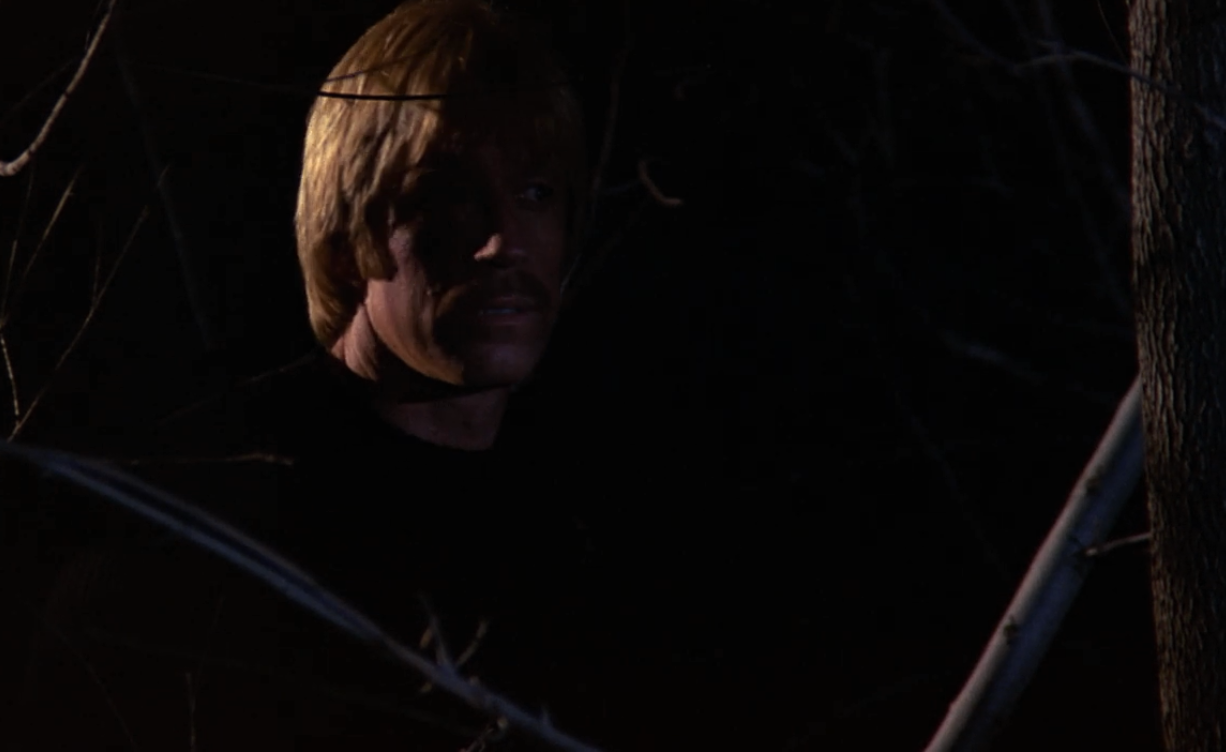
There was a time when Chuck Norris was every kid's friend, instead of merely liberalism's enemy and a hipster objet d'curiosité ironique. Back in the 70s, we kids all wanted mom to take us to see Good Guys Wear Black. The TV promo spot showed him jumping up over a speeding car and kicking the driver right through the windshield, in slow motion, all in black. They played it constantly. We kids couldn't believe it. We all wanted to see it, and could -- it was PG. But those who saw it said it sucked - the cool parts were all in the commercial. So then came The Octagon, this time rated R and with more fights. I personally didn't care. Fool me once: shame on you, and there will be no twice, Bruce Lee taught me that, you mustached neo-conservative betrayer of ADD matinee attention spans. BUT NOW... All these years and hipster revivals later, Octagon has a certain cedar sauna charm. Currently on Netflix streaming and looking reasonably remastered for HD, it's dorky charms are just enough for a low key rainy Saturday afternoon or day off from work, while you clean your guns. 


Sure, it's Norris and there are moves to be demonstrated, Hi-YAA! - but where Octa pays dividends is in its deadpan funny-paranoia: the ominous lack of musical cues leaves us uncertain what we're supposed to notice in the mise en scene; the cryptic stares and close-ups of car keys all portend some dire action is about to erupt any moment and keys will factor in, but no-- the key inserts are just there, they don't foreshadow some later key mix-up. Genius. And the weird stares offer the same elliptical pointless fake-out: is it just that Norris is a terrible actor, unable to convey any emotion, or say anything of interest, and the car keys exchanged are the best he can do in his delicate fighting condition by way of Hawksian cigarettes and drinks with the Patty Hearst-ish composite heiress love interest, Justine (Karen Carlson, with more than a faint air of Ellen Burstyn)? Meanwhile, a roster of grizzled TV western veterans work for Lee Van Cleef's security firm as Justine's bodyguards and easily outpace Norris in both the acting and charismatic presence departments, never a good sign.

Other bad omens: Norris tries to help Justine, too, he hangs around and tries to spot the dangers the bodyguards miss, but since he can't smoke or drink he pays for all that wariness in stress: a mop handle looming into the foreground rattles him like it's a bo staff in some yet unseen assassins gloved hands; a car backfiring rattles Justine and therefore him. And he has a problem of stuttering even within his inner thoughts, a habit he keeps up all through the picture:
"A.J.-j-j-, Justine-ne-ne, you wouldn't even know each other-r-r-r if not for me-me-me- I'm the bridge-ge-ge..."

Dick Halligan's loping score, when it does show up, pilfers from Ennio Morricone but at least he's stealing from the best. It hints that there's decent paranoia pastiche is buried in this movie somewhere. The tragedy is that Norris never finds it. Instead he spends the bulk of the movie refusing to help various women who beseech his aid in killing a terrorist ninja trainer, just because said trainer just happens to be his own brother. Figures. The ninja trainees/mercs finally get weary of their evil trainer's behavior on their own, and when they see him being a coward in a one-on-one with Chuck-- needing four other ninjas on his side, plus an unfair weapon advantage--they turn on the guards and start kicking ass, led by the hot furry Palestinian trainee named Aura (Carol Bagdasarian) above. Damn right.

For all the hype, Norris turns out to be a slow fighter. We have to take his word, roundhouse kicks aside, that he's actually a black belt in anything but posing and 'stache grooming. Maybe he doesn't want to accidentally hurt any of his stunt men. Most of the fights take place on sand or in carpeted domiciles so no one seems to get hurt when they fall. They rarely fly through glass windows or windshields or smash furniture. Still, it's diverting to see the ninjas pop up out of the torch-lit outer darkness from sandy holes under freshly laid corpses and so forth, compelling me to wonder if they just hang out under dead bodies all night, just in case Chuck happens by. Sounds rather dull, then, being a ninja...especially in the age before smartphones.

The Octagon itself isn't anything to get mom to take you to the local matinee about. It's just a space where ninjas are trained in some deleted scene. Its sandy floor and wooden beams start out rough but are varnished by the time of the climax, giving everything a dusky woodsy look like the clinic in Cronenberg's The Brood. So if you like rustic wood finish and cozy exteriors, see them both, as a double feature, and spray some bleach and patchouli in the air, and you'll think you're soaking in a cedar sauna. And isn't that what good bad trash movies are all about-out-out?

NOTES:
1. Britain doesn't have Halloween - they have Guy Fawkes Day, as seen in V for Vendetta
Related Posts Plugin for WordPress, Blogger...