Showing posts with label 70s sports movies. Show all posts

Saturday, November 21, 2015

Midlife Crisis Month: Best of the Beards #1: Kristofferson


Do they still do that thing of growing mustached for prostate cancer awareness in November? My sober anniversary month, November 17th, is always stained with the rainy teardrops of shaking and quaking; it's the usual marker between my manic and depressive phases, such as they are. Rough times, man. October is my favorite month, November my least. But what is Heaven if not Hell finally accepted? The flaming beard of the sage is as a nest for the bird of wisdom. Rant against cigarettes and condomless sex still the cows come home, o Safety-First Clydes. Gives a flying fuck doth the sage? No sir. He accepts his pile of Hell fully it so it morphs into a slice of heaven. Or as Kristofferson put it:
"I ain't sayin' I beat the devil, but I drank his beer for nothing.Then I stole his song." 
In November all I do is sit around and watch World War Two documentaries and Vin Diesel (he's our century's John Wayne and don't make me prove it), Tennessee Williams movies, James Coburn, John Huston, Voight, Reynolds and the man with the best beard of all, Kris Kristofferson. (1) See, the man Kristofferson is from a different time. His beard is a different breed from the quirky hipster's. It's all there in the movies of the 70s when country songwriters could still be men. In the movies today the good old boys can only play extremes of the type, so they're either twitchy meth dealers who abuse their wives and children or serious, hard working sober Christians in flannel who just want to teach the son of the hot single mom how to fish, whittle, and tune a guitar before he has to ride into the sunset or take one last shady job to pay for the boy's operation. There is no middle ground today. There is no man who is both reveler and decent guy, spiritual seeker and hedonist, not a cliche'd everyman but a dude who's genuinely free, able to drink and smoke without the score or subtext condemning him. That's why LEBOWSKI would be nowhere without Sam Elliot to supply the narration and Saspirilla drinkin'. The sanctification of the country hombre, old Sam's the link we need. We'd never see the straight line woven along from Bogart's Marlowe to Gould's Marlowe to Bridges' dude to Phoenix's Doc. All we got now is Adam goddamn Sandler and his saintly manchild contingents.

Back before that manchild thing, back in the 70s, if you wanted to tell a story about a raunchy team in the flyovers you could make them hard drinking, brawling, smoking ten year-olds or coaches who'd just as soon call the game off and pass out than snatch victory from the jaws of defeat. Those were real men! Even the twelve year-olds. I blame insurance companies, nanny state hyper-parenting, and academic overreach. It takes longer than ever to grow up.

And so it makes sense, it being November, to honor the facial hair not of the co-op hipsters that haunt the coffee houses of Williamsburg, for they'll never be a step away from dyin', or as Kristofferson says in the great and underseen Alan Rudolph film SONGWRITER:

"Do you suppose a man has to be a miserable son of a bitch all the time just to write a good song now and then?"

The hipsters today don't need to be miserable anymore, they got antidepressants and Cialis. They'd never be sons of bitches for the hell of it and they'll never get the nicotine and cyprine stained beards of the 70s dads and groovy football-when-it-was-cool older brothers, the beard that cares without being a pussy about it, the beard of a man had 'passed' his acid test and who was no longer that into looking young and gorgeous. He's above all, too lazy to shave.

So who gives a fuck about that little pisher Jesse Eisenberg throwing his lot in with the UWS bourgeoisie and their smug piddly ass New Yorker subscriptions and their tired tweed jacket self-importance and knowing chortles? Soon my kind will drop 'em down before we too drop, and the new generation of ten thousand talkin' and nobody listenin' will swallow them like the tide swallows the drunken bather. Kristofferson is still the coolest man on TV. And all you have to do is watch THE VOICE and how regularly lanky Blake Shelton wins against the crushingly insecure and narcissistic manchild Adam Levine. I'm no country music fan in general but between who I'd both pick to drink with and have as an AA sponosr, it's old Shelton. You just know he'd be able to talk about more than how you like his hair and what people are tweeting about him.
---
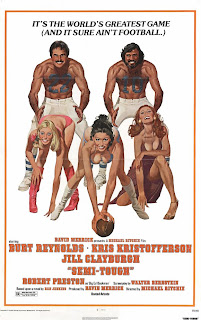
(From SEMI-TOUGH): 

"The "loving fight" concept was huge in the 1970s, especially, as I've noted before, in Burt Reynolds movies like SEMI-TOUGH. This was the age of bloodless bar fights, where chairs break easy over heads, and people fly through storefront windows with the carefree abandon of a kid jumping into a summer lake. Everyone makes up outside in the parking lot, their macho fury soothed with some good old fisticuffs in the grand drunken John Ford tradition. And SEMI-TOUGH has the coolest two guys and a girl group bond since DESIGN FOR LIVING. It's a trick that we've forgotten in the manchild 80s thanks to George Lucas, who's jedi Luke refuses to fight his father, even though fighting with fathers is a great way to train and get in shape. Didn't Lucas ever see SWORD OF DOOM? Killing can be an art devoid of passion or hate. John Ford knew it, and Reynolds and Kristofferson know it. Because they're perfect.

The 1970s dad was peaceful enough to understand the need for these sorts of outlets for his children and friends. In our more "enlightened" times no one is allowed to fight or have raunchy sex without consensual agreement in writing beforehand, and gloves on all contacting parts, or even the compulsive need to boast, overthink, drain the spontaneous joy out of it, and feel guilty afterwards, second-guessing and self sabotage all because we drank the nonsmoking manchild/perfect man dichotomy rom-com Kool Aid, which is exactly how European men describe the American woman's attitude towards sex. For all it's tossed-off clumsiness and Burt's intentionally shocking freedom with vulgarity and the N-word, SEMI-TOUGH is a rare document revealing that if only for a decade, we had sex like the French and fought like Americans instead of the sad reverse." (MORE)

COOLEST COUPLES: DINA SHORE and BURT REYNOLDS

We can see dim shades of it in Demi Moore and Ashton, but that's far more about, or seems about, two insecure narcissists desperate to connect. Modern Ashton and Burt in 1974 share a certain immature rawness, where you could understand an older woman going for it, because she knows she has something worthwhile to give them in return for suckling on their youth, more than money or maternal support they offer a kind of knowing sexual and professional wisdom. But there's no comparison beyond that because unlike Ashton, Burt was/is a real man. And here on Larry King he's being more emotional than Shore was, and that's why it's so brave, why it brings me almost to my knees to read that interview above because it reminds me of something our 21st century man has yet to find. Male sensitivity now is inescapable, and therefore worthless. What once was manly grace is now just passive-aggressive snickering boy nonsense wrapped in high-voiced ectomorphic pretentiousness. Dinah would bitch slap the lot of them, while Burt cracked up in the background, and because she's not here to do it, we all mourn. (more)

--- NOTES
1. I should add I'm very unnerved by Kristofferson when he's clean shaven. I know laudable critics from Kim Morgan to David Thomson love the naked faced KK in films like PAT GARRETT AND BILLY THE KID and CISCO PIKE... maybe I will too, one day.

Sunday, July 22, 2012

"You rolled, you really rolled" - ROLLERBALL and a 70s Bloodsport Overview


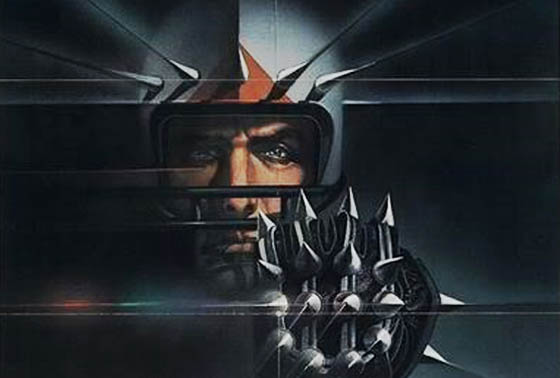
One of the advantages of age is added hues of golden 20/20 hindsight when discussing retro-futurism in movies and for me age doesn't factor into any retrofuturist film more than ROLLERBALL (1975). Today I finally actually watched the whole damned thing (it came on TCM), and understood it, and was thrilled by it in that low-key adultly 70s thrilled way. Why did it take me so long? There are reasons. Roll with me...


ROLLERBALL was a film that seemed to come across the TV quite a lot when I was a child but frankly it seemed far too adult for me to understand and I didn't need a film to tell me football was a violent, icky business. Why bother criticizing our penchant for media violence with more violence? To know the answer you must understand the 70s, the last decade before cable TV and the VCR changed the fabric of American life. Prior to then there were only three major networks, plus PBS and a few local stations on the UHF antenna, and most of them signed off around four AM with the Star Spangled Banner. Football would dominate the ratings any night it was on. Everyone in the family almost had no other choice but to watch it--especially if the principal breadwinner (the dad) called the TV shots-- and because it was so universal it developed a dirty kind of bourgeois cache it doesn't have anymore. It became shared culture across all classes, ages, temperaments. Once families had two TVs, VHS and cable, only the dads stuck around. The intelligentsia moved upstairs to the other TV. Suddenly ROLLERBALL had no choir left to preach to.

And anyway, it was hard to understand the appeal of both football and ROLLERBALL on analog (square) TV, no matter how big the tube. Unless the TV was huge and your eyes 20/20 you had to take their word for it there was even a ball down there. Now they put a digital yellow line to mark first down and with the big HD widescreen even I can finally enjoy it. But back in the day, sports movies and sports action was hard to keep track of, just a lot of 'half images,' and the 'editing for television' endured by the raucous (R-rated) sports movies further abstracted the story into oblivion.

In short, TV was no place for ROLLERBALL. If you wanted the real flavor of caustic satire about the NFL and glorification of macho violence, you needed to get a babysitter and go out to the cinema, the R-rated adult-aimed 'mature' cinema. Little kids like me would have to hear what it was all about second hand, by kids who'd overheard their parents talking to other parents about it.

But today I salute the sports movies of the 70s. They were wild, woolly, untamed, sexual, manic, a bit thuggish but also warm-hearted, loyal, shaggy, and drunk off their asses. Nowadays guys get kicked off the team for so much as a single toke of weed. What the fuck is the point? In the 70s, they would have pissed on your shoes before they pissed in your cup.

Perhaps the ball got rolling thanks to one of the big novels of the era: a savage insider tale of drugs, sex, and violence in the NFL called NORTH DALLAS FORTY, which in 1979 was made into a very popular movie with Nick Nolte-- then a young hunk who'd rose to fame via an early mini-series called RICH MAN POOR MAN (1976 - above right). Nolte wore a big 'stache in NORTH DALLS FORTY like Burt Reynolds, then the #1 box office star in the country thanks to the huge popularity of SMOKEY AND THE BANDIT (also 1976), which singlehandedly launched a craze for all things trucker-related: CB radios, diners, cowboy boots, biker bar brawls, convoys, sexy hitchhikers, jugs and speed.

smoking! today that would be a thousand dollar fine
Now I can re-examine these films from time's sweet retro distance and what I especially find healthy about NORTH DALLAS FORTY-driven sports satire popularity is the irreverent amount of sex and drugs involved vs. the sanctimonious, sober, overcoming-all-odds feel-good sober tedium in today's editions. Burt Reynolds' roster of characters may have been smarmy shitkickers at times but they were goddamned men. Even the kids got a version of this 'fuck you to niceness' in our own sports satire, BAD NEWS BEARS (also 1976).

Semi-Tough
While these kind of off-the-cuff sports films weren't necessarily critically acclaimed, they were beloved by many parents I knew (parents were younger then): they had broad, causal performances, tough locker room bonding, drug-induced hotel smashing, and Jack Warden as a weary coach going up against shadowy team owners who would do anything necessary to pack the stadiums, including pumping so much cocaine into their star quarterback he could keep playing even on a broken leg.

But for ROLLERBALL, director Norman Jewison is clearly aiming for something loftier. Jeff Kuykendall theorizes Jewison was trying to ape Stanley Kubrick and turn the film into a kind of Clockwork Football:
The problem here is that one could simply summarize the premise of the film, and the message would be inherent: society craves violence and leans toward corruption. The result is a film which is frequently pretentious: grasping at profundity and failing to glance it. Death Race 2000, directed by Paul Bartel and released the same year, ironically succeeds where Rollerball fails, tackling almost the exact same story but delivering it with such over-the-top violence and comedy that the whole achieves the sublime (and on a Roger Corman budget). Perhaps Jewison should have let go of the Kubrick approach; though it’s fascinating to see what happened when John Boorman took the exact same tack for the even-more-ridiculous Zardoz. - Jeff Kuykendall - Midnight Only


So sports movies were the rage along with car chase movies and truckers, in the mid-70s: aside from SEMI-TOUGH and NORTH DALLAS FORTY there was the tangentially-related BLACK SUNDAY (1977 - terrorist blimp attack at the Super Bowl); TWO-MINUTE WARNING (1976- assassin at the super bowl); SLAP-SHOT (1977 - brawling bespectacled brothers in hockey, below); BAD NEWS BEARS (1976 -smoking, beer-drinking, cursing in little league); THE LONGEST YARD (1974- prison football team); hell, even M*A*S*H (1969, but popular in the 70s) had a football game to satirize America's love of bloodsport.


And you can see the fundamental difference between today's and yesterday's sports movies with the remakes: The remake of BEARS loses the bulk of the profanity, smoking and drinking (so I hear), which mind you in the original was done by the kids; boy-man Adam Sandler replaces macho man Burt Reynolds in the remake of YARD; the remake of ROLELRBALL is a co-ed affair set more or less in the modern era on a sleazy Eastern European underground circuit, because America is so PC it's out of touch with good old bloodsport so they have to go where life is still cheap. The nanny state mentality makes it far less likely the heroes will bed numerous hotties and snort coke and shoot up steroids and more likely to cry at the bedsides of little dying kids, or scrape themselves up from poor neighborhoods, watched over by magical sober godparents. You know, like they did in the 40s, with the Catholic Legion of Decency breathing down their necks. What's our excuse?

In the 70s, you had games like this:


ROLLERBALL came out before both BAD NEWS BEARS and SEMI-TOUGH, but then again it's 'futuristic' and so is both ahead of the times as well as, now, behind them. Set in 2018, a lot of 'BALL's tropes have come true -- Caan pops in something between a DVD and an old mini-disc to watch home movies.... right there on the TV! In 1975! How did they know? And there's something like a TIVO and at one point Ralph Richardson kicks a big console computer intelligence that talks like a male version of Siri. And all the books ever written have been loaded into the computer-- though instead of being released as Kindle files they're summarized, i.e. stripped of any offending content or ideas that might run counter to the edicts of the shadowy ruling corporation and everyone knows that, um, today shadowy corporations don't control um... us.

But Jewison's 2018 is still a land without cellular technology and digital circuits so it's not that ahead of itself. They're still using punch cards and reel-to-reels and everything's huge and clunky. In the real future we get rid of all that heavy stuff, but keep the Ultimate Fighting Championship.  Roll, baby!


In between the violent sports games, John Houseman lurks and makes grim decisions on behalf of his shadowy corporation not unlike our own Dick Cheney. There's a decadent party where jet set kids blow up the last few surviving trees for sport. And everyone pops these things that come in little Sucrets-style boxes that makes people totally wasted. And like in SOYLENT GREEN, women have been reduced to chattel. James Caan is first given Maud Adams as a wife but then some high ladder salaryman whisks her away and Caan's pretty bent out of shape over it so won't retire when Houseman leans on him. Seems Caan's lone warrior rep is conflicting with the corporation's idea of the game as showing the importance of a group effort (i.e. a North Korean-style halftime show). They keep upping the violence quotient of the game namely to get him killed so his impudence doesn't go unpunished.


As tough a warrior as he is, you can tell Caan's not very bright; he's like the kid who'd rather kill all his friends than let them play while he has to go into dinner. He mopes around at libraries and computer desks trying to get some books about the corporations but none are forthcoming. He really can't understand the motives of the corporation! He's too OLD! Dude, why can't they just say it to his face. Caan's kind of grandiose behavior wouldn't fly in Hollywood no matter how many millions he was worth.

And then Rebecca Romjin (left) in sexy pads in the remake lets us know that now the future is much less macho; it's also tied in with the Twitter generation so that the bad guys can watch their stocks in the franchise rise in value with every kill that happens live on TV. Yeesh!

So what does it all mean. Yes, the original film is still pretty boring so I'm proud I managed to get through it yesterday, partly due to nostalgia and the new widescreen HD TV I got making it easy to keep my eyes on the ball. In honor of my violist dad I also constantly mentioned aloud the names of all the classical music dirges being played by Andre Previn's orchestra on the soundtrack. Also, my subsequent drug experience allowed me to understand the goofy chilled-out attitudes of the partiers. No decade did decadent, spread-out party scenes like the 70s.

But most of all I liked the final ending, where we see Jonathan slowly skating around the corpse-strewn arena in a series of twisted freeze-frame close-ups, his face unrecognizably distorted, as if all the violence and death around him was something he'd been waiting for all this time, so he could devolve into a rabid subhuman pixelated blur. This is a man who will always be the last one standing, a veritable reverse Horatio, holding the Hamlet head of dystopia in his hands as it dies, but then morphing into Roy Batty crushing the skull of his maker.

Trouble is, nothing's ventured or gained in ROLLERBALL, just the struggles of an innocent corporation's TV ratings as an ancient prima donna tries to keep playing a young man's game. Based on the level of drug-free helicopter hovering over today's athletes, the corporate masters in ROLLERBALL seem now to be the good guys. As Houseman's shadowy corporate ruler notes of Caan's mustached sidekick after the opening game, "You rolled, you really rolled." He sure did. Houseman may be the ostensible villain, but hey - he likes a good show. Anyone try to roll like that now, boom! Tested positive for MDMA and out of the game! I say a corporation that doles out drugs and applauds all the things they profess to loathe is A-OK with me. So roll on, Big Daddy, roll on! You may have been druggy and sinister but you were part of that last gasp of the era wherein parents were allowed to be raunchy, excessive and mature at the same time. Now we don't even know how to spell half those words.

Related Posts Plugin for WordPress, Blogger...