Showing posts with label Alfred Hitchcock. Show all posts

Thursday, May 24, 2018

Gravitational Distortion in 70mm: Hitchcock and Kubrick in VistaVision, Cinerama, on Blu-Ray


Summer means barbecues and blah blah but also giant outdoor screens with buggy picnics; and for the indoor kids: lots of intense air-conditioned journeys into beloved classics via the miracle that saved us all: HD widescreen TV + Blu-ray remastering, and in each case the ultimate choice for repeat big screen pristineria: the 70mm negatives of classic Hitchcock and Kubrick.

But what about the movies themselves? You've seen 'em all before, a thousand times, does all that popping color and definition make a difference worthy of double, triple, quadruple dipping?

Oh, Johnny-Oh. Of course it does.

Vertigo

NORTH BY NORTHWEST, REAR WINDOW, and VERTIGO always held up even on full-screen (though I always had my doubts about the latter), but now with the full brilliant intensity of VistaVision (which was 'taller' 70mm) captured on Blu-ray, the precarious angles and dangling off roofs, the plunging hills of San Francisco, the detail in all the little apartment backyard windows, and the presidential noses all make sense in a whole new way. On a big HD screen we can imagine the plummet straight down through Midge's window in VERTIGO, how it would look (above) on I-Max 3D; we feel the bottom drop out in our spines when looking down at the street or the rocks below Mount Rushmore in NORTH. IF w imagine the original audiences going "whoa" and closing their eyes when beholding these staggering drop offs on a three story 70mm VistaVision screen (but not getting motion sick from too much quick camera movement and rapid cut. The big screen explains the slow glacial lack of edits and close-ups.)

North by Northwest (walls as censor-and-gravity-defying beds.)
Meanwhile smaller spaces and angles take on vast dizzying nonlocality in Hitch's framing: which direction is up vs. down (and how the two get easily confused) factors heavily in NORTH BY NORTHWEST (as the title might indicate). The collapse of the bed in Eva Marie Saint's train compartment, for example, illustrates Hitch's using the power of a giant screen to play with audience's sense of gravity (and thus do a little pirouette around the censors, dreadfully afraid of seeing couples lie down atop each other). Though Grant and Saint are pressed against the train compartment wall during their big clinch, the vertical effect becomes almost horizontal. The way the roll slowly around each other while kissing against the wall feels like they are lying down in bed. It's only that the bed has become the size of the wall. Gravity has shifted. For awhile, the angles of the frame, and the angle of Marie Saint's eyes, are the only things stationary. Her eyes become the center of the spinning compass, as she and Grant twist around, moving down, and then up, the wall; a simple close quarters love scene is turned--through Hitch's savvy anticipation of the effect of VistaVision's giant screen--into a kind of smokin' hot amusement park ride.

North by Northwest (tire = sudden rupture of screen/distance)

The planes dissolve-
(small razor --- big face)
the dwindling safe spaces and the large open field
(no shields or stairs to the sewers).
The immediate kiss-off.
Roger transforms again into regular suited CK Dexter Haven,
shaving with her tiny razor
She makes the call, and it's all arranged, the desolate fields.

Flatness reins - the geometry of the image reduced to a child's conception of the horizon line (sky a blue band at top, ground a brown band at bottom.)

Without corners to hide in, mice feel terribly exposed.

"Big face, small razor" North by Northwest
"That plane's dustin' crops where there ain't no crops," notes the average joe on his way to wherever. He's the harbinger - a sign that from now on things will be done where they are not done. Lying down in the crops becomes like standing and leaning against a protective wall, like lying in bed with Saint, in reverse.

The plane and Cary now mirror again the plunge to the earth;
the plane comes down in triangles. The more triangles are created in this landscape, the more chances to hide. Eventually Cary all but draws his way out with angles, and Hitch makes sure math is obeyed, if not gravity.  The plane eventually has no choice but to collide into a truck. What a plane can do by buzzing down on a guy in a field no one knows, it's a dumb way to do it (when a simple drive-by would have been easier), marking the decline of Mason's villainous upper hand. Only once or twice do we even get a machine gun noise, and then, it's after the fact, as if he just takes some parting shots as he leaves, nothing like the inescapable damage done by an actual strafing WWI biplane.
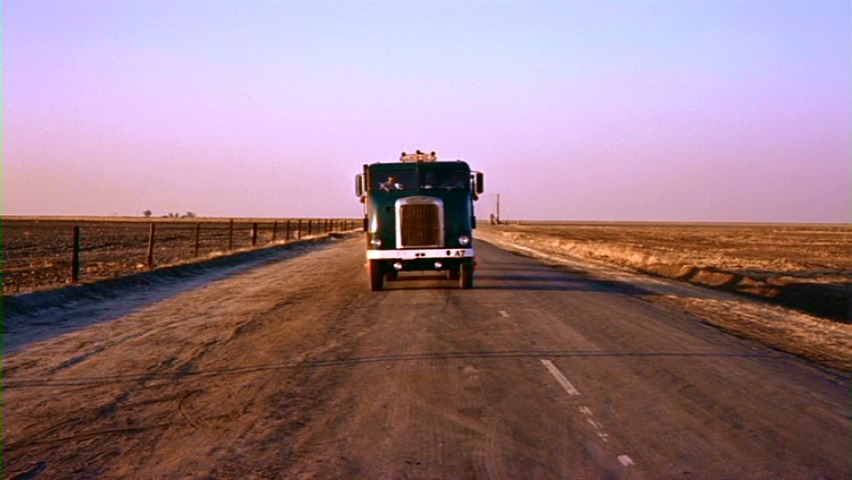
North by Northwest (directional lines invaded)

But the plane explosion marks the turning point - R.O.T (the "O" stands for "nothing") will play  the peevish lover. And then he'll even play dead (his very next role) from then on, be free of roles (except as 'himself,' since he's agreed to keep up the disguise of the undercover agent. In other words, once he assumes the mistaken identity, he validates the villain's previously wrong presumption). Just as Cary, if he'd been really that drunk and pointed downhill in his car headed towards a cliff SHOULD have gone over the side, and he should have been killed on the road. He's beginning to reverse the polarity. From now on - with the explosion of the plane - he's baptized in disillusionment - he's on the offensive.

North by Northwest (Grant loses equilibrium)
An earlier example of the gravitational distortion was lost for years thanks to the limitations of the small screen. Consider the scene in the precinct when a drunk Cary Grant is being led into night court at the local police station. Staggering around, the cop supporting him and leading him over to the bench. As he staggers to one side he sees another cop bend over to tie his shoe - and so Cary starts leaning over too, as if he presumes the bent over cop is actually standing up and it's Cary who is upside down! He's trying to compensate by turning his perspective upside down, not unlike how one might compensate for double vision by covering one eye. It's the sort of small detail Cary and Hitch just toss away -there's no cutesy musical quotes around it, no close-up of Cary's mugging face, and Bernard Herrmann is no Mickey Mouser --it's just folded in, a gift to notice only on the big VistaVision screen, or in the future, when TVs are wide and image as lustrous as brand new (2). 

Big faces...
By now our Thornhill is a master of corners, and screen traversement (North by Northwest)

I always loved North by Northwest, but some other big screen gems in the Hitch cannon---Vertigo and To Catch a Thief in particular--used to bore me senseless. With analog video's faded colors, the giant 70mm frame was cropped mercilessly, the long shots of San Francisco and the French Riviera seemed far away and dull, like something that might be shown by a grandparent some 7th grade social science teacher.

But then - seeing To Catch a Thief for the first time on Blu-ray, via my big HD 'deep black' home screen via a quality HD TV of decent size, digitally restored from a vivid VistaVision 70mm negative, was literally a revelation, as in a transformative religious experience. It was hardly the same film at all

To Catch a Thief - stills via DVDBeaver and 1000 Frames of Hitchcock
To Catch a Thief on VHS was a bore; on DVD it was okay; but on this remastered Blu-ray, man, it is one of the 'essential' vacation duplication movies in my roster. I watch it every winter on my 60-inch Sony Bravia and every summer on my 60-inch Sonia Bravia, and I feel like I'm there, having taken a running dive through my 60-inch Sony Bravia into the sunny waters of a magical alternate France where everyone speaks English and I can roll with a sunbaked Cary Grant in that crazy gray sweater and red cravat combination as he gingerly avoids Grace Kelly's smoldering but weirdly child-like perversity, as well as that annoying little scamp Brigitte Auber (1). We all know the one he should have hooked up with is Grace's badass mother [Jessie Rose Landis] but such was the way of the world... sigh.

The ending with all the stuffy period costumes and the dissolves through the long, endless dancing, gets a bit draggy even so. Endless lords and ladies all gussied up like you keep hoping for Cary's old gang to stop catering and dress like revolting peasants and guillotine the lot. But the slow leisurely pace is far less grating on a big beautiful Blu-ray where the colors of every flower pops and makes a personal connection so deep you can smell the roses, and taste Grace Kelly's expensive lipstick. All in all, it really gives you the symptoms of what it's like to cater an event like that, or play in the band, or DJ: the endless standing around, waiting to go home, the fantasy of being able to take your shoes off, prop 'em up on the coffee table, and watch old Universal horror movies while drinking til dawn. That fantasy of inevitable delight is here well-visualized by Cary's hair-raising rooftop chase,  bathed in intoxicating greens, making full use of VistaVision's harrowing downward plunges.

To Catch a Thief
Speaking of GraceKelly, I used to have the same problems (faded colors, pan and scan, etc) with Hitch's Rear Window (1954). I used to (i.e. since taping it around age 14) wince at the notion that this elderly anemic hobbled little gray-haired apple-haired gray-cheeked 'decent' all-American schmuck Jimmy Stewart kept trying to talk super rich hottie Grace Kelly out of dating him, ranting about the rough and tumble life a globe-trotting photographer, and that she'd have to tag along with him on his journeys, as if wives accompanied soldiers into battle, like they were handcuffed together. I felt like Grace Kelly was really slumming, dealing with old gramps here, when in other movies she was picking the far more worthy Cary Grant. Why on earth would she be courting this geriatric homebody artiste-type and why would he be insane to try to talk her out of it?

I would watch this film frequently for I had it on the same tape that had Never Give a Sucker an Even Break (1941), Naturally, I'd compare them, and imagine what Bill Fields--who was willing to marry the loaded Mrs. Hemoglobin (the ever-imperious Margaret Dumont) in order to put a nest under his little niece Gloria Jean--would think of Jimmy's reticence. Sir, you impugn this lady's austere character!

But time makes fools of us all, and I ended up feeling semi-trapped too in a similar relationship, from 2003-07--she an uptown successful professional girl who loved make-up and Diana Von Furstenburg dresses and all the finer things, etc. So I 'grew' into understanding LB's reticence and now, on the big screen, or via high quality Blu-ray Sony Bravia or whatever, I can get the effect of uncanny sexual fear generated by Grace's heedless adoration and that it's totally intentional. On the small screen she was beguiling - but on VistaVision, looming over sleepy LB Jeffries, 30 feet tall, looming above the audience she's like a combination Vogue cover and the Angel of Death about to sweep over a battlefield.

any similarity to Raymond Burr is purely subliminal (Rear Window)
 Hitch frames her as a vampire appearing out of the darkness; Stewart below her, shadowed, crippled, shriveled, semi-asleep (symbolically neutered) and somewhat fear-frozen. Her sheer proximity on a 70mm super-tall movie screen, face right up in extreme close-up, like a gigantic devouring vampire giantess beaming down lovingly but hungrily at a child she's about to drain, and us in the audience, and I can relate - a feeling like being tickled or looking down from a very high structure (!)

The Gigantic space-invading Mother Moab (Rear Window)


The best he can do to dissuade her is to rant about elephants and dusty African safaris, as if every wife had to accompany every travel photographer on every sojourn, when in reality, it's clearly the reverse. She's ready for the jungle - it is he who dreads her world. He dreads being trotted out to the opera and being bored at glib advertising parties, charity balls, and who can blame him?)

The other main benefit of the big screen Blu-ray 70mm enhancement of course is the clarity of the window boxes, the other apartments across the courtyard. On the small TV they were visible but unimpressive. But... Imagine you're seeing them on the big VistaVision screen: the figures in the small boxed windows approximately the size of you, in the audience looking up, as if you're snooping on real apartments across from the screen, like if you vaulted out of your chair you could land right in that hottie's window. In the reverse direction, there's Grace Kelly moving out of her moab-size 'immediacy' in LB's apartment, climbing up into the apartment of the suspect, a parallel to your own 'entering' the 3D massiveness of the screen -- like she crept out of the film and into the audience, or the reverse. Suddenly there's no difference, and it's spooky.

Climb on up and rescue the red-headed damsel (even in the 1950s, uptown NYC spinster/divorcees preferred short red hair.)
With this enhanced added effect, the dramas in the windows have a new added sense of lost beauty that is is, when the rain falls or the night is late, clearly indebted to the paintings of Edward Hopper. The above scene of "Miss Lonelyhearts" eating alone, for example, is so sad because she's unaware of our empathy (and is too dumb to just take off her fancy clothes, put her feet up, crack open a bottle of wine and some ice cream, and watch TV all night, like a real American). We can't reach her but she's there, framed expertly in the golden Hopper light against the ominous darkness. In earlier versions, even the older DVD, she was still far away - like a tiny newspaper illustration, with Jeff the life size character.. But now, in glorious deep black HD, we can step into these far away windows as well as Jeff's apartment. We don't see Jeffery as much as see through him - we're as trapped as he is (him by his own leg in a cast; us by the legs of those closer to the aisle in our row) and his gaze is ever shrinking into these far away windows. The more you look at these people in these little dioramas, the more your vision shrinks to tunnel focus, like cell phone addiction - so the larger real world becomes terrifyingly large.

Thorwald exits the frames; enters theater / Stewart's domain (Rear Window) like the truck in North by Northwest
So when the threat--the imposingly Nordic-named Lars Thorwald (Burr)--finally seeks him out and enters Jeff's apartment it's like he's a towering giant, an ogre. He's come out of the frame from the back, and worked his way around behind us in the theater, and he is gigantic. Jeff is like a frightened child menaced by a giant evil thug. He has in a sense now shrunk down to the size of one of his windows. He's become that which he spies on. (He can only pray someone across the way looks through his window). By now Jeff has become the total cinematic viewer stand-in, the type who hides in the dark and prefers to deal with reality through a small window rather than face the giant unruly beings like his girlfriend and this monstrous yet sympathetic figure. As a viewer it's unnerving because we can imagine being Thorwald as well as Jeff. We all hope we aren't being spied on from across the way; Jeff's only saved from being branded a stalker by his relative lack of focus, he's a restless channel flipper, whomever has their curtains open and is home is fair game. He's interested in Miss Torso (an intentionally grisly bit metonym) but not enough to get his blood up to a level that reassures Thelma Ritter.

another steep drop (Vertigo) and one of the first and only shots completely outside the apt
The sudden drop off from inside Jeff's apartment looking out to outside looking in is the next big moment after the sudden lack of window separation when Thorwald finally enters. In trying to throw him out the window, he's outed, literally, regarded by all the neighbors he spied on, rupturing the screen/audience barrier (and another steep drop - not as high but scary due to precarious leg healing (back to the bone mend drawing board and all that motionless for nothing - and again, the honeymoon must wait - isn't that in the end what Jeff was afraid of. Nothing like two broken legs as an excuse to not get bounced around),


Moving ahead --- to 2001 via 1968


This super clear, nearly-3D effect of the super 70mm clarity has other benefits, long forgotten after decades and decades of cropping, consider the wraparound giant screen of "Cinerama" and Kubrick's 2001: A SPACE ODYSSEY (1968). With its clarity enhanced, the colors restored via 70mm (or in this case 65) negative, at least Kubrick's stately stereo side framing strategies begin to make more sense, especially as we compare his angles and stillness or slow glacial movement with, say, How the West Was Won and other films shot for 'Cinerama,' and roadshow wrap-around screens, where, as I said, sudden cuts and big close-ups don't work well, just as the long static medium shots never worked well on cropped home screens.


(from top: How the West was Won (x2), 2001 (x3), This is Cinerama)
Consider the way the astronauts flank the porthole of the escape pod during HAL's lip-reading scene.) The 'pure' Cinerama of say This is Cinerama (below) isn't quite the same but as you can see, the 'fisheye' wraparound effect is largely the same in Kubrick's framing (HAL's fisheye lens vision being the perfect analogy to the wraparound effect). As the sides of the wraparound frame are invariably closer to the audience, and--ideally--nearly vanishing into their peripheral vision, it makes sense that they are invariably closer to the camera, larger, and the center of the action always in a kind of middle shot being slowly advanced towards. If you reverse it, and put a close-up in center frame and then distant background on either side, the fishbowl effect gets more pronounced, not unlike the reflections in the space helmet visors.
2001 was shot in Super Panavision 70, a process which involved principal photography on a 65mm wide, 5 sprocket hole high film frame (standard photography is on 35mm wide 4 sprocket hole high frame). This was projected back from a 70mm print, the extra 5mm being two 2.5 mm magnetic soundtrack strips "outboard" of the sprocket holes... In the original Cinerama installations, the film was projected on a deeply curved "louvered" screen which wrapped the image around the audience, sweeping them into the image. The Super Panavision version of Cinerama had an aspect ratio of 2.21:1 (the three-film and "rectified" Ultra Panavision versions of Cinerama were noticeably wider with an aspect ratio of 2.59:1). - Thomas E. Brown
Cinerama screen as background wall for moon shuttle - 2001
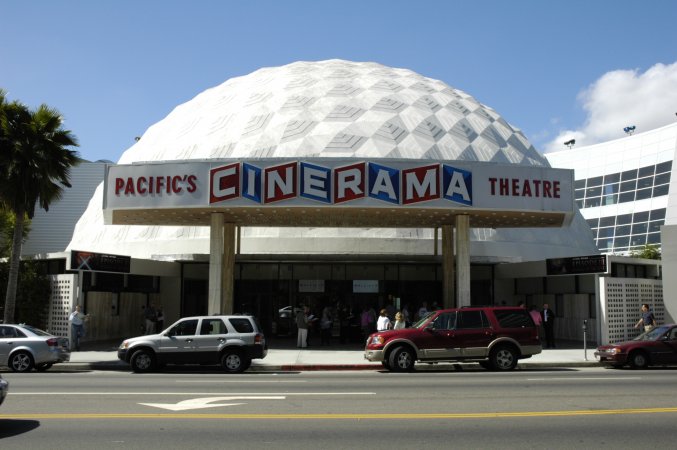
We see the Cinerama logo in 2001's end credits over and over, but never could have expected we'd benefit decades later. Could they have known back then we'd be reaping the benefits of that clarity in the 21st century from the comforts of our hovels? I bet Kubrick had an inkling. Certainly he fills the 2001: A SPACE ODYSSEY frame with reflections of wide home theater screens (above).

It explains so much about the boredom factor involved with 2001, as well as the travelogue nature of Vertigo and To Catch a Thief as discussed above. Quick edits and jarring close-ups in such gigantic formats would leave audiences dizzy and probably vomiting. Thus, in Kubrick's elegant compositions, we have images of stately wide shots with the focus of the action usually medium center and larger (close-up) images framing the sides and in the lower foreground that our eye can use somewhat like the edges of our peripheral vision. This gives viewers the immersive effect of being about halfway inside the screen, moving ever forward towards whatever is in the background center (the entirety of the film follows outward/upward movement - man's evolution as a steady outward stream of awareness, an ever-forward glacial gliding).

The early "Dawn of Man" scenes carry an--I'm sure intentional--Natural History Museum diorama vibe. Shot mostly on sets with the rocky ground ever on the bottom of the screen - 2001


The subtitle of the film "A Space Odyssey" makes more sense when considering this original wraparound 'event' presentation format. For 2001 is both more (way more) and somewhat less than the average 'thinking man's' sci-fi movie from the 60s (this being the age of Heston, and the Social Message). It's also evocative of one of those forty minute IMAX films shown in museums for a small additional ticket cost, about the history of balloon flight or African geese migration (the 2001 version being at a very forward-thinking planetarium). In other words, it is both a trippy narrative and covertly NASA-driven Cinerama spectacle. Years of seeing it in full frame have left it seeming merely glacial and Surely Important. But now, even if we're not seeing it in Cinerama, just knowing that it was meant to be seen that way helps contextualize the structuring of the frame and the slow, deliberate pacing.

We're not just watching a movie, man, we're on a goddamned ride. 


NOTES:
1. one of the few dislikable 'kid sister' characters in Hitch's ouevre - see Diane Baker in MARNIE 
2. if you noticed it already, on, say, a VHS tape or on normal analog TV, hats off! You're sharp.
--

Suggested Cont. Acidemic Related Readings:

SHINING Examples: Pupils in the Bathroom Mirror (from 10/11)


Friday, December 04, 2015

White Woman Waterloo: WEST OF SHANGHAI, JAMAICA INN, SKYSCRAPER SOULS


It's been my personal experience (and its obviously informed by Hollywood) that (single white, straight upper/middle class) European, Canadian, and South American women are, sexually-speaking how American (ala the USA) women are only on Halloween and New Year's Eve (unless they are outside US borders, or drunk), and if that makes no sense to you then you never noticed how in Guys and Dolls Jean Simmons is a quintessentially American girl, dumb enough to initially cut handsome Brando loose since he's not exactly the square dude she's fantasized about as a child, yet she's able to loosen up with a drink in her system and her system in Cuba --a double permissive whammy. South American and European women tend to date who they like, and like sex, so it's more musical chairs than hunger artist. They do not view their sexual ballot as some kind of swing state vote for the checklist of male traits they condone. They fool around without guilt or shame, the 'walk of shame' concept is itself offensive to them in its puritan connotations. And they don't need the mutually agreed on bacchanals of uptight USA single girls, New Year's and Halloween, to let loose.

Non-American women know that if Brando's gambling addiction doesn't meet their expectation of good Sky Masterin' then that's their problem, not MGM's and not Skye's. For European and South American women (a sweeping generalization I know, forgive me) the idea of sexual behavior not 'counting' on certain nights or under certain moons, seems like an infantile workaround of a distinctly Puritan problem. What are American women --in films and in NYC in trendier circles of dating particularly--waiting for? Do they so believe the ads and code-enforced mores their heads are saturated with that they feel they must hold out for Mr. Right? Do they really believe in princes with lots of money and no vices just waiting for them to round the corner, waiting to say 'thank god you waited.'? 

The question pre-code (and post-code sometimes) Hollywood loves to ask though, remains: Why are dull-as-dishwater Christian-mingling "white women" from the USA so highly prized amongst "the Orientals" (sic) --when it's so clear that white American straight Christian (missionary) women are shallow, self-entitled and sanctimonious and as 'locked up' in their nether regions as Fort Knox? Who do they think they're fooling? 

The answer to this mystery is so vile only the lewdest of prude censors can even imagine it. As the well-laid writers amuse themselves tying sexually embittered censors up in knots with these miscegenation fantasias and did they-or-didn't they fade outs on mid-afternoon naps, getting away with murder in the margins by conjuring llewd Chinese slavers under every innocent cherry blossom Stanwyck wafts by, A parade of gibbering slavering stereotype foreign men traipse past the windows of our innocent missionary figures. Beautiful Asian odalisques abound, but even the boxiest of sexless white woman is to die for. She beats them all! Is it because her repressed id/sexuality is so bottled up the only way she can uncork is via some loathsome heathen having his way by force? Is that what the censors think? 

This missionary's wife, then, becomes the censor stand-in, a figure MGM supposes is worthy of lionization and trust, but the writers conjuring her sneer at even while filling her ample diaphragm with florid dialogue. The result? A whole new front of masochism, since Hollywood demands the heathens die for the sin of even trying to bust a move. Even played--as they inevitably are--by a white man, a single kiss on a white girl's lips will topple an empire, or cause riots south of the Mason-Dixon line.

By which I mean, TCM recently showed the always alluring and shockingly racist (it gets more odious and racist with every passing year of dawning social awareness), Mask of Fu Manchu (1932) and also West of Shanghai, (1937) a film I'd never seen thanks to mediocre ratings and its post-code date, but actually it's much better at linear momentum and minutiae than the more glossily ornate and sexier, but dumber Manchu. It's even more racist, and sexist, and raunchier! No Myrna Loy though. It's still a pisser.

 Even if, like old Bitter Tea of General Yen (1933), West turns out rather like Houdini drowning in a vat of water while trying to wrestle loose from the handcuffs of racist censorship, it's got a few tricks marking it different: there's a slightly gay twist courtesy the resolutely unappealing and boxy dyke vibe of the missionary object of everyone's obsession, Jane Creed (Beverly Roberts); repeated fake-out firing-squad based tests of homoerotic male bonding between General Fang (Karloff) and the dashing wildcatter Jim Hallet (Gordon Oliver); big business intricacies (business deals with revolutionaries are worthless if they don't win, and even if they do since even business laws my be temporarily subject to --heh heh--
"interpretation" during wartime); and a zig-zagging first half ripe with good screenwriting.

In some ways, it fakes out our narrative expectations better than a Tarantino movie. In the beginning it seems like it's going to be the post-code Shanghai Express:e there's the Chinese Civil War backdrop, and disparate first class passengers saying their station farewells, boarding the train and settling into compartments. We wonder what plots will cohere as the voyage is underway; will there be something about the duplicitously jolly interrelation between foreclosing banker Douglas Wood, his somewhat attractive adult daughter Lola (Sheila Bromley), and Ricardo Cortez's big oil man Gordon Creed (shades of General Died at Dawn)? But nothing stays predictable, besides the confusion of war.  The train is rerouted and suddenly they're all heading out to Jim Hallet's discovery field in the titular direction, getting accidentally caught between Karloff's existential warlord Wu Yen Fang and the well-intended but stretched-thin Chinese army (Bitter Tea of General Yen). We soon learn Creed isn't just heading west to get Hallet's oil but also visit his boxy missionary wife Jane (Roberts), who's in love with Hallet -though Hallet only has eyes for oil. Creed doesn't want her back, understandably, for a more dour and sexless thing in all of China one may not find, but damned if he's going to give her up to Hallet... unless the do a lil deal, of course. Then they're all in bed... together. 

The foreclosing banker's daughter likes Jim Hallet too, and is the better bet, in my opinion, but hey, each according to his own closeted tastes. Karloff's rebel General Fang may want them all anyway and seems most in the position to get them. He starts with Jane, using a slow boil seduction strategy that occurs over real time until we're invited to feel her mix of excitement, dread, and curiosity. How is he going to bust his move? Whatever it is, it's going to be fast, strange and unstoppable once it starts.

He's a real practiced Romeo is our Fang. Sensory bewitchment ala the "Oriental" decor, incense, music, and Fang's practiced tact makes it pretty clear that all Jane will have to do is not scream or run and she'll be in bed with an Asian by the end of the night. Accorded A-number one mistress status on account of her white skin, she'll probably be dumped off at some Peking brothel once her bloom fades, or when he finally realizes she hasn't one to begin with, it was just the novelty of her race. Gorgeous Asian women are a dime a dozen it seems, while boxy, repressed white chicks are apparently more precious than mountains of jade. 

This may be perhaps just a grass-is-greener thing, but I always wonder how long these women would stay so valuable if they weren't so damned racist, or if the censor demographic (the kind of old broads who drag Joel McCrea to that wheezy triple feature in Sullivan Travels) suddenly all dropped acid and had an orgy. But maybe it's a fantasia they cultivate through their own frigidity? Either way it's intricate business for an allegedly lurid and exciting slice of adventure hokum.

Karloff plays his general like a weird mix of Charlie Chan and Willie Fung with just the right amount of General Died at Dawn's Akim Tamiroff-style poker faced existential brinksmanship to keep it all from collapsing into high camp. As with Fu Manchu, it's Boris at half-sail but still Boris, so wondrous to behold. His Fang is subtle, sure, light-hearted and infinitely bemused, especially compared to Warner Oland's similar role in Shanghai Express, and Nils Asther's in Bitter Tea of General Yen (both 1932)

Once could read them all as racist caricatures, but that would be narrow-minded itself. The missionary men in the women's lives don't come off much better. Most all the white characters act like hungover brats, reeking of white privilege and colonialist entitlement. At least the generals have some keen interest in displays of macho honor rather than in just pompous rank and skin color displays. For them, the measure of man is not based on skin color and social position, but how calmly he stands up to the intensity of a firing squad, or torture. If his hand isn't shaking when he lights his last cigarette, if he refuses the blindfold, and if he pontificates in typically post-WWI sardonic hipster élan about death instead of pleading like a weak-livered carpetbagger, then he's (or she's) earned respect. For a world still collectively PTSD-stricken. casual ambivalence about facing a firing squad is such a righteous mark of cool it's worth betraying your country just to get the chance. When a woman earns that same respect, ala Shanghai Lilly ("I believe a word of honor would mean something coming from you") she's elevated far above the merely ornamental HTG status of their peers.

Another reason I veddy much like West of Shanghai: despite the pidgin English, the Asian characters are actually far more complex than the whites, and (Karloff aside) played by actual Asians for a change. As Fang's #1 henchman Chester Gan brings streetwise cool to the role of an ex-pat Chicago gangster who speaks in hep cat slang; Richard Loo (the conductor on Shanghai Express) is the portly officer who christens the feisty Jane 'Little Dragon' after she takes umbrage with the way he distractedly bats her around; as a nationalist general who's killed on the train in the opening reels, Japanese actor Tetsu Komai as the decent, stately general who bonds with Gordon Creed early on. Steadied and eloquent, hes speaks in such a succinct, polite and honest style of English, clearly indicating it's a second language as spoken by an educated and intelligent person. Such a rarity it seems like he stepped in from a much realer, saner world) Happy to be in the company of so many white people he doesn't know in his first class car (they're more trustworthy than his scheming soldiers --he says), his polite dignity sets an early high water mark for dialogue and characterization that no other character in the film ever matches. His early death leaves a sad mark, as if the potential for a happy resolution for this conflict and for a much better film, is not to happen. It's a bummer and it's meant to be, for war is like that.  

The white set of passengers by contrast--white missionaries and wildcatter capitalists--are as a whole painted rather crudely. In their haughty colonialist arrogance they view the brutal civil war strife going on around them as just another Chinese excuse for slow room service. This is particularly well-drawn in the scene between Jane and Fang (Karloff) after Oliver is hauled off to the brig for punching a guard (in defending the lady's honor).

 Though Fang is seductive and charming in that seduction scene I started to mention, I should wind my way back to the frightening indication--beyond any racist simplification, that there's the clear indication she's bereft of alternatives, other than suicide or murder (via the pistol he's left on the table). "If I want," Fang says, "I take you. It veddy easy." The scene is rather chilling, and we feel the protean echo of the violent savaging women were enduring in mainland China at this approximate time (1937) at the hands of the Japanese Army.  The only way out of it is for our Androcles Oliver escapes his captors and rushes to the rescue where he's recognized by Fang for a thorn-out-the-paw favor he did back when Fang was just a wounded nobody rebel. "Phew!'

It's a pretty stilted resolution, but we're glad to be spared any further dismay over why such a slick operator would be attracted to this boxy blank broad, grateful she won't be assaulted, and grateful we can spend the rest of the film enjoying the the weird head games Fang employs as he runs along a silken edge betwixt outright menace, Solomon-style problem solving amidst his ranks and prisoners, and enough macho existential last cigarette firing squad-style coot to earn him a ladder rung between Dietrich's wiping away the young corporal's tears with the offered blindfold at the end of 1932's Dishonored (see: Decadence Lost) and Walken's "one shot" at the end of 1978's The Deer Hunter.  


SKYSCRAPER SOULS 
(1933) Dir. Edgar Selwyn
***1/3 

"A man and a wife should never live in the same house," Warren William says to his expensive absentee spouse Hedda Hopper (she comes to town only to snap $100K checks from his fingers like AA tokens). Indeed, William avoids houses altogether, living above where he works and mixing business and pleasure so seamlessly together all distinction ceases. A tycoon of towering ambition and ruthlessness, William's big ambition is a skyscraper monument to his own ego, one that dwarfs the Empire State. But. as so often happens, especially in Warren's Warner Bros. pre-codes, a white woman gonna lay him as low. Skycraper follows the blueprint of high-test William vehicles like Employee's Entrance and The Mouthpiece, mixing his brand of infectious big business wolfishness with a Little Red Riding Hood secretary or client naif waterloo as counterpoint. He falls for her and ends up going straight... usually to jail or the morgue. He can scale capitalism's summit in a bounding leap, but flash some naive integrity his way and he's in over his head. The naif here is Maureen O'Sullivan at the height of her sparkling gamin loveliness. She lays us low, just watching her climb drunkenly into his bed. Veree Teasdale, as Williams' mistress and personal assistant, is both jealous and protective of this young innocent (she runs the secretarial pool). As with all the best William films, the last chunk might be ham-handed kowtows to bumpkin decency, but the first swath is pure giddy carnal Mr. Wolf's wild ride. Usually that means an uninterrupted stretch of 'real time' at Williams' side during office hours. This time we see him problem solving and merrily bull-charging through a steady stream of assistants, clients, bankers, lovers, and the wife, all while still in his robe upstairs in his apartment: finagling investors is done in the lower level steam bath; appeasing the foreclosing bankers (after he 'borrowed' thirty million from the kitty) is done upstairs in his office; accruing endomorphic industry titan Norton (George Barbier) as a partner is done in a booze-and-babe-stocked penthouse. It all flows from day to early morning in a seamless pre-code rush. The practiced ease with which the great William lies and connives his way out of appointments with two different mistresses in order to seduce O'Sullivan, first telling her to stay late downstairs at the office and type a second copy of some report he doesn't need, then plying her with champagne upstairs--only to have her hang onto the less intimidating jolly old prospective client Norton!

Hmmm.... one can't just cockblock a desired investor outright, but that doesn't stop a big bad wolf like William. Just means he has to be extra conniving...


Feeling as if it's unfolding in total real time from the moment we see the peak-of-pixiedom Maureen (that sexy frock at left rivaling her deerskin Tarzan and his Mate) in the workday afternoon all the way through to him walking her out of the building in the early dawn, his catch-and-release seduction is so pure pre-code, so truly sophisticated and lecherous it rivals only a similar film (clearly a blueprint for this one), The Mouthpiece.

ALAS, this isn't Warners, this is MGM, so these reels of seamless business-during-pleasure fusion are offset by a lame working class romance in the lobby coffee shop and elevator, i.e.. the usual MGM bow to the sort of provincial moralism and hick sentiment that scrappy Warner Brothers or champagne and opium Paramount had expunged from their psyches when they moved into the sound age. 

In this case the 'decent guy' after O'Sullivan down in the lobby is a pushy little adenoidal mouth breather played by Norman Foster. One of the most annoyingly 'romantic' Madison Avenue-style ground floor lovers ever (an antecedent to Elliot Reid in Gentlemen Prefer Blondes) he's a type that's thankfully disappeared long ago from the national register of romantic male archetypes: the smug, overbearing ad man, pipe in mouth, granting himself the innate right to annoy cute girls at their place of work. This would only be tolerable if he wound up arrested, served with a restraining order, or barred from the building, but his overbearing come-ons actually work on Maureen, which seems to condone boorish stalker behavior in a very unhealthy way (1). He actually stopped me from watching the rest of the movie on two separate occasions. Thank God I finally just realized I could FF past his scenes without missing a goddamn thing (though even I don't like to see his life's savings lost in stock rush boondoggle).

The rest of the 'vertical Grand Hotel'-ish cast includes Jean Hersholt as a Jewish (vot else?) fashion designer smitten by one of his 'party girl' models (Anita Page). At least he's smart enough to not lose every cent of his money in the same boondoggle that wipes out Foster.

Guess who makes a killing on that same boondoggle? Damn right.

JAMAICA INN
(1939) Dir. Alfred Hitchcock
****

Our final oversize capitalist brinksmanship-swindler torpedoed by an innocent white girl gamin is the great Charles Laughton in Hitchcock's unjustly sidelined JAMAICA INN (1939). Cursed with decades of terribly murky prints, it was hard to tolerate no matter how stout the Hitchcock seafarer, that is... until last week when it showed up on TCM finally looking drop dead gorgeous in a cleaned-up new HD deep black transfer which made me instantly forget the dismally depressing time I had trying to watch it on public domain VHS over the last few decades. This new transfer is so good, by jove, I've changed my whole costume drama tune (I used to hit 'stop' at the first sight of petticoats, tricornered hats or powdered wigs, 'ceptin on rare occasions as it were, sonny). It looked so good on TCM that I put the Cohen BFI Blu-ray on my bleedin' Xmas wish list and started shouting "Chadwick!" in a worshipful impression of Charles Laughton as the British gentry/local constable. Unfolding over a few dark nights, set on a big tract of foreboding moors and cliffs along the windswept Irish (?) coast near the titular inn (a more Gothically delicious set-up you'll never find), it's basically yet another tale of an innocent beauty bringing her antiquated morality to bear upon a scene in which she is but a tourist and in the process felling some smitten tyrant or other, but it's far different in tone than the other two in this list. The wreckers at work here are genuinely evil--a truly murderous bunch of cretins--and in this case the beauty is a very young Maureen O'Hara in her first film. Who wouldn't choose to topple?

 
The stormy adventure eventually coheres into an extended thrilling chase as Maureen is pursued all over the adjoining properties, sea caverns, roofs, mansions, hills and dales, providing a fine example of Hitchcock's ever-evolving flair for  comedically-leavened suspense. What I remember most though is the genuinely fine mix of unique character actors as the wrecking crew, so full of rich slangy elocution and colloquial dialogue they rival of the unsavory crew of MGM"s 1935 classic Treasure Island (a personal favorite), none more than the crazy-eyed and haired Leslie Banks as Maureen's uncle-in-law. And, as might be supposed, Laughton--sneakily oscillating between gluttonous British lord swagger and conniving, homicidal greed--is at his nimblest, toying with O'Hara and the role as if a cat eager to make a mouse continually think it's almost gotten away. And for her part it soon cuts both ways: initially letting her woman's trust in signifiers of paternal power get the better of her, she comes around when it counts. Plucky, warm, brave, going to any length to save lives, even that of the no-good uncle-in-law (Banks) on account of her devoted aunt (Marie Ney), she practically leaps off the page of the screen, a fiction heroine of our imagination come to robust life. Now that there's a restoration wherein we can savor the beauty of the coastline and the deep horror film / mischief-night ambience, the dirty faces of the wreckers and the shadowy corners of the rooms, Hitchcock's Jamaica Inn has become a sploshing wave of thrilling old dark inn suspense, lovers-on-the-run mystery, colorful black comedy, and ripping action - jolly good show. And--what's this here? Could it be? Robert Newton is the romantic hero? Well strike me colors and call me ChadWICK!


NOTES:
1. see CinemArchetype 2: The Skeevy Boyfriend.
2. My father always said he originally wanted to name me Chadwick, but my mom stopped him.

Monday, August 01, 2011

Without a Slur: STAR OF MIDNIGHT (1935)


For any true classic alcoholic movie lover, Nick Charles, as played by William Powell, embodies the dream of being able to drink heroically while always remaining competent, coherent, and witty. Sadly, few of us have managed it in real life: sooner or later the drinks catch up to us, and forget about murders, we're lucky if we can solve the mystery of where our pants are or whose couch we're waking up on and what time it is. But Powell's Nick Charles, no matter howmennydrinksh he has, stays lucid, in control. Even if he slurs on occasion he can still spot even the tiniest slip-ups of well-concealed murderers. And Myrna Loy as Mrs. Charles doesn't bat an eye when her husband pops open the bedroom bar in the wee hours of the night. She merely raises a bemused eyebrow when he shoots out a window on Christmas morning with his toy gun present. She finds out he's already had five martinis, so orders five of her own instead of browbeating him. What a gal!

Bu the chemistry of Powell and Loy / Nick and Nora was something strictly from the land of genius drunk Dashiell Hammett. They were the happily ever-after of all the cool detectives who fall in love with their rich client's sexy 'good' daughters, thus eventually inheriting the family fortune. It helped their high-functioning, co-dependent cause that they started the series already married. In the post-code world, girls cared only about getting that ring on their finger, and if their man liked to drink, the 'comedy' came from making him stop before the bitchy mother-in-law moved in with her rolling pin and stern glowers.


And the success of the THIN MAN movies was something anyone who could afford to rent William Powell from MGM wanted to duplicate, even if they couldn't get Myrna Loy for his co-star. Of one example, STAR OF MIDNIGHT, Classic Movie Ramblings' Dfordoom notes "The plot is fiendishly complicated, perhaps even too complicated, but these sorts of 30s mysteries rely mostly on style, witty dialogue and classy acting so it doesn’t do to get too stressed out about following every one of the countless plot twists." And I'm glad he notes that because I used to use to go to sleep watching this film on a blurry VHS back in the 1990s, when my drinking was at its most Wagnerian. With its rambling, dull plot, the film knocked me out like a feather with a Harpo crowbar behind it. Only now, after 35 viewings, can I actually follow most of it. As for rapport, I even prefer even the breezy B-movie bonding between Tom Conway and his various lady taxi drivers in the Falcon films to Powell's futile attempts to be scintillating with Rogers' clothes horse post-code buzzkill.

As a point of conversation, however, STAR OF MIDNIGHT is an invaluable window into an alternate cinema universe that imagines a sadder-than-Pottersville alternate cine-reality, wherein Nick and Nora had never met, and Nick had instead become a lawyer and hung out with a post-code Ginger Rogers, i.e. vivacious, gorgeous, stylish, yet hammered into the common post-code frilly mold of a suffocatingly nurturing, marriage-minded champion of moral sobriety. In fact, her attitude and acting seem to bitchily satirize Powell's true cinematic love, Loy, as the Ludivico technique's Chase Kahn points out: "(Rogers) mocks the gaudy glamor and comedic timing of Myrna Loy, even scrunching her face at a sly comment... Well, Ginger, that kind of mocking only works if you're superior to the thing you're mocking! If not, it just scans as bitter jealousy.

And worse, she's incompetent even as a harridan micro-manager: when she finds out Powell's been shot (just grazed), she freaks out to the point where he has to snap at her: "Hey, it's my wound!" You can't imagine Nora ever being so overbearing, no matter how many humiliating situations and castration-symbolizing hats and hairdos she was forced into by the post-code Better Home and Gardens gestapo. In THE THIN MAN, when Nick was similarly shot (just grazed), Myrna Loy's response was touching --she was really scared for a moment--and her womanly concern was understandable; "I'm just... used to you, that's all." She gives him a drink; Rogers tries to give him a hot bath--a terrible idea for a flesh wound--and Powell is more or less forced to kick her out just to drink in peace. And when Rogers does finally pour him a drink, she measures it out with an eye dropper. Is that supposed to be funny, you bitch? Bitch, I'll KILL YOU!!

In short, without Loy, this MIDNIGHT can only remind us of the lonely feeling of being stuck in a relationship with someone who desperately wants us for a life partner but only after they've changed us to their and their mothers' liking, and we have no better offers at the moment, no pressing engagements, and we're too drunk and/or lazy and/or weak-willed to resist except in token increments.

This is certainly borne out in the late night presence of murder suspect Vivien Oakland (left) as one of Powell's former lovers, who bursts in to get information, stays to flirt, and forces Powell to give the old "what's done is done, lets just be friends" speech (later it turns out she's slept with half the other suspects). Oakland's matronly carriage offers subtle insight into this beaten-down Powell's weakness for low-hanging-fruit, as she clearly didn't seduce him with her lithesome beauty, sporting instead a Margaret Dumont-ish height and imperiousness (she was in a lot of Laurel and Hardy films, pie-faced, no doubt).


And that's the thing.... poor William Powell seems so lost and sad in this RKO alternate reality (he was on loan from MGM), it's as if he had no one to eat lunch with between takes and was afraid to ask even where the commissary was. Jean Paul Belmondo seemed similarly alone and adrift in PIERROT LE FOU, knowing he could never compete with the camera for Anna Karina's affections, so too Powell seems alone and adrift in STAR. Ginger nags about his lack of interest in marriage--answering her own question via her incessant hammering-- but he's too sorrowful and bewildered to resist much longer. He needs to cheat or something, or get a crowbar to pry her off him. Or hop on an outgoing freighter, suddenly and without leaving a forwarding address.

Meanwhile at least two people in the murder mystery are never even seen and a lot of the action takes place off camera. What we get instead are those suffocating post-code 'domesticities.' We come to know in great detail every domestic breakfast in Powell's chambers and where Rogers slept that night (in the butler's room) so the censors can relax. There's lot of virginal white bouquets around and if someone's going to get semi-naked and take a shower under a police grilling it's going to have to be Powell and not Ginger. In fact Powell's so pussywhipped the butler has to practically prod him into drinking with any kind of heroic gusto. STAR OF MIDNIGHT indeed! Rogers all but enforces a nine o'clock curfew.

The big eerie possibility might be, and I dread saying it, that this mismatched pair are truly in love, and that's why they put up with this draggy repulsion. Sometimes the only way your friends know you've finally found love is when you seem happy in your despair and by contrast your old joviality and free-wheeling bachelorhood seems, in hindsight, forced and a little desperate, as if you had to keep the drinks and murder clues going full throttle lest your shaking hands, slurred speech and total loss of coordination drag you down to that same old ledge, like VERTIGO's Jimmy Stewart, fighting against the tediously life-affirming gravity vortex that is marriage... to Midge. Good old...

Friday, October 08, 2010

Keep watching THE FOG (1980)


THE FOG's location setting of Antonio Bay is right up there with Bodega Bay (of THE BIRDS, top, 2nd down) as an example of the Northern California coastline providing the ideal setting for mass non-human invasion. Elements of Hitchcock's THE BIRDS (1963) refract all through THE FOG: the unmanned pump leaking gas into the street, the collecting of survivors in a local tavern, and the matriarchal infrastructure that dominates the main characters (Bodega Bay is even referenced in the dialogue; and several of the scenes are filmed in the same wharf).

Note the resemblance between the respective shot of Suzanne Pleshette and Adrienne Barbeau above! (I'm so madly in love with that dark hair, dark red color combination) and the weird fissures of inter-relationship twixt the two films: Hitchcock's PSYCHO star Janet Leigh as the the mayor of Antonio Bay, mirroring Jessica Tandy as the queen bee in THE BIRDS; Nancy Loomis as the mayor's perky sarcastic assistant mirrors Veronica Cartwright as the little Brenner girl. Leigh's real-life daughter Jamie Lee Curtis is the visitor/interloper who seems to bring the destruction with her, ala Melanie Daniels (Tippi Hedren). But none of these similarities draw attention to themselves the way a Brian De Palma film would. It's subtle.


Even without birds or avenging ghosts, Northern California's coastline highway is the perfect setting for a spooky story -- each little town isolated connected only by a small, winding road and shrouded in the mist and dark against windswept rocks looking out to a spooky, uninviting Pacific. With a simple, ominous synthesizer refrain, Carpenter makes an empty beach in daytime into something genuinely eerie. He knows when something's spooky enough on its own, when less is more - and to create a feeling of forlorn dread rolling slowly in from the sea all he needs a note or two on the synthesizer and a row of fog horns along a deserted beach. All the protagonists are hip enough, for the most part, to know when to just run rather than say stupid things like: "You stay here, I'm going to go check out that noise." Or "it must have been your imagination," even as half the people they know have been murdered in the same week. They don't have to yell at each other how this stuff "can't be happening." They just accept the weirdness as a given. It was the 1970s after all, and Northern California. If the weirdness is to be accepted anywhere, it's there, then... when things had a chance to be weird and casual right there even in the small fishing villages.

John Houseman in a seafaring cap, for example, opens the film telling campfire ghost story to a group of children, suffusing the tale with concise solemnity ala his work in THE PAPER CHASE; the camera pans up from the fire to the sea behind them and onward into the coolest credit sequence in horror film history: no music except the jazz on the radio, just weird sound effects and strange electrical shit happening all over the town between midnight and one o-clock; Adrienne Barbeau's husky DJ voice coming through the fog, the warm glow of radios mysteriously humming to life: "It's Stevie Wayne and I'll be keeping you warm through the midnight hour," playing vintage (i.e. royalty free library jazz) music.... oh my yeah.

Meanwhile, Carpenter's camera plays off the POV ideas in HALLOWEEN, but much more mysteriously. We don't know who in the story-- if anyone-- is 'seeing' what we are seeing: deserted stretches of town at night, souvenir shot glasses and key chains rumbling in the gas station convenience store; mysterious knocks at the doors of sleeping people who get up to answer as the fog rolls up; all between the hour of 12 and one AM... music rising warm and eerie from the turned-on radios, Stevie's sexy rasp-- the counter-irritant to the feeling of menace--carrying its cozy benevolent charge -- who is she talking to, if the radio is on and no one is listening? Soothing and maternally sexy as she may sound, Wayne's voice floating around with no one to hear carries a charge of ghostly Lynchian-style "no hay banda" audio mimesis.

The movie is ample proof that everything you need to make a horror movie is right there, in the dark. Like Val Lewton, Carpenter knows how to use the night and shadow. If you've ever been outside alone in the dark, on mischief night with a few friends, dressed all in black, armed with toilet paper and soap, hiding and still and alert behind shrubbery as a friend runs up and rings the doorbell then runs off, like your ears and eyes are plugged into the night itself, then you might get as I did a shiver of uncanny Halloween recognition:


Horror iconography is a fickle and strange mistress. Some little motifs get picked up and used ad nauseum and Carpenter invented a lot of them: the killer who falls but isn't dead, the slow thump thump of a knock at the door, the killer's face in the window when the person's not looking, but luckily Carpenter's an inventor not a follower, and his inspired use of a sexy husky voiced female DJ alone in a lighthouse broadcasting booth, looking out over the water and having an on-air freakout about the glowing fog moving in and pleading for someone to rescue her son "trapped in the fog" is totally inspired and hasn't really been turned into a cliche by lesser hands in the years that followed, so it still has a creepy cool charge all its own.  Barbeau's DJ mom has roots in the lighthouse keepers of horror past, such as in the famous Arch Obler Lights Out radio show, "Three Skeleton Key," or the two salts ("What I love are the ballads") in BEAST FROM 20,000 FATHOMS, but the update of making the lighthouse keeper a sexy single parent DJ from Chicago, moving out there to get free of the grind and a lousy husband, breaks free from convention. She's tough, but alone, and when she coos into the night "It's 12:43 and I got four in a row for ya, right here on KBB," you feel both comforted by her voice and worried for her soft flesh aglow in blue soundboard reflections, alone up against the sea like the last bastion of humanity; the drowsy generic soft jazz she plays perfect background music, just soothing enough to almost dispel the boogeymen, but impossible to lose yourself, to escape in.

In Carpenter's hands, a shot of a kid running along a deserted beach with just howling wind and surf on the soundtrack is suddenly very scary and forlorn. Or my favorite shot is a long shot of Barbeau walking down a set of winding steps to the sea in early afternoon, preparing to DJ all alone in her lighthouse, isolated, yet strangely protected by the power of magnetic tape. It's one of my favorite scenes in the film and nothing happens: no music, just the sound of the wind and her tape of radio tags, "This is KBB, your voice for Antonio Bay!" over and over, in different vocal styles with different music coming out of her portable tape recorder. Barbeau even makes being a mom driving to work in an bright orange Kubelwagen with big hair and big sunglasses seem cool. She's her own girl, no mix of cliche'd mom SUV stuff, or hot Jaguar-driving cougar stuff, just Adrienne... It took me many viewings to even notice details like the way the driftwood switches from saying "Dane" to "6 must die" when it catches fire and then changes back, or the way Jamie Lee brings her beer with her when they head out to the truck.

Mrs. Korbitz: 
So... are you going to give the benediction?
Father
 Antonio Bay was built on murder!!
Sandy (dryly)
"Is that a no?"

Even though it crosscuts constantly between its major players--the priest, Mrs. Kobritz and Sandy, and manly boat owner Nick (Tom Atkins) and Elizabeth, the pretty hitchhiker he picks up (Jamie Lee Curtis)--THE FOG never feels confusing or cheap. Endless cutting from one scene to another can become an excuse to mask mismatched shots for lesser directors, and this approach undermines a lot of today's horror films (WRONG TURN comes to mind) but in Carpenter's hands, the cross-cutting actually heightens suspense as it stretches time out, and yet keep minute-by-minute account of the hours after midnight. Like HALLOWEEN, the film unfolds in almost slower-than-real time, as in we don't lose events, so five minutes of elapsed mise-en-scene time, cutting back and forth between three different scenes/characters would take closer to 15 minutes, rather than five or less, if that makes sense, and it shouldn't, but it works. That's Carpenter's genius...

I love that Nick picks up Elizabeth--a total stranger--and she looks at him strangely, as if uncertain whether he's a serial killer, not helped perhaps by the fact that he's drinking a beer while driving (gasp!) oh wait this is still the 1970s:

Nick: 
Want a sip?(offers beer)
Elizabeth:  
(suspiciously)
Can I ask you a question... Are you weird?
Nick:
(pausing to think over the question
Yes... (nods) yes I am weird.
Elizabeth  (relaxing)
Oh, thank God! (takes swig of beer)


 The next scene of them they're in bed having already presumably had sex, and he's looking over her sketchbook. That's so hot!! They barely know each other but hey, what is there to know? It's 1979 and they're cool Californians and he seems older than her but hey, old enough to not be a dick about things. By the time of the 21st century remake, every single adult in the film will have long been weeded out, so instead of thirtysomethings who are happy to have a 20 year-old hitchiker spend a few days with them, like Nick we have WB pretty boys who wouldn't know a girl's sketchbook from a hole in the head, or an honest day's work, and are too busy gelling their hair and sulking to be anything but a brooding soapy snot.

Like the westerns of Hawks, you don't notice how great the FOG, how perfect, noble, witty, and durable it is, is until enough repeat viewings bring out its finer subtleties, while at the same time it never feels like it's trying to be much good at all. It's just trying to be a decent horror movie to take your date to on a Saturday night. Maybe that's the secret to its glory: in not trying to be art it's allowed to rock. In not trying to rock, it's allowed to be sexy. In not trying to be sexy it's allowed to breathe. In being allowed to breathe it becomes genuinely scary on a ghost story spookshow level... in not trying to be anything but a campfire ghost yarn, it becomes everything we love about the movies.
Related Posts Plugin for WordPress, Blogger...