
Thanksgiving has come and gone, other holidays are beginning to roll around; everyone with parents and grandparents to visit begin the backwards slide into composites of past versions of themselves, to not alarm their elders who remember them a certain way and the one chance for differing political views to find themselves handcuffed to tradition and turkey like a seasonal DEFIANT ONES. Self-righteous drunk sophomore English majors try to show racist uncles BLACK MIRROR, season two episode 3 ("The Waldo Moment") and uncles snidely flip to football cuz they claim they can't understand British accents.
After enough booze is drunk, and it's late, things get better, as if sensing a lull in the hostility, wives and aunts start nagging to go home or yelling down the stairs that it's time to go to bed just when you and your racist uncle or communist nephew are just starting to feel the buzz of familial love you've been drinking towards all night.
Hang all those reproachful female glowers,! Clink your ice and toast each other's burning health.
TWIN PEAKS has found an even better route to this union of opposites: the common bond of mystical forestry. Take only footprint casts and leave only pictures, polaroids hidden barely under autumn leaves right there on the forest floor... don't tell me of what the pictures are of, though, let Cooper look on my behalf, for his eyes are trained for horror, and peruses the back issues of Flesh World with the dispassionate eyes of a doctor.

On this we can agree: money buys booze which buys at least numbness, and before the morrow's dry mouthed pain, fluid ecstasy. And it's in the valley between those two states of mind that TWIN PEAKS does its misty mountain creeping. Especially once one folds in FIRE WALK WITH ME, because-- for all your family's flaws--unless they've sexually abused or otherwise warped you, they're good parents. If you're formed into an adult with a somewhat concrete sense of reality vs. fantasy then they did a decent job and deserve a break. If not, what right did they have spreading their Usher-esque inherited madness onwards into the future like a plague?
Of course there's no way for YOU to know if you are a single cohesive whole with a grasp on collective reality --you're too close to yourself. Only when you meditate, or trip really hard or get a massive fever, may you see just how easily your perception of self and reality can shrink to nothing but a pinpoint, or widen to the universal with each breath. And, alas, back again.
When you come back to normal from the madness of that serious acid trip, or your fever breaks, or your meds are adjusted, then you feel like a rebooted hard drive, and what programs open and how the drive structures itself --its basic startup OS--that's the parental gift. If you come back into a feeling of well-adjusted parameters of self, a good moderate balance between emotional extremes, then you owe your parents or caregivers big time because from age 1-5 they paid attention and partitioned your hard drive right, made you feel adored and then forced you kicking and screaming if needed, to go to kindergarten and to endure what seems like dozens of painful booster shots, then let the doctor give you a lollipop.
Like LSD or pneumonia, Twin Peaks bumps the neurochemistry of a 'normal' Pacific Northwestern small town so that the usually subconscious demons and darkness can come bobbing up to the surface like a ship's hull in stormy seas. Incest--that of Laura Palmer by her possessed father Leland--structures the core of the warping reality of Twin Peaks, the way that of Jack and Danny or/and presumably Jack and his father (not necessarily in physical reality) structures The Shining.
 |
| Is that lil Jack in the costume, and his dad? |
Instead he just warps back around with perfect logic until creepy paranoia sets itself up in the reader organically. Ager's theory is all the ghost stuff is cover memories and excuses for this most odious of abuses, covered by Shelly Duvall's denial. While I agree to a point, he begins to lose me when insisting these ghosts can't be both real and figments of a warped cover memory. Basic physics proves adequately to even the laymen that the perception of matter as solid is a hallucination, as is the perception that we are not on a giant rotating orb whizzing inexorably through space and time.
Perhaps--as in the 'stone tape theory--trauma releases an energy beyond our three dimensions that then leaves a permanent imprint; like some stray outlines of images from a deleted movie on a hard drive, outlines that show up superimposed on parts of the next film to be downloaded, just waiting for the right (disturbed) laser beam to come along and decode them into a solid form and 'see' that form into a kind of sub-existence.
UNTIMELY RIPPED:
The disturbing implication of course is that we're all somebody's bad dream cover memory. Be the part of the dream that helps the dreamer, that's the Cooper/Buddhist way, joyful participation in the sorrow of the sexy 50s universe pleasant dream that oscillates regularly into nightmare and back again. THE SHINING, on the other hand, is almost swallowed whole by that dream's devouring demon maw. There's no Cooper there, no cops (aside from emergency radio monitors who are powerless to intervene once the radio is smashed), nothing to help keep the one source of sane goodness--Shelly Duvall--from total breakdown. There's no sexual desire anywhere in the film, no connection whatever between husband and wife --the only expressions of love are between mother and son, and father and son in a weird terrifyingly 'off' way (the only way Danny can even voice his concern is by asking "Dad, do you feel bad?" The only desire in the film is for alcohol, and other venues of escape (including murder), things which--relatively speaking--help the dreamer either wake from the dream or else go deeper --into total unconsciousness / the past (where Jack apparently finds peace).
The common conspiracy theories about the reptilian sexual predator Illuminati CIA Monarch 7 programmers in our midst (see: Make up your Mind Control) tend towards young women, but other branches of the theory say members use their own children in sacrificial ceremonies and sex magick rites, not necessarily just for some kind of perverse pedophile enjoyment, but to intentionally create split personalities they can then use to their own ends (as assassin amnesiacs, etc.) and to create a massive amount of negative energy which sixth generational reptilian overlords love to drink, and/or use to enter our plane.
Consider the implication in a lot of these stories (THE INNOCENTS and THE HAUNTING in particular) that deep cover memory repression of dark events provides the current that activates the dark ghost 'residual energy' captured in the walls, so that traumatic moments in the past keep repeating. That energy stays there, up for grabs to anyone with the right wireless router to tap into. And who has that router? Free-floating demonic spirits--formless and powerless usually, like inactive ions or dried-up flies in the corners and basement doorways--the trauma recorded in the stone provides the energy jolt back into corporeal existence (on some higher or lower frequency from the spectrum of most human's perception). Be the energy coming from the trauma of past dark crimes or--in the case of poltergeists--boys or girls hitting puberty. The huge amount of psychic disturbance shocks the inert magnetic anomaly some choose to call Satan into our dimensional spectrum.
In other words, incest or similarly abominable crimes are like a wave generator that gets the boat of consciousness bobbing, allowing the usually unseen barnacles on the lower hull to rise above sea level. Thus the unseen barnacles whisper to sleeping seamen above them through the wood, bidding them to obscenely vile doings.
This is why we need our dad to protect us from demons, why we long to sleep in our parents' bed. Monsters are afraid to come bother us there, this is a fact in our minds - UNLESS the incest is real and the parents are the monsters --then the child has no one to run to. That's so horribly unfair and cruel it's too horrible even for horror films (except in the abstract, as past events) and may explain the bad vibes and press accorded Fire Walk With Me. Nearly every living human agrees pedophiles are monsters and we have no wish to see their despicable acts. Is the refusal to film or see these things what makes us human? We know such things exist - as we hear about their 'rings' being busted up - but most of us, I trust, wouldn't have the first notion how to find them or slightest urge to want to. If I didn't believe that, how would I be able to look my fellow humans in the eye on a day-to-day basis? They exist, these people, but out of sight.
And the craziest part, is that the incest doesn't even need to be 'real' to have this dehumanizing effect. The primal scene witnessed at the right age and blocked from consciousness, existing only as a dark projected reflection in the water of the child's subconscious, creates a weird pre-school jolt of anal phase sexuality creates the nucleus hollow jouissance core around which will be spun the tennis ball threads of healthy adult sexuality. Covered up as it is with lime green felt, the hollow core is still there, giving the ball its bounce, even if usually it's never even seen.
With 'real' pedophiles (who were usually, almost always, molested themselves as children), the outer felt never forms. the threads hang loose, and there is no core, or core is all there is.

And surrealism, of course. The primal scene and repressed infantile sexuality are the interior decorators of the subconscious. And if the filmmaker is a good surrealist--like Bunuel or Lynch--they decorate the mise-en-scene with seemingly incongruous details that point to truths too deep and subconscious to approach directly. As with dreams they are the mirror to the Medusa; gazing directly at the primal horror of our own primal birth, the gaudy horrors of the human reproductive life cycle, will drive even anyone mad. The whole process, from erection to umbilical snip, is like some bloody, gooey scene from ALIEN until--ideally--that tennis ball felt forms around it, a felt of birth announcement postcards, cure hand-knitted booties, and wedding veils. The flesh wraps like a forgiving curtain over an autopsy.
 |
| It is happening... again |
This is only part of why the first glimmers of sexual desire in young children tend to be focused onto their parents, who--as most do--merely accept these fleeting crushes as passing stages, using them to perhaps encourage them to clean their room, but they must never reciprocate or indulge or even encourage such a crush. Otherwise the young, developing brain warps like a plant growing in on itself or a feedback squall. Dissonant and destructive reality itself becomes like a dream, a time and space-melt occurs, the usually progressive phases jam up on each other like a bunch of kids piling up like a highway pile-up halfway down a twisty water slide. Multiple selves spring up to accommodate; the singular slide becomes a hydra, each head branches away in opposite polarities (one self is a wanton harlot, the other a virgin, etc.)
Usually a kind of yin-yang dividing line between the adult conscious mind (structuring 3-D space/time reality and correct decoding of social signifiers), and the unconscious mind (dreams, fantasies, hallucinations, mythic correlation; the ability to become immersed in a book or movie narrative) becomes a complicated post-war map where boundaries are susceptible to constant invasion far beyond our usual 'waking up into or out of a dream' while either falling asleep at your desk in class, or having a lucid flash in a bad dream and trying to wake up out of it in the dead of night by clicking your ruby slippers together like Dorothy trapped in reform school after drowning Mrs. Gulch (yet there she still is, every night, in the mirror- the mouthful of toothpaste water spat at her does but melt her for a moment)
Consider the WIZARD in this context: if Dorothy was molested, say by her aunt and uncle while growing up, then the wicked witch would be unstoppable. The Wizard would have Dorothy's face beaming back at her instead of his own; and all the scarecrows and lions would be left to their own devices while she hid forever in the poppy fields, and later killed the tin man, emptied out his armor and hid inside it when the Emerald City PD rolled through.
The first thing she'd do when back in Kansas is become a tornado chaser, then later when that didn't work, move to Kansas City to become an opium addict prostitute who--when she looks in the mirror--sees the dead wicked witch of the east looking back. Gotcha, you wicked old witch, the witch says to her, my little pretty - now it's hydrophobic Dorothy running from the sweet young witch and her rubby slipper fetish.
It's fate, baby. If you can't even look in your own backyard without a tinge of terror and shame, then you'll be very distressed to know there's no place like home because even at home you are still, as they say, no place.
Thats why Lynch is such a genius and why we can see through the bullshit tropes of the other Twin Peaks writers--the ones from season two who turned it into a kind if Cheers set in a Pacific NW police station (i.e. the dopey romance between Andy and Lucy); and why--even if you were a TWIN PEAKS fan in 1991--you too were horrified by the 'cop-out' answer to who killed Laura Palmer in 1992, because it brought in the supernatural in such a way as to almost seem like cheating (the 'it was all a dream' twist that leaves any respecting horror fan feeling disgruntled).
THE HACKS DESCEND
There were other annoying things, all involving the fame of the show itself, for a craze had sprung up in the weeks before the season one ending cliffhanger, and thus the show now had the burden of becoming of a whole summer of expectation and speculation. By the time the Bookhouse boys were raiding One-Eyed Jacks and dealing with Michael Parks rocking the worst French-Canadian accent in the history of TV, we realized it had become the show our parents were remembering--like if someone wanted to make a movie about Dali's melting clocks, so they cast a normal American family called "the Clockers" living in a tropical environment without AC and having the usual adventures (teacher's nights, PTA snacks gone wrong, starting a small bakery) while slowly melting from the heat.
In other words, what Seattle feared would happen, happened: I know, I was part of it. Moved there with my then-girlfriend after college, summer of 1989, left for good the following spring 1990. TWIN PEAKS was riding up in my rearview as I drove across country like a boomerang. Starbucks too, was in my backdraft (indeed, one can see how thoroughly Twin Peaks influenced Starbuck's then-nascent dark wood / low yellow light chain aesthetic when one realizes that when the show first came out, Starbucks was strictly a few 'stands' set up at various Seattle malls and locations around the Pike Place Fish Market, etc. - in other words, it's success marks it as the first and most enduring sign of how thoroughly the show influenced the dark look of 90s America). Nirvana was still a few months away. There was no time to even change into your rattiest flannel shirt before flannel shirts were fashionable and then you couldn't wear them anymore.
I'll confess, I loved it all. I felt like all the things I loved about the Pacific NW had come back east with me, like some kind of virus care package.
SILENCE OF THE LAMBS came out around the same time as season two -- you could feel the TWIN PEAKS air in its veins--and took the whole moody small town serial killer leaving enigmatic clues thing to a whole other level. Naturally the sudden season 2 appearance of Wyndham Earle seemed a rather hamfisted move to keep up with the Lecter craze (the super genius serial killer leaving strange clues thing). Dumb shit like the one-eyed crazy wife Nadine thinking she's back in high school and exhibiting superhuman strength after an amnesia conk; the dewy, pleading, over-acted puppy-eyed David Schwimmer-esque agoraphobe with the special diary; James--the bland leather jacketed, dumb-as-a-post pretty boy with the dyed-black hair--embroiled in a femme fatale's rich husband killing scheme like goddamned John Garfield after riding his bike away to mourn yet another murder of his girlfriend; the love affair and pregnancy between the dangerously incompetent buffoon cop Andy and the baby-voice nitwit receptionist Lucy at the sheriff's office; Josie Packard's old Hong Kong pimp flying in to raise hell over a perceived double cross (that part was OK, but underdeveloped); Ghostwood Estates, Joan Chen, Peggy Lipton's ex-con husband the poor man's Patrick Swayze glum soap opera mid-age hunk type; idiot James blaming himself for everything that goes wrong... When Lynch isn't at the helm of an episode, the traumatic disruption of the primal scene isn't there, the underlying dread of a real, dark, reality-altering secret isn't there to vivify the symbology, the tennis ball has no bounce; the clocks do not melt.
Instead, dead husbands are now alive for no real reason; the furor surrounding a noted anonymous travel writer / food critic A.M. Wendt (what a chortle to be had over all the painfully trite mistaken identities!) seemed like some middle-aged hack who'd been banging out scripts since the Lucy Show might think is "that Twin Peaks kinda kooky," like "that Barton Fink feeling," the sort they glean from a cheat sheet faxed over by their agent.
As the series petered out there were still spots of brilliance: Lynch's appearance as Cooper's boss at the FBI came with his incomparable homage to the Weenie King in THE PALM BEACH STORY ("you have a nice clear voice like a bell!"); Wyndham Earle evoking the great Brember Willis in two James Whale movies--as the kindly woodland hermit in BRIDE OF FRANKENSTEIN and crazy cackling Saul Femm in Whale's 1932 OLD DARK HOUSE--in his befriending and torture of still-alive Leo--who eventually (after being sadistically tortured enough by Earle that our need for vengeance is satisfied) becomes sympathetic. The great David Warner himself importing genuine menace, class and surprise as Josie Packard's old pimp, surprising everyone by re-bonding with Dan O'Herlihy, the man he tried to kill, still alive; after all; David Duchovny as the cross-dressing FBI buddy of Cooper's (their easy by-play exhibiting truly wondrous Hawksian male professionalism)
But there were other less inspired things: Earle's elaborate games with the pretty girls of the show--their naive excitement over a "Miss Twin Peaks" contest (I think they'd had a real-life 'Girls of TWIN PEAKS' group Vanity Fair cover by that point) deadens their collective mystique the way our love for Nick Drake deadens when we hear first hear "Pink Moon" in a car commercial.
When Lynch directs an episode you can tell right off as the surreal touches stack up like an eclipse of uncanny frisson; when other hands take the controls, we just get the 'sequel' - the 2010 to Kubricks' 2001.

I'm not blaming anyone in particular. If anything it's the public that are to be blamed, myself included. The whole TWIN PEAKS craze had broke out in full over the summer before the second season started-we were TWIN PEAKS obsessed but there were only seven episodes and now we had a long wait for more. Like JR before, we had to know who killed Laura Palmer. All that summer you could feel the pressure they were under to not lose track of whatever they felt had led to the success, even though it was maybe never intended to emphasize those elements.
A long-time practitioner of transcendental meditation, Lynch surely knew the damaging effect that kind of acclaim can have. Lynch has an ego like a polite and gifted child who sings sweetly and musically and keeps quiet when asked because it knows it's not in charge--its part of a soul's democracy with higher and darker forces of yin and yang. But pity the man with no self-distance or humility in a similar circumstance, who lets the acclaim he's receiving puff out his ego so it just never shuts up, shrill and incessant and laughing at its own jokes. A strutting marionette rather than a worthy king, old Ego hears the praise and it just puffs him further out until the unconscious anima voices that won him the acclaim are drowned out and hackwork carpetbaggers move in, the same baggy-suited shills who've been slowly killing suddenly popular TV shows since the 50s.
What's immediately apparent is the difference between true surrealism (reflecting the primal scene and subconscious' incestuous dread--which again doesn't have to have actually ever happened--to 'exist' on some level in the collective subconscious) and 'bein' quirky' - i.e. surrealism lite, the kind you can show to grandma. Whereas in Kubrick and Lynch (and Bunuel), the incongruous elements point towards dark subconscious desires which are neither there nor not there, in the hack episodes the elements point only to older sitcom and soap plots, arduous contrivances to lead to some slapstick buffoonery (Andy with his foot in an umbrella stand at the snooty wine tasting - Bwa Bwa!). The writers and directors on these episodes are like the dad who crashes his son's game of war and decides he can shoot around corners and and never has to die because he can make bullets become dandelions before they hit him. Half the kids leave as soon as they realize he's not playing by the rules, but the son is trapped and then--so proud of himself--the dad later boasts he's such a good parent for 'entering his son's imaginary world.'
But in trying too hard to be 'different' in that by-then mass-marketed Twin Peaks-style, these lesser episodes only accentuate how bad formulaic weirdness is vs. what's at the deep deep core of true weirdness, which is something no sane parent wants any part of and hence is always present below the levels of actual perception or existence (like radio static).... the primal scene. As inescapable and under the surface, as immediate and foregone an eventuality as sudden cannibalism. We don't lunge at our children and devour them at dinner, and we don't molest them -- it's a no brainer -- on such things society is formed, and the titans like Cronus are banished to the depths of the Earth for doing both and so the sun finally comes out. Whether or not the Illuminati demand corruption of the innocent for their magicks or if it's just the collective subconscious burbling up through the cracks of regressive post-suggestion hypnosis I for one cannot say, but I can say, this being the age of "After Freud," that it doesn't necessarily matter. If the primal scene / repressed libidinal picture of Satan worshipping child molester gathering in robes with candles to commit ritual violation didn't exist it would by very virtue of its taboo status be dreamt about anyway and seen by paranoid schizophrenics and visionaries as all too-real.

But if she did, where would you be now?
You'd be happy for a few more hours but then fucked forever. More often than not, thank heavens, mom knows this and her innate maternal instinct is tempered by the juicy thought of being free from your neediness for a few golden hours. Just as we must stop sleeping in our parent's bed, and we must go out and play with other children, mom must shoo us from the room. If not done soon enough, Norman Bates is the result.
So what happens if, instead of Norman Bates, we have the Laura Palmer? What if instead of enduring this trauma during the Elektra complex phase of a girl's life, she actually does take the mothers' place in the primal bed? It's an infantile wish the young girl doesn't even understand the implications of, and she shouldn't have to, the frustrations of not being able to supplant her mom fade as the thwarted energy builds to knock her into the next stage of development. If the dad comes to her when she's deep asleep while still in this phase, it might not even register as more than a disturbing dream just way more vivid than most. Even if he's a typical good dad, the dream might still be there, but coded, vivid enough that a hypnotist with an agenda can coax it into reality and maybe it will even be 'remembered' as real if the hypnotist digs deeper than the actual reality and unearths the subconscious instead, like she's trying to excavate the back yard to put in a pool but accidentally cuts into a water pipe or deep reservoir of repressed libidinal sewage. It's a simple mistake but the result destroys the father's life and ruins the backyard forever.
No family is innocent of incest if the subconscious is taken as real. The result if it is is an inversion, the conscious--the social life, school, normal boyfriends, family dinners--are made dream-like, nightmarish. If she's pretty and charming the subject's dreamlike disconnect can enrapture and confuse a whole community. When she dies it's like a triple reverse axle of depth of field --her body is marooned in the river of the real, a decomposing home to crabs and muddy water, and yet her mystique is even more assured. Her profound effect on the community increases to the point of mythic heroism; she lives on now in the collective subconscious like the princess anima for the entire town. She's the madonna of their personal nativity, the siren of their collective ocean, and the demon whore of their private nightmare delirium tremens.

SCHRODINGER'S CAT-SCAN
If we can't remember back to our own childhood conception of sex, the weird miasma of magic and misunderstanding by which we imagined our coming out of our mother but carrying our father's features, we're maybe lucky. I envisioned a soundwave-based process wherein my mothers' "stomach" received a radio signal from my father's brain.
It's perhaps the duty of parents to put up with the child's constant curiosity about these big issues, their being drawn to the sound of the primal scene going on upstairs, the Oedipal 'mom is being hurt; thing.' If we learn the truth too early, let it be from other kids so it comes masked in plausible deniability. I remember being told about by kids who'd seen X-rated magazines in the parents bedrooms, and calling them liars. Hearing it from other kids first we get a grace period for it all to settle in the brain as fiction prior to fact (we're grossed out --that's where we pee from!), so the monstrosity of these acts can slowly fade under the safe buffer of possible fiction. Hearing it from our parents we can't deny it. We're like a middle-aged smoker waiting for the results of his first chest cat-scan. Sure, smoking killed our relatives, but as long as the doctor's cat scan hasn't come, we can bluff our cough and grey pallor in the mirror. While waiting for the X-ray results or the Cat-Scan, we're ashen with genuine fear. This is the Schrodinger's Cat-scan paradox.
---

All fans of horror must deal with the feeling Freud doesn't mention, but Lacan does, that the primal scene also carries a current of jealousy and if prolonged over time ("Bob's been coming to me at night since I was seven") the cover memories become part of the maturing identity ("Laura was like two different people"), which could never grow if stunted by the traumatic realization that this bestial act is how in fact we came to be. If it comes too soon upon the heels of our birth, the very same horror that created us now destroys us, like Lot's wife turning around to look at the explosion too close to the blast radius, only instead of becoming a pillar of salt we're merely bereft of any sense of security or safety, with no idea of what is a dream and what is reality because we don't trust the person who should be waking us up when we're screaming. That's why Lynch is such a rare great filmmaker for he can tap into that zone. There's no need to distinguish a dream from reality for Lynch, there is no difference in importance between the two, because meditation and vision have given him the strength to not flinch from the blinding light and scalding sunshine. He can hear colors and see sounds! At the very least, he's found the ultimate 'door in the floor' to his own subconscious mind. Therein be monsters that can come up to grab you (Bob to Leland; Leland to Laura) like a maniac from the backseat suddenly grabbing the wheel while you're going 80 on the highway.

It's in Lynch that this dark incestuous table cloth flip comes to life via surrealist touches--collective cover memories woven together from 50s teenager pop culture-- worlds darker and farther beyond most dime-store freak-show nonsense.
If the incestuous reverse primal scene happens for real it's like a fish riding a dark 'devouring father' pederast Cronus bicycle through the mirror, splintering the budding superego reflection into a thousand persona splinters; the fish may as well be plastic and mounted on the wall, and occasionally turning to face the camera and singing "Take me to the River." We spent thousands on marketing and mass audiences really responded to that song, while showing women subjected to brutal rapes is okay for the church, a female orgasm is demonic. Behind me right now is playing a film on Syfy, a Predator rips the spine out of a dude, but the dude literally can't even say 'shit'! The most basic and obvious taboos are so far afield they're blind to them - but Lynch isn't. That's the surrealist difference and you can sense it even with your eyes closed, maybe even especially.

HOPE FOR THE FUTURE: Audrey Horne
Audrey used to be favorite crush, but that was 25 years ago. I have changed, gone from her approx. age to old enough to be her father. Seeing the show now, Audrey seems impossibly young and superficially coy; cherry stem knot or no, she's out of her depth at One-Eyed Jacks. Still, we admire her for going, as we admire Cooper's fortitude in rebuffing her sexual advances without disrespecting or humiliating her; he changes an explosive situation into a positive growth experience. We also note with relief the healthy disregard and wary respect her capitalist father, Benjamin Horne, has for her. Rather than see her as a confederate or opposition or burden, Ben is scared of her. He might try to ignore her as much as possible but at her age, isn't that his job? Compared to the incestuous closeness of Leland to Laura, he's a saint. Her freedom from negative paternal influences (Ben and Cooper both) allows for room for Audrey to safely practice the art of feminine manipulation. Working on the manager of Horne's department store (above) to get a job at the perfume counter, the 'gateway to Jacks' comes easy and seems-at first-a walk in the park. But once there, Audrey is subject to a near miss of incest (that would have horrified Ben even more than her, which is why we like him, relative saint that he is.)
That the situation--part of the season 1 cliffhangers--is resolved, and nothing happens between them (neither discovery, nor incest) is a pointer towards how daddy-daughter relations can have respect and tension without all the physical closeness craved so unrealistically, even frenziedly, by say Natalie Wood in REBEL WITHOUT A CAUSE. If a daughter still wants to climb all over her dad's lap by the time she's 17, something is wrong. She should hate him, or think he's square. And he should encourage that freedom from himself. This is the natural order. Ben has his own peccadilloes to worry about - Audrey comes and goes as she pleases. Her mom is a clueless depressive, her brother mentally handicapped --both are seldom onscreen. Audrey may feel unsupervised but with the run of the hotel (and its secret passage system) she's unusually protected and empowered. It's only when stepping outside its walls--into the red velvet womb lining of One-Eyed Jacks--that she becomes endangered. We admire her because her motivations are noble --her desire to help Dale more than just desire to earn his gratitude, but a recognition of his goodness, the sort of goodness that allows her to practice bad girl behavior under a roof of relative benign paternal safety - making her the opposite of Laura, who played at good girl sainthood under the roof of sordid incestuous uncertainty.

Note above the masks echoing the Illuminati masquerade party in Eyes Wide Shut. If you know you're conspiracy theory you know the whole one eye shut signifier is Illuminati code, pointing to the Eye of Horus (as in the top of the dollar bill pyramid - watch it next time you're tripping and see if you can catch it winking --magic's everywhere, bro).

 |
| Ben Horne makes the universal Illuminati sign, "The Eye of Horus." |
Lack and the world laughs at You:
Cocaine and the Fantasmatic
Alternately, Laura Palmer died after she degraded herself with the two nastiest characters in the series--Leo, and the fat, gross drug dealing bartender slob Paul Renault, purveyor of the sick sex and drug parties given in the cabin in the woods. Conspiracy theorist will point out the compulsion towards degradation in Monarch-victims and incest survivors, but one can't forget too the all-consuming jones that comes with regular use of bad drugs like cocaine and heroin. I've seen impossibly gorgeous models go home with sleazy townie-toothed dirt bags for coke. It's quite shocking and upsetting. I'm too cheap, and decent, and high-class, to not be horrified. A noble Cooper/Audrey type, I am! But hey, if you have a lot of cocaine, and bring some to a model party, but leave the rest at home, you can score with girls normally way outside your league. All you have to do is have enough, have far more than you personally use, and be patient enough to nurse their jones into full on addiction and then you cut off the supply--but make it clear (but on the DL) you have plenty but aren't passing it out anymore, and are now leaving to go home-- and see who asks for a ride. You didn't hear it from me. I'd never stoop so low myself. But I've been to those parties sober, and seen the externals of that whole process, and even drunk off my ass, was horrified.

Lynch wisely makes no attempt to capture the realness of that scene--the sordid externals of the druggie backwoods lifestyle--but rather conveys a mix of what it's like to actually be that super high on 'tactile' drugs like cocaine and ecstasy and what an outsider straight-edge like Lynch-- who by all accounts doesn't do drugs--might imagine with a mix of envy and horror.
Not doing them or having wild orgies himself (by all accounts), allows Lynch to invest these scenes with his subconscious fantasy, what Todd McGowan (in his book The Impossible David Lynch) calls the fantasmatic level (rather than the tawdry sadness of, say, a cocaine rehab). According to McGowan, Lynch's films occur on two levels at once, the fantasy conscious idealized small town social constructs (picket fences, log trucks, diners, poodle skirts) and the fantasmatic (dark red or blue velvet on the walls, kinky sex, drugs, road houses, slow dancing), each a reflection of the other - made extreme by the other's extreme (the sunnier the upperworld, the murkier the lower). Cooper is a variation of Kyle's Jeffrey in Blue Velvet, an Orpheus descending from the Upper into the Underworld to find lost souls (Palmer's body like the ear in the field), just as Bob ascends from the fantasmatic dimension to the real, i.e. One-Eyed Jacks and the cabin in the nebulous stretch of woods between Canada and the USA on the 49th Parallel, i.e. Canada ("border towns bring out the worst in people" as Charles Heston says in Touch of Evil).
DESCENT INTO THE FANTASMATIC
 |
| The most amazing and least talked of aspect of the show is the way dreams and mystical visions are never doubted as evidence or valuable clues, not even by Mel Ferrer's FBI coroner |

 |
| Agents: Cooper goes deep--to the Black Lodge--from his position in the above, a representative of the US and the FBI, a paladin essentially from heaven; Bob - goes up, from his position as a representative of the Dancing Dwarf. essentially from Hell with Bob, for all his fierceness, imprisoned and subject to some lower order dictated even to the Dwarf |
 |
| ex-gang members: One shot Cyrus; one stabbed Bernardo
---
|
EPITAPH-EDRINE
I mention all this to posit gratitude for parents born, dead, even indifferent, because if you're not a split personality coke whore schizo at your soul death's door it's not for your lack of trying, it's for their time and investment. They may have done dumb things, or ignored you or fought or burdened you with their problems, but if your primal scene crypto-Elektra complexes were grown out of-- relegated to the subconscious basement of childhood--then you're lucky, because so much work and energy and care has to go right for you to come out normal --at least six or seven years of solid attention, the right brand of attention, and then the ability to lessen that attention and--if necessary--to boot you out the nest, hoping you fly but willing to let you crash to the forest floor.

And as for the series itself, Season two especially warns us of the danger of moving too far afield from primal scene anxieties and the other subconscious elements (the misconstruing of what constitutes sex, the mysteries of one's own conception and inheritance of one's father's features) and instead reflecting already reflected signifiers, the sort found in nearly every small town soap drama: food critics, conspiracy, jailbird husband stalkers, cross-eyed imbecile cops, every male wearing the same terrible curly haired black toupee, amnesia, hospital pillow snuffing, femme fatales seducing cross-eyed pretty boys into offing their husbands, shady gambling dens and brothels, disguises, seductions, identical cousins investigating a murder from a different town, beauty contests and other lame attempts to become everything it thinks you think the show already is, rather than what you're afraid of dreaming.
If in doubt, consider the slasher movie, still loping around dying drive-ins prior to Twin Peaks' 1990 debut, vs. the game-changing (and Twin Peaks-reflecting) Silence of the Lambs in 1991. Suddenly there were countless dark Vancouver-shot psycho mood pieces. These indirectly led to the X-Files. Badalamenti's memorable music led to loungecore and trip-hop, led to Lana del Rey. And the Black Lodge.... is still there, alive in Salvia culture and Ancient Aliens, and the dusky Pacific NW old growth romance vibe is in Twilight, and the dark wood and yellow lighting aesthetic of Starbucks (which moved east from Seattle in conjunction with the show's success). And you were there, Tiny Dancer, Tim Scarecrow. And your crutches and sobriety fell like glitter from a Wigstock head trip makeover, down, down into the abyss of the materiality second wind, the rich co-opting our fabulousness to sell each other art and perfume, couture...
Maybe too it was the disturbing second murder episode halfway through season two where we see in vivid detail a terrifying dual performance from both Ray Wise as Leland and Frank Silva as Bob - each one more terrifying than the last. Ray Wise especially is genuinely blood chilling as his compassion and sadness at what's happening intensifies to higher and higher degrees until the madness of a howling rabid dog.
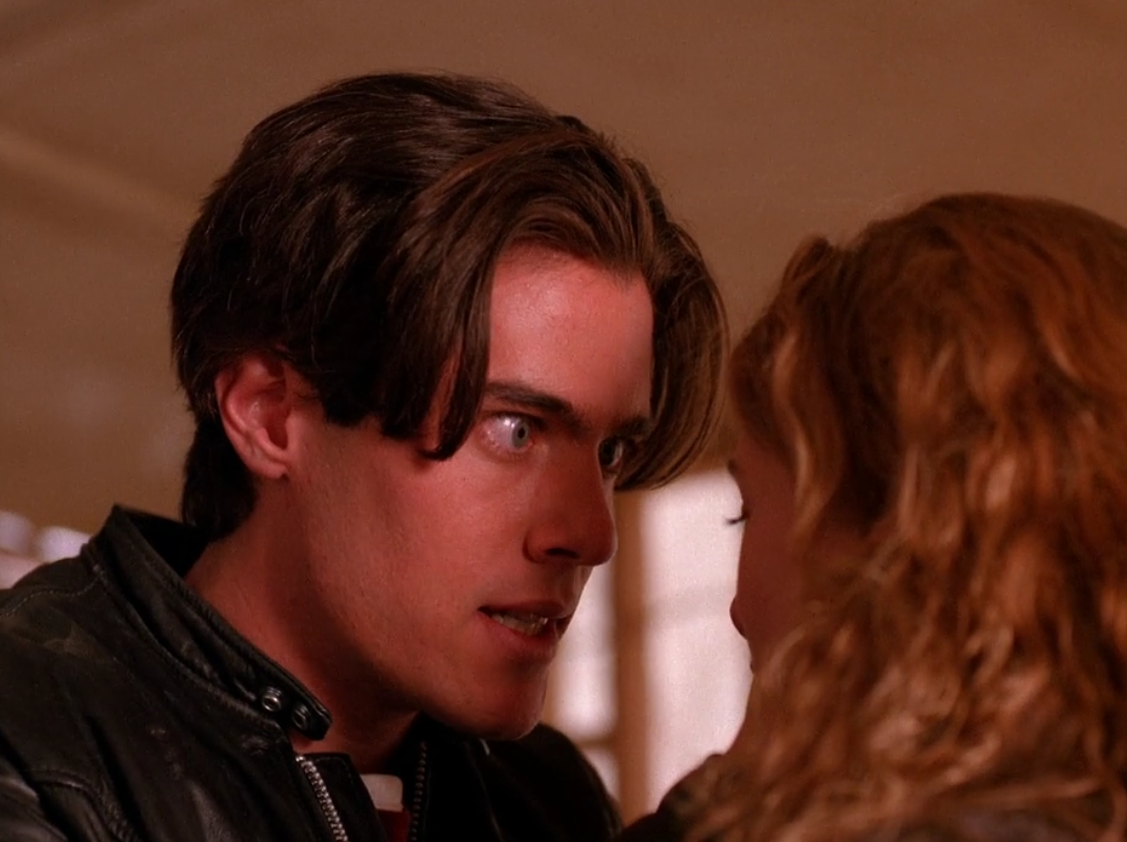 Critics fawn over Dennis Hopper in BLUE VELVET (1986), a precursor of Lynch's that led to TWIN PEAKS, but on revisiting both, Ray Wise as Leland blows Dennis Hopper out of the water; for that matter so does Dana Ashbrook as Bobby (left), because his eyes show real madness, just as Lynch's visions are mad, vs. the way people between the lines and inside the box think of as mad, in terms of the surface, i.e. put a giant waiter talking in cryptic code up in there or have a shrink with 3D sunglasses and an obsession with Hawaii, hey far out, the fake mad vs. the real mad.
Instead of relying on familiar tropes, Lynch goes deep into the moment. You never know where another is going to land --blood on the donuts, squeaky chairs. Now that I, too, am insane, I can smell the real deal vs. the trying to be crazy version, and for all his coiled angst, and Dennis Hopper's sobriety gets in the way of his Frank. He's an angry, strung-out man pounding cracks in a wall like De Niro did as RAGING BULL (1980) - but he doesn't break through any wall. The crazy exhibited in the work of Dana Ashbrook and Ray Wise on the other hand is truly wall-eroding. Wise's layered madness in season two is marred only by his insistence on singing, which might be the writers' idea, but I always suspect actors of asking directors to let them have a scene where they can sing once it's clear the series is going to either be renewed for a third season or canceled; they do it a lot in actor indulgent TV shows like later seasons of most anything when the original creators begin to run out of ideas.
 |
| I remember this image from the local Seattle paper when I lived there, needless to say they were very dismissive -- how dare a non-Pacific NW native attempt to depict their lifestyle and love of gourmet coffee? |
Alas - while Fire Walk with Me and the second season second murder both reverberate with a pulsing surreal horror, there are still some 12 episodes or so remaining after that in which to kill time after the killer is caught. Cooper's almost out the door, back to Washington, and in walks a DEA Fed and a Mountie, railroading Cooper on behalf of Jean Renault who's angry about his dead brother Jacques. Not so fast!
You can hear the entire nation groan in the feeling they're being taken for a ride. Or rather, the weight heaving on the trolley as the few million viewers still left all got off in one collective outraged howl.
If that wasn't bad enough, forth cometh the quirks, the soapy nonsense, the frills and the meandering
If The Shining didn't have any murders, what would it be?
A tree falling in the woods?
Would you answer it?
Even if it was her... hot and damaged Del Rey that was the tree and she was falling...
falling....
in love?
And she was out of meds? And it was the rainy season?

 |
| Zooey Deschanel was ten when her mom was shooting Twins (as Donna's mom) and you can kind of tell. |
Trip to the Lounge, Swim to the woods.
TWIN PEAKS to DEL REY
Post-Histaural Chronologic Signifer Map
TWIN PEAKS to DEL REY
Post-Histaural Chronologic Signifer Map


