
Showing posts with label Claude Rains. Show all posts

Thursday, July 28, 2011

Casey Anthony and the Hollywood Stoners


In THEY WONT FORGET (1937) a frenzied mob takes the law into their own hands after the hottest girl in town is murdered and the ambitious local D.A. (Claude Rains) spurs it all on the with the help of an unscrupulous journalist. The murdered girl Lana Turner in her film debut and the camera catches her every tight sweater bounce as she struts through the blindly celebratory Memorial day crowd before her death. Audiences remembered that bouncing sweater, not so much the grisly murder, just as it is forgotten within the film as lynching fever takes hold and right there one must shudder at America's cold, lusty, lethal gaze. How implicated are we in the audience via the fact Lana's sweater bounce won her fame and fortune via the ultimate in sacrificial volcano virgin unwilling martyrdom?


FURY (1936), THE OX-BOW INCIDENT (1943), and THEY WON'T FORGET (1937) were recently shown back-to-back on TCM, a lynch mob triple feature; it may be some wise old programmer's subliminal nod to the crazy mobs outside Casey Anthony's trial. Just as in the stacked deck of rube eggin' in OX-BOW, with Fonda in his pious 12 ANGRY MEN lecture mode:  "Hangin's any man's business that's around," in Casey's case it's everyone's business regardless of being around. Old Henry delivers his OX-BOW recitations well, but I actually preferred old Ma Joad (here the bad guy) to the blubbering lynch victim: "Keep yer chin up. You only die once, son."  Yeah, don't we wish?
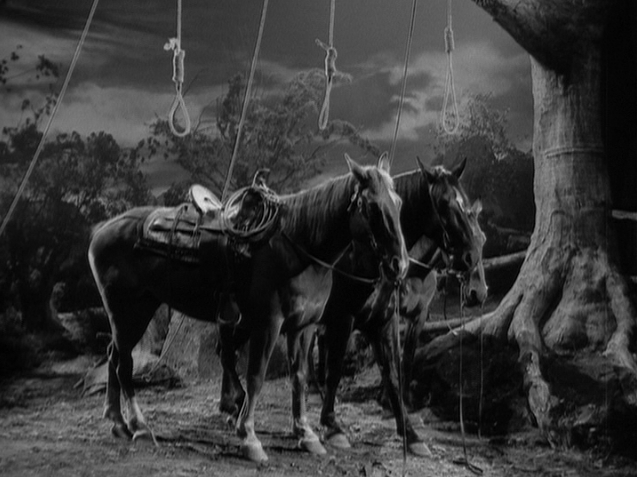

Did people outside of the liberal media elite (Oscar voters) ever want to see these films? What's the hook in lynch mob message pictures? Even the media elite shouldn't want to actually pay money to sit down in a theater and learn how skeezy and easily led the throngs around them in the audience are. If there is a fire in the theater you begin to suspect you would surely get trampled on your way to the exit. But at the same time, they are riveting, compelling viewing, and that's the answer: nothing gets us feeling personally involved, gives us the feeling something is at stake, than an abused, missing, or murdered child. Hollywood films aren't crammed with revenge against sleazy pedophiles and ruthless kidnappers for nothing. When films like THEY WON'T FORGET come around they're like Hollywood's chance to preach against what the studios themselves practice, the anti-liberal backlash mob action they both cause with their rabid headlines and tut tut with their sober message movies.

Lynch mobs seem less abundant in an age where we don't need a marriage license to check into a hotel room and are allowed to marry people of other races, but the repressed, frustrated ugly main street populace still haven't fought for the right to party, and still get mad at those who do. Now, instead of Claude Rains' fame-hungry D.A. we have Nancy Grace, tireless in her hounding the accused mom, Casey Anthony. When a child's involved it's the business of any accusatory hysteric that's around, and when it's a dead blonde girl child and the mom looks good even in the harsh overhead lighting of the courtroom; and--something even more shocking for the strictly sober Christian wives out there--you can show pictures of her orgymongering, that's where careers like Grace's are made. 


The three anti-vigilante violence films TCM screened all get a royal four stars from the obedient Leonard Maltin, which is not surprising. They're all well done enough to be solidly entertaining despite the sermons but the liberals of the Hollywood media aren't necessarily right just because they can make a movie about people being wrong. The liberal media has never hid its contempt for the red state working man. Just show an American flag, some jeans, a cowboy hat, an endangered toddler, a sixer of beer and, as far as New York's advertising elite are concerned, the suckers are hooked.  The game is just as fixed in FURY as it is on Fox News, as fixed in Stanley Kramer's films as it is at a carnival pitch game.


Still, my rage at these cretins FURY director Fritz Lang depicts is so blazing it threatens to engulf me, even though I know it's a fixed game, even though I know that Lang hates them more than I ever could, and if my rage is so easily inflamed, how much better am I than the mob? Just because I am more 'educated' and 'debauched' I may feel I am free to join Fritz Lang in his cosmopolitan revulsion towards the provincial reactionaries of these films, whom he considers little better than the Nazis he left behind in Vienna, whom he considers as sheepdogs for whom the law is like a leash, roping them by the neck to a master they hate and fear. With the leash comes off they only answer to the general consensus of the rumor mill which is by nature predisposed towards exaggeration and a common enemy, and which has no sense of future responsibility.

And nothing blinds oneself to one's own faults quite like rage, awareness of one's own inner struggle is the only way to survive it. How many of our evil transgressions were done to impress someone, even if they only spoke to us through radio or TV? How much are we owed, we think, for the stress we feel assuming responsibility for events that have nothing whatever to do with us? Next time, let us think of Claude Rains in THEY WONT FORGET, a man smart enough to know that mobs don't want truth, they want blood, and who gives it to them. Let us try, in the heat of the moment, to never cast even the second stone... without first stoning... ourselves... let us not condemn drugs until we have tried them. Let us not condemn the mob without first knowing the terrifying thrill of bloodlust belonging.

Wednesday, July 20, 2011

Great 70s Dads: Claude Rains in CAESAR AND CLEOPATRA (1945)

"Caesar doesn't eat women. but he does eat girls... and cats."

His manner like a doting father who brooks no weakness, iron with courage as the rock under his feet, a man who'd talk directly to the sphinx, and be not ruffled when it talks back as a 'divine child,' a glorious advisor/sponsor/teacher for Cleopatra (played by Vivien Leigh like a panther cub on her first kill), such is Caesar as embodied by Claude Rains and emboldened by the lashing and-oh-so British pen of George Bernard Shaw. Directed by Gabriel Pascal, Caesar and Cleopatra is an underrated Technicolor masterpiece (for the most part) and the most expensive film made up to that time in Britain, and made right after WWII. I swooned upon stumbling onto it, halfway through, on TCM recently, recognizing from the gorgeous deep dark grays and dusky velvets the hand of legendary Technicolor artist Jack Cardiff. The dark red of Roman capes and trim has never seemed so wild and sexy. As Caesar notes, it all seems like a beautiful dream... and for Cardiff fans an extension of the haunting, painterly beauty in Black Narcissus, The Red Shoes, A Matter of Life and Death, The Barefoot Contessa, and Pandora and the Flying Dutchman.

Like any great 70s dad, Caesar rules shrewdly but without pomp or sanctimony. Unlike the less civilized historical version, or the lusty brigands of De Mille, this Caesar is too British to even try and get Cleopatra into bed. He understands that true love is free of all prurience (if he does sleep with Cleo, he doesn't let Shaw and Pascal find out). Yet others' perversions are not condemned by him unless they violate the golden rule of do unto others, for he is no provincial moralist. He has lived enough of life to know better, killed enough to know death well and to respect it and to all the more value life, even in peacetime. He has drunk enough wine to know the value of sobriety, but his is a sobriety that retains love and respect for drink and drunkards. He hath turned towards kindness and tactical benevolence as inevitably as night follows day, but kept his wit and force unbowed. He hath transcended lust and its accompanying folly, but keeps his carnal momentum in constant play.

So often in ordinary men of power doth wisdom turns to dull dogma, leadership to tyranny, goodness to ranting on about how bad everyone else is. A true Caesar avoids such pitfalls, and so earns the loyalty even of his enemies, the adoration even of his exes.

When he's insulted by the throngs of Alexandria, for example, Caesar doesn't grow overly indignant, but merely reveals his waiting armed reinforcements, blocking all exists, with deadpan theatrical flourish. Outwitting his rivals at every turn, Caesar never loses his good-natured love for them, even as he may kill them. In true 70s dad style he has given up the most enticing vice of all, hatred. And in true 70s dad style can present himself as an ogre and the prince that dispels the ogre simultaneously. Such a man is impervious to barbs and a great teacher of amoral, wicked young ingenues like Cleopatra. Like all the 70s dads of Bernard Shaw's rogues gallery, he preaches sin but practices morality, thus confusing the shit out of people, albeit in a most advantageous (to him) kind of way, exposing in the process the core of what most people in authority are, the sad reverse.


We see this love in his fatherly advice to Cleopatra before she realizes who he is. She doesn't yet know he is anything but an ordinary wanderer in the night, and so shares her anxiety over meeting this legendary emperor, and Caesar is amused and delighted to continue the charade, advising her as a life coach with all the beautifully silken intonation Rains is beloved for: "Cast out all fear, and you will conquer Caesar. But if you quail..."


While prurient interests might wonder where the love affair that was hinted at in previous versions has flown, Shaw cares not for such prurient nonsense, and so mighty Caesar is instead pleased to dangle the idea of Marc Antony--a warrior Cleo had a crush on when he blew through town years before--as a kickback for her deal with Rome. Caesar can accept her attraction for a younger man as effortlessly as he accepts her wide-eyed adoration, both just sides on a coin with his own Roman face on it. In Shaw's philosophy, Viagra would surely be labeled yet another albatross along the route of spiritual advancement as the bucking horse of desire is finally demounted. What progress on the torturous ascent up Buddha's mountain path can there be when hotties like Vivien Leigh are speeding down past you on Technicolor powder blue, v-shaped sleds and bidding you to drop your weary pouch over the ravine and jump on? I can only marvel at the grace with which Rains' Caesar accepts Cleo's shock at his baldness after taking off his laurels: "Cleopatra, do you like to be reminded that you are very young? Neither do I like to be reminded I am... middle-aged." Like England itself, this Caesar accepts insults with grace, and gives back only shrewd kindness and canny observations.


It's no accident after all that this film was made in 1945 by a nation that had just been bombed halfway to shit and was now victorious and in control of its enemies' people and half its territories and had learned the rather hard lesson from WWI to not be vindictive and petty in triumph. Rains' Caesar seems to have been halfway imagined as a wisdom-enriched manual for the military police controlling the borders of major cities like Vienna and Berlin, where politics were a daily matter as Russian, British and American police swapped prisoners, disputed borders, and enforced curfews on a beaten, broke, hungry populace. In his role as conqueror, rogue, and rascal, Rains' Caesar is the model for how to celebrate your victory without crushing the fragile spirit of your vanquished subjects. When his enemies lose, everyone wins.


But no man can be a good leader of conquered people if he has not first conquered his own desires. Such a man is free to hate no one, and so fears nothing, and naturally shows mercy to his conquered subjects, even to the extent of freeing his demons back across the dividing line of consciousness, letting the trogs and gollums sink back into his hidden inner marshes with the promise that they will come to work for him the next morning, in suits and ties, and take their place along the assembly line as loyal charges of the empire (ala the hitherto thuggish Robert Newton in Shaw's Major Barbara). Shaw's revision of Roman history sometimes seems a bit too delighted by itself, enamored of its own distinctly British wit, and the stretches between the juicy conversational bits are leadened with marching and walking around the vast sets, the painted pale blue matte skies are often sickly if representing  'day' but the setting sun murder scene is a stunner, as is a scene in a very eastern chamber with a harp, the marble stone step and wall colors rife with rich elaborate red and purples, floors awash in myriad green hues. At night and in shadow, the colors turning deep, dark, and dusky, Cardiff's skill frees the mind of all weariness and ushers in carpets of delight. With Shaw's dialogue inspiring and profound even as it has you smirking like a gin-drunk Ernest Thesiger; if nothing else, it all suggests that Rains' merry police captain was the true heart and soul of Casablanca. Why no dorm room posters of Claude Rains? Why no posters... of Caesar?

Related Posts Plugin for WordPress, Blogger...