Showing posts with label Joe Dante. Show all posts

Saturday, October 31, 2015

Halloween Special Edition: 10 Quintessential List + 13 More on Bright Lights


As a lifelong classic horror fan it gets my arse all in a tether when channels like IFC figure what we need are marathons of crappy HALLOWEEN sequels, or that horror means only three names: Freddy, Jason, Michael or god forbid, Jigsaw. To me that's like bringing a keg of green dyed Bud Lite to a highbrow Dublin wake. It's gouache (the watery paint, not the adjective). It's the one time of the year the punters might learn something about our rich horror heritage but instead they're allowed to indulge in feeling that 'classic' doesn't extend back farther than the mid-90s.

Well, rejoice brothers and one sister. I've made a grand list of 13 horrors fit for even Hiram Walker himself, found only on Acidemic's more coherent and lauded (laudanum-laminated) cousin, Bright Lights Film Journal:

Sh! The Horror! 
13 Suggestions for an Uncommon Halloween 
Viewing Experience

Also, make sure to visit my Netflix horror recommendations on:

Post-Giallo Nightmare Logic ala Netflix
and Netflix Deadpan Comic Horror Inititative
and Last year's 13 Obscure Horror Gems (via Slant)


Many lists... many masters. But this next list cuts through them all, for they are the lesser-known but relentlessly magnificent gems I watch every year around this time, as far back as whenever I first taped, bought, or saw them. Each is so laden with atmosphere you can smell the bonfires and first chill of night, feel the centuries of huddling around the harvest hearth in your collective ancestral ganglia. Rather than finish all these half-assed reviews I've been struggling with, here now, some short mentions of all the favorites I revisit every year.

CITY OF THE DEAD 
(AKA Horror Hotel)
(1960) Dir. John Moxey

There's so many strange similarities between this Amicus debut feature and Psycho that, were they not made in the exact same year on opposite sides of the Atlantic, you'd swear they were emulating each other. Both feature naive but courageous and very pretty blondes who wear their hair moddishly short and leave their comfort zones on big adventures, alone, against other people's advice or good common sense, and wind up staying at decrepit inns where they are killed, by a knife, in the middle of the night, and the middle of the picture. Then follows the boyfriend to investigate and eliminate the threat, but the damage has been done; our locus of identification is forever shattered. Welcome to the 60s. (from: CinemArchetype #5: The Human Sacrifice)

Even her name, Nan Barlow, evokes her sacrificial position (similarity to John Barleycorn) and her beauty and low-key acting style evoke Veronica Lake--who played a witch herself years earlier. But what's most important is the swirling black and white fog, sinister shadows, minimalist sets, and the feeling of pre-ordained noir-ish dread, Nan reading a history book about the burning death of Elisabeth Selwyn to (unwittingly) Selwyn herself in her ghostly materialization alias as the hotelkeeper, also reading about the human sacrifice, guileless about how the things she's reading about--the Candlemass sacrifice to Lucifer at the hour of 13--will be happening to her in a few hours -- just a sweet innocent college student unaware of the dangers around her, with no smirking boyfriend to protect her (he tried to talk her out of it but didn't come along). There are no outdoor shots: the town is just a fog-bound ever-dark soundstage, and all the better for it, especially in the moments of warmth like Nan's refuge in the cozy bookstore. Add Christopher Lee, Brit actors rocking "American" accents, a very-deep voiced ghost Satanist (Valentine Dyall), and a bunch of comeuppance heaped upon that smug boyfriend when he finally shows up (he sounds like he's doing a Ralph Meeker impression)--and you get a favorite of mine that makes a great triple bill with BURN WITCH BURN (an actual line in the film) and VOODOO MAN. In each our loyalty and sympathy is always in flux, the hatred for intolerance and denial and its long-term damage on the world vs. the actual bottomless malevolence and pagan human sacrifice at the core of pre-Christian religion, making Christianity seem, if you'll forgive the expression, the lesser of two evils. After all, we come to like cute little Nan - the unlucky Alice drawn to her Barlow-corn wicker girl wonderland waterloo and her death is genuinely upsetting --maybe even more so than Marion Crane's, because Nan has time to see it coming - to know what's in store having just read about it, and we feel her bottomless dread as she looks into the merciless eyes of her killers as they coldly chant the hour. It helps make the admittedly silly climax cathartic, and then there's one final PSYCHO-echo, a slow turn of a chair into the light to see the corpse of the presiding female spirit. 

MESSIAH OF EVIL
(1976) Dir. Willard Huyck 

This impressive debut feature from future Lucasfilm writers Willard Huyck and Gloria Katz stars Mariana Hill as Arletty, the emotionally vacant daughter of a disappeared artist (Royal Dano). There's a hushed quality to Messiah of Evil, all the better to hear the waves crashing in the distance. Nobody shouts until they're about to die, usually at the hands of cannibal mobs. A super-chill dandy, Thom (Michael Greer), and his two girlfriends, Laura (Anitra Ford) and Toni (Joy Bang), join Arletty in an attempt to unravel the mysteries afoot in this secluded, unfriendly location, and as Thom busts a move on Arletty, the girlfriends get bored and disappear into the ominous blackness. Among the film's more haunting elements: photorealist faces peering through windows and a wall weirdly painted with a full-size escalator. At any moment, this empty house seems as if it could warp into a nightmarish shopping mall—one of many bizarre evocations of a film that cannily mixes Lovecraftian dread with Antonioni-esque alienation. (Slant 10/30/14)


KILL BABY KILL
(1966) Dir. Mario Bava

It take a few viewings to really appreciate KILL BABY; it's not as highly regarded as some of Bava's other work, which is probably due to a history of bad prints and title changes. A Victorian Gothic Italian rural villa ghost story, KILL, BABY, KILL's Italian title was OPERAZIONE PAURA! (Operation: Terror!). We don't blame them for changing it, but why make it sound like a giallo spy thriller? The similar sounding film FASTER PUSSYCAT, KILL! KILL came out the previous year, and was a film that set the bar for outre grooviness, but grooviness hadn't even been invented in the BABY's Victorian Age setting. Instead there are beautiful 'old master lighted' bowls of fruit, great wind effects, sedatives ("give her 20 drops") and an array of strange and wonderful women, including a beautiful brunette bruja (Fabienne Dali), a terrified innkeeper's daughter (Micaela Esdra), a stylish and terrified med student named Monica (Erika Blanc), and Melissa Graps, a ghost girl with blonde hair (to tie the film even deeper into RIGHT ONE, she's played by a very spooky boy, Velerio Valeri). She's like Italy's Victorian era version of THE BAD SEED times the SHINING's murdered twins divided by Norman Bates in "wouldn't hurt a fly" drag. In fact, I've seen this movie ten times now and it gets better every time, even if it does occasionally put me to sleep.  Since BABY tells only one story, it's not as relentlessly scary and blackly comic as Bava's 1963 trilogy BLACK SABBATH, and can seem padded here and there with repeated shots of bells tolling and gloomy ghost-eye exteriors. Cool scenes of victims returned as undead servants of the evil spirit, foreshadowed all through the first 2/3 of the film never materialize. Did Bava run out of undead make-up? Is that the reason the film is so slow, and yet over so fast? Who cares, it's Halloween down to its core  (more)


THE UNDEAD
(1957) Dir. Roger Corman

I saw UNDEAD when very young on TV and the scene were Duncan seeks shelter at the witch's house is to me the eternally definitive Halloween moment, Dorothy Neumann the definitive good witch. Her crooked nose, clearly made by cheap putty that seems always about to dry and fall off (you can see the line between Neumann's real nose and the false one), bubbling cauldron, and other trappings, puts to rest the libelous claim of Glenda in OZ that "only bad witches are ugly" (the bad witch is sexy Alison Hayes) and I love the casual way she asks the stranger at her door "Are you from this era or from a time yet to be?" as if hypnotists from the future were not uncommon.

Lastly, the insidiously merry laugh of Satan himself, played brilliantly by Richard Devon, incorporating modern wit and ancient evil as a good-humored beatnik trickster who transcends time itself and recognizes the time-traveling hypnotist right away, by name! Awesome. Once the rubes leave, the site of the black mass becomes a point of contact between the by-now-insane hypnotist, Duncan, the devil, and both witches as they all argue for and against Duncan going back to the executioner in the morning. Ingeniously, Corman finaly moves his camera outside, making the sun and sky seem suddenly more unreal and dreamlike than the black fog supermarket-bound night that came before.


THE DEVIL RIDES OUT
1968 Dir. Terence Fisher

Here in Hammer's tight little adaptation of Dennis Wheatley's novel we have everything that makes British devil films great: Christopher Lee, some intelligent older women, Charles Gray as a sophisticated, witty villain, and upper crust Jet setters cult worshipping Satan through black magic, peppered with a few older eccentrics who look like any minute they're flying to Manhattan for Rosemary's baby shower. (CinemArchetype 17: THE DEVIL)

1968 Dir. Jack Hill

As with GIRLY, described in my last post, SPIDER BABY seems to merge with my psyche as if it had been made just for me... zeroed in but not in a sort of overkill give the people what they want kind of way but a perfectly-realized, just gory and strange enough but never to the point of post-modern narrative disruption way. It lies on the historical time line between my love for those old Bela Lugosi Monogram and PRC poverty row horrors and the art film Corman-school mix of post-beat wit and Corman trained mastery of on-the-fly shock, schlock, and drive-in pacing. Nowhere are there the tedious elements that usually mar old dark house and murderous family films: no snarky reporters, imbecilic cops, doting old ladies or suspicious tire salesmen and yet there are all sorts of groovy meta links to the gonzo films of the past in the casting: Monogram mainstay Mantan Moreland opens the film as an unlucky telegram Sam; Carol Ohmart, the archetypal broad in Castle's House on Haunted Hill (1957) and Corman's The Creature from the Haunted Sea, is great at making greed and contempt super sexy; Sid Haig, the Jack Hill and later Rob Zombie perennial, brings weird savage naive pathos. Why, the whole thing just stinks with atmosphere! (that's a quote from the sun-dappled but roughly similar and underrated Boogeyman Will Get You (1943). (more)


PLAN NINE FROM OUTER SPACE
(1959) Dir. Ed Wood

"...if you’re old enough to remember UHF TV then you remember seeing PLAN NINE or BRIDE OF THE MONSTER and having your mind blown. Wood understood children’s need for disruption of narrative and that need is the same as Godard’s. Nothing bores children like heavy plot-driven adult conversations and mature coded historically accurate subtlety. When green slime drops from a CARRIE bucket onto Kid’s Choice Awards presenters, how different is the laugh derived than the laugh when Tor Johnson bumps into the doorways and shakes the walls in BRIDE?"(see my MUBI List: Accidental Brecht)


THE RAVEN
(1963) Dir. Roger Corman

A personal favorite Halloween perennial, this loose comedic 'adaptation' of Poe has reluctant sorceress Vincent Price longing for his Lenore and Peter Lorre (old and bloated but still hilarious) as the raven, turned that way by Dr. Scarabus (Boris Karloff), who it just so happens killed Price's father and has, as it turns out, stolen Lenore (Hazel Court) - who's still alive (a bit like he stole Lugosi's wife in the 1934Black Cat, another Poe "adaptation"). Soon they're all packed away in a carriage, along with a super young Jack Nicholson as Lorre's son Rexford. It all culminates in a memorable sorcerer duel that's fun for all ages.

The Blu-ray remastering is jaw dropping --as different as beautiful soothing night from shitty gray-ass day; its vast and impressive sets (Corman kept all the sets from past Poe films and by the time of The Raven he'd assembled them all into a vast sprawling Gothic maze) always looked kind of brownish and washed out but now every flicker of the big fire pit is a poem; once the gang enter Scarabus's castle the HD transfer begins to shimmer and glow in a new hauntingly lovely greenish gold reflective light and inward depth. The Les Baxter score at times errs on the side of the smugness and helicopter overbearance; but this is pure uncut Halloween delight, so might as well bring the kids by which I mean depressed lovelorn sophomores reeling from too much bad acid too soon in life, catching this at the Student Union, aching in their tired raging bones for the velvet-lined purr of Price. (Mephisto from Missourri - 10/14)


HORROR EXPRESS
(1972)

This Spanish-British horror union of Horror Express (1972) was long a favorite of my father's back in the day, with a bad guy as an alien that passes from body to body that's been thawed out from inside the frozen ape man brought onto the Orient Express by Himalayan explorer Christopher Lee. The thing inside --which drinks your brain through your eyes rendering your brain creaseless--crashed here before life began; its glowing red eyes carry imprints of things it has seen such as the Earth from far away, and dinosaurs. They look like drawings from a book but that's not the reason superstitious Rasputin-style monk (giallo regular Alberto De Mendoza ["thy will be done as it is in Hell!"]) steals it off the tray. There's also Silvia Tortosa as a foxy countess, Alice Reinheart as a foxy spy and Telly Savalas as a Cossack who comes barging onto the train at the worst possible time rocking his usual awesome ridiculous hamminess ("Who are da killas!? WHO!??" he shouts to the assembled first class dining car. "Who are da trubblemakers!"). Christopher Lee Peter Cushing make an engaging Holmes-and-other-Holmes style duo (aided well by Totosa) and the Orient Express makes a perfect backdrop for a tale of existential steam-powered escape, where through the ever-increasing momentum of man's scientific reasoning --the lone guiding red lights hurtling through the Ice Age Siberian tundra; the train whistle Morricone-ish score, the alien red eyes sucking up information the way we wish we could with books and professors and maybe will be able to one day with brain boosting chip memory implants, we get a tragic and profound sense of science still having a long way to go before we can escape the gravity of these archaic bone machines with any kind of permanent return to our true friends and family... out there, in a way that's infinitely more profound than The Man who Fell to Earth. 

(see also: The Creeping Flesh - 1973)


(1985) Dir. Dario Argento

I've seen fire and I've seen rain, and I've seen SUSPIRIA enough times to not even mention it here - but PHENOMENA is a perennial because it's got Jennifer Connelly in the dark mirror twin role to her LABYRINTH wanderer (made the following year). With her raven-black hair blowing in the wind roaring down from the Alps, as the echo and flanger-pedal-drenched electric guitar and throbbing synth moments of ex-Goblin Claudio Simmonetti's evokes some echoing electric alpenhorn trying to signal anyone who can hear it to an unseen spectral menace. If you can move into the frame of mind of being at a near-deserted drive in in the middle of nowhere or even if you can't, you will dig the spook show surrealism and great wind noises.

It takes all the hot topics of the early 1980s/late 1970s and mashes em up with Argento's bizaarro touches: there's a chimp named Tanga (played by a very cool chimp named Inga) avenging his slain master ; SWARM-style bug attacks; CARRIE-esque telekinetic revenge against bratty schoolmates (replete with wind blowing the hair back ala FIRESTARTER); a deformed Jason-like child, flaming lakes, a razor left in a trash can, beheadings, maggots, POV killers shots with a knife on a pole ala PEEPING TOM, and all of it scenically filmed around the base of the Alps, where it's nice and stark and windy, in what wheelchair-bound Donald Pleasance dryly refers to as "the Transylvania of Switzerland."

People have written bad things about Connelly's acting here, i.e. her blank expressions when she should be scared, but hey--I think she's letter-perfect. She's a sleepwalker! And good lord did she have to suffer bouncing around in that decomposing offal pit, so give her a break. PHENOMENA works best, as its fans note, as a fairy tale, with Connelly's power to attract bugs perhaps the key to her fearlessness. She's like a superhero, hence the killer's question, my favorite line in the film, "Well? Why don't you call your insects!?"(more)

THE HOWLING 
(1981) Dir: Joe Dante

For my money this is the best lycanthrope study since WEREWOLF OF LONDON (1934), the one with Henry Hull and Warner Oland fighting over a Tibetan flower, not the one with David Naughton arguing with a decomposing Griffin Dunne in a Piccadilly cinema. Maybe I just don't care much for werewolves that get hung up on the letter of the law, like Landis' AMERICAN WEREWOLF IN LONDON, which came out the same year as HOWLING and there was much to-do in the press at the time about which make-up artist did the better transformation. Rick Baker won, and he's a genius, sure, but he and Landis makes Naughton's transformation unbearably agonizing, the moon inescapable, the beast itself a real wolf puppet on all fours. He takes it all way too literally. Joe Dante and Rob Bottin, on the other hand, know it's a goddamn metaphor, so they don't get hung up on the 'real' parameters. Thanks to witty script by John Sayles and Terry Winkless, their werewolves move way beyond such hang ups as urban realism, looming tall, standing upright like monster gargoyles, they're effective reactions to a world gone wrong. There might be too many indulgent close-ups of air bladders but so what!? It still rules. Following in the shoes of Dante patron, Roger Corman, HOWLING taps into the lupine side of 1970s sexual swinger and EST-ish encounter groups and woodland retreats. It's funny and scary and trashy and witty all at once, full of strong liberated professional female characters, De Palma meta-refraction, audio mimesis procedural delirium, Carpenter ominousness, Cronenbergian clinical immediacy, and a plethora of great bit roles by folks like Dick Miller, John Sayles, Kenneth Tobey, Slim Pickens, Kevin McCarthy, Forry Ackerman, and Corman himself..
--
Even FURTHER LISTS:
Great Women of Horror - Acidemic Top Ten. 

Netflix 24-hour Horror Marathon 
(though only about half the films listed are still streaming over there. Netflix what happened to you, man?)

CinemArchetype 17: THE DEVIL

Friday, October 10, 2014

October Capsules: OCULUS, SHIVERS, DETENTION, HOWLING, MIMIC 2: HARDSHELL

OCULUS 
(2013)  Dir. Mike Flanagan
***1/2

A brother and sister reunite at the house where, as kids, they watched their dad and mom lose their shit, thanks to a haunted mirror. Now they've returned to the empty house to sort that mirror's shit right out. To prove it;s haunted, sister's got the whole joint wired for sound; cameras are set up and timers are set to keep the siblings from drifting out of reality, because the mirror has a habit of causing hallucinations, flashbacks, and homicidal insanity if there's no one or thing to jar you out of it.  The younger brother, having been in an institution ever since 'what happened' to them as kids, explains away the happenings as stress-born cover memories, to which his his sister says "they really did a number on you in there, didn't they?" And if nothing else, it's pretty awesome to hear rote psychiatric skepticism blasted open in such a direct and intelligent manner. With great creeping camerawork that services the slow-ride suspense instead of just the usual 'sudden' shocking and mickey mouse telgraphy, this is one spooky, cool film, the best since last year's THE CONJURING. Turns out you don't need a big empty hotel in Colorado to convey the ease with a sensitive family can dissolve into cabin fever psychoses, you just need a big spooky mirror that can distort reality. And when the children in the flashback even begin to notice their future selves watching them like ghosts from the future, and the horrific encounters in both past and present reach a fever peak, you know OCULUS is onto something genuinely new and creepy. Haunted house 'past crimes' have never seemed more immediate; the idea of four walls holding in psychic trauma and malevolent forces seems palpable, as if the image on a videocassette has left the tape, shimmied back along the spindle and is now and watching itself in reverse order.


Director Flanagan also avoids the whole 'hallucination-or-was-it?' schtick, delivering some pure monster moments along with the madness, effectively (and correctly) illuminating the futility of ever knowing what's real even when evil spirits aren't fucking with you. DR. WHO fans will appreciate seeing 'companion' Karen Gilan stars the older version and Annalise Baso as younger is harrowingly raw and viivd -her cute little redhead alien face and orange hair are perfectly lit and she could teach a master class on showing every step involved in channeling terror into adrenalin-spiked courage (you can feel every turn of her courage being screwed to a sticking place). Heartbreaking, exciting, and genuinely spooky all at once, OCULUS gave me a literal spine tingle. And it doesn't need a dram of cheap shocks or torture porn trauma to get there. Filmed, for some ignoble reason, in Alabama.

SHIVERS 
(1975) dir. David Cronenberg
***
This weird first Cronenberg feature hasn't been available on DVD for awhile, but it's been on both Netflix and Amazon streaming recently and mustn't be missed, despite its cheap, grimy look. Far more disturbing than an outbreak of flesh eating zombies (which are too abstract - very few people think about cannibalism all day at work), is a contagious parasite that delivers inhibition-shredding insanity that converts the infected almost instantly into lewd sex-crazed maniacs. It's like if someone spiked the water supply with incredibly high levels of MDMA so everyone who had even a sip went crazy and started rubbing up on every passing person, be they family members or complete strangers. Not just pretty people in their 20s-30s, but the elderly, 'normal' types, and even children, the bulk of the real world we see (and are seen) by every day.

It's not MDMA (or ecstasy) in this film - that drug didn't even exist in 1975-  but an ugly free-roaming parasite that looks like an uncircumcised kidney, created by a doctor who wanted to turn the world into one large orgy. Taking to heart that (beloved of Cronenberg) med school adage that sex is the invention of a very clever STD, this parasite pays off in flooding the host's brain with inhibition lowering / libido elevating / clothes shredding / wife alienating insanity. Since it's breeding by traveling between sexual partners and it has a whole vast modern Montreal apartment high-rise to roam around in (each with a mail slot on the door), people can bedroom hop around without ever stepping outside. The eventual habit of everyone to run up and down the narrow halls in a big groping pack, knocking on random doors and taking over and turning on those who answer the door, or coming onto strays down in the laundry room or the foyer, reminds me a lot of my when someone would show up with a bunch of acid, ecstasy (called 'x' in those days) or shrooms to sell in my old dorm of Flint Hall in Syracuse, circa 1985. One well-stocked visitor could reduce the whole building to a mass of writhing, breathing, groping arms and tentacles. With no one having a car, or even a parking spot, we could roam the vast hallways like it was all one big crazy open house, everyone's door open and different drugs or weird sites in each room. As we say in AA, I really related.

Spiked with livid, funny gross outs as the kidney things hop from mouth to-locked-in-willing-or-unwilling mouths, the film's a 'careful what you wish for' example of 70s singles swinging rather too successfully. It takes a minute to get started, but once the two doctors get on the scene, and Lynn Lowry shows up as the nurse (Lynn, you rock eternal!), and a thing crawls up Barbara Steele in the bathtub, well, things get great, I mean, Romero's CRAZIES-level great, which came out two years before SHIVERS and it's a film I think Cronenberg acknowledges as an inspiration by casting Lowry. Eventually the paltry budget and sometimes harsh lighting even work to the film's advantage: the performances are deceptively brilliant, more and more so as the circumscribed roles are shed to reveal the true chthonic uncivilized wild savages we all are generally only in our deepest subconscious. And Cronenberg really gets what it's like to be inside 'the hot zone' of an outbreak, where just getting to a phone across the hall can take hours as one interruption and calamity builds on the next. Eventually the paltry budget and harsh lights even work to the film's advantage, giving it a flat 16mm instructional film feel (it really should be shown in every high school health class - teen pregnancy would drop off to zero).


There's only a few familiar faces in the cast, but the two doctors (Paul Hampton and Joe Silver) are cool--you believe they really are doctors (and admire the way the Hampton just shoots people and beats them to death with a crowbar) and the scene were Steele and the emotionally overwhelmed wife (Susan Petrie) of the giant-lipped patient zero+1 (Allan Kolman -- a kind of a Sid Haig meets Jamie Gillis, i.e. perfect casting) hook up may curl your toes as it did mine. Other atrocities include incest, kids being led on leashes (a nod to that memorably disturbing shot in Go Ask Alice?), elevator groping, rapes, terrible catering, homosexuality, all sorts of crazy orgy scenes and an eventual indoor pool party that would shock Mae West. A real trendsetter, it made a lot of bread in the US under AIP as They Came From Within. And cinema as we know it would never be the same. If any film should be remade, and probably never will be, this is it. As Chris Rodley put it
"One experiences a tremulous sensation that suggests one might have reached the end of the unconscious. There it seems to be, thrown up on the screen in all its perverse and truly repulsive splendour, unmasked and unashamed." (40)
DETENTION
 (2011) Dir. Jospeh Kahn
***
Sharp wit and slashing rejoinders are not dead in this post-modern high school deconstruction comedy for the 'Twitter generation.' This hybrid of CLUELESS and SCREAM 2 proves itself the SCARY MOVIE for the smarter kids, zipping by in layers too fast for a single viewing (though in presuming repeat viewings it perhaps presumes too much). The presence of diminutive HUNGER GAMES "hunk" Josh Hutcherson should lure enough girls to at least give it a few hits, though, and tomboy Shanley Caswell is refreshingly wry as the 'second biggest loser at Grizzly High' with whom Josh has a long shared connection. But now she's upset that he's going out with the alpha hot chick Ione (Spencer Locke), angering her ex-boyfriend the big dumb jock Billy (Parker Bagley), who wants to fight Hutcherson but keeps erupting into FLY-like symptoms. See, he touched a meteorite as a child and spent most of his elementary school life with his hand in a television. You heard me!


I can see Godard and Antonioni loving this movie, especially the scene where the kids watch a bootleg copy of CINDERHELLA 4 while in detention to see how to survive their situation, resulting in the best screen-within-screen infinite chronosynclastic infindibulum meltdown since SPACEBALLS. Stunt casting includes Dane Cook as a dickhead principal and... no one else, but there's a time-traveling bear mascot and enough cheerleaders to make this a bizarro sister to the other semi-self aware Netflix high school horror comedy, Lucky McKee's ALL CHEERLEADERS DIE, and enough trans-dimensional portal usage to make it the callow tweaker cousin to JOHN DIES AT THE END. Writer/director Joseph Kahn's previous feature was 2004's TORQUE which I also liked a lot for its gonzo over-the-top deadpan in-on-its-own-joke dumb comic product tie-in momentum.

MIMIC 2: HARDSHELL
 (2001) Dir.  Jean de Segonzac
***
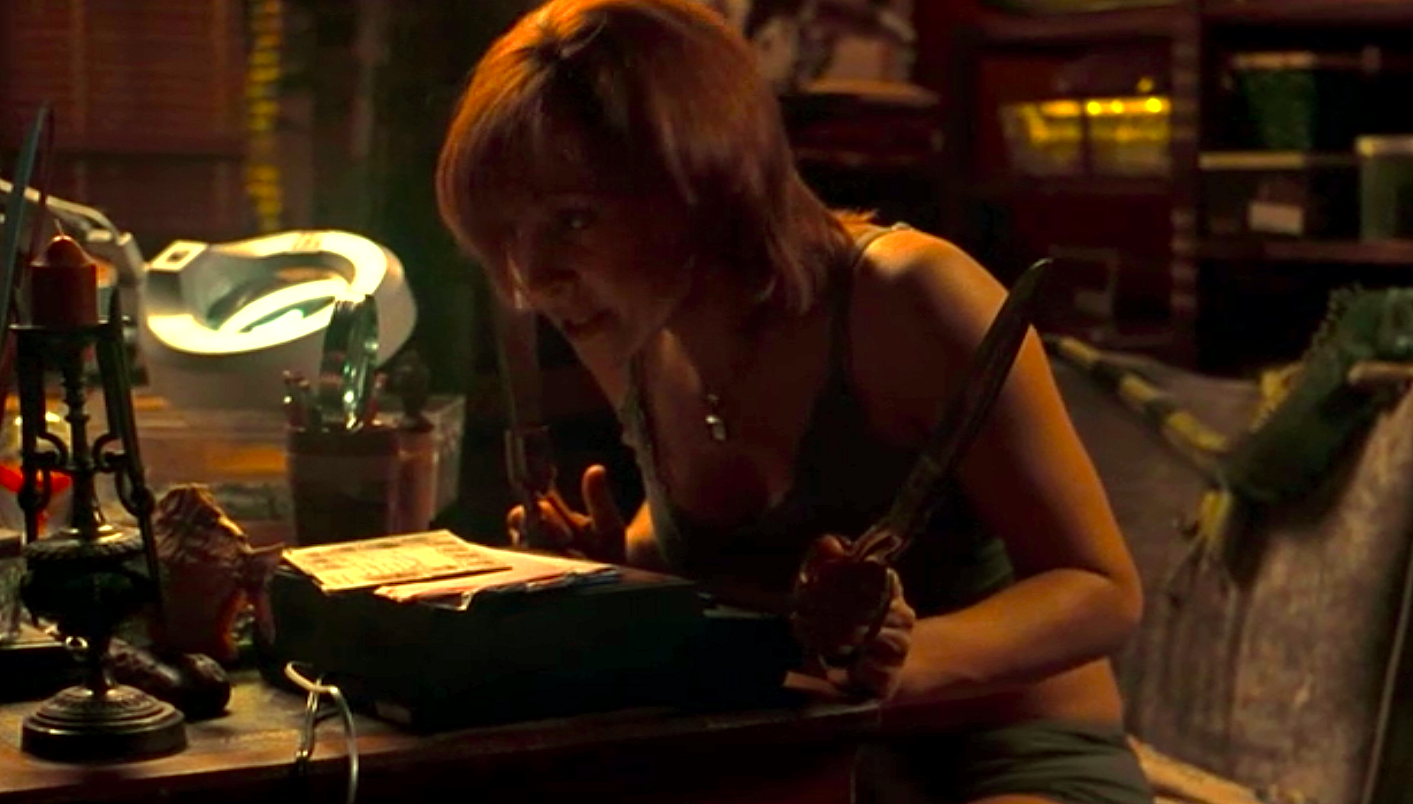
Most direct-to-video sequels aren't worth a damn, but here's one with a cute redheaded badass high school etymology teacher (Alix Koromzay) navigating treacherous urban streets and fending off insect suitors by using sewing scissors as mandible talons to rend their exoskeletons in twain. Koromzay clearly decided to treat this like A-list material and the result is a great example of a director and star using producer indifference to wiggle past the patriarchal groupthink that sinks so many sequels before they start. Instead, Koromzay goes all out in depicting a super strong woman still so sexy she has a whole coterie of devoted, smitten inner city students with whom to hole up in the high school while giant insect mimics hunt them and a cabal of governmental agents seal off the building with plastic tarps. So what if there's a smudge of direct-to-video sequel cheapness? It's the ideal third or fourth entry of any all-night horror binge, one where your defenses are down and your pheromones are at peak between-shower pungency.

THE HOWLING 
(1981) Director: Joe Dante
***1/2

For my money this is the best lycanthrope study since WEREWOLF OF LONDON (1934), the one with Henry Hull and Warner Oland fighting over a Tibetan flower, not the one with David Naughton arguing with a decomposing Griffin Dunne in a Piccadilly cinema. Maybe I just don't care much for werewolves that get hung up on the letter of the law, like Landis' AMERICAN WEREWOLF IN LONDON, which came out the same year as HOWLING and there was much to-do in the press at the time about which make-up artist did the better transformation. Rick Baker is a genius, sure, but he and Landis makes Naughton's transformation unbearably agonizing, the moon inescapable, the beast itself a real wolf puppet on all fours--he takes it all way too literally. Joe Dante and Rob Bottin on the other hand know it's a goddamn metaphor so don't get hung up on the 'real' parameters. The HOWLING wolves move way beyond such hang ups, looming tall like monster gargoyles. Following in the shoes of Dante's patron saint, Roger Corman, HOWLING taps into the lupine side of 1970s sexual swinger and EST-ish energy, it's funny and scary and trashy and witty all at once, and then adds De Palma meta-refraction and audio mimesis procedural delirium, Carpenter ominousness, Cronenbergian clinical immediacy, and a plethora of great bit roles by folks like Dick Miller, John Sayles, Kenneth Tobey, Kevin McCarthy, John Carradine, Slim Pickens Forrest Ackerman, and Corman himself (below, waiting for the phone).


The story grabs you from the start: pre-E.T. Dee Wallace smoldering gamely as a TV reporter / newswoman heading off to interview a possible serial killer at a downtown SF adult book store while her crew monitors her every move worriedly from the warm safety of the station, or tries to--but then they lose her signal. Some bad shit goes down before it's over and she ends up with amnesia prompting a pop culture therapist (Patrick Macnee) to send her to 'the Colony,' his Northern California Pacific beachfront encounter group, where patients/residents make beach bonfires and grill lots of meat. A combination of sinister swinging couples and shady locals, including John Carradine howls at the moon and Elizabeth Brooks is a major smokin' badass as the wolf mother elemental nymphomaniac who comes onto Dee's mustachioed husband (Dennis Dugan) after he's separated from his hunting party. You may find yourself questioning your loyalty to the non-lycanthropic human race when she cooks Dugan's shot rabbit. Later they get it on by the bonfire, the powers of desire and orgasm shifting and churning their inner wolves while Dee Wallace nightmares it up alone in their cabin.

Lifelong Dante fans are born in these weird moments, especially once the entwined lovers switch to animation.


Like Cronenberg's films of the same era, the sex and the horror entwine in deep Jungian-Freudian knots, and as I said, these werewolves aren't running on all fours or just a guy with some fur --they're freaking big, vicious, unstoppable killers who can regrow limbs. They're more like "skin-walkers" than than the traditional full moon brand, and far more interesting, and even scarier despite LONDON's smoother snout grow and superior overall make-up (HOWLING uses one too many inflatable gas bags under cracked latex--perils of HD).  But instead of all the dated too-on-the-nose "Moon" pop songs, HOWLING rocks a great moody Pino Donaggio score, almost none of the usual trite 'dismissal of the supernatural as poppycock' stuff, and no sudden unsatisfying ending or Peter Grant-style dream sequences. Instead there's prodigious use of the gorgeous misty old growth forest, Northern California coastline, and great womanly rapport between Dee Wallace and fellow Colony guest Margie Impert (and in the city, Belinda Belaski as her producer/assistant), the kind of maturely sexy sisterly rapport that just doesn't seem to exist in movies anymore, not since Mary Tyler Moore ended... for all of us. 

And--despite LONDON igniting my then-crush on Jenny Agutter--HOWLING is sexier. Brooks is like the creepy older sister of GIA-era Angelina Jolie, proving that--in late 70s/early 80s horror films--(unprotected) monster sex with a genuinely creepy carnivorous wolf lady could still be guilt-free. And even E.T's future mom Wallace displays a great carnal immediacy that enhances rather than detracts from her courageous intellect, non-bitchy authority, and (unfortunately poodle-like) nose for news. If she had more roles like this in horror--not mothers but sexually experienced competent professionals of the 70s encounter group liberated vein--she'd be a genre favorite unrivaled. If only these types of films kept on being made, and the cultural zeitgeist that spawned them still in action. But life goes on, or facsimile thereof. Even now... for all of us. Cut to commercial. 
Related Posts Plugin for WordPress, Blogger...