Showing posts with label Marilyn Monroe. Show all posts

Friday, November 23, 2012

Kristen Stewart in the Snow with Poison: SNOW WHITE AND THE HUNTSMAN


Why do so many people "hate" Kristen Stewart? Note the quotes. They don't really know her so how can they hate a projected fear from their own repressed subconscious? It just means she's doing her job. The only explanation is that these are the same people who were stoning adulteresses and burning hot young naturalists at the stake (and still are in some Islamic backwaters, so the headlines scream), in ye olden tymes, or driving innocent kids to suicide through their malicious scandalizing gossip, ala PEYTON PLACE. But who are these schadenfreude-addicted bitter old gossipy finger-pointers? Do they even exist?  Does the Huffington Post and AOL just cater to them as an imaginary reader, a middlebrow projection?

I'll confess: I am the "they" who thinks the other "them" "hate" Kristen Stewart. But I can only go by what I see in the Huffington headlines, and angry feminist blogs, which with all but scream "Burn her!" in their coded subtext, and my paranoiac feminist's desire to protect the maiden faire clouds my judgment. Plus my great/x8 aunt Mary Easty was hung as a witch in Salem, so perhaps I'm her reincarnation, sworn to avenge all the women sacrificed on the altar of mob prudery.

For the hit SNOW WHITE AND THE HUNTSMAN (2012), the mainstream critics did loudly trumpet their ambivalence, as if on cue: too much snow, they wrote, too much pouting, too much CGI. Kristen Stewart's British accent alone generated a blighted orchard's worth of poison pen apples. The evil snow queen played with slow burn elegance by the great Charlize Theron could not hope to match this type of sneering evil. If they were just badmouthing Stewart's acting it would be shameful enough but a new scandal erupted shortly after the film's release that proved a Pavlovian trigger for the press to erupt in a misogynist viciousness so appalling it basically drove boyfriend Robert Pattinson to forgive her (she cheated on him! With the director! Who's married!) Calling Kristen names usually considered the height of bullying or rat-fink treachery in the high school cafeteria, the critics went way too far, way too fast, as packs of fascist bullies are wont to do, and hopefully the bloody tossers have had pause since. I mean, what had she done to deserve such bitchiness? Seriously, Popular Press, what? Answer me! She thought you were her best friend! O Popular Press, didn't her minor--but to you at the time unforgivable--trespasses not provide you with the juicy gossip you so crave?


Well, the release of SNOW WHITE AND THE HUNTSMAN on DVD corresponds to the release of the final chapter of TWILIGHT, and in each lies the answer -- Kristen Stewart plays young, vulnerable, awkwardly beautiful women very well, and that in itself concerns critics. Mainly it's her look. Not her looks, but the way she looks, as in outward. Her gaze like a boundary-dissolving laser beam, Stewart looks outward from the screen and weighs and judges and forgives the hearts of those watching, even the wicked stepmothers, and so those who think themselves impure, beyond saving, recoil from her absolving gaze. These secret wretched watchers-- who pretend in public to be happy and normal but deep down consider themselves odious gollums and troglodytes--blanche from her gaze. Her forgiveness hurts them the way sunlight hearts the C.H.U.D. She is Esmerelda, freshly born anew like a colt onto the barn floor, watering the rows of wracked Quasimodos with her gypsy wineskin gaze. The Frollos up in the rafters, clutching their yellowed press passes like rosaries, seethe with DSB; they never thought her beauty should be shared with creatures more loathsome even than themselves. She shares anyway, and that they do not forgive.

And I would argue that calling Kristen Stewart a terrible actress is like calling Marilyn Monroe a terrible actress. Monroe was more successful at preserving a sense of vulnerability and precognitive absence/presence onscreen than she was as a dramatic thespian of the Eve Harrington variety. Monroe was more method. She legit crazy. She seemed crazier playing sane than vice vera. Critics and audiences were more attuned to their own Freudian repressions in the 1950s, so they knew the difference between an actress able to convey a susceptibility to male attention and a "common slut." Now she's a goddess on a trillion posters and stamps. But if she came around today she'd be ostracized for exuding kitten sex. Maybe in 2050 the old patriarch critics of the day will laud Stewart's vulnerability the way they laud Monroe's now. And the way parents are encouraged now to ransack their kids' rooms and under the bathroom sink for bath salts, they'll be crucifying some new tart. Even the strawberry scented bath crystals grandma sent for Christmas must go, just to be safe

Call this prediction crazy, but Stewart shares with Monroe more than a gift for conveying shyness onscreen, both of them love, or at least 'feel sorry for' the creatures most of us have cast off. MM felt compassion for the Creature from the Black Lagoon, and didn't even mind flirting with the toad-like Tom Ewell if it meant free air conditioning. Hey, princesses have kissed worse frogs for far less incentive. That's what it boils down to, and boiling is the correct word. Stewart is like the first girl you kissed, ever, though she didn't know you, hardly, at all. She was the starlet of your Middle School's Bye-Bye Birdy, who let all the cast members--male and female-- kiss her on the lips open mouthed in the doorway of the ladies' room before the big premiere, for luck, and in your case, transcendental romantic ignition.

To make we Quasimodo-esque viewers remember that kiss, or anticipate it, the fumbling awkward magic of it, Stewart has a make-up bag full of little facial tics and micro-lip quivers, eye dilations, the looking up from her lover's lips to his eyes to the snow below in a series of deep breathing feints and attract-repulsion micro-movements, her eyes going in and out of focus, hand on fire with twitchy, muted minor key exhilaration.


Perhaps it is through this minor key micro acting that she upsets more classical-conservative critics. Monroe's exhilaration, her breathless delirium, was most definitely major key... and it helps their feeling of patriarchal ensconcement that she's conveniently dead, her womanhood no longer an active threat. Stewart is alive, young, coiling and uncoiling with a thousand breathy tendrils, altering our genre paradigms, dissolving whole wings of Hollywood's sexuality museum with her Medusa glance. But that too is an illusion. She too shall age and become the dreamy stuff of legend, shall occupy some wing in the Hollywood sexuality museum, or be helped out to the microphone for her Lifetime Achievement award, and then her magnetic attraction-repulsion divisiveness will be understood, and only then.

Lillian Gish
Or maybe if we look back past Monroe and all the way to Hollywood's infancy, to Lillian Gish and Mary Pickford-- who had to convey their girlish amor in flickering silent films with mixed emotions fluttering over and through their eyes and lips like butterfly micro-change vibrations--then we can place Stewart's gifts in a less sexual, more timeless context. Gish and Pickford were the first women to show the world the difference between acting, as in grand operatic gestures meant to reach the back row of the theater, and cinematic truth, vulnerability, intimacy, the strange sense that a camera right up in their face is no more or less terrifying than just being alone in a room with the boy they like. What the Gishes beamed at became beautiful, like their gaze was a love potion, opening the hearts of the world.

It's only natural with such silent ancestry that Stewart speaks with words halting and unsure. She fumbles for eloquence and grace rather than babbling like a bourgeois Woody Allen character. For HUNTSMAN she even surprises with a rousing Joan of Arc-esque speech toward the climax, after her true love kiss awakening, rallying her seven dwarfs and coterie of knights to a climactic attack. Starting out soft and wafting, a little wan and undernourished, she slowly coils her Kundalini in a serpentine ascent that cute, clipped adequate British accent rises in pitch and deepening in timbre, conveying an urgency and sense of exhilaration fused to courage in the face of terror that we seldom get outside of novels or Henry V.


Even without Stewart, there's a lot to like in SNOW WHITE. Like few other adaptations of this fairy tale it seems to totally fit--with a Lara Croft treasure solving gear-aligning click--into the archetypal unconscious Jungian rite of passage / heroine's journey pantheon. Chris Hemsworth's (he plays the Huntsman) youthful gravitas activates some special hormone in the nitrate of Hollywood's unconscious; he's the hero we've needed and if there was almost no romance or connection between her and Stewart in the film, why should there be? They barely know each other. With modern female heroines, romance doesn't just happen in a dissolve. They need time to think, and pine.

What we have in this instead one are some psychedelic bad trip-haunted swamp visuals; poison gas belched out by some rotten spores abounding in the swamp makes Snow White hallucinate black snake branches; "the swamp feeds on your weakness!" The evil duke looks like Max Von Sydow in THE SEVENTH SEAL or THE VIRGIN SPRING. I like the weird fairy forest with its beautiful hart, and the tender effect Snow White has on all life around her, including a big ugly troll that in a movie for boys would be slain with thunderous 3-D sword swings before it has a chance to even declare a side. Instead it's all elegantly done and if some of it is overdone, as in the dwarf's Brit character actor business, I forgive them, as the spirit of Snow White forgives me, even as I write this, and forgives you, even as you read this.

If SNOW WHITE AND THE HUNTSMAN never strays from its archetypal Jungian template resonance then all the better to entrain its frequency to the experience of teenage maturation, the dangers, pains, triumphs, heartaches, and treacherous currents all of us face, or have faced, on the road to the fullest bloom of our adulthood, my precious.

So back to the Stewart gaze: I know some of my regular readers can't stand Kristen Stewart and maybe I'm blinded by my affection, but I think her appeal is deeper than just hipster hotness. She's never really been marketed as a sex symbol, wisely, and in SNOW she looks pretty bedraggled throughout. First she's a prisoner, then a half-drowned swamp rat tripping balls, then she's dead, then reborn. It takes its toll on her make-up. I don't think she gets more than one bath or shower in the whole damned film, erotic or otherwise. But like most of her fans I don't go to sleep fantasizing about dating her anymore than I think oh man Lillian Gish was hot. Rather, I identify with her. I admire her pluck, and feel protective --I love her through her own eyes. To open up to a blue screen and trust a monster or giant hart will be inserted later so she doesn't look like a homeless mime, that takes courage. Anyone can be removed and aloof to a blue screen (Angelina Jolie for example). But it takes true courage to be open-hearted and vulnerable even when you know the closed-hearted are going to send slings and arrows at you to validate their own fears about opening. We've seen coltish young starlets gambol around enchanted countrysides before (STEALING BEAUTY), but aside from her occasional moments as a side player (as in INTO THE WILD) Stewart's seldom cast as a LOLITA sex object. She is the caster.


Into the Wild
My undergrad liberal arts PC feminist brainwashing made it hard to not hate my own gender, but I find forgiveness in myself for being a man because Stewart's openness feminizes my own viewing gaze. Perhaps that's why the bourgeois critics rankle and rear like startled stallions at the mention of her name? I like that the Twilight movies are not made for me, neither my gender nor my age. Like, FINALLY! I like the Twilight films the way Kathryn Bigelow likes war movies, as a chance to morph my gaze into a complete reversal of its gender-assigned specifications, to understand that my 'eye' informs and entertains my shadowy anima unconscious as well as my masculine ego.

A classicist may prefer to follow along as a woman like Janet Leigh is gradually driven mad or sliced up by our male gaze desire and think he's understanding the male gaze's destructive drive even as he indulges it, hey, we all do that too, but it's Kristen's gaze that has the power and it actually reverses that devouring destructive Norman's mother gaze like she's flashing an S.O.S. mirror at Medusa. Her gaze may devour and objectify the male, but in a feminine, open, compassionate way. She stops the pendulum swings from phoenix to ash and back again and focuses in on some genuine romantic gazing, back and forth slowly, gently, like calming a spooked horse. And that's such a shock for some viewers they can't get over it; no matter how patiently she whispers to them they just won't gentle. They've got burrs under their leather shoulder-patched tweed suit jacket saddles. How dare Kristen Stewart, in a sense, look back at them as they stamp and snort and kick the back of their stalls in outrage, unable to shake that burr no matter how vitriolic their reviews.

Hey hoss, you can fight it all you want, but the young, vulnerable feminine awkward bravery Kristen Stewart conveys onscreen is here to stay because it never left, just dormant, ready to be awakened at the close of the century-long witch's spell. Still semi-sleepy but ready to fully flower any moment, Stewart is our Lillian Gish on the ice floe in WAY DOWN EAST. She's Mary Pickford leading her fellow orphans through the gator-filled swamps in SPARROWS. She's Judy Garland about to throw that bucket of water in WIZARD OF OZ. She's ANNA CHRISTIE, slouching and mumbling towards Brooklyn to be born again, not as some twisted version of a farm girl or milk-drinking lady but an abused and still triumphant, whiskey-drinking woman. You may moan and kvetch and sign up on the next tramp steamer out of town but it's far too late to change the tide--your gaze has lost its power. Her gaze reigns and is neither as good or as bad as you think it is, it's just a harbinger of your own spectatorial dissolution. Don't blame the messenger if she points out you're meltingggg.... oh what a world. Be kind to it, Kristen, it's only our cheap tin 'testimonial', and now its broken.


Sunday, April 29, 2012

Iguanas and Mustangs

"When you're in love with a beautiful woman / you can't keep from cryin'" - Dr. Hook

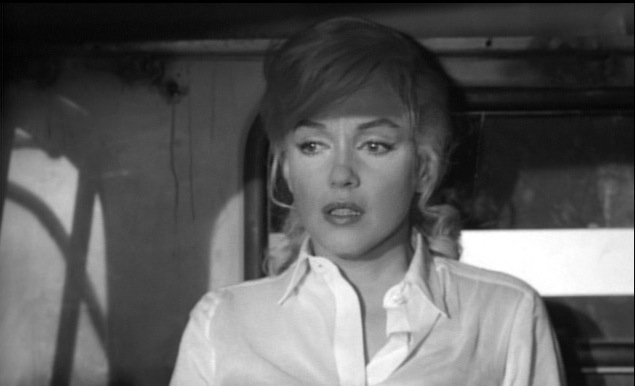
THE MISFITS (1961) was just on TCM and for a big chunk of it I was floored by its poetic train wreck qualities and wondered why Marilyn Monroe's performance is often maligned in snootier film criticism as 'uneven'. It's like a bi-polar character written for a bi-polar actress by her bi-polar ex-husband can't get a break in this square ass bourgeois town. Now that we can diagnose and prescribe SSRIs for these sorts of mental dysfunctions, perhaps the problems seem one of acting or writing rather than the deep psychic rifts they were. The old school booze and tranquilizer self-medication regimen isn't as respected as it used to be, alas. The hip Critics able to recognize the fearless genius of bringing her own madness to bear on her performance --leaning into it rather than trying to overcompensate. Critics today feel strange about applauding her bravery rather trying to prescribe her lithium. They don't see how she's staring into death in her way --three of the four leads would soon be dead and the movie seemed somehow to know it. But I guess it's no longer 'cool' to confront death like a kid slamming into an oncoming wave at the beach. That wave might have an undertow, Johnny! You're not to fight waves anymore. Fighting is wrong! 

But the hep cats amongst us know death is where madness and marriage are finally reconciled but the 'now' we are in is much more terrified than we were back in 1961 when atomic annihilation seemed only a motion away. Now it's less about mortality and more about inclusion and representation, of strength and unity. Death barely factors into 'Big Art' cinema at all, unless it's too have a funeral and scenes of crying while watching old home movie loops of some backyard picnic, freeze-framing on your dead daughter while the tacky Howard Shore music moans and minor keys its way deep into your, you know, your heart?

Once upon a time, though, unrestricted booze, cigarettes, uppers and downers access helped great white male (GWM) writers and directors to see into the void without flinching. Titans like Hawks, John Huston, Tennessee Williams, Eugene O'Neill, Hemingway, John Ford, Henry Miller and Sam Shepherd could make movies and plays about cowboys that were really about how to face death, about dying and reconciling ourselves, presuming full well the next bell tolls for thee. Now, with all these new SSRI prescriptions, we can't even remember where that damn void is much less stare into it. The heroism is gone. 

But hey, man, MISFITS still looms tall, for all its faults, and the last family of wild mustangs roaming the wasteland are a handy catch-all metaphor for chain smoking drunk writers, and their indulgent lovers (and the gangsters and big shots that paw them while you watch helplessly from behind your typewriter). Here, in this Arthur Miller-scripted little chamber piece, Marilyn Monroe is both the cherry atop our collective drunk American dream and its hungover, melancholic morning after. She's the enticing gauntlet that you mortgage your soul to grab. And she's the embarrassment when you come too quick and pass out, waking up feeling cheap and ashamed. She puts up with it all, it's part of the job. But she wants more out of her career than playing endearingly daff sexpots, and Miller digs it. He gets her, recognizes that she's the smartest person in every room, forced to couch her genius in breathy baby talk and to resign herself to being ignored even as everyone drools down her blouse. She's used to being alone in a crowd, exiled by her beauty, as if men--being rendered stupid by her allure--can't process her words beyond their shape in the wind. Only Gable's cowboy gets how sad she is. That's what wins her over. But she really connects with Clift, who seems as resigned to death, shell-shocked from bad rodeo falls, as damaged as she is - they're like lost souls, Lake and Ladd, Cage and Shue in LEAVING LAS VEGAS. They don't have to sleep together to share intimacy of the sort Eli Wallach meanwhile doesn't even know he secretly longs for. He can't get bast his crotch chakra, when all the time his heart is broken over an ex-wife whose dream house is an unfinished cottage facing the wasteland of sunburnt eternity.  

Meanwhile, the stand-in for Arthur Miller (MM's newly-minted ex-husband) fumes back there on the Reno divorce court steps, watching Nevada cowboys fall over themselves at his once-wife's feet and secretly venting his spleen against them and her inability to fend them off or make her intellect known, the guys tossing him confrontational stares in between flirts, all resulting (or having resulted) in him feeling like he's being cuckolded every time he and her went out in public. He becomes like Welles childish, insecure cutting off ex-wife Rita' Hayworth's hair and dying it blond for LADY FROM SHANGHAI, a symbolic neutering, a vain (and in-vain) attempt to satisfy his petulant egoic insecurity. 

But unlike Welles, Miller sees beyond his own genius far enough to recognize his pin-up ex-wife's mythic potential. Hayworth's character in Welles' film could be played by anyone --it's generic femme fatale material. But for MISFITS, Miller clearly understood Monroe's full mythic American mirage and the intelligent would-be beatnik underneath it; he saw the bravery in trying to escape from her own demons as well as the public's. As a termite art reward he writes for her these devastating one-liners that become private jokes between herself and maybe us if we're really listening rather than just drooling in the dark. Even if the rest of the world dismisses her quips as 'idiot savant wisdom' she at least has saved herself, the way Prospero saves himself from potentially infected late-coming party guests in MASQUE OF THE RED DEATH.  


And it's Death that must be acknowledged first and foremost if Marilyn is to come into focus. Death! The ultimate marital therapist, it hangs over THE MISFITS like a windless, gnat-filled haze. Death! It hovers over the maiden of madness (MM) as a halo. Death! If you've never had to face it yourself--i.e. in a war, hospital, or crematorium--let me assure you it can be done with sanity intact, if you're drunk. Booze can enable a clear-eyed view of death invisible to the naked, sober, civilian eye (who'd merely shake and tremble like the drunk does sober just thinking about 'wages'. Cigarettes can help you think clearly enough to write about rather than just screaming in terror. But kill you? Yes, that too.

John Huston, like Howard Hawks and few others, saw the inextricable link of death to the cinematic outdoor activities of all men, be they whalers or iguana wranglers or prospectors or cowboys or boxers or detectives. Huston's great literary drunkenness is of the sort one sees in WWI pilots in 1930s movies, the kind only facing death, and seeing your friends die in flames, can endow. 

The similarity of MISFIT's 'freeing-the-horses' climax and the incident of Richard Burton cutting loose the titular lizard in NIGHT OF THE IGUANA (1957) should prove no coincidence but a clear thread in Huston's 60s oeuvre (who made both). In the nonstop stream of barbarism that is civilization through the eyes of the alcoholic, poetic, and bi-polar (the only sane souls around), Huston knows that a single act of compassion just may save oneself, like a kind of ceremonial anti-sacrifice, because 'you are that'. It's this motif that attempts to somehow impose order on the swirl of visuals in Malick's TREE OF LIFE (my sort-of review here), for example, as when a dinosaur merely tags a wounded possible dinner with his foot and marches off (and later a similar gesture is repeated between warring siblings), and it's this gesture--the throwing them back because they're too small, as it were--that, ideally, finally, redeems both womanizing drunks Burton and Gable, and sends ugly Americans like Ms. Fellowes and Guido (Eli Wallach) home to stew any chance they had for love in their own fermenting mason jar juices.

Otherwise, the plots of IGUANA and MISFITS are almost comically nonexistent. In the former, Dick Burton freaks out after getting fired from his job for giving in to the relentless charms of Sue Lyon, then is told weird sad Carson McCullers-style stories of an old maid's two sexual encounters with creepy lonely men while an old man spouts a poem. In the latter, Gable, along with fellow cowboy Montgomery Clift, ropes wild mustangs in the Nevada desert to sell to a dog food conglomerate. Before that they drink with and try to ball Marilyn Monroe while Thelma Ritter acts as a tipsy sort of chaperone, But in these skeletons of plots, the whole world seems to fall apart only to magically reveal that death has the power to pull it all back together.

In MISFITS, it turns out Gahle, Clift, and pilot Wallach have already caught and sold every last mustang in the desert, all bound to be "stacked and canned" as Burton puts it in IGUANA. except for a single hardscrabble family, still hanging on. The strategy: ex-bomber Guido barnstorms them down out of the mountains and into the lassos of Gable and Clift, there waiting at the end of the ravine. Meanwhile, alone in the car, Marilyn has a nervous breakdown thinking about these poor gorgeous wild and free beasts being ground-up, stacked, and canned (Burton's words for modern humanity in IGUANA) so the boys can afford to get her drunk.

A whole reel goes by while the cowpokes tussle over who will release the horses and win MM's favor, all while she convulses in empathic-neurotic pain in the backseat, as do we. But outside on the vast flat plain, her dramatic tantrums seem lost in the wind. Huston films her way downwind, so her shouts are heard only as murmurs. I'm fairly sure, Huston hated her by that time in the shooting, for holding up filming so many times people were getting heart attacks and kidney stones in frustration. But hey, it suits her character. Despite the gorgeousness, she's a drunk through and through, same as the lot of them, so what the hell were you expecting? To gentle her down real nice with the right halter? (five bucks if you recognize that quote!)


But it's a tricky line between a sober actor playing drunk and an actor drinking during shooting and then acting drunker (or less drunk) than he or she is. The sober actor might get all the motions and slurs right, but the insulated bi-polar aspect -- the ability to careen from jubilant to morose, from possessive to ambivalent, from greedy to benevolent from mopey to zen, and back again, like a drunken slow motion slalom -- can only come from the fortified brand of drinking that limits itself to only one or three before breakfast, just to kill the shakes, you understand? And out in the desert heat that kind of buzz-balancing can knock you flat on your dehydrated ass by lunch, let alone holding out til cocktail hour, where you can finally drink in public, and get as sloppy as you want.

We know Burton and Huston drank constantly on the set of IGUANA (and Elizabeth was there, too). And the actors we see in MISFITS are all 'real' drunks, except Wallach. We can feel it. The drinking is legit. That being said, real drunkenness isn't always 'fun' to watch. I used to feel kind of strange when our old neighborhood would have big block parties and all the adults would get smashed and be out all night laughing it up in their lawn chairs while we kids roasted punks and marshmallows, blessedly free of any set bedtime, able, like them, to stay up until dawn. We'd be somewhat alarmed but also thrilled, to see our parents falling off their lawn chairs, hooking up with each other's wives, and belting out slurred folk songs, while we roasted marshmallows and smoked punks to keep the mosquitoes away and played kick the can while the parents roared at their endless dirty jokes around the glowing coals and seemed gradually to get sort of dangerous and unhinged. To me, in my innocence, they seemed like they'd all just been in a bad car accident or been hit on the head with baseballs. They lurched wildly and said contradictory things, punishing us for doing something they told us to do mere moments ago, and then forgetting they punished us and giving us sips of their (horrible-tasting) beer, rubbing our head too hard, then pushing us away again, telling us, at 5 AM, not to stay up all night. 


The main drawback of MISFITS for me is the skeevy presence of Eli Wallach as Guido. Nothing personal against him as an actor. We all love him as the crafty Sicilian seducer in BABY DOLL, but Guido as a character here, with his all-too human sexual frustration and petulant longing for Monroe--is repugnant and tragically mired in biologic impulse. I don't want to see Wallach in anything for weeks after a MISFITS screening. I want to remove him from the scene, as I've tried to do with friends who get drunk and won't stop hitting on other friends at all-night parties, and I feel bad for Thelma Ritter, forced to be the fifth wheel as Monty Clift, Clark Gable, and Wallach all vie for MM's attention like starving orphans at the Charles Dickens bakeshop window. Of course we're not supposed to like Guido, but if not why are we even hanging out with him? Age is supposed to make people wise, and Guido seems an odd fit, like if Mrs. Fellowes stayed up with Shannon and, Maxine, and Miss Jelks in IGUANA and tried to get Burton in the sack herself. There's moments when Wallach cuts in on Gable and Monroe dancing that remind me of De Niro in NEW YORK, NEW YORK. We're like, yes, the guy can act and the guy filming him can direct and the writer can write, but they all forgot an essential ingredient: why we should we spend two hours with someone that this pushy and uncouth? As sensible people we naturally want to ditch guys like Guido at the bar, so we sneak out while he's in the bathroom, bring the cool people back with us, pick up a quarter keg on the way, and then turn the lights out and tell everyone to be super quiet if he comes peering in the window and/or knocking.  I resent that Miller underestimates my wally-shucking acumen!

Then again, it is his house.

POST-SCRIPT 7-5-15- Interestingly, I'm half-watching this again on TCM and not getting this skeevy Wallach vibe at all. It's clearer that he respects both the boundary of Gable-Monroe (who've been living together a week somewhere between their first trip to the half-finished house, and the day of the rodeo, which I missed in the past) and he's nice to Thelma Ritter --together they're like the fifth business of the play - the secondary romance between the man's butler and the maiden's maid, so to speak, though they're just buddies. His bemused tolerance of her bespeaks to his character- though he gets skeevy later it's still nice to see him less loathsome than I recall via this post.

POST-SCRIPT 8-7-16 - Interestingly, I'm half watching this while spanking my sphinx (don't ask) and notice --as I never did before--that Gable and Monroe are supposed to have spent at least a few weeks together shacked up in Guido's unfinished house in between the day of the rodeo and the last time Thelma and Guido were there--time enough to build a garden at least-- and Marilyn's brilliant observations--ignored by the rest of them for the brilliance they are--and Clift's shattered face and wobbly drunkenness and the way everyone is so hammered all day at the rodeo, not just Clift, nor Monroe, nor Gable but Wallach, too--I don't remember any of that. Last time I was blinded by my dislike of skeevy Guido; this time I'm not overly horrified by him, nor enthralled by Clift or Gable by contrast (Gable's mush-mouth drunkenness seems tragic; he makes a spectacle of himself in a great powerful scene (was he really drunk? It sure seems that way). I also noticed details in the ride home from the rodeo with Gable passed out in back of the station wagon, Clift sleeping on her Marilyn's lap in the backseat, and Wallach weaving over the yellow line while looking backwards and cresting 90 mph. " Now I respect Wallach's existential loneliness, he 'gets' Rosalind in ways Gay and Monty don't --he's impressed by her sensitivity ("when something happens to someone, you care.") and is wiser to his own failings; he just doesn't know any other way to reach Marilyn except through sexual come-ons --and though it's kind of repulsive, it's because we don't want to own up to feeling that way herself. He wants what Gable has, and Clift has with her- a kind of stray puppy playing with a young girl kind of affection. He's tragic. And Marilyn is tragic (even Clift makes a kind of sad play for her in the end) and Gable is tragic (he's got tombstones in his eyes). and he knows it. 


To confess, I guess I developed a deep Guido hatred from being in a band in college, which meant having a hot girlfriend and regularly throwing big drunken parties wherein I had to regularly fend off the sexual mustang-hormone snarky needy skeevy bastards with their denim jackets and terrible townie teeth that hung around her and clawed the turf and snorted coke through their bovine nostrils and got all mean and grew ugly devil horns after I cut in and/or kicked them out for daring to try and traverse the yawning chasms of charisma between them and my gorgeous girl. So yeah, I hate the Guidos and the wallies and the dirtbags. And when their scummy bullying come-ons trumped my poet boozer moodiness, I formed a permanent resentment.

In other words, Arthur Miller, I feel your pain. 


It's not fair to him, of course, because he had an unimpeachable literary rep, so the heat was on to perform as a genius and he must have been suffering from the same anti-wally poison due to being the envy of every man alive. There's a Charlie McCarthy Show (radio) episode where Charlie and Marilyn are running off to get married, and when the world finds out he's chased by legions of angry soldiers and sailors trying to prevent it. Everyone chimes in, from Arthur Godfrey ("by golly, there'll be no commercials today") to Winston Churchill ("never has so much... been taken away from so many... by so little.") Even the justice of the peace tries to steal her away ("Mrs. Monroe, I'm a bachelor steady habits").

Surely passing sailors and soldiers didn't view splintery ectomorph Arthur Miller as competition in the virile red blooded satyr category, any more than they did "woodpecker's pin-up boy" Charlie McCarthy. Guido seems to be the receptacle for all that passive aggressive rage Miller surely felt against all the slavering legions - he's the trog everyman who knows he'll kick himself for days if I doesn't at least make a try for that blonde brass ring. I can vouch that it's a horrible, powerless feeling being the Arthur. People mistakenly think it's a prestige position --the envy of every man--but it's hard to keep 'earning' her in their eyes, no matter if they're perfect strangers. There's almost nothing you can do about it that doesn't look childish on your part. (My strategy: spill my drink on their shoes, but I rarely did since I loved booze too much to throw it away.) I avoided dating really hot girls, but keeping them as friends if possible --to be the Clift, so to speak, rather than either the Guido or the Gable. But then again, I've got tombstones in my eyes too. 

Perhaps it's no accident then that Wallach is the only actor still alive in real life as of this writing, as if watching all the other cast members slowly vanish in the desert wind like shimmering horizon angels left him cursed with longevity (the reward for self-hatred). The other actors found 'the highway under the big star' and left Eli behind to fly his damned crop duster "without ever being able to land."


Then there are the wild mustangs in that desert valley. You can wonder why Gable doesn't realize that he, himself, is the reason there are no more wild mustangs in the canyon. His attitude in roping them, so casual about the preciousness of animal life, tells us he's a true cowboy and maybe cowboys--courageous as they may be--are all sociopaths. Maybe all hunters and soldiers have to be immune to their fellow creature's suffering just to keep from cryin'. Gable's blind to having drained the mustang bottle, but Marilyn knows those poor mustangs are just like her --caught in the thresher of dirtbag male desire. The horses bring money for booze which the cowboys feed to her in an effort to get her into bed. Guido then offers to free them if it means her can get her into bed without the bottle (thus 'landing' in however patchy a field) which skeeves MM and us all out--like he's holding the horses hostage--and Clift is just too sensitive, too banged up, to deal with her pain, beyond a sympathetic gaze.

By all accounts Clift and Monroe were both half out of their minds on booze and pills during the torturously long location shoot and the wild-eyed, emotionally battered vulnerability they display is not just acting. Though still charismatic in certain angles, overall Clift looks like shit, with visible broken nose ridge fracture, smashed puffy face; he seems super out of it even before he's kicked by a bull, like "that bull had the whole Milky Way in its hoof!" (was his character's beat-up look a way to rationalize the obvious damage to  Clift's face?) 

And the Marlboro cowboys all thrown up against the barb wire tracheotomies of Reno, legs wrapped up in kids' paddleball strings, noses bloody from getting kicked by bucking broncos, faces paralyzed in car accidents, faces bloated by booze and "another roll of pills"-- and they shall lament there's no more hosses to rope for dog food, and the pills are harder and harder to get now that the jig is up, and the dogs that ate the food there was are all dead from old age and Clift and Monroe never got there at all.

That's progress, like the westward expansion of the dust bowl. The whole final segment of roping the mustangs and Marilyn Monroe freaking out with those big bipolar doe eyes is so painful I sometimes have to walk away from it, but keep it running on the DVD player anyway, and come back in time for that brilliant final fade-out, with Gable and Monroe driving 'home' towards that far off star. No credits, no music, no... nothing. It's not perfect as a film but as Death's desert Christmas card it's ripe with transcendental mythic inscrutability and that alone makes it a drunken, desperate little triumph. Set it free, Shannon, set them all free, like Monroe, Clift and Gable and the iguana and mustangs are set finally free, and play God here tonight. Run, Marilyn! Run for the hills before the Giancana beach boy's cannibal hot pots claim your sweet gropeworthy fetlocks and your mustang hips are devoured by the ravenous eyes of our collective Anubis.

Tuesday, June 02, 2009

"There isn't any other song": Niagara (1954)


To celebrate Marilyn's special day (yesterday, June 1), I want to celebrate NIAGARA all over again!

NIAGARA is my favorite Marilyn Monroe movie (dramatic category), with her performance and form-fitted red dress so perfect against the misty location shoot backdrop that I play it constantly during my more stressed moments, both soothing (the water) and distracting (the curves). DON'T BOTHER TO KNOCK and THE MISFITS feature more nuanced (as in vulnerable, batshit crazy) MM characters, but neither quite captures the cunning sexual potency the actress was capable of. In most of her best known films she's kinda dumb, gullible, led by sex as if a leash, but in the best like NIAGARA and GENTLEMEN PREFER BLONDES that iconic allure is more a weapon she employs to her own ends. Unlike in SOME LIKE IT HOT, she doesn't wind up with the sticky end of the lollipop. Instead she is a femme fatale par excellence. The dysfunctional death drive underpinning her allure is elegantly tapped into via the iconography of the falls--the dangerous currents and harsh downward rock dash underneath the staggering beauty--realized brutally in the crushed soul of Joseph Cotten as her cuckolded older husband. He's a bit of a loser, and I can sure relate. My wounds from going over the dge still haven't healed.

Death drive or no, falling for Marilyn has always seemed to me like a bad idea, like Dracula in reverse: Dracula takes and takes, MM gives and gives until you just have to run and hide in a dark cool corner, which is almost worse. Most protagonists in MM films are tempted by her unyielding yielding but manage to escape before it's too late. Joseph Cotten's shell-shocked sheep rancher George Loomis isn't so lucky. He starts out this 'vacation' already worn to a shaky "In the Gloaming" rocking chair nub by her rapacious hungers. A kind of flyover state version of Emil Jannings in the Blue Angel, he's realized too late that his hot young trophy wife is a "tramp" on whom he's flitted away his ranch and life's savings to buy expensive gifts and dance club bar tabs to no avail other than staving off the inevitable. Their stay at the falls is supposed to heal their rift but she's actually luring him there to make him jealous and crazy in front of the other motel guests for purposes too shocking to reveal here. Suffice it to say, even though he's far from sympathetic, Loomis gets our sympathy, and when you sympathize with someone who gets to sleep with Monroe, you know something's wrong.


Some claim Cotten is "miscast" in the role of George Loomis. I think miscast is the whole point: Cotten represents any mortal male who gets sucked into the rushing deadly flow of Marilyn's hot voodoo and has no choice but go over the side and and plummet to the rocks below. He's every "human" male in the audience who longs for Monroe's quivering form but knows, deep down, if he got her in real life she would destroy him. She'd leave him broke and broken-hearted, much the worse for having ever gotten involved since now he could never enjoy "mere life" without her luminous allure in his private constellation.

And yet they all nonetheless also know that if she cast her eye their way, they'd still jump into that lethal current like a lemming, tossing savings and sanity to the wind in her wake.

Wouldn't you?

Contrasting this doomed tragicouple are a pair of clean-cut marrieds (Casey Adams and Jean Peters) on their belated honeymoon. While producer-writer Charles Brackett treats George Loomis like a tragic fall guy hero, Casey Adams' grinning all-American Madison Avenue square is lampooned ala a Frank Tashlin comedy. "We're the Cutlers!" he announces from his convertible driver's seat as they pull into the cabin grounds, as if he expects everyone to cheer and break out the sparklers. He brings his books to "catch up on his reading," to which the Canadian border patrolman--scoping out Peters' sexy body in the passenger seat-- shakes his head in sad disbelief. Sheer thickness of skull has apparently shielded Mr. Cutler from the monstrous sublimation of sex that constitutes his plastic fantastic Madison Avenue scene. For him, Monroe's hussy walk is alluring--"Get out the fire hose!" he says when she saunters by that evening--but he'd never dream of pursuing. He doesn't even pursue his wife, except to take cheesecake shots of her sunbathing. He's like a cardboard clone shaped by the average 50s TV commercial. Surely the production code never thought a guy like this would be the result of all their moral meddling. He's enough to make the Pope send for Mae West.

His wife Polly (Peters) is allowed to be much more restrained and human, meanwhile, and her big scene with Loomis in his petulantly trashed cabin offers a moment of genuine connection, probably the only one in the whole film. Unlike their American dream caricature mates, the more restrained Polly and George linger in shadow as a gloomy contrast: real characters, with sorrow and quietude in their natures (they're the Brando and Simmons to Monroe and Adam's Sinatra and Blaine), struggling with the shrill farce that passes for 'normal' in 50s America. But opposites attract, and though these muted key types might find some weird bond, they are chained to their respective "phonies" like life support.

Another reason I dig this film: the soothing quietude -- the rush of the falls-- is constant and reassuring. When George or his boss (Don Wilson, from the Jack Benny show) aren't bellowing and guffawing, it's totally serene. The score only bursts to life during key moments of danger or foreshadowing of danger. Otherwise there is only the ambient, soothing rush of the falls, both comforting and eerie, everything a film you watch over and over on DVD in an insomniac haze should be (it's a great white noise machine of a film). The quiet emptiness of the town in contrast to the mad rush of the falls creates a sense of contemplation (when I was there, with a Monroe-level gorgeous Italian-American girlfriend after graduation (I wasn't the Loomis yet, that came later, when we moved to Seattle together), it was similarly deserted, though everything was open --eerie and wonderful). You can imagine Siddhartha ending up working as a motel manager around there, attuned to the profound mystic frequencies, and perhaps he has, and is even there now... yet the environment functions also both as a classic "automotive tourist trap" and a perfect backdrop for Monroe's fatale américain scheming. The result is a movie as durable as a life preserver, the perfect film to keep you cool during the hot summer city months. You'll be as glad to have access to the beauty of Monroe and the falls as you are grateful in the end to be dry, home and in love with a nice safe mortal.

(a different form of this article originally appeared in Bright Lights After Dark 08)
Related Posts Plugin for WordPress, Blogger...