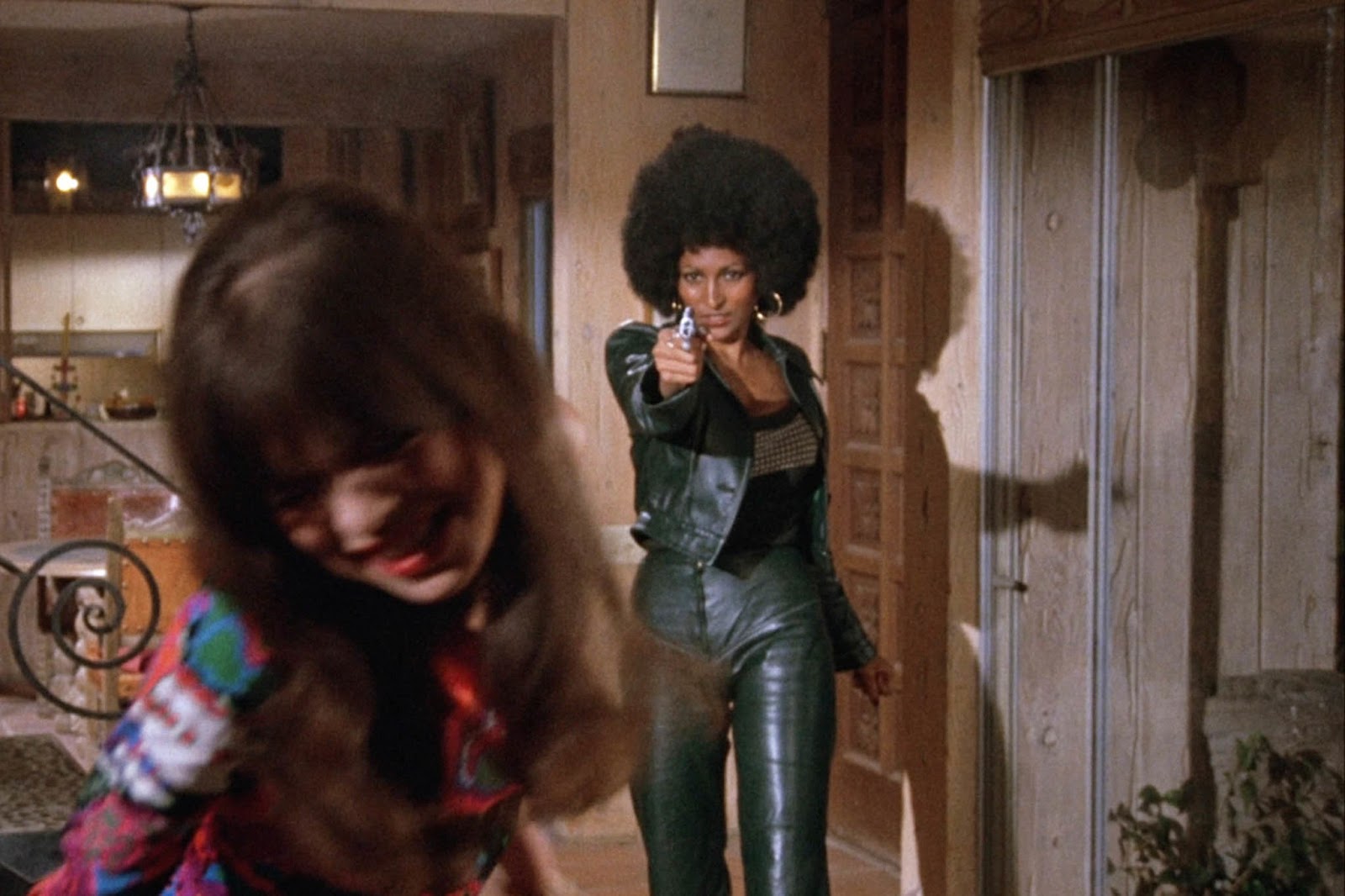

That was New World's golden era, with natural breasts, wry wit, deadpan nonchalance, crazy stunts, social urgency, cool, compassion and something I call 'libsploitation'. New World capo Roger Corman's habit of hiring young, unproven talent fresh from film school paid off all over the place beyond just Scorsese and Coppola, with kids who knew these cheap fast and out-of-control films could hit the marks and still resonate with goofy full-steam ahead cut-the-crap energy.
 Here are seven films I recommend-- all but two of them looking great in remastered HD prints streaming free on Prime. They may not be Gone with the Wind, but they're way shorter and are more integrated. They come to you with good pedigrees (John Sayles, Lewis Teague, Angie Dickinson, George Armitage, Jack Hill), are over in under 90 minutes and--most importantly-- they don't take themselves too seriously nor too lightly. Funny, sure, but not in a hokey, campy self-aware (i.e. Troma) way, these films are (mostly) from the pre-Jaws / Star Wars era, the time when the drive-in was aimed at adults. They might be driving around in shag carpeted vans, but they were still (relatively) mature.
From what I could tell as a kid in them, to be an adult in the 70s was to understand the superiority of actual car crashes, seeing movies on the big screen, not being so repressed (no one went to the shrink unless they were dying). actual, natural curves. They understood the need to hear the crunch of steel, they knew where where the nipple naturally occurs on a human breast, and that pubic hair wasn't gross, but sending pictures of your penis around was. In the 70s a man could be laid enough to not wind up a skeevy troll. In the 70s a woman could be the aggressor in sex without it indicating repressed childhood trauma. Sex wasn't 'problematic.'
Then.
Yes, maybe it turned out to be problematic, but no one knew it at the time. There's more than just bliss in ignorance, sometimes, there's virility.
And now you don't even have to hide in the trunk to escape paying your bloody and just-dessert dues. The screen has widened once more. All the shit shot on video for square screens can hit the curb! The 70s even junk movies were shot on 35mm and widescreen. That quality is now restored, HD New World 70s seven... begin now!

One of the first films made by Corman's new label, New World, and a home run right out of the gate courtesy the great Jack Hill. Filmed it in the Filipino jungles with a brigade of hot American starlets, and Sid Haig as a fruit vendor/smuggler, it's the quintessential Women in Prison movie. Pam Grier in her feature debut sings the title song ("99 Years"), her signature swirl of raw toughness and empathic vulnerability is already in full effect; Brook Mills is her junky squeeze; Pat Woodell is a political prisoner, teaching her cellmates how to shoot machine guns; Roberta Collins is the tough blonde who's only looking out for herself, and advises the newbie (Judy Brown) to do the same. It's Collins who gets the movie's best line ("you'll either get it up or I'll cut it off!") as she's so sexually frustrated she even tries to rape Sid Haig's nervous assistant Fred (Jerry Franks).
 Naturally warden Dietrich (Christiane Schmitmer) and her sadistic head guard Kathryn Loder won't tolerate such flagrant breaking of house rules. So while the mysterious figure in a black hood watches from behind some black netting, Loder lets her hair down and goes to work. The new (male) doctor protests all the bruises on the patients but Dietrich dismisses the inmate's complaints as a lot of gossip and imagination. Who's the doctor going to report these abuses to in a country so corrupt? There's no choice but to revolt!
Even if you despise WIP genre, Big Doll House earns its freedom from condemnation. It's filmed largely on cool sets (or at any rate indoors) with great lighting and camerawork and far fewer tedious slogs in showers, mud and torture rooms than the films that came after. Calling it a WIP film is like calling Corman's Wild Angels (1966) a biker film. There was no such thing as a 'biker film' before Wild Angels. Everything that came after Corman's huge surprise hit was an imitation, i.e. part of the biker movie cycle, including--if you'll forgive me for saying so--Easy Rider. They poured them into the drive-ins so fast we're still trying to figure out which one is which even today.
It's the same with Doll House, it's not following any markers. The girls are looking at classic Warner Bros. movies like Each Dawn I Die and 20,000 Years in Sing-Sing for their cues, and shrugging off their welts like Cagney or Bogart, see? These chicks are tough!


Beautifully shot at Cinecittà Studios Studios in Rome, there's enough vivid tactile detail in this saga of female slaves forced to fight each other as gladiators that you can practically feel the roughness of the catacomb floor underneath your sandals. The fantastic cinematography is, believe it or not, by Joe D'Amato (under the alias Aristide Massaccesi) and it's produced, clearly with great care, by Mark Damon (the hero in Corman's Fall of the House of Usher). Though the mood is ultimately downbeat, one can't argue with the fury of Pam Grier and her cool chemistry with dynamic Margaret Markov as the two best fighters, and partners in an ultimate revolt. Markov and Grier were by now a proven fighting team, having been in The Hot Box and Black Mama White Mama before this. It must have seemed they were forever enduring abuse in Filipino prisons and gladiator pens before wreaking cathartic vengeance in their violent dashes to freedom. (This would be Markov's last, as she married Damon and went over to the business side). Though the whole thing is a bit rote in its round the 'debauched ancient Roman bend', there's a mincing gay character, a gluttonous arena owner, the contrasting innocence of the girls' pre-abduction rituals (Celtic for Markov, African tribal for Grier), demeaning slave auctions, light shaft-lit steam rooms, food fights, etc, we get what pleasures we may such as Grier getting to do her funky African war dance, twice! Familiar faces like Marie Louise and Rosalba Neri help us feel like we're not too far from home.

I don't want to go into detail of plot but will tell you that their climactic catacomb escape is tense, violent (the ladies really do know how to fight), and the final outcome always questionable. There are attack dogs, there are jumps, there are deaths. In New World WIP-style films, the rebels are never guaranteed any measure of success. They can easily both die or get sent back. Besides, where does one go when the whole civilized world is run by Rome? Ah well, maybe they'll make it. And in the meantime, while they may be slaves but at least the girls are eating well, have access to wine (Lucretia Love plays a slave who develops into quite a lush - now that's a successful escape), and no one goes to sleep sexually frustrated or forced to tame their wild lovely 70s hair (this ain't goddamned Handmaid's Tale.) The Roman audiences may be too close to modern TV watchers for the average TV watchers' comfort--but hey, deal with it.
The main reason I include it this in this list however is what it doesn't have: the terrible bangs and the stilted 'Roman' speech patterns that equate pontification and leather sandals with importance. What it does have: action! thrills! Pre-Christian morality! Grier and Markov together again and sticking it to the patriarchy! Brevity! And with Prime's HD upgrade, the blackness of those catacombs is so deep it's like the screen becomes 3D (at least on my groovy Sony Bravia, the best TV ever made!)
On the downside: is Markov dubbed by a different actress?

 And that’s all before she becomes “The Lady in Red” who was with Dillinger the night they shot him down. And after that, the real fun begins. In addition to the cathartic vengeance and valuable socialist lessons, subtextually it’s a big middle finger to the petty morality of the post-1934 production code gangster movies, and yet throughout its mayhem and amoral glee, Lady tells an absorbing story, rich in period detail, with a large cast of characters, all deftly sketched, complexly (for this sort of film) motivated and interesting.In addition to Martin, there familiar faces are Christopher Loyd as a sadistic gangster, Louise Fletcher as the madame, (she gets in a searing monologue toward the end)…and Corman regulars like Dick Miller. Robert Conrad is Dillinger and the only guy in the cast who can’t seem to get the TV out of his blood, but that’s okay; he dies quick.

Produced for New World by Roger Corman's cool brother Gene, directed by old Republic serial journeyman William Witney and written by the great George Armitage (Gas-s-s-s, Miami Blues), here's a real find for the lovers of the weird. If you mesh something like Beach Blanket Bingo with Duck Soup and Shelly Duvall's Mother Goose's Rockin Rhymes, and a Bugs Bunny cartoon if Elmer was a cop (played by Dick Miller, of course, but then made it all uniquely and totally black fantabulous (ala The Wiz, then the rage on Broadway), you'd get--exactly--this urban satire fairy tale set in what I think is supposed to Watts (actually Tennessee, according to imdb) or just of a surreal Monkees-meet-Parliament on Electric Company alterna-reality. Ether way, it's dynamite stuff. The loose plot has Syreena (Trina Parks), member of a superhero-like gang of decked-out 'trikers', trying to find her abortionist mom, Cinderella, who has disappeared, possibly the result of a dastardly white man plot (lots of upstanding young black men are missing too).
Pursued along the way by KKK members on dirt bikes and inept cops with a giant siren on their car (that makes UFO noises), Syreena encounters bizarre characters like the 'Pot-Sicle' man, who sells drug-infused ice cream (I really wanted the 50/50 LSD peyote bar, but couldn't get my money through the screen), and tries to recruit a super cool detective who's feeling left out since no one has abducted him yet. ("Maybe it's like rape," Syreena says with a gyrating movement, "you have to ask for it.") Armitage's script (probably heavily improvised with the cast, knowing his style) is full of wild lines that fly fast you can't even cognize their greatness. And though Roger wasn't involved you know this is from the Corman school of moviemaking: constant movement during dialogue scenes keeps the eye busy. This is a movie where no one ever sits still. If they do, a strolling band of sweet harmony singing brothers materializes out of the park and the whole thing hits another level.

It's more than a single viewing can take in, and it would maybe not be worth it if not for the great comedic timing of Trina Parks. Whether disguising herself as a traffic cop, or a nun to get a inside the evil Colonel Cross's (Norman Bartold) southern-fried plantation mansion, she surfs the madness with a wry shrug and deadpan groove that sets a mighty fine tempo and mood. If she played it too straight it would be as much of a drag as if she did it too campy, instead she finds the exact right tenor and rides it all the way. The rest of the cast jive on her energy and each other and the whole thing seems like a wild, fun party that, by the strength of her performance, never devolves into an incoherent fracas.
Seeing this on Prime and recognizing genius in it, well your mileage may vary especially if you have a hard time with 'jive' slang as written by white people (or, like in a Russ Meyer script, made-up slang no one really says in real life, but damned if they shouldn't) layered improv dialogue and action not always decipherable in the mucky mix; luckily-- on Prime--you can access subtitles.
And coolest of all, as with Armitage's Gas-s-s-s, one is free to wonder if the non-sequiturs and tripped-out combo slang are what was in the script or just jumbled together on the spot by the 'game for improv' cast (Corman and Armitage are both heavy proponents of improv and in-the-moment variation) Either way, no matter how much of it is accidentally offensive (as a straight white male I'm recused from making judgments thereto), accidentally brilliant, or just plain inept, you can't very well argue that it's unique, and oftentimes WTF-level hilarious, stirring, and divine. Maybe that's why it's so rare - god damn it needs remastering! The quote picked up by Prime for their description (both Michael Weldon and Ebert say it in their reference books) is that the costumes alone are "worth the price of admission alone." I say they're worth bugging Shout or Olive to do a Blu-ray version for, too. Someone rattle the chains and set this Cinderella free upon the world.
As you might guess, Tarantino is also a fan of Darktown Strutters. I'd never heard of it before last week (or if I did I got it confused with the song "Darktown Strutter's Ball," and then imagined boring biker movie / hustler convention-style documentaries so stayed away) but now I've already seen it twice and can't wait until I see it again. I only hope Shout or Olive release a remastered Blu-ray soon (I'm dubious about the Cohen disc) Meanwhile, who knows what weirdness might bubble up from Prime's fathomless basement next!!
Luckily we can still find these gems on youtube, albeit in worse quality even than the Prime print of Strutters. (There is a DVD-R Strutters version though I'm afraid the quality is the same - anyone seen it?).


-->

From what I could tell as a kid in them, to be an adult in the 70s was to understand the superiority of actual car crashes, seeing movies on the big screen, not being so repressed (no one went to the shrink unless they were dying). actual, natural curves. They understood the need to hear the crunch of steel, they knew where where the nipple naturally occurs on a human breast, and that pubic hair wasn't gross, but sending pictures of your penis around was. In the 70s a man could be laid enough to not wind up a skeevy troll. In the 70s a woman could be the aggressor in sex without it indicating repressed childhood trauma. Sex wasn't 'problematic.'
Then.
Yes, maybe it turned out to be problematic, but no one knew it at the time. There's more than just bliss in ignorance, sometimes, there's virility.
And now you don't even have to hide in the trunk to escape paying your bloody and just-dessert dues. The screen has widened once more. All the shit shot on video for square screens can hit the curb! The 70s even junk movies were shot on 35mm and widescreen. That quality is now restored, HD New World 70s seven... begin now!

1. THE BIG DOLL HOUSE
(1971) Dir. Jack Hill
*** / Amazon Image - A+
 Naturally warden Dietrich (Christiane Schmitmer) and her sadistic head guard Kathryn Loder won't tolerate such flagrant breaking of house rules. So while the mysterious figure in a black hood watches from behind some black netting, Loder lets her hair down and goes to work. The new (male) doctor protests all the bruises on the patients but Dietrich dismisses the inmate's complaints as a lot of gossip and imagination. Who's the doctor going to report these abuses to in a country so corrupt? There's no choice but to revolt!
It's the same with Doll House, it's not following any markers. The girls are looking at classic Warner Bros. movies like Each Dawn I Die and 20,000 Years in Sing-Sing for their cues, and shrugging off their welts like Cagney or Bogart, see? These chicks are tough!

Highlight include the Collins 'seduction' of Fred; with great pinkish lighting illuminating her heaving pink jailhouse frock, she makes the best use of her full-throated, nearly Meyer-esque lines and sends the whole thing up to another level. I also like Mills' crazy dance around the cell after Grier gets her high (and her anguished withdrawal when Grier runs out of supply) and Woodall's tough performance under torture and later with machine guns in both arms - she underplays so tough you get chills. . Hill delivers a great long tracking shot following the girls as they leave the yard and go into the cane rushes so Grier and Collins can have their big mud fight, all walking slow and Wild Bunch-evoking badass nonchalant. And when in their shared cell the girls are all lovingly framed in wide medium shots - their brushed long hair and luxuriant limbs (it's the tropics so they're always in shorts) displayed with languid sultry (non-leering) cool. Loder is genuinely spooky as the torturer head of the guards, with just enough Nurse Ratchet surface warmth to chill the blood all the more when she takes off her cap and lets down her wild long hair (underlit with a green eerie horror movie glow).

On the down side: Sid Haig is way too jokey and over the top, overdoing a hammy southern accent and shouting his lines rather than following the deadpan approach of all his comely co-stars.
The new HD transfer on Prime makes the Philippines, finally, look livable. Color grading has been done with such loving care (take close notes of the rose hues in Collins' skin hues vs. the pink prison uniform above -poetry) that it seems like a cool, breezy paradise rather than the sweaty, waxy humid hell it always looked like on VHS.

Angie Dickinson stars as a good-hearted, sexually voracious Depression-era backwater widow who brings her two nubile daughters on the road for a life crime, hooking up with various outlaw lovers and sexy hostages. The sisters are played by Switchblade Sisters' Robbie Lee and Candy Snatchers' Susan Sennett. Dick Miller is the increasingly frustrated FBI man in dogged pursuit (wild period car chases and crashes galore). Machine gun-waving desperado Tom Skerritt hooks up with the girls, fall first for Angie, but winds up bedding both the sisters instead when gentlemanly sharpie William Shatner (with an unconvincing antebellum accent) joins up, takes over Angie's conjugal duties, and helps the gang move into high society, i.e crashing tony social events and robbing everyone at gunpoint.
A big rollicking hit, Corman followed this up with a slew of imitations, none of which measure up (with one exception, Lady in Red -below). Unlike Demme's dated Crazy Mama, this doesn't confuse 'rollicking' with goofy - there's no sped-up car chases with cartoon sound effects and ragtime music--something AIP for example relied on all too often. Here the characters may be having a blast but the movie never forgets they're playing for keeps --people die- in fact nearly everyone does by the end. The cars might be old Model-Ts, but that just means they flip over easier- they just don't explode as fast as the ones in the 70s. But it's still cool!
Good as that all sounds, what made this huge hit for New World was Angie Dickinson doing nude scenes --in an R-rated movie! Shhh! This was back when things like that were big news: Playboy used to offer celebrities a million dollars and if the said yes, the world took a deep collective breath of anticipation. Angie was neither a prude nor a fool; she did the film for a percentage, smart enough to get rich on her assets, and everyone made out like interstate bandits. This was when girls could be sexy into their forties and all their body parts were real and therefore all the sexier. In fact her sex scenes here but most other sex scenes to shame. We totally get why both Shat and Skerritt would be gaga over her. We sure are.
Most sex on TV and movies now is either rapey (HBO) or this kind of joyless 'smash cut rut' (my term for this habit of cutting from some innocuous greeting right to the middle of some mutually demeaning rutting). But what made sex under Corman's watch so fun is its naturalism: there's goofy laughter and awkward jumping around. Lee and Sennett jump around on the bed and leap on top of Skerritt like he's a big bean bag chair; they're innocents following their bliss without phony bourgeois limitations. I think a lot of patriarchal studio heads today would be threatened by that kind of uninhibited female enjoyment. There's no violence or tired soft focus close-up shots of random body parts. We always know who's in the bed, and who's sulking outside it. Not only are the tasteful they're important to the narrative. Sex is how Mama keeps both men under her spell, and these things have consequences, as when Robbie Lee gets pregnant the first time out losing her virginity.


Grier rocketed to deserved exploitation stardom as the queen of blaxploitation films with this big cult hit-- capably stepping out from her ensemble work in the Philippine prisons of New World and into starring roles back in Los Angels at AIP, which had then gone full blaxploitation (I thought this was New World which is why it made this list, but I wouldn't dare disrespect her by taking it out). Here she stars as a hardworking nurse out to avenge her smack-addicted 11-year-old sister by waging a one-woman war on LA's drug/prostitution racket. First she poses as a strung-out junky willing to do "anything" to get a fix (then blows the dealer away with a shotgun); she threatens to carve up the face of the excellent Carol Locatell as a hungover call girl (pay close attention to her subtle shifts in demeanor once she takes a morning hit from her stash), and finally sets up upscale pimp King George (Robert Doqui) for a great fall. Then shit gets pretty hairy, but she works it out and... well. In between all this, keeps her job as a nurse at the night shift of a downtown hospital.
 What makes Grier's performance here so indelible is the unique mixture of raw anger, sensitivity, unflappable cool, seductive brio, and dauntless courage on the one side, and the obvious emotional toll on the other as she screws and shoots her way up the pusher food chain. Her towering strength always comes with back-end weariness, though a cup of coffee or a Sunday drive with a good man can help. Her "why not?" when her cop friend Carter tells her she can't just run around killing people, is priceless. It's clear Tarantino was trying to capture that mellow openness, the weary but kittenish honesty, during Grier's early scenes with Robert Forster in Jackie Brown.
I know I've written on this before (see Jills of Jack Hill) but that viewing was over Xmas in AZ, when I was in bad shape, hallucinating, junk sick, twitchy, and seeing triple (so it looked like Pam had seven heads) Now, thanks to Prime's excellent HD transfer (nicer than the waxy Blue-ray from Olive) and my own 'straight' headspace, it looks totally different; it breathes and glows and you can feel the slight chill in the salty Pacific coast air. Instead of looking like it's all going down a moldy set slowly collapsing on its sweaty inhabitants, the mise-en-scene now glows and breathes and evokes sets in earlier AIP freak-out films like Psych-Out and The Trip. In this new air it's clear this is the best of all the Hill-Grier collaborations, and maybe the best blaxploitation film, maybe the best Hill film too. The writing and acting are superb in their innocuous subtlety: consider scenes like the post-coital vacation plan-making by Coffy and politician boyfriend (Booker Bradshaw) up at his swanky pad by the fireplace. Their discussion is filmed with her leaning back on him as they both stare into the fire, both are naked, comfortable around each other, the colors of the apartment and the flames of the fire all perfectly complimenting their black skin; they both look into the fire as they talk, in low real person voices. It's such a simple little scene but it's startling how rare scenes like this are in movies: Hill Grier and Bradshaw have made a real moment that enchants in its simplicity. We all remember the catfight at King George's loft party, but there's so much more to savor, so many little bits, the great use Sid Haig makes of an ordinary thug/henchman role, his genuinely chilling sadistic laugh as he drags King George around a junkyard tied to the back of his own car, and his warm regret --he wants her to know it's nothing personal--while driving Coffy to her death.
But the main takeaway is the power a woman might yield when she uses her sex appeal rather than letting it use her. The men Coffy messes with may be bad but they are all constantly in danger of losing themselves to desire for her; her body gives her power over them. It's mind control. And yet, the kind of sex we see in Coffy is practically foreplay compared to the demeaning rutting on TV these days. Maybe in a way that's why Coffy is almost more adult. For Hill's film postulates that maybe casual sex can be mutually rewarding, even on an emotional level, even between mortal enemies.
On the downside Pam's Jamaican accent is awful, mon.

The new HD transfer on Prime makes the Philippines, finally, look livable. Color grading has been done with such loving care (take close notes of the rose hues in Collins' skin hues vs. the pink prison uniform above -poetry) that it seems like a cool, breezy paradise rather than the sweaty, waxy humid hell it always looked like on VHS.

2. BIG BAD MAMA
(1973) Dir. Steve Carver
*** / Amazon Image - A-
Angie Dickinson stars as a good-hearted, sexually voracious Depression-era backwater widow who brings her two nubile daughters on the road for a life crime, hooking up with various outlaw lovers and sexy hostages. The sisters are played by Switchblade Sisters' Robbie Lee and Candy Snatchers' Susan Sennett. Dick Miller is the increasingly frustrated FBI man in dogged pursuit (wild period car chases and crashes galore). Machine gun-waving desperado Tom Skerritt hooks up with the girls, fall first for Angie, but winds up bedding both the sisters instead when gentlemanly sharpie William Shatner (with an unconvincing antebellum accent) joins up, takes over Angie's conjugal duties, and helps the gang move into high society, i.e crashing tony social events and robbing everyone at gunpoint.
A big rollicking hit, Corman followed this up with a slew of imitations, none of which measure up (with one exception, Lady in Red -below). Unlike Demme's dated Crazy Mama, this doesn't confuse 'rollicking' with goofy - there's no sped-up car chases with cartoon sound effects and ragtime music--something AIP for example relied on all too often. Here the characters may be having a blast but the movie never forgets they're playing for keeps --people die- in fact nearly everyone does by the end. The cars might be old Model-Ts, but that just means they flip over easier- they just don't explode as fast as the ones in the 70s. But it's still cool!
Good as that all sounds, what made this huge hit for New World was Angie Dickinson doing nude scenes --in an R-rated movie! Shhh! This was back when things like that were big news: Playboy used to offer celebrities a million dollars and if the said yes, the world took a deep collective breath of anticipation. Angie was neither a prude nor a fool; she did the film for a percentage, smart enough to get rich on her assets, and everyone made out like interstate bandits. This was when girls could be sexy into their forties and all their body parts were real and therefore all the sexier. In fact her sex scenes here but most other sex scenes to shame. We totally get why both Shat and Skerritt would be gaga over her. We sure are.
Most sex on TV and movies now is either rapey (HBO) or this kind of joyless 'smash cut rut' (my term for this habit of cutting from some innocuous greeting right to the middle of some mutually demeaning rutting). But what made sex under Corman's watch so fun is its naturalism: there's goofy laughter and awkward jumping around. Lee and Sennett jump around on the bed and leap on top of Skerritt like he's a big bean bag chair; they're innocents following their bliss without phony bourgeois limitations. I think a lot of patriarchal studio heads today would be threatened by that kind of uninhibited female enjoyment. There's no violence or tired soft focus close-up shots of random body parts. We always know who's in the bed, and who's sulking outside it. Not only are the tasteful they're important to the narrative. Sex is how Mama keeps both men under her spell, and these things have consequences, as when Robbie Lee gets pregnant the first time out losing her virginity.

I'd never really heard of Steve Carver before watching this recently for this post, and then I noticed he also did the The Arena (below) and Lone Wolf McQuade! In other words, he's the type of journeyman that somehow never stuck out for notice the way, say, Arthur Marks and John Flynn have recently stuck out, thanks to post-Tarantino crime revivalism. Shall his time too, not come? Ask anyone and they'll agree: Big Bad Mama is one of the quintessential New World pictures-- it has all its good parts and none of its bad, and the same goes for the lovely Amazon Streaming Image quality (the colors seem a little faded but it's possible it was intended that way to lend an old timey sepia tinge).
--
On the downside, Shatner's southern gentleman accent is awful. And PS - Jim Wynorski's sequel BIG BAD MAMA 2 is also on Prime, albeit in full frame VHS dupe style, which is clearly all it deserves. Angie is in that one too, and--ever the trouper--she still gives it a good god-damn go, even though the care and love that went into the original is replaced by a kind of bachelor party costume theme tawdriness (the boys have that terrible mousse-sculpted hair of 80s porn stars). AVOID AVOID
--
On the downside, Shatner's southern gentleman accent is awful. And PS - Jim Wynorski's sequel BIG BAD MAMA 2 is also on Prime, albeit in full frame VHS dupe style, which is clearly all it deserves. Angie is in that one too, and--ever the trouper--she still gives it a good god-damn go, even though the care and love that went into the original is replaced by a kind of bachelor party costume theme tawdriness (the boys have that terrible mousse-sculpted hair of 80s porn stars). AVOID AVOID

3. COFFY
(1973) - Dir Jack Hill
**** / Amazon Image - A+
**** / Amazon Image - A+
Grier rocketed to deserved exploitation stardom as the queen of blaxploitation films with this big cult hit-- capably stepping out from her ensemble work in the Philippine prisons of New World and into starring roles back in Los Angels at AIP, which had then gone full blaxploitation (I thought this was New World which is why it made this list, but I wouldn't dare disrespect her by taking it out). Here she stars as a hardworking nurse out to avenge her smack-addicted 11-year-old sister by waging a one-woman war on LA's drug/prostitution racket. First she poses as a strung-out junky willing to do "anything" to get a fix (then blows the dealer away with a shotgun); she threatens to carve up the face of the excellent Carol Locatell as a hungover call girl (pay close attention to her subtle shifts in demeanor once she takes a morning hit from her stash), and finally sets up upscale pimp King George (Robert Doqui) for a great fall. Then shit gets pretty hairy, but she works it out and... well. In between all this, keeps her job as a nurse at the night shift of a downtown hospital.
 What makes Grier's performance here so indelible is the unique mixture of raw anger, sensitivity, unflappable cool, seductive brio, and dauntless courage on the one side, and the obvious emotional toll on the other as she screws and shoots her way up the pusher food chain. Her towering strength always comes with back-end weariness, though a cup of coffee or a Sunday drive with a good man can help. Her "why not?" when her cop friend Carter tells her she can't just run around killing people, is priceless. It's clear Tarantino was trying to capture that mellow openness, the weary but kittenish honesty, during Grier's early scenes with Robert Forster in Jackie Brown.
 I know I've written on this before (see Jills of Jack Hill) but that viewing was over Xmas in AZ, when I was in bad shape, hallucinating, junk sick, twitchy, and seeing triple (so it looked like Pam had seven heads) Now, thanks to Prime's excellent HD transfer (nicer than the waxy Blue-ray from Olive) and my own 'straight' headspace, it looks totally different; it breathes and glows and you can feel the slight chill in the salty Pacific coast air. Instead of looking like it's all going down a moldy set slowly collapsing on its sweaty inhabitants, the mise-en-scene now glows and breathes and evokes sets in earlier AIP freak-out films like Psych-Out and The Trip. In this new air it's clear this is the best of all the Hill-Grier collaborations, and maybe the best blaxploitation film, maybe the best Hill film too. The writing and acting are superb in their innocuous subtlety: consider scenes like the post-coital vacation plan-making by Coffy and politician boyfriend (Booker Bradshaw) up at his swanky pad by the fireplace. Their discussion is filmed with her leaning back on him as they both stare into the fire, both are naked, comfortable around each other, the colors of the apartment and the flames of the fire all perfectly complimenting their black skin; they both look into the fire as they talk, in low real person voices. It's such a simple little scene but it's startling how rare scenes like this are in movies: Hill Grier and Bradshaw have made a real moment that enchants in its simplicity. We all remember the catfight at King George's loft party, but there's so much more to savor, so many little bits, the great use Sid Haig makes of an ordinary thug/henchman role, his genuinely chilling sadistic laugh as he drags King George around a junkyard tied to the back of his own car, and his warm regret --he wants her to know it's nothing personal--while driving Coffy to her death.
But the main takeaway is the power a woman might yield when she uses her sex appeal rather than letting it use her. The men Coffy messes with may be bad but they are all constantly in danger of losing themselves to desire for her; her body gives her power over them. It's mind control. And yet, the kind of sex we see in Coffy is practically foreplay compared to the demeaning rutting on TV these days. Maybe in a way that's why Coffy is almost more adult. For Hill's film postulates that maybe casual sex can be mutually rewarding, even on an emotional level, even between mortal enemies.
On the downside Pam's Jamaican accent is awful, mon.

4. THE ARENA
(1974) Dir. Steve Carver
**1/2 / Amazon Image - A+

I don't want to go into detail of plot but will tell you that their climactic catacomb escape is tense, violent (the ladies really do know how to fight), and the final outcome always questionable. There are attack dogs, there are jumps, there are deaths. In New World WIP-style films, the rebels are never guaranteed any measure of success. They can easily both die or get sent back. Besides, where does one go when the whole civilized world is run by Rome? Ah well, maybe they'll make it. And in the meantime, while they may be slaves but at least the girls are eating well, have access to wine (Lucretia Love plays a slave who develops into quite a lush - now that's a successful escape), and no one goes to sleep sexually frustrated or forced to tame their wild lovely 70s hair (this ain't goddamned Handmaid's Tale.) The Roman audiences may be too close to modern TV watchers for the average TV watchers' comfort--but hey, deal with it.
The main reason I include it this in this list however is what it doesn't have: the terrible bangs and the stilted 'Roman' speech patterns that equate pontification and leather sandals with importance. What it does have: action! thrills! Pre-Christian morality! Grier and Markov together again and sticking it to the patriarchy! Brevity! And with Prime's HD upgrade, the blackness of those catacombs is so deep it's like the screen becomes 3D (at least on my groovy Sony Bravia, the best TV ever made!)
On the downside: is Markov dubbed by a different actress?

5. TNT JACKSON
(1974) Dir. Cirio H. Santiago
**1/2 / Amazon Image - A
Filipino actor/director/producer Cirio Santiago was a great find for Corman's New World: he could be both producer and director when needed and he knew the New World secret like only a handful of others: if you can't make it good, make it fast. That's certainly true with TNT Jackson - it zips by. If you can get past the first few 'missed-him-by-a-mile with your fake-ass kick and he fell anyway' fights (Santiago doesn't seem one for stunt doubles), this gets pretty slam-bang, and the quality of the image on Prime is terrific. If you've tried to watch this on past VHS versions and given up after five minutes (guilty, your honor), you'll swear it's not even the same movie!

Fresh off the plane, American girl TNT (Jamie Bell) cabs it over to Manilla's drug section to find her fiancee (or brother?) who sent her a strange letter. Within minutes of crossing into this bad area, Jackson gets into about 80 fights. Luckily her lack of karate skills don't get in the way of her wild kung fu hand gestures. We know she's enjoying herself with these crazy, fluid, Bruce Lee-ish hand movements because, frankly, she's not a good enough actor to hide it. Luckily she doesn't enjoy herself to the point she cracks an actual smile, instead rarely departing from her one-note button-nosed pouty frown, refusing all outside aid, refusing even be cordial to the big drug kingpin of the neighborhood, even though there's no immediate evidence he killed her brother, or fiancee (or whatever). There's also a mysterious white lady (sultry Pat Anderson) who also seems to have an agenda concerning all the recently hijacked heroin shipments; it almost becomes her film as much as Jackson's --they fight each other and fight with each other as the shit goes down, and both are awesome. Anderson is a real stealth asset (and can be seen in Santiago's Fly Me if you really want to raid New World's Filipino larder.)
 The real scene stealer though is Stan Shaw (left) as the sartorially splendid kung fu heavy, who Jackson beds, bothers, bewilders, and then beats to a pulp. He's terrific, even if he's pretty dumb in refusing to believe Jackson could cause any trouble since she's such a fine sister in a place where there are almost no other black people. But why is she in Manila anyway, really? His thinking is cloudy, but who can blame him? Jackson uses his desire against him as smoothly as Coffy did the year before against old King George.
Little clues let you know Enter the Dragon had come out the year before, too, and was probably still in theaters. But Jackson has nothing to worry about in comparison, especially once she does her famous topless kung fu fight. Zipping around her bedroom, flipping off the light to run to and fro around her hotel room and the outer hallway--her assailants ever-dwindling in number and fighting stamina as she slowly gets dressed--this tiny little lady earns our loving respect for being both sexy and playful (with all the 'around and on beds' battling it reminds me of my brother and friends and I chasing each other around the upstairs beds as kids - our kung fu almost as fake looking).
As it does with Big Doll House, Amazon's recently upgraded streaming print makes the Philippines look far less clammy and claustrophobic than in its countless past editions. So if you've been waiting, now's the time.
And what about that badass super intense final fade out? One in a million.

This fast moving tale of a young farm girl led into a life of crime, prostitution, communism, love and finally, bloody machine gun vengeance has everything an alienated teenager trapped in suburbia could want in a movie, rolled up tight into a lean 90 minutes. Star Pamela Sue Martin is gorgeous beyond description in the lead. Produced by Julie Corman, directed by Lewis Teague and written by John Sayles (hence the Communist subtext), it’s like one of those high pedigreed rich brainy cool chicks that ruin your life then jet back to Dartmouth while you die in the gutter! And you regret nothing! So much time and attention (relatively speaking, this is Corman after all) is poured int into Sayle’s pinko screenplay and the crafty editing that it zips along at the speed of one of those post-Goodfellas stream-of-narration biopics, (only Lady, see, don’t need no narration). We watch farm waif Polly (Martin) grows up into a machine gun-toting badass believably! There's well modulated character development!. Scenes and situations flow like cheap but tasty wine down an alabaster neck with a black velvet choker, from Polly’s gullible virgin surrender to a fast-talking sleazeball, through taking it on the lam with gangsters, working in a sweat shop and standing by her communist agitator roommate, to being jailed and then farmed off to a house of ill repute where she shacks up with, amongst others, Robert Forster!

Fresh off the plane, American girl TNT (Jamie Bell) cabs it over to Manilla's drug section to find her fiancee (or brother?) who sent her a strange letter. Within minutes of crossing into this bad area, Jackson gets into about 80 fights. Luckily her lack of karate skills don't get in the way of her wild kung fu hand gestures. We know she's enjoying herself with these crazy, fluid, Bruce Lee-ish hand movements because, frankly, she's not a good enough actor to hide it. Luckily she doesn't enjoy herself to the point she cracks an actual smile, instead rarely departing from her one-note button-nosed pouty frown, refusing all outside aid, refusing even be cordial to the big drug kingpin of the neighborhood, even though there's no immediate evidence he killed her brother, or fiancee (or whatever). There's also a mysterious white lady (sultry Pat Anderson) who also seems to have an agenda concerning all the recently hijacked heroin shipments; it almost becomes her film as much as Jackson's --they fight each other and fight with each other as the shit goes down, and both are awesome. Anderson is a real stealth asset (and can be seen in Santiago's Fly Me if you really want to raid New World's Filipino larder.)

Little clues let you know Enter the Dragon had come out the year before, too, and was probably still in theaters. But Jackson has nothing to worry about in comparison, especially once she does her famous topless kung fu fight. Zipping around her bedroom, flipping off the light to run to and fro around her hotel room and the outer hallway--her assailants ever-dwindling in number and fighting stamina as she slowly gets dressed--this tiny little lady earns our loving respect for being both sexy and playful (with all the 'around and on beds' battling it reminds me of my brother and friends and I chasing each other around the upstairs beds as kids - our kung fu almost as fake looking).
As it does with Big Doll House, Amazon's recently upgraded streaming print makes the Philippines look far less clammy and claustrophobic than in its countless past editions. So if you've been waiting, now's the time.
And what about that badass super intense final fade out? One in a million.

6. LADY IN RED
(1979) Dir. Lewis Teague
*** / Amazon Image - C
This fast moving tale of a young farm girl led into a life of crime, prostitution, communism, love and finally, bloody machine gun vengeance has everything an alienated teenager trapped in suburbia could want in a movie, rolled up tight into a lean 90 minutes. Star Pamela Sue Martin is gorgeous beyond description in the lead. Produced by Julie Corman, directed by Lewis Teague and written by John Sayles (hence the Communist subtext), it’s like one of those high pedigreed rich brainy cool chicks that ruin your life then jet back to Dartmouth while you die in the gutter! And you regret nothing! So much time and attention (relatively speaking, this is Corman after all) is poured int into Sayle’s pinko screenplay and the crafty editing that it zips along at the speed of one of those post-Goodfellas stream-of-narration biopics, (only Lady, see, don’t need no narration). We watch farm waif Polly (Martin) grows up into a machine gun-toting badass believably! There's well modulated character development!. Scenes and situations flow like cheap but tasty wine down an alabaster neck with a black velvet choker, from Polly’s gullible virgin surrender to a fast-talking sleazeball, through taking it on the lam with gangsters, working in a sweat shop and standing by her communist agitator roommate, to being jailed and then farmed off to a house of ill repute where she shacks up with, amongst others, Robert Forster!
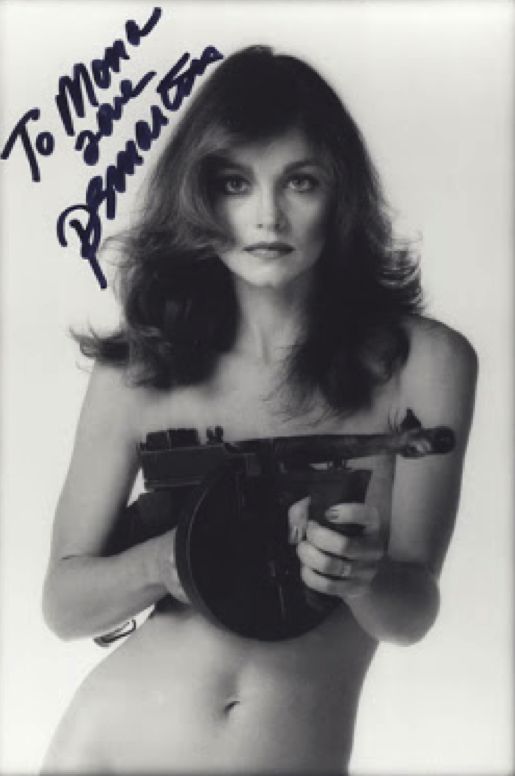 And that’s all before she becomes “The Lady in Red” who was with Dillinger the night they shot him down. And after that, the real fun begins. In addition to the cathartic vengeance and valuable socialist lessons, subtextually it’s a big middle finger to the petty morality of the post-1934 production code gangster movies, and yet throughout its mayhem and amoral glee, Lady tells an absorbing story, rich in period detail, with a large cast of characters, all deftly sketched, complexly (for this sort of film) motivated and interesting.In addition to Martin, there familiar faces are Christopher Loyd as a sadistic gangster, Louise Fletcher as the madame, (she gets in a searing monologue toward the end)…and Corman regulars like Dick Miller. Robert Conrad is Dillinger and the only guy in the cast who can’t seem to get the TV out of his blood, but that’s okay; he dies quick.
So, good lord, with so much talent and beauty and sexy camp flowing through this (great editing too), why isn’t it recognized more widely as a cult classic? Google or remember the words “Lady in Red” and what do you get? That smoov Chris De Burgh song and its shady affiliations with the Gene Wilder comedy, The Woman in Red (1984). Right there it gets confusing. Then, trying to correct the damage, it was re-released as Touch Me and Die and Guns, Sin and Bathtub Gin. Neither one gives the film a good patina – one seems like a morose rape-revenge thriller and the other a lame attempt at 'rollicking' prohibition comedy. I would have renamed it Polly wants a Tommy Gun. But it’s probably too late, it’s already dead by Wilder-De Burgh association… except of course for us few, hard, proud, pipe-hittin’ revivalist hoods like me!
Alas - the Amazon version seems uploaded from the old Corman DVD rather than the newer Shout version: it’s presented in full frame, blurry. Maybe it will inspire you to get the Shout DVD where it comes coupled to the eminently forgettable Jonathan Demme jukebox movie Crazy Mama.

7. DARKTOWN STRUTTERS
(1975) Dir William Witney
*** / Amazon Image - C-
Produced for New World by Roger Corman's cool brother Gene, directed by old Republic serial journeyman William Witney and written by the great George Armitage (Gas-s-s-s, Miami Blues), here's a real find for the lovers of the weird. If you mesh something like Beach Blanket Bingo with Duck Soup and Shelly Duvall's Mother Goose's Rockin Rhymes, and a Bugs Bunny cartoon if Elmer was a cop (played by Dick Miller, of course, but then made it all uniquely and totally black fantabulous (ala The Wiz, then the rage on Broadway), you'd get--exactly--this urban satire fairy tale set in what I think is supposed to Watts (actually Tennessee, according to imdb) or just of a surreal Monkees-meet-Parliament on Electric Company alterna-reality. Ether way, it's dynamite stuff. The loose plot has Syreena (Trina Parks), member of a superhero-like gang of decked-out 'trikers', trying to find her abortionist mom, Cinderella, who has disappeared, possibly the result of a dastardly white man plot (lots of upstanding young black men are missing too).
Pursued along the way by KKK members on dirt bikes and inept cops with a giant siren on their car (that makes UFO noises), Syreena encounters bizarre characters like the 'Pot-Sicle' man, who sells drug-infused ice cream (I really wanted the 50/50 LSD peyote bar, but couldn't get my money through the screen), and tries to recruit a super cool detective who's feeling left out since no one has abducted him yet. ("Maybe it's like rape," Syreena says with a gyrating movement, "you have to ask for it.") Armitage's script (probably heavily improvised with the cast, knowing his style) is full of wild lines that fly fast you can't even cognize their greatness. And though Roger wasn't involved you know this is from the Corman school of moviemaking: constant movement during dialogue scenes keeps the eye busy. This is a movie where no one ever sits still. If they do, a strolling band of sweet harmony singing brothers materializes out of the park and the whole thing hits another level.
Darktown's far-out vibe, hipster madcap pace and DIY school play-style props takes some adjusting to, but if you can lock onto its goofy kinetic pace, its mix of surreal WTF-ing around and jet black social satire becomes a truly sublime trip. A climactic dirt bike chase between Syreena and the Klan can rivet us, for example, but then we don't get irritated if Syreena stops her foe's evil plantation dungeon escape in order to groove with the soulful band the Dramatics, who serenade her from behind bars with their big number, "Whatcha See is Watcha Get." Musicians are supplied by Stax Records. Uncredited soulful serenaders sing film-specific soul groove greek chorus-style commentary, adding to the homespun but so-sweet madness.
 |
| Commander Cross, aka Sky Hog (any resemblance to a white devil purely...) |
Seeing this on Prime and recognizing genius in it, well your mileage may vary especially if you have a hard time with 'jive' slang as written by white people (or, like in a Russ Meyer script, made-up slang no one really says in real life, but damned if they shouldn't) layered improv dialogue and action not always decipherable in the mucky mix; luckily-- on Prime--you can access subtitles.
And coolest of all, as with Armitage's Gas-s-s-s, one is free to wonder if the non-sequiturs and tripped-out combo slang are what was in the script or just jumbled together on the spot by the 'game for improv' cast (Corman and Armitage are both heavy proponents of improv and in-the-moment variation) Either way, no matter how much of it is accidentally offensive (as a straight white male I'm recused from making judgments thereto), accidentally brilliant, or just plain inept, you can't very well argue that it's unique, and oftentimes WTF-level hilarious, stirring, and divine. Maybe that's why it's so rare - god damn it needs remastering! The quote picked up by Prime for their description (both Michael Weldon and Ebert say it in their reference books) is that the costumes alone are "worth the price of admission alone." I say they're worth bugging Shout or Olive to do a Blu-ray version for, too. Someone rattle the chains and set this Cinderella free upon the world.
 |
| Remember when everything looked this bad (i.e. VHS)? |
OTHER GEMS OF OFF-THE CUFF DEADPANARCHY
Currently Suffering in No-DVD limbo!
Most of Darktown's crazier sisters and brothers--the ones that cross over any genre they want without losing their deadpan cool or getting too campy- aren't on even DVD. Is this because they're too weird for the powers that be to categorize? Something like the gonzo adventure of the 1984 Sandahl Bergman-starring She for example, is ostensibly based on the H Rider Haggard novel but throws in every trick in the book, including a hilarious guard who looks like a blonde Paul Thomas and runs through a head-spinning gamut of obscure old radio show impressions; then there's 1978's Get Crazy and Shelly Duvall's Mother Goose's Rockin' Rhymes (1990). None are available. So weird and so wondrous. What are they so scared of, Mary Joe? Rockin' Rhymes was a cable kids' movie. Surely it's safe for modern consumption? Luckily we can still find these gems on youtube, albeit in worse quality even than the Prime print of Strutters. (There is a DVD-R Strutters version though I'm afraid the quality is the same - anyone seen it?).

(1982) Dir Avi Nesher
***
***

(1983) Dir. Allan Arkush
***1/2
***1/2
 |
MOTHER GOOSE'S ROCK 'N' RHYMES
(1990) Dir. Shelly Duvall
***1/2
RELEASE THEM AT ONCE!!
---
See also on avail on Prime in good condition (but not New World... or even AIP):
TRUCK STOP WOMEN (1974)
BONNIE'S KIDS (1973)
THE ROOMMATES (1973)
Other Recommended 70s New World Hits avail on DVD (but not Prime):
BIG TEXAS DYNAMITE CHASE |