

Barbarella's naïveté utopique and Babylonian orgone gluttony may offend our age's born-again prudishness, but it behooves us to remember that--until the little beaks and jaws of a million disillusionments ravaged her--the spirit of psychedelically-enhanced free love was so powerful we still reeled from its effects even in the 80s, by which time it was mostly just vapor. You could call it dated, maybe instantly so, but how far back must we look to go how far forward?
You could go back 3,500 odd years to Shamhat of the Temple of Ishtar, "one of the priestesses who give their bodies to any man in honor of the goddess" (1) who is sent into the woods seduce the hairy pre-Flood Bigfoot-style Enkidu in the Sumerian saga of Gilgamesh or 2,100 years into the future, for a hippie version of the same character, an Earth ambassador of love and sexual manipulation, played with perfect wide-eyed guilelessness by Jane Fonda bedding a hairy guy who saves her life by flogging wild children. Either way, as long as we're not stuck in this drag of a now, when all (straight) sex onscreen consists joyless smash cut rutting (in HBO/AMC doggy style), maybe sex can be saved.
 Conceived by Jean-Claude Forest, director Roger Vadim, and co-writer Terry Southern, even the liberated sex in Barbarella comes with its caveats: People on Earth only make love with exaltation transference pills, pressing hands together "for one minute or until full rapport is achieved," but only if their "psychocardiagrams are in perfect confluence." The liberated Earth people now regard weapons as strictly ancient history: all conflicts are resolved with sex and love. Luckily, Earth's representative in sexual potency, its ambassador for love's forgiving, aligning, transformative power in the galaxy, is Barbarella. A virgin in the 'real' physical realm, she tells her first would-be lover, the "Catchman of the Ice and Forests of Weir," an Enkidu-style hirsute wildman (Uggo Tozzi) -- that "[physical sex] was proven to be distracting and a danger to maximum efficiency." Her eyes widening just a little bit with fear she adds "besides it was pointless to continue if better means of ego support and self esteem were made available!"
Though usually letter perfect, even while so young and impossibly nubile, Fonda occasionally lapses into a vaguely scolding put-on of innocence that hints at her future North Vietnam exploits. When the "rotating president of the sun system"(Claude Dauphin wearing a black boa and talking at her naked breasts) teleports over some space weapons for her mission, she seems quite judgmental ("A weapon? What would anyone want with a weapon? The galaxy has been pacified for centuries!") Noting that the Tau Ceti system might "still be living in a state of erotic irresponsibility" it's pretty clear that--in the eyes of the French, and certainly for ex-pats Fonda and Terry Southern--'ugly tourist' America has replaced sex with firearms. Guns are all over kids' shows, sex and nudity obliterated) But really, man, what's so loving about judging ugly America for its ugliness. As our current political nightmare reveals, you can't fight hate with hate--hate always wins. But if you can fight with love, you can shake Valhalla with a little virgin pinky.
Hey, maybe we forgot all about it, even in Paris, today- but a lot of us, there in the acid age, and even now, have experienced the love that has no opposite, the love that goes beyond duality. It is a love so powerful that even its usually-assigned opposite, hate, is revealed as merely projected self-criticism --hardly the opposite of such an expansive universal force. This pure unrestrained love can embrace even hate and fear; even violence can be forgiven and forgotten. A true angel doesn't even resent his own tormentors, holds no grudge, has no memory to hold. The only opposite to that total love beyond duality force, is need, want, hunger, lack, the sort of thing that makes men into monsters.
We see it in Jesus Christ Superstar, we see it in Mother! and we see it in Bunuel's Viridiana and in Antonioni's Red Desert, and we even see it in Barbarella: a flood of hungry mouths descending on the free love tree, stripping her trunk past its stocking bark so that the once endlessly opening lotuses no longer bloom, their roots torn away and boiled to feed the billions of starving little mouths for a day, rather than letting the plant restore itself to feed thousands forever. This is the same thing that swamped Jesus' life raft: the ceaseless pawing and snapping in such numbers as to reduce any blazing fiery Christ to a pecked-blind Prometheus in a piranha minute. It's the ultimate last laugh of the establishment - finally drowning the spirit of universal love in so much needy hands and mouths that even Jesus would cry for a plague, or a war, to thin the herd. He may have turned a few fishes and loaves into enough food to feed his hungry audience, but how long did they stay full? What did he do the next day, when they were just as hungry, and just as lazy? Just how far can he stretch that catch?


Maybe to understand it, you have to have done powerful psychedelics while young enough to handle the accelerated heart rate and in a scene full of supportive friends, all cool and non-creepy and on the same page. Did you feel the tongs of a glorious expansion of the parameters of self so that "you" were no longer just 'your' body, but the entirety of the scene and felt your energy widen from a trickle to a flood? You belonged at long last - to the world! People changed around you. Frowns turned upside down with a simple wave. You were a positive charge changing the current of the world!
 |
| Note subliminal fairy wings |
Make love or do not - it is all one. Only the urge to own is a sign of ego insecurity--all that is behind you now. Evil and self-centeredness disappears in the face of this bright and shining collective power, like a dark cloud quickly evaporating in the high desert afternoon. This is why anyone with love in his heart for his opponent cannot be defeated.
Or why cults are so hard to escape.
Hence it makes sense for the President of Earth (Claude Dauphin) to send an unarmed sexually 'woke' (if that's possible) being like Barbarella to a far-off planet in the Tau Ceti constellation, where war still exists, and sex is done the old-fashioned way. (ie. an analogy for Earth). Her main strategy is to throw herself into harm's way, and be rescued and then use sex to reward her rescuer which --as luck would have it --tends to satisfy her as well. Luckily (or is it karma?) the older, pot-bellied, jowly, grey haired old dudes like Professor Ping (Marcel Marceau) and the president may lick their lips from afar, but they don't drag her down with a lot of flaccid denial of essence (they're too far away). The main villain, Durand Durand prefers the arms' length of his orgasmatron, sparing us the unsightly prospect of his garishly made-up porcine face sweating greasepaint astride her while "Down Down Down! (Drag me Down)" rocks the soundtrack. Thus, her good karma for being so hot and righteous ensures its own continuation through a steady progression of lucky good turns, 'Physical' lovers are all young or at least manly, or at least strangely sexy; for the rest, the rest are safely behind the window of 'the image/ination, the fantasy, the screen (you can gawk but touch only yourself), and isn't that in the end why karma never fails?
Or why cults are so hard to escape.
Hence it makes sense for the President of Earth (Claude Dauphin) to send an unarmed sexually 'woke' (if that's possible) being like Barbarella to a far-off planet in the Tau Ceti constellation, where war still exists, and sex is done the old-fashioned way. (ie. an analogy for Earth). Her main strategy is to throw herself into harm's way, and be rescued and then use sex to reward her rescuer which --as luck would have it --tends to satisfy her as well. Luckily (or is it karma?) the older, pot-bellied, jowly, grey haired old dudes like Professor Ping (Marcel Marceau) and the president may lick their lips from afar, but they don't drag her down with a lot of flaccid denial of essence (they're too far away). The main villain, Durand Durand prefers the arms' length of his orgasmatron, sparing us the unsightly prospect of his garishly made-up porcine face sweating greasepaint astride her while "Down Down Down! (Drag me Down)" rocks the soundtrack. Thus, her good karma for being so hot and righteous ensures its own continuation through a steady progression of lucky good turns, 'Physical' lovers are all young or at least manly, or at least strangely sexy; for the rest, the rest are safely behind the window of 'the image/ination, the fantasy, the screen (you can gawk but touch only yourself), and isn't that in the end why karma never fails?
 |
| Fonda's fresh-faced innocence catches the eye of this child of Sogo. |
A futuristic hippie in the purist form--Barbarella is the product, not merely of male fantasy --though she is surely that--but the 'enlightened' Aquarian fantasy, the fantasy of the post-smoking, acid-dropping idealist who has the right idea even if he's still lost in his own priapic woods, so to speak. Even as it makes sure to satirize itself, Vadim's film can't help believing in its message, that love is more effective than evil or violence, and that America's ingrained Puritan repression has ensured its cutest sex kittens maintain a healthy naive innocence so profound that even a sophomore year stint at La Sorbonne and an affair with a Galouise-reeking existentialist named Michel can do nothing to disillusion. An American girl full of peace and love, Fonda's Barbarella is almost invincible in a decadent European environment (i.e. Tau Ceti standing in for disillusioned post-war Europe [2]). Since so many men will be likely to help her, her beauty forma a a rallying standard for heterosexual (re)union, marred only by her tiresome homophobic refusal of Anita Pallenberg. This is much the way Dale Arden affected Mongo, enacting a fatalistic round robin with Ming and his daughter Aura, and Flash Gordon, by adding her All-American innocence into the decadent lurid jet set stew of foreign (heterosexual decadence only) stereotypea (see: Tigron and Taboo).

Thanks to her almost Cary Grant-like gift for deadpan physical comedy, Fonda never seems remotely passive, or disinterested, as she regularly uses nonviolent means to her ends. Compared to the much dimmer Ewa Aulin in the similar comic book big budget sex fantasy Terry Southern shaggy dog tale Candy (also 1968), Fonda never seems out of control. Nothing sexual happens before she’s consented to it, in one way or another. It’s her enjoyment – her ‘lalalala’-ing in post-coital distraction afterwards, that conversely illustrates her effectiveness as an agent. She’s not ashamed about using sex in her work: first because it’s a symbol of unification (like a hug or handshake); but second, because she finds she likes it, and on her planet its removal (due to it being a “distraction from maximum efficiency”) for over 300 years has disassociated it with any latent Christian shame and guilt (or presumably, reproductive or STD consequence).

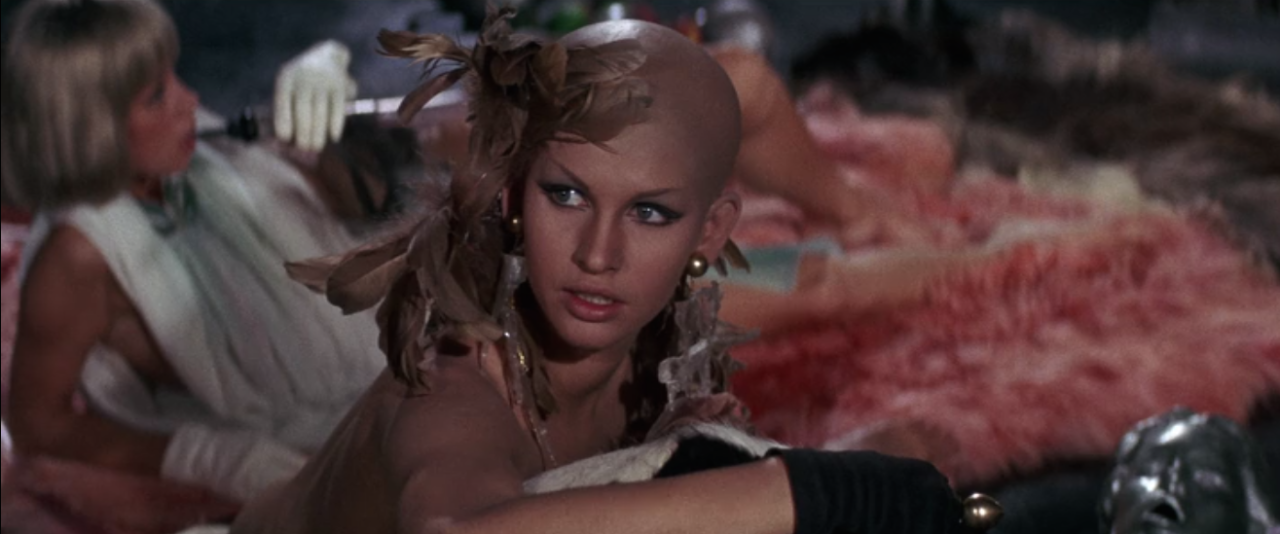
Even Barbarella's rival/shadow, ruling through fear and pain, the Black Queen (Anita Pallenberg, above, voice dubbed by Joan Greenwood) AKA the Great Tyrant, can't resist her charms. With a Sadean mixture of sadistic voluptuary delight, she calls Barbarella "pretty... pretty..." like a kitten. But she must continually do evil to satisfy the Matmos, a magnetically disturbing sentient liquid intelligence bubbling below her city, supplying it with light, warmth and energy, while feeding on negatively charged evil deeds and thoughts, corrupting those on its surface and turning the whole place into one giant wicked orgy of sadomasochism and drugged-out excess in order to keep itself sated. Just walking around above its pulsing current, Barbarella can feel the heady effects, and it can feel her incorruptible innocence the way we might feel a mild electric shock.
Ever-bubbling below their feet, its liquid hypnotic light show effects playing on modular TV screens and projections in amidst the posed revelers, the Matmos turns the whole place into a Gomorrah you might imagine while staring deep into a lava lamp, mind reeling with a swerve of the LSD experience into what Stanislav Grof called the third stage of rebirth: the grotesquely elaborate sadomasochistic hell imagery (1) of a bad trip, a sudden total recall of the trauma of one's exit from the constricting birth canal into the hell of the doctor's glaring light and harsh spank. Long suppressed by the even the unconscious mind, this remembrance of this moment of total hell needs a fast coping mechanism. Developing a kind of off-the-cuff masochistic streak becomes a do-or-die necessity: revel in the madness or be rent to shreds by its demonic claws. Barbarella alone finds the third way -- to accept it and not judge it, to embrace the burning blade and be neither cut nor burnt. Hers is a kind of coal-walking purity of essence (POE), the kind that sashays right through the rending claws of those paradise-guarding demons. Like the angel Pygar (John Phillip Law) she holds no grudges. When she finds he has rescued the evil queen after she blinded and exiled him in the past, Pygar carries her to the safety of Barbarella's ship. "An angel has no memory" ends up being the film's last line but it might better be "an angel forgives all trespasses against it."
But that would be too Christian.
 SOGO!
SOGO!
As opposed to the lurid visions of Bosch or Barker, the orgy envisioned by Vadim proves pretty nonthreatening, except in a rough trade performative sort of way, conjuring a kind of very-60s heterosexual-centric Warhol Factory-meets-Rome art gallery happening full of ennui-befogged jet set revelers, sprawled on divans and swings around brilliantly molded epoxy resin walls, floors, and round pulsing screens, turning the whole 'street' into a hookah bar/after hours club/ airport terminal, where the businesses seem to include either drinks, prostitution, or mugging. As usual Vadim doesn't really know how to move his camera through such tableaux with any urgency, but the art is still there. Now that we can savor the full breadth of the compositions on the HD color-restored widescreen, there's enough neat shit to look at that the dramatic lethargy doesn't irritate.
Epilogue 1: LACANIAN DESIRE MODEL and ZABRISKIE POINT IN SPACE!
Barbarella's ravenous sexual appetite is awakened into a new dimension by her first experiences of physical love, her pre-set sexual openness is such that she's already disappointed (after mating with both the Angel and the furry Catchman) when David Hemmings (in high demand since Blow-Up) as the rebel leader wants to use the pills (he's been saving them for five years waiting for a stray Earth woman who knows how to use them). Shortly thereafter she's attached to Durand Durand's orgasm piano machine, and what could have been a great moment - his outraged cry of "shame!" on her after she breaks the machine due to her yawning propensity is undone by his dreadful make-up, this weird need of some Italian make-up artists to do up older character actors as garishly as if they were on stage and supposed to look tan to the back row. It's too bad, as Milo O'Shea really sells his insanity with wild eyes and mellifluent voice.

Maybe the single most influential work of the counterculture, as far as high art and especially European 'art' films go - Antonioni's BLOW-UP can't be overestimated in terms of its effect on art cinema and 'beautiful people'-approved films. It became a kind of Kubrickian monolith milestone of high fashion post-modern influence. Vadim's Barbarella therefore resembles Antonioni's less-successful follow-up, Zabriskie Point (1970) more than anything else. Touching on an array of similar concerns and reflected points about the burgeoning youth movement, drugs, changes in sexual mores, and anxieties about the future --what the Point really proved was that Antonioni was unable to be 'hip' two times in a row, though neither could anyone else, it seemed (not even Dennis Hopper). For once he'd made a milestone, Antonioni was as influenced by it as anyone else, making his next work seem like either a copy or a failure. What he did was take a page from Godard and just film the young people being political - and if his intellectual eye found a place to cough "bullshit!" under his breath within the image, so be it.
Vadim's Barbarella covers a similar older straight-male-intellectual base (the only gay voice we hear in Barbarella is the lisping male equivalent of "Siri" or "Alexa" that guides Barbarella's weird neckless, three-balloon protuberance / mandolin space ship): the amok savage children running loose in the wastelands; the languorous orgy; the pretty boy angel/pilot spurred to eclipse a social order that has already, in a sense, exiled him; the young beautiful sexually willing female agent of a remote older male lover, sent into the zone alone on some secret mission; the climactic explosion signifying the Blow-Up of the old order. All that Barbarella is missing is a killer score. Zabriski gets great use out of Pink Floyd and a Jerry Garcia guitar solo. Barbarella uses goofy faux-John Sebastian vocals and obvious, spy movie lounge music. One wants to shake his lapels. "Roger! Something's happening here! And it's not this." Even dated by 1965 standards, let alone 68. There are some nice electric guitar moments, weird electronic string echo-drenches while a few of the wilder light shows are going on, but not enough. The best thing it's got going on is a relentlessly funky bongo beat and some electric bass evoking Nelson Riddle.

But otherwise, so much in common with Zabriskie Point that these bases must have seemed to weigh on the unconscious of the place and time. So let's examine them - all seem to swim up from what I'd imagine as the older establishment expressing its anxieties about the counter-culture while being determined to stay on top of it - even as it was like a powder keg with no keg to define it. They--the older artists--wanted the job of defining it, of being its grand spokesman, or summing up its issues. While Antonioni nailed it in 1966, there was no specific 'it' to nail yet, so he could make an 'it' as well as anyone. By 1970 though, "it" was too big (with a sign that said: you must be "this" young to ride). As we see with the first order, the young and hip of a year ago are the old and in the way of tomorrow. (5)
1. Wild Children: With young people in the late-60s so free, so 'turned-on' and open, there was worry amongst the older generation about their coming grandchildren. After growing up in communes, allowed to skip school, inhaling secondhand reefer smoke, mutated by broken DNA from mom's LSD use, would these kids go to actual public school and learn boring math? Or would they run amok in wild child gangs until they're caught and brought to Sogo to indulge in perverse passions? In Zabriskie Point they throw a rock through the diner window; Daria Halprin tries to relate to them but they just paw at her skirt and sneer.
2. The Languorous Orgy: Imagined often by non-participants or experienced only while zonked on tranquilizers, the late night orgy became a happening - but only as long as it wasn't swamped by horny dudes ganging up on zonked virgin chicks (as in Riot on Sunset Strip), or bikers trashing the place. The desert hook-up in Zabriskie seems to mutate out into a dozen other couples, horsing around, play wrestling and being otherwise in the moment and young and loose with Jerry Garcia lays out a nice relaxing solo, but must a scratchy affair itchy affair with so much dust and sand floating around. In Barbarella, physical contact and loose playful exploration of one another's touch -this seemed a new and rare experience to the older generation who had maybe not experienced it fantasized about its transformative effect coupled to the horror of the collapsing barriers of self (the equivalent today of hearing about 'bracelet' parties on Fox)--seemed surely abuzz in decadence, with tortures and glazed joyless faces of the stoned participants.
Those who experienced one or witnessed one knew the deadening effect it can have. There's no joy in it after awhile, only pain when its over or broken off from, like getting so used to a hot tub you don't feel it at all, only a terrible aching chill when you step out of it into the dry air. Stay in it long enough and you merge into the furniture, the walls (like the exiles in the Sogo Maze), and no one even notices you until suddenly you stir to get up and move positions and people freak out. Dude, you're still here? Especially if you're the newly sober roommate of the guy throwing the party, who pops out of his door at 4AM to pee, and trips over entwined bodies, as I was circa 1998.
Too is the eerie similarity between all the languid people turning into rocks in the labyrinth and the people cohering out of the desert for an orgy, and the louche inhabitants of Sogo.
3. The Fallen Pilot / Angel: The equivalent of the hanged man who, once removed from his cross on the cornfield row, becomes a crow (as he was long ago) rather than a scarecrow. The Alice/Dorothy female central character has a love affair with this one, perhaps short of length, for he seems above and beyond the current scene. At home in no zone; his beauty is like an Apollonian ideal that can't quite incorporate in the modern Gomorrah of the age and so is sacrificed, crucified, blinded. "An angel doesn't make love, an angel is love," Pygar tells the evil queen who's trying to shag him. "Then you're a dead duck," she snaps back. This little bit of hippie phrase-bending didn't stop Barbarella from shagging him, so why does the Tyrant let it put her off her groove?
4. The cops / guards: The old vestige of the evil (demonized) social order. In Zabriskie Point, Antonioni gives us a cop in the desert who comes to Daira with concern (she's wondering alone in the desert with no shoes) but she treats him like he's a Nazi. Some universal love that is! In Barbarella the guilt is assuaged by having the suits of the guards be empty shells. In Zabriskie they fill the jail to overflowing with demonstrators, but then again what else are they going to do? Topple from their Martian machines at the first sign of a cold? Without the cops, the movements would collapse, like a team falling backwards during tug-of-war if the opposing side suddenly lets go.
5. The Oppressed: The inhabitants of the maze are older people, grown mossy and unhip, gradually growing into the rocks, kept alive only by expensive lotuses (it 'amuses' the Great Tyrant to lay out such a ridiculous expense). In Zabriksie they are the locked-up students, the squares stuck in their 9-5 scenes, and the besieged desert community diners, slowly falling into their beers at the Rumpus Room. Antonioni seems to be trying to come to terms with his own obsolescence but is he just admitting that one can only be shallow and naive once, and no amount of acid can make you forget your hard-won wisdom?
6. The Revolution! Doomed to fail. On both sides. On both sides. Only the Matmos, and the virgin-whore, survive.
6. The employer patriarch: An older but still virile relic of the old guard. Claude Dauphin on the screen in the opening of Barbarella - he gives her her mission and looks forward to enjoying her sexually sometime in the future; in Zabriskie, Rod Taylor is Daria's employer- possible lover--a virile new breed of capitalist manly men.
7. A climactic apocalypse - it of course never occurs to Barbarella that her free love mantra has kept her and the Black Queen all nice and dry while utterly laying waste to the entire city of Sogo and getting nearly everyone on the planet wiped out in a catastrophic flood / disintegration beam combination. That's America abroad, via Vadim's portrait of his American wife and her overly serious stance on politics, inciting a rebellion and then leaving when it fails and everyone on either side lies dead. Maybe in Italian director Antonioni's Zabriskie America is still intact, the Roy Orbison song after the slow-mo explosion climax Floyd jam lets us know the only casualties here are the young, blinded by their own self-righteous hotness; that's the European intellectual abroad in the American Southwest, as heavy as Baudrillard at a roadside attraction.
8. Don't let our Wasted Youth Go to... more wasted? - The young are beautiful, but their playfulness is so heavy-handed, scripted and flat vs. say the in-the-moment nowness of a document like French auteur Agnes Varda's Lions, Love (and Lies) or the Roeg/Cammell masterpiece, Performance. We wonder what Antonioni sees in these two actors, or in this story, maybe the most heavy-handed film about flight ever.
Epilogue II: ALICE TO DOROTHY / CANDY to BARBARELLA - Girl to Woman under a Sexist (male) rubric.
Pauline Kael's reference to the film as a dirty Wizard of Oz (3) may be warranted but only in that Barbarella is an innocent girl making her way through a strange landscape with the goal of meeting a wizard /scientist. With every man wanting to sleep with her, there's also the linking up to the same year's Candy, (below), another Terry Southern script (based on his novel) and much seedier (and funnier --for the first half anyway), with a more Alice in Wonderland arc (rather than some distinct mission). Candy just flees one escapade to wind up in another, spurred regularly onwards to the next vignette by some sex maniac she escaped previously. Really, she's little more than a passing lusty obsession for a series of extended comic monologues for Great White Male actors, most of whom end up babbling and groveling more than actual fornicating. For Barbarella on the other hand, the men come in handy (she always needs help fixing her space ship, like a nymphomaniac parked on the side of a road, trapping men by fretting over her open hood), but rather than following her through some devotion to her niceness and her sincerity in trying to help replace their missing 'pieces,' these men help her because she represents, in herself, a cause, a freedom, a gorgeous openly sexual being whose innocence cannot be corrupted even when she's 'shamelessly' out-orgasming a death-by-pleasure machine. And Barbarella is a master seductress. We just may not notice since Jane handles things so discreetly. All Marcel Marceau's Professor has to do is mention Pygar needs 'inspiration' and she's gently guiding him back to his nest.

Comparisons to Alice in Wonderland are less apt, since the focus there is on a critique of British politics and the girl is too young for the adult set of signifiers we get with Barbarella. In fact you might stack them up in terms of age. Alice is the coming of age myth for the girl between 7 and 13; Dorothy for 13-17; Barbarella for 18-22. And anything older - honey if you haven't trained your animus and incorporated it into your whole so you're no longer looking for incomplete males to act as animus projection screens while your fairy tale your way to maturity, well, you're likely to be animus-dominated forever. If you don't get a milquetoast husband to boss around in the voice of your militant father, the only next stop is the Norman Bates shower of the sacrifice: your younger self (Janet Leigh) is still clinging to the husk and must be cut free to make way for a fully incorporated adult (Vera Miles) to take over.
Unlike the 'hero's journey' as per Jung and Joseph Campbell, the psychedelic Alice/Dorothy mythic trek to maturity doesn't operate on a direct link to consciousness. For the male, there's always that breadcrumb trail or string Theseus unspooled when going through the maze, or some other device to return to consciousness and the social order. He's just a visitor here in the forest, the maze, the realm of the chthonic, the feminine unconscious of the masculine psyche. The masculine unconscious of the feminine psyche by contrast, isn't so cut and dry. It is uncut, and ever-wet. The woman descends not into the maze but to the social order. She is only a visitor here in the Apollonian world of patriarchy and order. If she's hoping to gain something from her trip here, it's the ability to get back home, not necessarily with any prize to hand, and the home is generally not the one she left, but one where some good true prince (or grandmother) is waiting. She is the maze, the forest, in a way the masculine hero is not. Her role is not as conqueror or reformer or thief of some magic item, but of reclaimer of herself from the jaws of the wolf. She must face the devouring mother, the wolf in grandma's skin, and take over possession of the feminine archaic unconscious, she must become the red queen. She is the forest through which the knights wander, the moon that masculine clouds obscure but never fully blot out.
When Hate turns to Affectionate Tolerance
Confession: I used to hate Barbarella. And all Vadim's works. The only film of his I like is Blood and Roses (1961) and it's not even on DVD, Blu-ray, or VHS. It's hung up in legal limbo. You can get greymarket copies but it's frustrating to imagine how much better a nice restored Criterion edition might look. Turns out, Barbarella is an example of how much such treatment can better a film. Before it was badly cropped for TV, with unrestored muddy colors which --with some of the bad dubbing-- made it seem like a total tedious kitschy waste of time. Now it seems quite modern and wondrous, like so many Dino Di Laurentiis productions, it's got a great sense of art direction, with vast soundstage indoor/outdoor decadent tableaux reminiscent of his other great films -- Flash Gordon, Dune, Conan, to such an extent that they're all much better now that they were ever before, since they're initial theatrical release. You da man, Dino
As for Vadim, I guess I was jealous. Not anymore. Why? Because I love his memoir, Sympathy for the Devil. It's impossible to dislike him after reading it. In fact it might even explain his luck with gorgeous women -- his raconteur-ship is without peer!
Another plus is that, with the passing of time, the sex in Barbarella no longer seems as adolescent. Pornography as so dulled our collective senses that semi-softcore period erotica has found an audience in debauched cineastes like myself who can appreciate the genuine anarchic deviance, dream logic, and carefully artistic framing in the works of Jean Rollin, Jess Franco, Radley Metzger, or the propulsive over-the-top vavoom of Russ Meyer We don't 'get off' on them, or see them for their 'adult' cachet as they were created fo --at least not solely. Rather their ability to do whatever they want in between satisfying the demand of the producer (who expected a certain 'Adults Only' rating), they were free to do as they pleased leads to a kind of permissive experimental snapshot of their moment kind of thing that makes them almost time machine-level pertinent to modern instances. Thanks too to a steep drop in libido, I'm not clawing the turf and howling in forlorn longing over the extreme sexiness of Fonda. And John Phillip Law no longer scans as a towheaded focal point for my jealous rage, this maybe thanks to having seen the other big 60s European adult comic book title, Danger! Diabolik, where he stars, and also he's such a good-humored mensch in the extras on that DVD, it's hard not to love him. Also the music has become far enough out that it's back in. The vocals on the title song used to fill me with rage, rhyming Barbarella with cockleshell-a? Infuriating! All that does now though is make me realize what a wasted opportunity it is not to make Barbrella's spaceship look like half an scallop shell, or open up like a massive scallop, or draw some other Venus association, associating space with the ocean, as for example the film The Witch who Came From the Sea would do on such a smaller budget years later. A few connections to myth, to the archetypal roots underneath this stuff, would have gone a long way to making it less instantly dated (it would be 'timeless' instead).

Epilogue III: FONDA AND THE BIG O
The evolution of sex in popular culture has become intextricable from Fonda, both for her groundbreaking exercise tape, films like Barbarella, and--an element oft forgotten by other film historians -- her character in Coming Home (1978) has her first big orgasm via cunnilingus from a parapelegic Jon Voight. That year was marked by a kind of friction Oscar-grabbing war between that film and The Deer Hunter, making it a Big Moment for films critiquing the then relatively recent Vietnam experience. While their combination surely offered a kind of sociological sea change, what eager kids such as myself still remember, overhearing moms talk about it who hadn't even seen it., and even reading about in the grocery store line People, was suddenly cunnilingus was in. A woman's orgasm via oral sex was now a hot topic.
This was all part and parcel with Dr. Ruth Westheimer's popularity as a TV icon - her ability to come onto prime time and talk sweet old lady-like about sex and female orgasms, was quite an eye-opener, for the whole family. There does dwell within academic halls a hardcore feminist camp that thinks the whole "Joy of Sex" thing that started in the late 50s and flowered all through the mid-60s-late 70s, is just a long-con of a horny patriarchy to trick women into being more promiscuous. If so, then I also wonder about the motivations underlying this need of some female academes to poison the hetero well, so to speak. I don't cast blame, it's all unconscious and academes are notorious for being blind to their own analytical faults. (as the Rev. Shannon puts it in Night of the Iguana, "If Ms. Fellowe's ever found out about herself it would destroy her").
Maybe they're right, on the other hand. It took me a long time to realize that, as a straight, ungodly, debauched man, I may not be the best judge of what's good for feminism.

Epilogue IV: VADIM and the Depleted Drive.
OK, last tangent. Back to Roger Vadim. I love his book, Memoirs of the Devil - you read it and you 'get' why he got so many beautiful women. He's modest, charming, thrilling, insightful and always observant. His book reads like fine wine but his filming style is very drab. Why? How can a movie with a honey like Jane in those dynamite threads be so... inert?
Answer: the momentum of the drive, the propulsive energy generated via unrequited desire. Lacking the masochistic impulse, he can only chronicle the scene-- he isn't 'getting off' on some obscene element that might be there in the (partially) Terry Southern script. For a Terry Southern contrast, consider a film like Candy that aches and contorts with a kind of sexual longing that two-plus hours of unrepentant rutting does nothing to fulfill. It's a hungry ghost movie, and Candy's beauty and nubile... achingly... argggh physical allure is the never-ending wellspring at which we drink and drink and are left but thirstier.
By contrast, Jane notes later Vadim was often drunk by noon on set, and it makes sense, as there's no thirst unquenched in Barbarella, the way there is in Candy or, say, those twin Sue Lyon masterworks, Lolita (where our puritan drive to know did they or didn't they is obscured by the censor, and made so ambiguous we go as crazy as Humbert over those boys at Lo's school) or Night of the Iguana (where Ms. Fellowe's hovers in the wake of Charlotte's relentless come-ons)


Tennessee Williams and Richard Burton are both masters of giving us this 'need.' We see it in Burton's T. Lawrence Shannon (in Night of the Iguana) walking across cut glass, ranting about 'fever' with the same agonized longing as he rants about his 'need', groveling in pools of Scotch on his Rolls' floor in Candy. We see it in the near-riot Sue Lyon causes down at the beach cabana bar (above), where the bartender declares "we don't want our boys to grow up knowing girls can be like you!," knowing full well Sue Lyon's voluptuous amok sexuality could set whole communities on their ear. But Williams gave us more than just the problem - or skirt chasing and regret (or Vadim's lackluster prurience).r A master, burrowing deep until the layers between mythic and personal are peeled away to nothing, Williams allows for stray notes of hope for genuine positive change. Iguana comes to terms with the change that lies beyond the realization the satisfaction's impossibility, the eternal thirst encoded into the lure of desire. Like Williams' other classics, it's about the enormous sacrifice that entails accepting what is, and letting go of one's terrible, aching wants. It's the kind of movie alcoholics love because it gives you all three worlds: what it was like before, what happened to change it, and what it's like now, i.e. astray-leading desire; nervous breakdown/attempted suicide; acceptance and grace through a talking cure--and then, letting go, because we're playing god here tonight. So AA, bro. He doesn't even have to get sober, because Ava Gardner will always get him back up. Pretty sweet.
Vadim on the other hand, tends to give us beautiful lush girls set up against gross, misogynistic entitled rapey small town sexists, like the vile older brothers in And God Created Woman, one-upping each other on the field of Bardot like the gang of small town wastrels in I Spit on Your Grave or like Giannini's Sandro before he kind of wakes up to his own Italian macho womanizing long enough to actually cry at the end of L'Aventura.
Barbarella was, when I first tried to love it as a teenager, on VHS, cropped and scanned and dreary, and my feminist onus bristled for I loathed the male characters I expected a sci-fi sex comedy to be either funny or sexy or sci-fi mind-blowing - and Barbarella was only one of the three. Perhaps I hated it originally growing up in such a snickering society of high school males, maybe not even in real life but certainly in the rote high school 'sex comedies' that ran parallel with the slasher craze for awhile in the early 80s, the two twisting together like scorpions screwing in my mind along the poison of DSB and hormones cooking me in their own juices, long before I discovered that any two alcoholic drinks downed quickly back to back would allay it all.

But I'd also seen Flesh Gordon (1974) by then, a very long-running midnight movie that film history has tended to forget. And not without good reason. The stop motion animation is good enough that it seems a waste, talented animators resorting to penis monsters like a bunch of third graders. The makers of Barbarella on the other hand, are about getting laid, not tittering through a keyhole with your snotty friends.
But on the other hand, Roger Vadim's prolific and top tier sexual relations made him a stranger to the parameters of desire. He directs like he's so sexually satisfied he can barely move the camera. Without the awesome and frequent costume changes, the deadpan wit of Jane, and the crazy artsy happening sets, it would be unendurable.
For Vadim you see, is a chronicler of an experienced pleasure - and that doesn't translate to the screen. It's why, too, Dino Di Laurentiis' pervious comic strip film, Mario Bava's Danger Diabolik is so much better than Barbarella, even though it's got way too few well-lit sets and too many outdoor shots for my taste; Barbarella is entirely setbound, and gorgeously designed.
We might look at this way, this handy way (this one), Flesh, Flash and Foxy
Puerile (junior high school) - the 'not laid / no prospects' virgin, both obsessed with sex but resigned towards it all existing in some alternate realm with no chance at the real thing: Flesh Gordon (1974) -
i.e. action without consequences/effect (not even trying to seduce, but rather snickering to mask your virgin sexually-frustrated terror)
Obesessive (high school) - chasing one's first sexual experience with singular focus: Flash Gordon
i.e. action with consequences/effect (getting one's feet wet in the world of desire, but generally finding oneself in a loop-de-loop where the girl you like doesn't like you but her little sister does, and you think she's maybe too young or evil and manipulative.)
Laid (college) - desire fulfilled, leading to the prospect of enhancing pre-existant pleasure, and accepting the 'isness' will always missing from desire's fulfillment: Barbarella.
consequences/effect without action ( But then you go to boast to your bros but after that, you're left still with a void inside, and now you're expected to call her back! Burn!)
-----
It ends here, all of cinema, the way Godard tried to the same year with WEEKEND.
Rather than end that way - we stop. For we're not so pompous to think we can speak even for ourselves.
And it helps to remember that this was still a time when strict censorship laws that had been creating all sorts of grief (and money) for talented writers like Southern, Ginsburg and Bill Burroughs, Henry Miller, etc. were being slowly eradicated. From 1967-1973-ish, dirty mindedness on a pop culture scale was genuinely subversive (even unto the late 70s there were elements of it - for an example consider the way Burt Reynolds uses curse words in films like Semi-Tough, there's almost a pause afterwards for the audience to lose their minds - 'is he allowed to say that?') But once the bar was lowered and half the world jumped over, such stuff ceased to be relevant. Without a proper conservative agenda to rail against, the dirtiness became tawdry rather than subversive. Censorship was like a leash that keeps dogs brave until the dog realizes the owner isn't holding the other end. In spelling everything out, the whole language of the 'code' ceases to have meaning! We're in post-structuralist territory! Even Antonioni gets lost in here!
Sorry if I failed to reach a point - but you know how it is. I just got back from St. Maarten and am still getting back into the groove. So in closing I'll just say - if you saw the old Barbarella, on VHS or cable TV, forget it. See it again on widescreen remastered HD. Vadim's laid buzzed ennui or no, you can savor the gorgeous Claude Renoir photography, the gonzo Di Laurentiis-brand costumes and set design, and give thanks to the human gene pool for giving us the DNA sequence known as Jane Fonda. Sure, Barbarella seems dated now, and was dated then - but whether it's back 3,500 years or ahead 2,100, it's still a groovy trip, pills or no pills.
For Woozle!
FURTHER READING:
On Vadim:
Pimps: The Devil's Subjects
CineamArchetype 17. The Devil
On Pallenberg:
Ich Liebe dich so....
Great Acid Movies #2: PERFORMANCE (1968)
On Jane:
Bree Daniels, Gamblers: KLUTE, THE MALTESE FALCON.
Jane Fonda does Tennessee Williams: PERIOD OF ADJUSTMENT (1962)
Post-Sexual Jane: THEY SHOOT HORSES, DON'T THEY? (1968)
On The Feminine Unconscious:
Why Don't We Just Go Ask Alice?
Alice 2.2: The Looking Glass Dolls
Some (was some) kind of (a) Mushroom: GO ASK ALICE (1973)
Reeling and Writhing: ALICE IN WONDERLAND (1933)
Camptown Sci-fi:
Tigron and Taboo: the Freudian Dream Theater of FLASH GORDON (1936)
Tales from the Retro-Futurist Pharmacy: SPACE STATION 76, PHASE IV, Boards of Canada
Goal-struck Post-Structuralism:
Cinq à sept vs. the Censors: RED DESERT
BSummerLofOmyPlasticW-USoldierP (1966)
Zabriskie Point is Everywhere
"My" Great White NEED
(before better means of ego support and self esteem were made available):
My Long Day's Journey into NIGHT OF THE IGUANA (1964)
All Tomorrow's Playground Narratives: Kubrick's LOLITA (BL)
Easter Acid Cinema Special: MOTHER! (2017)
Quixote Ugly: THE SWIMMER (1968)
All the Flower People Screaming: DOCTOR FAUSTUS (1967)
Laureate of the Laid: Terry Southern, CANDY (1968)
Pictures taking Pictures: MYRA BRECKINRIDGE and the Misandric Hollywoodophile
Fantasy Phallus Fallacy: SATURN 3 (1980)
The Foxy, the Dead, and the Foxier: DEATH-PROOF (BL 1/08)
Feminine Paranoia:
Age of Asherah: ROSEMARY'S BABY (1968)
le rayon bleu Deneuve REPULSION
Gimme Cockaine: MELANCHOLIA (2011)
Hey BETTY BLUE, Come Blow Your Mind (+ INSIDE, TROUBLE EVERY DAY)
Ms. Icarus Risen: THE BLACK SWAN (2010)
NOTES:
1. Gilgamesh (c. 2100 BC) - Stephen Mitchell translation - p. 77
2. "In Europe, sex is a fact. In America, an obsession." - Marlene Dietrich.
3. In her New Yorker review - " Jane Fonda has the skittish naughtiness of a teen-age voluptuary. She's the fresh, bouncy American girl triumphing by her innocence over a lewd, sadistic world of the future."
5. The same went for another Italian, Zefferelli, whose 1968 hit Romeo and Juliet resonated with the Vietnam-torn youth movement, but whose 1971 follow-up, the idealistic hippie trip Brother Sun, Sister Moon - bombed big, though personally I love it way more).

Thanks to her almost Cary Grant-like gift for deadpan physical comedy, Fonda never seems remotely passive, or disinterested, as she regularly uses nonviolent means to her ends. Compared to the much dimmer Ewa Aulin in the similar comic book big budget sex fantasy Terry Southern shaggy dog tale Candy (also 1968), Fonda never seems out of control. Nothing sexual happens before she’s consented to it, in one way or another. It’s her enjoyment – her ‘lalalala’-ing in post-coital distraction afterwards, that conversely illustrates her effectiveness as an agent. She’s not ashamed about using sex in her work: first because it’s a symbol of unification (like a hug or handshake); but second, because she finds she likes it, and on her planet its removal (due to it being a “distraction from maximum efficiency”) for over 300 years has disassociated it with any latent Christian shame and guilt (or presumably, reproductive or STD consequence).

Even Barbarella's rival/shadow, ruling through fear and pain, the Black Queen (Anita Pallenberg, above, voice dubbed by Joan Greenwood) AKA the Great Tyrant, can't resist her charms. With a Sadean mixture of sadistic voluptuary delight, she calls Barbarella "pretty... pretty..." like a kitten. But she must continually do evil to satisfy the Matmos, a magnetically disturbing sentient liquid intelligence bubbling below her city, supplying it with light, warmth and energy, while feeding on negatively charged evil deeds and thoughts, corrupting those on its surface and turning the whole place into one giant wicked orgy of sadomasochism and drugged-out excess in order to keep itself sated. Just walking around above its pulsing current, Barbarella can feel the heady effects, and it can feel her incorruptible innocence the way we might feel a mild electric shock.
 |
| Viddy the Matmos! |
But that would be too Christian.

As opposed to the lurid visions of Bosch or Barker, the orgy envisioned by Vadim proves pretty nonthreatening, except in a rough trade performative sort of way, conjuring a kind of very-60s heterosexual-centric Warhol Factory-meets-Rome art gallery happening full of ennui-befogged jet set revelers, sprawled on divans and swings around brilliantly molded epoxy resin walls, floors, and round pulsing screens, turning the whole 'street' into a hookah bar/after hours club/ airport terminal, where the businesses seem to include either drinks, prostitution, or mugging. As usual Vadim doesn't really know how to move his camera through such tableaux with any urgency, but the art is still there. Now that we can savor the full breadth of the compositions on the HD color-restored widescreen, there's enough neat shit to look at that the dramatic lethargy doesn't irritate.
Epilogue 1: LACANIAN DESIRE MODEL and ZABRISKIE POINT IN SPACE!
Barbarella's ravenous sexual appetite is awakened into a new dimension by her first experiences of physical love, her pre-set sexual openness is such that she's already disappointed (after mating with both the Angel and the furry Catchman) when David Hemmings (in high demand since Blow-Up) as the rebel leader wants to use the pills (he's been saving them for five years waiting for a stray Earth woman who knows how to use them). Shortly thereafter she's attached to Durand Durand's orgasm piano machine, and what could have been a great moment - his outraged cry of "shame!" on her after she breaks the machine due to her yawning propensity is undone by his dreadful make-up, this weird need of some Italian make-up artists to do up older character actors as garishly as if they were on stage and supposed to look tan to the back row. It's too bad, as Milo O'Shea really sells his insanity with wild eyes and mellifluent voice.

SET AND SETTING: POST-BLOW-UP EUROPE (1966-69)
Maybe the single most influential work of the counterculture, as far as high art and especially European 'art' films go - Antonioni's BLOW-UP can't be overestimated in terms of its effect on art cinema and 'beautiful people'-approved films. It became a kind of Kubrickian monolith milestone of high fashion post-modern influence. Vadim's Barbarella therefore resembles Antonioni's less-successful follow-up, Zabriskie Point (1970) more than anything else. Touching on an array of similar concerns and reflected points about the burgeoning youth movement, drugs, changes in sexual mores, and anxieties about the future --what the Point really proved was that Antonioni was unable to be 'hip' two times in a row, though neither could anyone else, it seemed (not even Dennis Hopper). For once he'd made a milestone, Antonioni was as influenced by it as anyone else, making his next work seem like either a copy or a failure. What he did was take a page from Godard and just film the young people being political - and if his intellectual eye found a place to cough "bullshit!" under his breath within the image, so be it.
Vadim's Barbarella covers a similar older straight-male-intellectual base (the only gay voice we hear in Barbarella is the lisping male equivalent of "Siri" or "Alexa" that guides Barbarella's weird neckless, three-balloon protuberance / mandolin space ship): the amok savage children running loose in the wastelands; the languorous orgy; the pretty boy angel/pilot spurred to eclipse a social order that has already, in a sense, exiled him; the young beautiful sexually willing female agent of a remote older male lover, sent into the zone alone on some secret mission; the climactic explosion signifying the Blow-Up of the old order. All that Barbarella is missing is a killer score. Zabriski gets great use out of Pink Floyd and a Jerry Garcia guitar solo. Barbarella uses goofy faux-John Sebastian vocals and obvious, spy movie lounge music. One wants to shake his lapels. "Roger! Something's happening here! And it's not this." Even dated by 1965 standards, let alone 68. There are some nice electric guitar moments, weird electronic string echo-drenches while a few of the wilder light shows are going on, but not enough. The best thing it's got going on is a relentlessly funky bongo beat and some electric bass evoking Nelson Riddle.

But otherwise, so much in common with Zabriskie Point that these bases must have seemed to weigh on the unconscious of the place and time. So let's examine them - all seem to swim up from what I'd imagine as the older establishment expressing its anxieties about the counter-culture while being determined to stay on top of it - even as it was like a powder keg with no keg to define it. They--the older artists--wanted the job of defining it, of being its grand spokesman, or summing up its issues. While Antonioni nailed it in 1966, there was no specific 'it' to nail yet, so he could make an 'it' as well as anyone. By 1970 though, "it" was too big (with a sign that said: you must be "this" young to ride). As we see with the first order, the young and hip of a year ago are the old and in the way of tomorrow. (5)
1. Wild Children: With young people in the late-60s so free, so 'turned-on' and open, there was worry amongst the older generation about their coming grandchildren. After growing up in communes, allowed to skip school, inhaling secondhand reefer smoke, mutated by broken DNA from mom's LSD use, would these kids go to actual public school and learn boring math? Or would they run amok in wild child gangs until they're caught and brought to Sogo to indulge in perverse passions? In Zabriskie Point they throw a rock through the diner window; Daria Halprin tries to relate to them but they just paw at her skirt and sneer.
2. The Languorous Orgy: Imagined often by non-participants or experienced only while zonked on tranquilizers, the late night orgy became a happening - but only as long as it wasn't swamped by horny dudes ganging up on zonked virgin chicks (as in Riot on Sunset Strip), or bikers trashing the place. The desert hook-up in Zabriskie seems to mutate out into a dozen other couples, horsing around, play wrestling and being otherwise in the moment and young and loose with Jerry Garcia lays out a nice relaxing solo, but must a scratchy affair itchy affair with so much dust and sand floating around. In Barbarella, physical contact and loose playful exploration of one another's touch -this seemed a new and rare experience to the older generation who had maybe not experienced it fantasized about its transformative effect coupled to the horror of the collapsing barriers of self (the equivalent today of hearing about 'bracelet' parties on Fox)--seemed surely abuzz in decadence, with tortures and glazed joyless faces of the stoned participants.
Those who experienced one or witnessed one knew the deadening effect it can have. There's no joy in it after awhile, only pain when its over or broken off from, like getting so used to a hot tub you don't feel it at all, only a terrible aching chill when you step out of it into the dry air. Stay in it long enough and you merge into the furniture, the walls (like the exiles in the Sogo Maze), and no one even notices you until suddenly you stir to get up and move positions and people freak out. Dude, you're still here? Especially if you're the newly sober roommate of the guy throwing the party, who pops out of his door at 4AM to pee, and trips over entwined bodies, as I was circa 1998.
Too is the eerie similarity between all the languid people turning into rocks in the labyrinth and the people cohering out of the desert for an orgy, and the louche inhabitants of Sogo.
3. The Fallen Pilot / Angel: The equivalent of the hanged man who, once removed from his cross on the cornfield row, becomes a crow (as he was long ago) rather than a scarecrow. The Alice/Dorothy female central character has a love affair with this one, perhaps short of length, for he seems above and beyond the current scene. At home in no zone; his beauty is like an Apollonian ideal that can't quite incorporate in the modern Gomorrah of the age and so is sacrificed, crucified, blinded. "An angel doesn't make love, an angel is love," Pygar tells the evil queen who's trying to shag him. "Then you're a dead duck," she snaps back. This little bit of hippie phrase-bending didn't stop Barbarella from shagging him, so why does the Tyrant let it put her off her groove?
4. The cops / guards: The old vestige of the evil (demonized) social order. In Zabriskie Point, Antonioni gives us a cop in the desert who comes to Daira with concern (she's wondering alone in the desert with no shoes) but she treats him like he's a Nazi. Some universal love that is! In Barbarella the guilt is assuaged by having the suits of the guards be empty shells. In Zabriskie they fill the jail to overflowing with demonstrators, but then again what else are they going to do? Topple from their Martian machines at the first sign of a cold? Without the cops, the movements would collapse, like a team falling backwards during tug-of-war if the opposing side suddenly lets go.
5. The Oppressed: The inhabitants of the maze are older people, grown mossy and unhip, gradually growing into the rocks, kept alive only by expensive lotuses (it 'amuses' the Great Tyrant to lay out such a ridiculous expense). In Zabriksie they are the locked-up students, the squares stuck in their 9-5 scenes, and the besieged desert community diners, slowly falling into their beers at the Rumpus Room. Antonioni seems to be trying to come to terms with his own obsolescence but is he just admitting that one can only be shallow and naive once, and no amount of acid can make you forget your hard-won wisdom?
6. The Revolution! Doomed to fail. On both sides. On both sides. Only the Matmos, and the virgin-whore, survive.
6. The employer patriarch: An older but still virile relic of the old guard. Claude Dauphin on the screen in the opening of Barbarella - he gives her her mission and looks forward to enjoying her sexually sometime in the future; in Zabriskie, Rod Taylor is Daria's employer- possible lover--a virile new breed of capitalist manly men.
7. A climactic apocalypse - it of course never occurs to Barbarella that her free love mantra has kept her and the Black Queen all nice and dry while utterly laying waste to the entire city of Sogo and getting nearly everyone on the planet wiped out in a catastrophic flood / disintegration beam combination. That's America abroad, via Vadim's portrait of his American wife and her overly serious stance on politics, inciting a rebellion and then leaving when it fails and everyone on either side lies dead. Maybe in Italian director Antonioni's Zabriskie America is still intact, the Roy Orbison song after the slow-mo explosion climax Floyd jam lets us know the only casualties here are the young, blinded by their own self-righteous hotness; that's the European intellectual abroad in the American Southwest, as heavy as Baudrillard at a roadside attraction.
8. Don't let our Wasted Youth Go to... more wasted? - The young are beautiful, but their playfulness is so heavy-handed, scripted and flat vs. say the in-the-moment nowness of a document like French auteur Agnes Varda's Lions, Love (and Lies) or the Roeg/Cammell masterpiece, Performance. We wonder what Antonioni sees in these two actors, or in this story, maybe the most heavy-handed film about flight ever.
 |
| "a good many dramatic situations begin with screaming," |
 |
| "The black guards are leather men; they are without fleshy substance." |
Epilogue II: ALICE TO DOROTHY / CANDY to BARBARELLA - Girl to Woman under a Sexist (male) rubric.
Pauline Kael's reference to the film as a dirty Wizard of Oz (3) may be warranted but only in that Barbarella is an innocent girl making her way through a strange landscape with the goal of meeting a wizard /scientist. With every man wanting to sleep with her, there's also the linking up to the same year's Candy, (below), another Terry Southern script (based on his novel) and much seedier (and funnier --for the first half anyway), with a more Alice in Wonderland arc (rather than some distinct mission). Candy just flees one escapade to wind up in another, spurred regularly onwards to the next vignette by some sex maniac she escaped previously. Really, she's little more than a passing lusty obsession for a series of extended comic monologues for Great White Male actors, most of whom end up babbling and groveling more than actual fornicating. For Barbarella on the other hand, the men come in handy (she always needs help fixing her space ship, like a nymphomaniac parked on the side of a road, trapping men by fretting over her open hood), but rather than following her through some devotion to her niceness and her sincerity in trying to help replace their missing 'pieces,' these men help her because she represents, in herself, a cause, a freedom, a gorgeous openly sexual being whose innocence cannot be corrupted even when she's 'shamelessly' out-orgasming a death-by-pleasure machine. And Barbarella is a master seductress. We just may not notice since Jane handles things so discreetly. All Marcel Marceau's Professor has to do is mention Pygar needs 'inspiration' and she's gently guiding him back to his nest.

Comparisons to Alice in Wonderland are less apt, since the focus there is on a critique of British politics and the girl is too young for the adult set of signifiers we get with Barbarella. In fact you might stack them up in terms of age. Alice is the coming of age myth for the girl between 7 and 13; Dorothy for 13-17; Barbarella for 18-22. And anything older - honey if you haven't trained your animus and incorporated it into your whole so you're no longer looking for incomplete males to act as animus projection screens while your fairy tale your way to maturity, well, you're likely to be animus-dominated forever. If you don't get a milquetoast husband to boss around in the voice of your militant father, the only next stop is the Norman Bates shower of the sacrifice: your younger self (Janet Leigh) is still clinging to the husk and must be cut free to make way for a fully incorporated adult (Vera Miles) to take over.
 |
| "Decadence Lost" |
The Heroine's Journey
 |
| One of the film's sexiest costume changes - Vadim shoots Jane in it like he barely notices her heavenly thighs. Then she's into something else - a criminal waste of some great boots. |
When Hate turns to Affectionate Tolerance
Confession: I used to hate Barbarella. And all Vadim's works. The only film of his I like is Blood and Roses (1961) and it's not even on DVD, Blu-ray, or VHS. It's hung up in legal limbo. You can get greymarket copies but it's frustrating to imagine how much better a nice restored Criterion edition might look. Turns out, Barbarella is an example of how much such treatment can better a film. Before it was badly cropped for TV, with unrestored muddy colors which --with some of the bad dubbing-- made it seem like a total tedious kitschy waste of time. Now it seems quite modern and wondrous, like so many Dino Di Laurentiis productions, it's got a great sense of art direction, with vast soundstage indoor/outdoor decadent tableaux reminiscent of his other great films -- Flash Gordon, Dune, Conan, to such an extent that they're all much better now that they were ever before, since they're initial theatrical release. You da man, Dino
As for Vadim, I guess I was jealous. Not anymore. Why? Because I love his memoir, Sympathy for the Devil. It's impossible to dislike him after reading it. In fact it might even explain his luck with gorgeous women -- his raconteur-ship is without peer!
Another plus is that, with the passing of time, the sex in Barbarella no longer seems as adolescent. Pornography as so dulled our collective senses that semi-softcore period erotica has found an audience in debauched cineastes like myself who can appreciate the genuine anarchic deviance, dream logic, and carefully artistic framing in the works of Jean Rollin, Jess Franco, Radley Metzger, or the propulsive over-the-top vavoom of Russ Meyer We don't 'get off' on them, or see them for their 'adult' cachet as they were created fo --at least not solely. Rather their ability to do whatever they want in between satisfying the demand of the producer (who expected a certain 'Adults Only' rating), they were free to do as they pleased leads to a kind of permissive experimental snapshot of their moment kind of thing that makes them almost time machine-level pertinent to modern instances. Thanks too to a steep drop in libido, I'm not clawing the turf and howling in forlorn longing over the extreme sexiness of Fonda. And John Phillip Law no longer scans as a towheaded focal point for my jealous rage, this maybe thanks to having seen the other big 60s European adult comic book title, Danger! Diabolik, where he stars, and also he's such a good-humored mensch in the extras on that DVD, it's hard not to love him. Also the music has become far enough out that it's back in. The vocals on the title song used to fill me with rage, rhyming Barbarella with cockleshell-a? Infuriating! All that does now though is make me realize what a wasted opportunity it is not to make Barbrella's spaceship look like half an scallop shell, or open up like a massive scallop, or draw some other Venus association, associating space with the ocean, as for example the film The Witch who Came From the Sea would do on such a smaller budget years later. A few connections to myth, to the archetypal roots underneath this stuff, would have gone a long way to making it less instantly dated (it would be 'timeless' instead).

Epilogue III: FONDA AND THE BIG O
The evolution of sex in popular culture has become intextricable from Fonda, both for her groundbreaking exercise tape, films like Barbarella, and--an element oft forgotten by other film historians -- her character in Coming Home (1978) has her first big orgasm via cunnilingus from a parapelegic Jon Voight. That year was marked by a kind of friction Oscar-grabbing war between that film and The Deer Hunter, making it a Big Moment for films critiquing the then relatively recent Vietnam experience. While their combination surely offered a kind of sociological sea change, what eager kids such as myself still remember, overhearing moms talk about it who hadn't even seen it., and even reading about in the grocery store line People, was suddenly cunnilingus was in. A woman's orgasm via oral sex was now a hot topic.
This was all part and parcel with Dr. Ruth Westheimer's popularity as a TV icon - her ability to come onto prime time and talk sweet old lady-like about sex and female orgasms, was quite an eye-opener, for the whole family. There does dwell within academic halls a hardcore feminist camp that thinks the whole "Joy of Sex" thing that started in the late 50s and flowered all through the mid-60s-late 70s, is just a long-con of a horny patriarchy to trick women into being more promiscuous. If so, then I also wonder about the motivations underlying this need of some female academes to poison the hetero well, so to speak. I don't cast blame, it's all unconscious and academes are notorious for being blind to their own analytical faults. (as the Rev. Shannon puts it in Night of the Iguana, "If Ms. Fellowe's ever found out about herself it would destroy her").
Maybe they're right, on the other hand. It took me a long time to realize that, as a straight, ungodly, debauched man, I may not be the best judge of what's good for feminism.
 |
| Her spaceship with its 4-walled carpet (for zero gravity spinning), keyboard for controls, view screens/monitors, art works and strange tile board scanner wall, make it a kind man cave/recording studio of any sensible dude's deepest wishes. |
Epilogue IV: VADIM and the Depleted Drive.
OK, last tangent. Back to Roger Vadim. I love his book, Memoirs of the Devil - you read it and you 'get' why he got so many beautiful women. He's modest, charming, thrilling, insightful and always observant. His book reads like fine wine but his filming style is very drab. Why? How can a movie with a honey like Jane in those dynamite threads be so... inert?
Answer: the momentum of the drive, the propulsive energy generated via unrequited desire. Lacking the masochistic impulse, he can only chronicle the scene-- he isn't 'getting off' on some obscene element that might be there in the (partially) Terry Southern script. For a Terry Southern contrast, consider a film like Candy that aches and contorts with a kind of sexual longing that two-plus hours of unrepentant rutting does nothing to fulfill. It's a hungry ghost movie, and Candy's beauty and nubile... achingly... argggh physical allure is the never-ending wellspring at which we drink and drink and are left but thirstier.
By contrast, Jane notes later Vadim was often drunk by noon on set, and it makes sense, as there's no thirst unquenched in Barbarella, the way there is in Candy or, say, those twin Sue Lyon masterworks, Lolita (where our puritan drive to know did they or didn't they is obscured by the censor, and made so ambiguous we go as crazy as Humbert over those boys at Lo's school) or Night of the Iguana (where Ms. Fellowe's hovers in the wake of Charlotte's relentless come-ons)


Tennessee Williams and Richard Burton are both masters of giving us this 'need.' We see it in Burton's T. Lawrence Shannon (in Night of the Iguana) walking across cut glass, ranting about 'fever' with the same agonized longing as he rants about his 'need', groveling in pools of Scotch on his Rolls' floor in Candy. We see it in the near-riot Sue Lyon causes down at the beach cabana bar (above), where the bartender declares "we don't want our boys to grow up knowing girls can be like you!," knowing full well Sue Lyon's voluptuous amok sexuality could set whole communities on their ear. But Williams gave us more than just the problem - or skirt chasing and regret (or Vadim's lackluster prurience).r A master, burrowing deep until the layers between mythic and personal are peeled away to nothing, Williams allows for stray notes of hope for genuine positive change. Iguana comes to terms with the change that lies beyond the realization the satisfaction's impossibility, the eternal thirst encoded into the lure of desire. Like Williams' other classics, it's about the enormous sacrifice that entails accepting what is, and letting go of one's terrible, aching wants. It's the kind of movie alcoholics love because it gives you all three worlds: what it was like before, what happened to change it, and what it's like now, i.e. astray-leading desire; nervous breakdown/attempted suicide; acceptance and grace through a talking cure--and then, letting go, because we're playing god here tonight. So AA, bro. He doesn't even have to get sober, because Ava Gardner will always get him back up. Pretty sweet.
Vadim on the other hand, tends to give us beautiful lush girls set up against gross, misogynistic entitled rapey small town sexists, like the vile older brothers in And God Created Woman, one-upping each other on the field of Bardot like the gang of small town wastrels in I Spit on Your Grave or like Giannini's Sandro before he kind of wakes up to his own Italian macho womanizing long enough to actually cry at the end of L'Aventura.
Barbarella was, when I first tried to love it as a teenager, on VHS, cropped and scanned and dreary, and my feminist onus bristled for I loathed the male characters I expected a sci-fi sex comedy to be either funny or sexy or sci-fi mind-blowing - and Barbarella was only one of the three. Perhaps I hated it originally growing up in such a snickering society of high school males, maybe not even in real life but certainly in the rote high school 'sex comedies' that ran parallel with the slasher craze for awhile in the early 80s, the two twisting together like scorpions screwing in my mind along the poison of DSB and hormones cooking me in their own juices, long before I discovered that any two alcoholic drinks downed quickly back to back would allay it all.

But I'd also seen Flesh Gordon (1974) by then, a very long-running midnight movie that film history has tended to forget. And not without good reason. The stop motion animation is good enough that it seems a waste, talented animators resorting to penis monsters like a bunch of third graders. The makers of Barbarella on the other hand, are about getting laid, not tittering through a keyhole with your snotty friends.
But on the other hand, Roger Vadim's prolific and top tier sexual relations made him a stranger to the parameters of desire. He directs like he's so sexually satisfied he can barely move the camera. Without the awesome and frequent costume changes, the deadpan wit of Jane, and the crazy artsy happening sets, it would be unendurable.
For Vadim you see, is a chronicler of an experienced pleasure - and that doesn't translate to the screen. It's why, too, Dino Di Laurentiis' pervious comic strip film, Mario Bava's Danger Diabolik is so much better than Barbarella, even though it's got way too few well-lit sets and too many outdoor shots for my taste; Barbarella is entirely setbound, and gorgeously designed.
We might look at this way, this handy way (this one), Flesh, Flash and Foxy
Puerile (junior high school) - the 'not laid / no prospects' virgin, both obsessed with sex but resigned towards it all existing in some alternate realm with no chance at the real thing: Flesh Gordon (1974) -
i.e. action without consequences/effect (not even trying to seduce, but rather snickering to mask your virgin sexually-frustrated terror)
Obesessive (high school) - chasing one's first sexual experience with singular focus: Flash Gordon
i.e. action with consequences/effect (getting one's feet wet in the world of desire, but generally finding oneself in a loop-de-loop where the girl you like doesn't like you but her little sister does, and you think she's maybe too young or evil and manipulative.)
Laid (college) - desire fulfilled, leading to the prospect of enhancing pre-existant pleasure, and accepting the 'isness' will always missing from desire's fulfillment: Barbarella.
consequences/effect without action ( But then you go to boast to your bros but after that, you're left still with a void inside, and now you're expected to call her back! Burn!)
-----
It ends here, all of cinema, the way Godard tried to the same year with WEEKEND.
Rather than end that way - we stop. For we're not so pompous to think we can speak even for ourselves.
And it helps to remember that this was still a time when strict censorship laws that had been creating all sorts of grief (and money) for talented writers like Southern, Ginsburg and Bill Burroughs, Henry Miller, etc. were being slowly eradicated. From 1967-1973-ish, dirty mindedness on a pop culture scale was genuinely subversive (even unto the late 70s there were elements of it - for an example consider the way Burt Reynolds uses curse words in films like Semi-Tough, there's almost a pause afterwards for the audience to lose their minds - 'is he allowed to say that?') But once the bar was lowered and half the world jumped over, such stuff ceased to be relevant. Without a proper conservative agenda to rail against, the dirtiness became tawdry rather than subversive. Censorship was like a leash that keeps dogs brave until the dog realizes the owner isn't holding the other end. In spelling everything out, the whole language of the 'code' ceases to have meaning! We're in post-structuralist territory! Even Antonioni gets lost in here!
Sorry if I failed to reach a point - but you know how it is. I just got back from St. Maarten and am still getting back into the groove. So in closing I'll just say - if you saw the old Barbarella, on VHS or cable TV, forget it. See it again on widescreen remastered HD. Vadim's laid buzzed ennui or no, you can savor the gorgeous Claude Renoir photography, the gonzo Di Laurentiis-brand costumes and set design, and give thanks to the human gene pool for giving us the DNA sequence known as Jane Fonda. Sure, Barbarella seems dated now, and was dated then - but whether it's back 3,500 years or ahead 2,100, it's still a groovy trip, pills or no pills.
For Woozle!
 |
| Babarella - back on a planet too starved to accommodate her level of beauty |
On Vadim:
Pimps: The Devil's Subjects
CineamArchetype 17. The Devil
On Pallenberg:
Ich Liebe dich so....
Great Acid Movies #2: PERFORMANCE (1968)
On Jane:
Bree Daniels, Gamblers: KLUTE, THE MALTESE FALCON.
Jane Fonda does Tennessee Williams: PERIOD OF ADJUSTMENT (1962)
Post-Sexual Jane: THEY SHOOT HORSES, DON'T THEY? (1968)
On The Feminine Unconscious:
Why Don't We Just Go Ask Alice?
Alice 2.2: The Looking Glass Dolls
Some (was some) kind of (a) Mushroom: GO ASK ALICE (1973)
Reeling and Writhing: ALICE IN WONDERLAND (1933)
Camptown Sci-fi:
Tigron and Taboo: the Freudian Dream Theater of FLASH GORDON (1936)
Tales from the Retro-Futurist Pharmacy: SPACE STATION 76, PHASE IV, Boards of Canada
Cinq à sept vs. the Censors: RED DESERT
BSummerLofOmyPlasticW-USoldierP (1966)
Zabriskie Point is Everywhere
"My" Great White NEED
(before better means of ego support and self esteem were made available):
My Long Day's Journey into NIGHT OF THE IGUANA (1964)
All Tomorrow's Playground Narratives: Kubrick's LOLITA (BL)
Easter Acid Cinema Special: MOTHER! (2017)
Quixote Ugly: THE SWIMMER (1968)
All the Flower People Screaming: DOCTOR FAUSTUS (1967)
Laureate of the Laid: Terry Southern, CANDY (1968)
Pictures taking Pictures: MYRA BRECKINRIDGE and the Misandric Hollywoodophile
Fantasy Phallus Fallacy: SATURN 3 (1980)
The Foxy, the Dead, and the Foxier: DEATH-PROOF (BL 1/08)
Feminine Paranoia:
Age of Asherah: ROSEMARY'S BABY (1968)
le rayon bleu Deneuve REPULSION
Gimme Cockaine: MELANCHOLIA (2011)
Hey BETTY BLUE, Come Blow Your Mind (+ INSIDE, TROUBLE EVERY DAY)
Ms. Icarus Risen: THE BLACK SWAN (2010)
NOTES:
1. Gilgamesh (c. 2100 BC) - Stephen Mitchell translation - p. 77
2. "In Europe, sex is a fact. In America, an obsession." - Marlene Dietrich.
3. In her New Yorker review - " Jane Fonda has the skittish naughtiness of a teen-age voluptuary. She's the fresh, bouncy American girl triumphing by her innocence over a lewd, sadistic world of the future."
5. The same went for another Italian, Zefferelli, whose 1968 hit Romeo and Juliet resonated with the Vietnam-torn youth movement, but whose 1971 follow-up, the idealistic hippie trip Brother Sun, Sister Moon - bombed big, though personally I love it way more).


.png)


