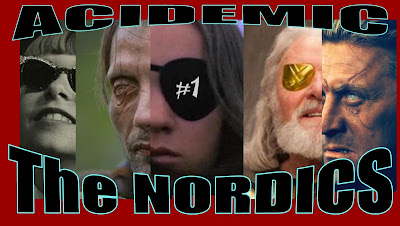
The Fall 2011 issue of Acidemic Journal of Film and Media is now active, on-line, and considered harmed and dangerous.We've got awesome work from an array of deep talent and warped visionaries. post-theorist Steven Shaviro (The Cinematic Body, Connected); Sweden's Daniel Ekeroth (Swedish Death Metal, Swedish Sensationsfilms); revered L.A. film and rock critic Kim Morgan (Sunset Gun, MSN); beloved film historian David Del Valle; sharp-eyed Budd Wilkins (That Obscure Object of Desire); the haunted Steve Tweed; the celestial Lucy Blodgett; sharp newcomer Molly Marie Wright; rising painter Audra Graziano, and topics ranging from the sleazy sex-snuff apocalypse of the Balkans and Swedish cinema's trailblazing sexual openness to the 'kicker' phone booth vandalism of mid 1980s Stockholm; 21st wave 70s feminism via German DEFA science fiction and the 1976 TV show, Star Maidens; Bob Hope meets Thriller: They Call Her One-Eye; Let the Right One In vs. Twilight; Thor in the Gardens of Sebastian Venable, and of course some Nordic alien theory! Come and See, and behold a pale blonde horse and the name that rode on it was Acidemic Journal of Film and Media #7: The Nordics...
And also check out the August issue of Bright Lights Film Journal #73 also online, Acidemic's two-fisted older brother!
Thursday, September 01, 2011
Friday, August 26, 2011
Pre-Code Capsules 8: THE NARROW CORNER, WEST OF BROADWAY, HEADLINE SHOOTER, THE CROWD ROARS, TOP SPEED
(1933) Directed by Alfred E. Green
****
You never know what classic author's film adaptations are going to ferment into wine and which to vinegar after they're buried for decades in obscurity then exhumed for TV, but the pre-code steamy and existential South Seas commonwealth sagas of W. Somerset Maugham--a flood triggered by the iconic success of RAIN (1931) have become a very potent, tasty wine and THE NARROW CORNER is the good stuff you keep for yourself during dark nights of the soul. Why is it so forgotten while the self-absorbed forgotten man whining of something of a similar existential decadent modernist play/film like THE PETRIFIED FOREST is so lauded? Leslie Howard's suicidal rambling in FOREST smacks today of self-pity but Maugham characters's dead-eyed stare into the riptide--where life is wrest from us as a berry from a branch by a half asleep Mexican gardener--is admirable, heroic, and damned hilarious. Cheers! Tape it and save it forever.
The story of a wan rich kid Brit who has to take it on the lam to the South Seas after he kills... ahem... the lady's husband fits its star, Douglas Fairbanks Jr. to a double-crossed tee. We can see in him the natural actor who's absorbed everything he saw and heard as a spoiled child in the thick of his famed father's silent era decadence, realized it was his birthright but never quite respecting it, and binging that gentlemanly ambivalence to bear on his caustic character. Starting the film as a peevish spoiled bounder, he comes to hate himself and the women who fight over him because then he has to deal with jealous husbands and fiancees--which here will ultimately include Ralph Bellamy as a naive Dutch plantation owner. Fairbanks reflects his own history as a man who more or less had fame handed to him on a platter because of his name, and rather than become utterly spoiled (believing the hype) has lost faith in the inescapably shallow world that fawns over him no matter how surly he behaves. His dad has chartered a ship to take him around the islands in a way to stay ahead of the law and evade further scandal and he sulks mightily upon it. But when the ship almost goes down a storm, he becomes impressed at the peptic ulcer-afflicted drunkard captain (Arthur Hohl) who drunkenly laughs in the face of the lashing winds. The storm waves crashing into the ship over and over, soaring into the wind, all night, does something to his soul, cleans it out you might say. And the next morning he's a newly-minted man instead of a spoiled surly brat. Any seasoned tripper will surely relate. Without a terrifying, grueling and prolonged initiation (hazing, if you will), the man cannot change, Danger and endurance are the heat in the forge through which one can soften the sword of their self and hammer out a new shape.
Meanwhile a debauched doctor (Dudley Digges) also aboard ship tells his trusting Chinese servant how many (opium) pipe loads he'll have every night, to 'ahem' unwind ("seven pipes tonight... no more, no less,") rendering him useless at critical junctures but leaving him always self-effacing, droll and unblinking as he stares into the void, his opiated brain alight with the zonked poetry of a Eugene O'Neill or Tennessee Williams-style poetic, existential drunkard ("Regret nothing. Life is short, nature is hostile, and man... is ridiculous.") He's the type of character who no longer exists outside of classic modern plays, one borne of the WWI trenches and dogfight skies, the drink a prayer for the dead all ready; hurrah for the next who dies mentality. It's a mentality we've lost in today's climate, and frankly I blame nanny state morals and the turn away from manly gravitas that is the result.
There's also William Mong (above) as a mean old Swedish sea captain, boasting to fellow salty dog Arthur Hohl that he used to pilot slavers, and that he wants to gut his son-in-law (the eminently guttable Reginald Owen as a professor, idling for years with a translation of some obscure Portuguese poem); Sidney Toler as the agent who secures the passage; and Patricia Ellis as the lovely daughter engaged to lunkhead Ralph Bellamy. He's such a good soul that Fairbanks decides to go decent, and that just makes things worse! Still, you can't argue with the beautiful Hollywood exotica scenery and sense that once upon a time it really was possible to buy illicit passage away from the long arm of the law, even if you immediately found the same old troubles when you got outside its reach, but the lack of educated white people around the islands made it easy to make friends with those you stumbled on. There are very few movies that really get what it's like to be desired by women to the point you're constantly pissing offEE rivals and winding up in disputes between roommates and husbands. Don't ask me how I know, but I do. And so, clearly does Maugham because, NARROW CORNER gets it super right. 'Bros before hos' then becomes the golden rule, and I also love Fairbanks' character is named Fred and Bellamy is named Erich. Fred is my own real brother's name! Eight pipes tonight, no more, no less!
WEST OF BROADWAY
(1931) Dir. Harry Beaumont
**1/2
Here's a curio starring former-matinee idol John Gilbert, caught like a fly in the amber of the sound era: when he tries to sound manly and tough he just sounds hung over, speech halting awkwardly like he's sending a morse code S.O.S. in the spaces between the words of his dialogue, hoping his buddies off-camera will translate and rush... to his aid... with a flask. In the early sound equipment days they were taught to take long pauses and say words... clearly. It's like he's counting director-mandated seconds between the words.
But it's worth seeing for the brave way Gilbert captures the art of the shaky rebound. His character comes home from the Great War,E hero with four bullets still in him, to find his fiancee Ann (Madge Evans) not there to meet him, and instead off with some slime ball. He laughs it sardonically away but it hurts and she's gorgeous and his hired rebound girl Dot (Lois Moran) is merely "pretty in a trashy sort of way." "Dot the I and cross the Ann," he says, while introducing them to each other at the (I guess) the only swanky nightclub in NYC. "Double cross." Rueful stuff!And it's worth it for the sly way the waiter says "your package sir," and slips Gilbert a fifth wrapped in a white towel, low under the table at the club, so the cops don't see it, and for the sleazy, no holds-barred details of Dot's life as a hired girl who's brave enough to refuse Gilbert's hand-out (she and her girlfriend owe ten days' back rent) even as she notes to her friend that at Gilbert's party there were "hands all over me" and then gropes herself in a resigned way to illustrate.
But the best part is poor Gilbert's shakes the morning after he marries the hired girl (oops). I don't think I've ever seen Saint Vitus dance so accurately rendered. And for her part it's great when Dot takes over as woman of the house and gets all racist, barking at the Chinese cook, or sprawling out in a wicker chair to shoot the shit about Jerry with his high class friends, like she owns the place (hired girls who get married to drunken playboys in black-outs are always either ruthless gold-diggers or good girls awaiting redemption, seldom are they neither). And when he tries to quit drinking the cowboys are singing outside and suddenly you tap into RIO BRAVO's scene where Dean Martin almost takes a shot of whiskey while the Mariachi death song plays down the street from the jail. As Dot, Moran is a little firecracker but her pal is no Joan Blondell, and when we see Gilbert ponder whether or not to keep her after their marriage's been annulled you feel he's genuinely tapped into that ambivalence Frank Sinatra had with Shirley MacLaine in SOME CAME RUNNING. But Gilbert, he was almost all the way tapped out, and it shows. Man, those shakes are something else.
And Gilbert's a good enough actor to use his personal desperation in a scene: you can feel his desperate stiff upper lip trembling as he finds out Ann's moved on. She could be standing for his entire female silent film fan base, which was once universal and then nonexistent. Like Barrymore's drunken has-been in DINNER AT EIGHT, he's a classic case of an actor's pain and his character's bleeding into each other, the pain of being smart enough to know when you're outdated, when your matinee adoration is all wound up, and you're too drunk to find a new illusion, and seeing the only way to go is down, so might as well get drunker and plunge into the void like a cock-eyed W. Somerset Maugham kamikaze. All else is vanity.
HEADLINE SHOOTER
(1933) Dir. Otto Brauer
***
THE CROWD ROARS
(1932) Dir. Howard Hawks
***
The cars are game and Cagney's explosive, but it's kind of tough to care because it's not like racing cars really contributes anything to society, and mainly its because he's also such a shit to his women, i.e. the groupies of the track.. He's a race car driver who tries to warn his little brother off of the loose ladies he himself runs around with (like Joan Blondell); they're good enough to shag, but not to marry, and the brother is of course all ready to take the first girl he meets at face value and propose before bedding etc. But so what? It's Ann freaking Dvorak, who wouldn't want to marry her instantly? What's Cagney's problem? Well, all that fades when one of his buddies dies in a wreck and the race keeps going, so Cagney starts to smell his old pal frying in the blaze every time he drives around the bend, around and around and around...Sure, that's enough to put anyone off his feed.
So he flips out; he leaves the race, and the racing world. Ann Dvorak chases him down to the Indy 500, and we get some great scenes of Cagney asking for jobs and being turned down by various crews because he's lost his nerve. Lost his nerve? Cagney? A great parade of typically laconic Hawks-types has to say no to him, and it's here more than anywhere else you can feel the Hawksian touch in its infancy, and when Cagney finally tells Ann about the crash and the smell of McHugh's burning corpse, he cracks up in her arms, and from then on it's racing with style and you know it's not just Cagney's macho racer that has learned women are wiser than men and sexually assertive girls who make the first move deserve respect instead of contempt, it's Hawks too. And maybe Dvorak and Blondell are the ones that taught him, like they teach Cagney.
Maybe? Maybe nothin'!
TOP SPEED
(1930) Dir. Mervyn Leroy
***
An early sound comedy-musical (with most of the music numbers cut) starring the rubber-mouthed comedian (the millionaire willing to 'adopt some' with Jack Lemmon in SOME LIKE IT HOT), and a daring chronicle of the years before the Depression, this is a last gasp of college letters and class resentment. The passing era of sexual repression lingers in lines like, "I'm so modest I won't allow lamb chops on the table unless they have those paper pants on." Both suggestively lewd and comically moralist, the film sums up the only sane response to the draconian, near fundamentalist level of sexual repression endured under the watchful eye of hotel detectives, chaperones, and social reform-minded wives of the era, who did their damnedest to make premarital sex impossible. Herein we also learn the origins of now forgotten phrases like "over a barrel" (it's a protean kind of CPR given to drowning victims, put them face down over a [lying on its side] barrel and roll the person back and forth to pump the water out of their lungs) and "counting sheep" (apparently it was a big fad like Atkins is today, and Brown explains it complete with hand gestures). And since 1930 was such a 'scandalous' time, well, it was very easy to be scandalous. Just being caught in a hotel room with a woman not your wife could earn you a public flogging, and from thence we get those boudoir comedies of sneaking around fire escapes in one's underwear, hiding under beds while the house dick peers through the keyhole. It's hard to get that kind of naughty steam going in our more permissive age, but here's a world where men can't show their torsos on the beach and have to wear full body swim suits. It explains a lot... about Saudi Arabia.
Coming off like a primordial Jim Carey, Brown is a surprisingly manly presence, and when his character pretends to be a millionaire so he can get a room at a posh hotel he sounds just like Walter Matthau, or did Matthau emulate Brown as a kid, catching films like TOP SPEED on matinees while anti-Semite bullies skulked outside in the Brooklyn streets? Footage of the climactic boat race is ridiculously mismatched to Brown's rear projection drunkenness but Edward Arnold disparages well the news his future son-in-law took a bribe, but in true financial savvy the pal just takes the money and screws his briber, bets it on himself via his stooge buddy Joe E. Brown, and then pockets the profit. Oh to be alive in an age where millionaires were made so effortlessly.
Oh, but we'd have to get married first.
Wednesday, August 24, 2011
Bride of Bogartstein: IN A LONELY PLACE (1950)
Spousal abuse is so demonized these days that not a single redeeming characteristic is allowed to remain in our violent men of drama. Gone are the magnetic brutes like Stanley Kowalski, gone deep but abusive artists like Dix Steele in IN A LONELY PLACE (1950). It's not surprising then that we're unprepared for how hard it has become to adapt to these characters and their sudden brutal displays. We've become accustomed to not having to think about violent men in any way other than as cardboard action targets, as objects first for derision, then hate, then vengeance, and lastly more derision. No more can they seem sexy, or have good qualities.
But Bogart is Bogart, he could play a serial killer and we'd have to like him, and since he's playing a famous Hollywood screenwriter his tantrums and blinding rage white-outs (1) go unchecked save for police intervention which his studio then works to keep out of the papers. This is the kind of guy you should just get away from, the minute you meet him, but can't since he's famous, witty and charming in a bleak sort of way --he's Bogart! He's inescapable. His fist has a gravitic drag. Thus a brute is allowed to stay brutish as a side effect of his Hollywood success, when he should be in jail, or the ring: "I've had hundreds of fights," he says to Gloria Grahame as his concerned neighbor, as if that's some sort of mark of the martyr, some mark of courage. Many other successful men in Hollywood must go through their whole adult life without throwing a real punch, especially with the proximity of hotshot lawyers never in doubt.
While Bogart looms like an electric golem gone to gray, Grahame flexes her beautiful face into a Hollywood glamor death mask as she tosses and turns in bed, worrying that she's sleeping with a raging egotist who could fly into a homicidal rage over the slightest thing she does wrong. This keeps her awake and she starts taking pills to sleep. He might not like that, so she worries more: "This one's not going to let you go that easy," snaps her masseuse, who it is implied has given her more than one happy ending over the years. Grahame's sad eyes show that for all his violence and bossiness, Dix is the last non-loser she's likely to run into before her happiness clock expires. But he's worse than a loser, he's a thug with an expensive tux and a case of the eternal shakes.
Bogart doesn't even allow us the comfort of falling back on his Bogart charm. Instead he lets himself get creepy; his dark self-effacing wit seems strained. The Bogie we know is too sharp not to know when those around him are turned off, but his Dix has no clue. Bogart is brave enough to show the angles by which even his actorly charisma can be exposed as vain antipathy. Even Dix's "A simple yes or no will do very well" proposal of marriage comes off like a threat. He sees marriage as providing any lady her luckiest break (or fracture) like signing a deal with a confused white tiger, or an face-eating chimp, temporarily cute and calm but... really, the rest of your life with this thing? One loud, sudden noise outside in the street and you could lose a limb. The only way out is to cultivate a penchant for servile masochism. As if to illustrate, Dix's battered agent exclaims to Gloria in the least coded of gay double entendres: "He's Dix Steel, and if you want him you've got to take it all" Rationalizing the hurt, he notes: "People like him can afford to be temperamental."
Any self-respecting woman would have left Dix the moment he first snapped, just as Krasner should have left Pollock when he made his first embarrassing scene at the dinner table. But such are those few unlucky moths that are so blind they can only see the most brilliant light, the light of charismatic madness; so they become stuck on the bulb of an ego that has swollen mercilessly with the pumping eternal handshake current of exploding pockets, and the medals that come with surviving the bloody war-like business of making pictures.
I'll admit the first few times watching IN A LONELY PLACE I got a headache, partially from the unpleasant frisson of seeing Bogart so violent, but mainly from all those ringing phones! The road to Hollywood heaven must be paved with nonstop telephone calls. I guess in L.A. they are like music. The best phone calls I ever had were from a gorgeous film writer girl in L.A. They went on for hours, for days! Phone calling is the very breathing of the biz, and you can tell Dix's line never stops ringing. Ding Dong, The dead witches are in the making. The infernal bells are enough to drive anyone mad.
![]() |
| "Squeeze harder! Harder!" |
Director Nicholas Ray loved him some insane abusive men. The link between Dixon and James Mason's tyrannical father in BIGGER THAN LIFE is clear: Hollywood is (or was) the place where white rage fights, shooting, drugs and casual sex are wantonly indulged in, thought about, and depicted for the enjoyment of the world. Certainly Ray indulged in these things in real life--his appetite is legend--but his love makes him different than the poseurs of violence and despair. His forgiveness of his fucked up protags is his way, perhaps, of trying to forgive his own trespasses. Like Sal Mineo's tortured puppy killer in REBEL WITHOUT A CAUSE, or Mason's cortisone-fueled madness in BIGGER THAN LIFE, Bogart's violence is considered an illness for our shocked empathy as well as fear. Both BIGGER and IN A LONELY PLACE show a man who thinks you are swooning at his brilliance and fearless spending instead of cringing in embarrassment like his abused love.
Perhaps only natural bullies can make it in Hollywood; only they can climb the chain of intimidation. Or maybe all this is just a pop culture codependence and denial. Of course it would be damn nerve-wracking living with someone so violent, but Bogart was always a little menacing anyway, that's what gave his heroes their punch--those sudden eruptions--the "that means one of you is gonna get a beating for nothing!" climax of TO HAVE AND HAVE NOT, or that cruel mirth in his eyes when he knocks out Joel Cairo in MALTESE FALCON.
I just gave some strange writerly advice to someone: "never give it your all unless you're paid less than it's worth." Was that my dyslexia, or was this apparent paradox part of the sick queasy feeling created by seeing what financial overcompensation can do to a man like Dix Steele? When MALTESE FALCON followed LONELY PLACE on TCM (for Bogart Day), the combo seemed like a twisted freak show straight out of the Todd Browning oeuvre: I've seen FALCON a trillion times but suddenly the camera angles seemed beyond bizarre. Long takes of nothing: a phone gradually reached for and talked into offscreen; a phone on the night table; a lit cigarette. I finally realized I should be wondering whether Bogie's in bed with Mrs. Archer, or alone reading a racing form. When we finally see him again it's from low angles, looming around big hotel lobbies or taking his maternal support on the sly from Effie. His Sam Spade becomes a terrifying bully all of a sudden, just from the proximity to Ray's film on the TCM schedule. after IN A LONELY PLACE is a monster no matter who he's playing.
It's common Hollywood history that he and his first wife Virginia Mayo were known as "the battling Bogarts." So we know this was never a man to fuck with. Such a man is maybe too quick to violence even in WW2 approved locales. Ray is able to locate the monster underneath all the newly-slathered CASABLANCA heroism and underneath the monster, the sweet poet soul in the process of being crushed by the combined weight. Once the war is over and there's no one left to legally kill, the monster in the Bogart persona starts to crack through the detective/war hero/romantic lead mask, right along the crow's feet, and his dormant Frankenstein monster starts trying to reach out to crush someone.
The fourth time through PLACE, gone was my headache over the phones, and to the floor was my jaw at the sheer intense brilliance of Bogart's slow burns and sudden lashings. When something doesn't go his way, the anger begins mounting, slow and inevitably ignored by those who are unaware they need to stop babbling and just back away. After his lashing out, every attempt to quiet him is regarded through progressively more paranoid eyes. In the end the murder mystery is solved and yet Dix has almost started a whole new one.
Dix's ego is such that he shouldn't be allowed to be in a movie, any movie, but Ray never gives up on any character, even when they're so foul we recoil in shock that we're seeing them at all, let alone as protagonists. His love for dangerous maniacs is contagious; their lives are his downfall, and our redemption.
NOTES: 1. I had a rage white-out once, and I can tell you it's exactly what it sounds like - you literally go blind; a kind of dissolving white noise signal clouds your vision, and you start lumbering towards your prey like a drunk Frankenstein.
Sunday, August 21, 2011
One Pill Makes You Corporate: LIMITLESS (2011)
LIMITLESS, or AMERICAN PSYCHO-PHARMACOLOGICAL, is about that drug so popular amongst investment bankers, Adderall, disguised as a wonder pill that turns its taker into a super genius, based on the idea that we only use 10% of our brains, so what if we could use all of it? And have total recall of even the most mundane moments in memory? Such is the gift of the magic pill, which then our hero sleepy sad sack novelist Bradley Cooper gets hooked on and needs more of, and so do a lot of other (bad) people. The chase is on and the hangovers accrue, paranoia steps up, loose ends are tied behind people's backs, and sheer stupidity rears its head.
The problem here is that Bradley Cooper and the filmmakers are afraid to go full AMERICAN PSYCHO, so a hinted at black-out murder is just a plotline dropped in time for the big climax of battling the usual baldheads. So instead of some bitter downward spiral wherein Cooper -- who plays a self-absorbed novelist initially too stupid to take an offered pill from his ex-brother-in-law--goes insane, we have him become a Tom Cruise-style action star. Once he does make the grade, so far so good, but on his big day presenting his portfolio to Robert De Niro's power-talking tycoon, he decides now's the perfect time to not to take a pill, like a first class dumbass, so he's sick from withdrawal, and almost throws up on De Niro's thousand dollar loafers. Turns out he has a stash of pills at his girlfriend's house, but of course never dreams of getting it, because that would be too easy. Instead she (Abbie Cornish) has to get it, on her lunch hour, while he shivers like a crackhead in her office.
Trust me, no addict is that unprepared.
Don't doubt that I personally am similar and, as we say in AA, really ID'ed with Cooper's rise and fall. I myself was once a horribly blocked writer, tortured with longing, until my shrink put me on Effexor, and now I'm super-human on the keypad, writing so damn much my fingers fall off, smoking Camel Lights and guzzling diet coke and staying otherwise sober but always riding that low throbbing train of chemically-enhanced motivation and focus. Drugs have been overcoming writer's block since the dawn of recorded history, of course (those shamanic mushrooms), but that's not Bradley's problem. What sinks him and what is most unbelievable is that his girlfriend could be so dismayed that his newfound confidence isn't 'real' since it was boosted by a substance.
Listen lady, substances are the core of existence! We wouldn't even have civilization if not for coffee. We'd still be asleep, and cranky, in our thatched huts, hoping and dreaming that someone else will bring us some breakfast. But Cooper's refusal to remember he has pills around until it's time to try to take them to fight Russians is just not believable...
Imagine Popeye spending hours trying to open a can of spinach, his hands shaking, finally needing Olive to do it while he stammers through his teeth, an empty pipe in the corner of his clenched mouth. Not good. Popeye needs an open can ever at the ready, and so he has it. Has Bradley ever tried spinach? From a can? No, too cool for that; his spinach is fresh from Balducci's. All he needs is a little pill, and he's such a genius he can't even remember he's dead in the water without one.
I won't give away the ending, but I will tell you it's needlessly happy, a validation of Hollywood's fetish for solipsism's comely victims. What the story cries out for is a finale reflecting the terrifying loss of control and sanity that comes from tampering too long with your brain chem--as in AMERICAN PSYCHO (2000, top, bottom) which finds our 'hero' trapped in the vapid clutches of Reese Weatherspoon with no idea if he's been dreaming or actually living all his murders, and she'll never even stop talking about herself long enough to notice how much he loathes her. Instead of that kind of murky ambiguity, LIMITLESS bears out the creepy douche bag feeling I used to get hanging out on certain Upper East Side AA meetings listening to a certain class of rich snobs fawn over their sobriety like humility is the very latest Coach bag. Why doesn't our super-enlightened Bradley figure out a cure for AIDS, or how to levitate, or remote view, or make some draconian decision to wipe out half the population in a plague he's designed, carefully by hand, in order to make the world less crowded, ala LATHE OF HEAVEN? No, he drops his writerly pen and goes right for the long green. What a tool. And what a validation for Wall Street. If only Gandhi had possessed Cooper's level of enhanced confidence and brain power, imagine the great things he could have done with financial gains market share manipulation!
In the end, this drug just kind of turns you into Tom Cruise, and for the Los Angeles power worshippers, assertive narcissism and total fearless confidence is everything. I guess they figure New York is like that too. Here we love that trait like we love gangster movies, or mad scientists, or Hannibal Lecter, but you can't have your face and eat it too; you can't expect that Bradley alone is rising in the ranks in the realm of pill abuse. Where are all the others struggling for their smarty fix? In reality, pills like this come along all the time, but trouble is, everyone finds out about them and within a year taking it doesn't give you a leg up on the competition so much as barely keep you in the running, hence steroid testing is a kind of unilateral treaty.
Fact is, Cooper's character seems pretty stupid to begin with, but he loves his drugs and we're supposed to be in awe of him irregardless of Abbie Cornish's disappointment. If we come away from the film angry at our own sloth and trapped potential we should remember there's a reason we shuttered the upper rooms of our brain mansion: thar be monsters. Tread lightly, and bring a good therapist, or sponsor, or sword, or suffer the consequences. Unless, of course, you're Bradley Cooper, for not even the darkest demon can compete with the gravitic drag of such black hole vanity.
Subscribe to:
Posts (Atom)