Tuesday, January 10, 2012

I dunno man, I took the BLUE SUNSHINE and I feel fine...


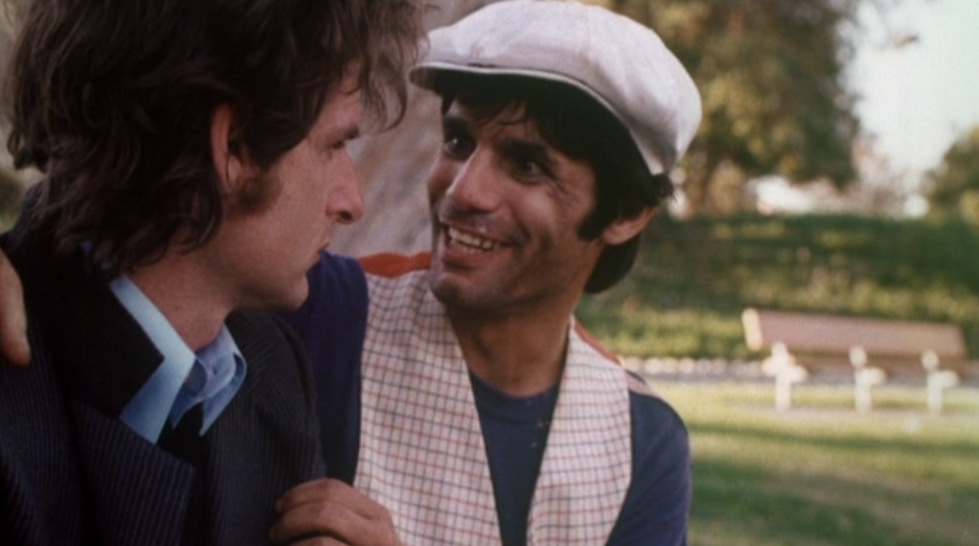
It doesn't really have all its marbles together but Blue Sunshine (1978) provides an interesting amalgam of low-rent mid-70s horror filmmaking that's roughly comparable to the slew of early 70s artsy gut-punch horror shows coming out of NYC, Toronto, and Pittsburgh--De Palma's Sisters, Romero's The Crazies, Cronenberg's Rabid, Cohen's God Told Me To. Like them it's touched by the conspiracy thriller with pharmacological implications, but this time mixing Hithcockian 'man on the run' action with a Big Chill-style alumni "what happened to the dream we all shared at Stanford ten years ago, when we all dropped this weird acid called Blue Sunshine made by our chemist friend who's now running for political office?" cross-section of compromised idealists. The answer, my friend, is that the dream is gone. All the friends start wigging out, all across the land, at the same time, more or less. And it turns out they've lost their hair and been wearing wigs and barely keeping it together - any little wig slip--figurative or literal--can send them over the homicidal edge, all right around the ten year-mark of their Blue Sunshine trip. Dude, that Blue Sunshine's flashback kick is prcises as a Quartz watch! Gimme some!

Perma-scowler Zalman King is at one of their reunions when one of them starts wigging out. He must have been the 'guide' of the bunch ten year ago, or the conscientious objector who didn't want to pollute his chromosomes, as he's the only one not turning homicidal and bald ten years after basking in the 'blue.' Sensing an opportunity, perhaps, to escape the boring party, he takes it on himself to run around stopping everyone, single-handed, before they hurt themselves or others. This means, naturally, looking guilty holding the knife he takes from his assailant before she falls to her death after he barged in on her and started yelling, etc. Rather than stick around and explain to the cops, King just presumes they won't believe him so runs off one to singlehandedly save the next acid casualty (and indirectly hasten their end). He didn't cook it up, or sell it, or even take it. He had nothing to do with it1 He's just a narcissist martyr who wouldn't share a chance to be the hunted Hitchcockian hero in a million years. To most temporarily sane viewers, no matter how much acid they've done, he's only slightly more irrational and wacko than the crazy baldheads he visits.

Oh Zalman King, your self-righteous scowl is so unrelenting you make Jason Patric seem like Harpo Marx!


Like its leading character, Sunshine can never figure out where it wants to go or how its hero can help (it's not like Zalman's got a bag of Thorazine with him), though fascinated by the power of LSD, the film lacks the nerve to take two tabs and go off the deep end like everyone else (i.e. to visualize the hallucinations), so it mopes on the sidelines and 'misses the party,' and it's the same party at which Hitchcockophiliac De Palma, STD clinician Cronenberg, downtown paranoiac Cohen and blue collar Swift Romero lost their minds - becoming lifetime master auteurs. So while those dudes broke new cinema ground and flew into cult immortality, and today have a body of work still trenchant and discussed, director Jeff Lieberman was left behind, the late arrival to the acid test, the kibbitzer,, preferring to dabble in a little bit of each of their areas, to finish the drinks they left behind and hang in the back, feigning interest in the bookshelf. And the movie is his justification for his cowardice: Turns out all that nonsense about mutating chromosomes was right! Nyah Nyah.

The only person you know for sure did some, in the whole film, is Leon the replicant (below) and the guy in the poster at top (the eyes never lie, Manolo). Star Zalman King on the far other end of the spectrum, is such a wearingly sober Sean Penn-ish scowler he makes 'experienced' viewers annoyed. Perhaps King annoyed Lieberman too, as the film seems to dryly mock his martyrish spotlight hog (he was probably directing all his own close-ups and milking lines for every last ounce of method interiority).

"wake up, time to fly!"
Meth, I hear you callin'
The plot is set in motion when--at a druggy all-night party--a guy is revealed to be bald and wearing a wig. When the wig comes off he gets mad and kills three women! He runs. He's hit by a car after King takes it on himself to chase after him, and then King takes it on himself to run like an outlaw rather than wait for the cops, presuming in his self-centered martyrdom that the cops will automatically suspect him of the murders. He never deigns to clarify why it's so important he finds out the names of everyone who took the blue acid ten years ago at Stanford. Apparently the guy who made was a kind of local Tim Leary, but he's now a Mitt Romney running for office, which is as unlikely a transformation as you're liable to find with a budget this low.

Luckily, the murderous freak-outs are pretty hilarious, with the killers apparently perfectly normal, if a little stressed and sleepless, until someone rips off their wig and exposes them as bald and they go apeshit with superhuman strength.

Winters looks just an ex-girlfriend I did a lot of acid with senior year, uh oh
As for the rest of the cast: Deborah Winters is cute and alert as the girlfriend who King uses for odd jobs and leaves in the dust of parking lots when he's going to go talk to a witness or whomever. She seems ready to be beamed up into a better film, and deserves a much cooler leading man. She's sassy, sweet, and able to manipulate big dudes into her sway. As one of the alums who took the sunshine, Adriana Shaw (above and below) gets the scariest scene when--in her blazing red bathrobe one morning--she finally snaps and attacks some neighbor's kids she's watching who are being too loud watching cartoons in her living room. The blocking is a little clumsy but it's great to see a director other than Spielberg or Lang dare to play the child murder card. To paraphrase William Carlos Williams: so much depends / on a bald lady in a red bathrobe / with a butcher knife / chasing small children.

My doctor added Abilify
While I expected more from a film named after a brand of blotter acid, there are various points where it almost all comes together, like it's a few feet shy of 39 Steps... let's say 22 Steps. It never, if you'll forgive the expression, gels. Still, I'm glad it's around, in the freezer, waiting for just the right time to blow the world's mind or at least divert it for a hair (if you'll forgive the expression). Just don't invite old sullen, sulky, self-righteous Zalman King to the party, at least not until he gets his Red Shoes laced. He's apt to come at you with some elaborate long-ago disproved factoid about the drugs you're doing, and then try to get you to go to rehab, or he won't let you drive home, even though you only had one drink, ten years ago.

May also induce scowlingitis


Saturday, January 07, 2012

Slaves to Unconvention: TINY FURNITURE, ANOTHER EARTH, The Sarah Silverman Show


A great scene comes through the otherwise trite Another Earth like a cyclone: A female TV journalist is broadcasting live from a radio control room, watched on TV by Britt Marling's family. The first person making contact with the recently arrived Earth 2, the journalist talks over the radio to someone she gradually realizes another version of herself from the new planet.  So that means there are now two of everyone. "Maybe the other me didn't make the same mistakes," she notes. Yes, but maybe her hair is lifeless and dull and not stunning like yours, Britt Marling!

She's beautiful, is Brit Marling, with golden hair which she hides under janitorial hood ala some kind of repentant nun, mopping floors and moping over the past. While a minor she killed the wife and kids of some dorky composer via a drunk driving accident (and hackneyed script workshops)-- and now she's out of kid jail and all grown up and wracked with guilt and oh-so obsessed with spying on this dopey composer and she doesn't have the guts to tell him who she is. So she pretends to be from a cleaning service giving out free samples and she continues to serve and worship him and clean his place and it's all rather creepy, like the fantasy of any mid-life crisis slacker, where some beautiful young girl gets rid of your wife for you and then comes and cleans your house for free and eventually falls in love with your sorry middle-aged ass. Like all film school screenplays, it smacks of misogyny that's so deep no amount of therapy or PC post-grad hand-wringing will remove it. You just know this dull, one-note mourner of guy would never get a hottie like Marling unless just this twisted scenario happened and in the end that's the only reason for it.

Rembrandt-ish darkness and sunlight impress in Another Earth far more than the characters as they clean and sulk in the dopey composer's artfully demolished farmhouse. The cliche'd two-character framing undermines the radio and TV broadcasts about the second earth, which would have the weird post-modern immediacy of the best parts of the first two Romero dead movies--where we're just watching TV news come apart at the seams--if everyone wasn't too busy underacting. Instead we're forced to endure the crisis of conscience Sundance screenwriting instructor-mandated 'human story.' Those Sundance mandaters should be asking why -- why bother visiting this alternate earth if it's exactly the same? Are y'all that narcissistic? Y'all that afraid to go somewhere new for a change?


Poetry journal conceits aside the moral here is that actors love roles that require lots of emoting and screen time but less memorization of dialogue and if you let your cellist boyfriend design your score for you don't be surprised if he drowns your every muted reaction shot in tired chamber sawing and wants to make a big production of serenading you by musical saw in an empty auditorium as you visualize old Sputnik photos. You're Britt Marling, damnit! You look gorgeous in front of a big blue Earth, and you're hip and been to some fancy school for math geeks and this is what you're going to let yourself be seduced by?

She does grant herself a really good monologue about learning to love the things that annoy you if there's no way to change them, and there's a Tarkovsky-esque moment playing Nintendo boxing and a great final shot. But in the end, why care about a guy so selfish he tries to talk his girlfriend out of going to space after she wins the essay contest and gets approval from a Richard Branson stand-in? Imagine if Charlie's uncle tried to talk him into giving up his golden ticket because his bunions hurt and he didn't want Charlie to go without him! A guy that self-absorbed deserves to lose his Marling. - **


So I've been watching the old Sarah Silverman Show a lot on Netflix. I love it since it provides all the elements Another Earth so dolefully lacks, namely mischief and a sense the goings-on aren't just cliched emotions being trod out to appease some hack screenwriting teacher.  There's a great animal cunning that comes over Sarah's face when she's stalking her prey or marching purposefully around her apartment; she can be insufferably coy but the gleefully amoral, post-apathetic sprite she plays on the show is at least alive and Nietzschean. I could do without the two hairy nerd slothful, poop-obsessed gay dude neighbors and the ham cop boyfriend, but Sarah's real life sister plays her sister and she really seems like someone I could talk to.

In order to grasp the Silverman revolutionary aesthetic, first see The Big Sleep (1946), Meet Me in Saint Louis (1939), and Animal Crackers (1930), and then think of Silverman as a cross between Carmen Sternwood, Tootie and Harpo.
***


Tiny Furniture (2011) explores life as an intelligent but negative body image-stricken recent graduate whose major was in film theory, though she never seems to make any trenchant Antonioni references. Instead she throws herself at self-absorbed moochers and druggie restaurant kitchen chefs (a notoriously slutty lot), and while the whole "I learned the truth at 17" motif is subtextualized it looms right out into the top text, and Lena Dunham refuses to even smile or hold up her chin, and eventually her inertia drags us down, especially in high-def.

Dunham, second from right.
Lena is the real-life daughter of a famous artist I've never heard of so its understandable she'd try to counterbalance her mom's extroversion and acclaim via a rejection of all aesthetic and social criteria, but why then punish the viewer? Her character's one claim to fame is a shoddy youtube bunch of exercises in a skimpy bathing suit and it seems like we're supposed to read this unappealing spectacle as a challenge to standards of feminine beauty. But more than that it's a misguided bid to belittle her artist mother; to essentially out-maneuver 'Art' itself via a primitive return to Willendorfery; to return the shock value and uncanny horror elements to nudity; to strip the bride bare for her gay bachelors, as it were. It's a good start, but it won't get you laid. This isn't Willendorf or a Dubuffet 1950"corps de dame" mixed media on canvas. This is the movies! In hi-def! Have a heart!

Jean Dubuffet, 1950
There's nothing to be ashamed of in being frumpy if you embrace it but don't expect us to do it before you do it yourself, am I right, Montel?! That just shows a contempt for the public that's probably founded in Dunham's deep ambivalence about what makes art successful. It's a hard thing to do, an artsy differentiation from your artist mom, made with her money, presumably. Talk about a stacked deck, it's a whole lot like Godard asking for money from his rich Swiss dad to finish his Parisian critique of the bourgeoisie.

And there's a reason flawless skin and beautiful cheekbones rule, especially in hi-def. With her frumpy demeanor, Fieldsian nose, and dead eyes, you feel (or at any rate, I feel) that after only an hour or so into Tiny Furniture, you can't wait to get home, take a Silkwood shower and close your online dating account. Is that too shallow? No. It's just shallow enough.

However, Lena's real life sister plays her sister and she really seems like someone I could talk to, and Jemima Kirke (left) as the posh Brit accented party girl Charlotte is cute, daft and completely mad. I kept wanting to whisk her away to another party, do ecstasy with her and live in her bedroom forever! Am I shallow? Why should I be expected to be less shallow than Dunham herself? She should cultivate an interest other than exposing herself to gross boys! Boys are gross. She should have hung out with Charlotte more and done lots of drugs. She would feel better and look good in no time.

Oh well, maybe she'll put that film theory degree to use yet and I have a feeling we'll see Kirke again. I hope so. To sum up, Kirke and Sarah Silverman are at least their own monsters. With gorgeous Marlin bound to dour indie convention and Dunham bound to dour rich kid myopia, we're left with the realization that film school is misleading our confused sensitive young artists, teaching them rules of story development and male conflict enhancement too well and self-realization too poorly for them to every make anything interesting, and the Kirkes must go home and sleep alone.

Escape the Sundance conventional box, girls, go ahead and tell rules of narrative and sacrifice to go the fuck themselves, and shiver in Silverman blue light of... Another Melancholia!

(POST SCRIPT - Dunham's series Girls is rocking HBO and proving everything I said wrong. Or maybe Lena read this post and took my suggestions to heart? Either way, it's hilarious that now some camps are giving her flak because her show isn't more cookie cutter banal! hahahah)

Thursday, January 05, 2012

Acidemic #8: Brecht, Godard, Wood (and other Acidemic news)


Calling all Quakers, Pundits, Philosophers, Troy McClurians, Brechtians, Woodians, Match Kings and Red Queens, check out: Acidemic Journal of Film and Media, the eighth issue (of which this blog is a proud offshoot).
Brecht - Godard - Wood, an unheimliche trio (their muses--Lenya, Karina, Vampira, above); from the fourth wall shattering, narrative immersion-disrupting carny barker Marxism of the Weimar Era's own Bertolt Brecht to the 'unconscious' post-modern transvestite sci fi of Edward D. Wood, Jr. to... Godard, wherein we can perhaps locate the creamy middle of what cinema, metatextuality, artifice and the 'pleasure' of suspension of suspension of belief  is all about

With his shots of spinning tape recorders and pop singers sulking around pinball machines and reading philosophy aloud from the bookstore, Godard compares well to Wood's indifferent sense of (dis)continuity. Is Brecht their spiritual father and where does fleabag economy and drunken incompetence blur into post-modern genius and intellectual rigor? And he asks you where What is. It all comes unglued just by talking about it, and there's plenty of room between these melted titans to explore other serious or accidental post-modernists: Ulmer, Lewton, Beaudine, and Fassbinder.

Tuesday, January 03, 2012

If I was a TCM guest programmer / and you were a (cobra) lady: FREUD, COBRA WOMAN, DISHONORED, CEILING ZERO

Don't you hate when TCM guest programmers pick titles from the same old classic safety list TCM shows constantly? Here's their big chance and they pick Lawrence of Arabia, Casablanca and, um, maybe you've never heard of it, Citizen Kane! Yeah, right... over and over.

I love those films too, but we need guest programmers like me, who are keenly aware of all the films TCM hasn't shown in at least 100 years, if ever. These four are classics that should be ubiquitous but instead are never aired... why? Why, Nat?

8 PM - FREUD 
(aka "The Secret Passion")
1962, dir. John Huston

Why don't they exhume Huston's Freud to tie in with Cronenberg's A Dangerous Method? Are Freud's theories of infantile sexuality still too shocking? Any John Huston film starring Montgomery Clift and filmed in expressionist-Victorian hothouse black-and-white should be a mainstay anywhere. It's not perfect--it's very brainy and theoretical as we follow Freud's life from a young intern at a psychiatric hospital challenging the status quo, up through studies of hypnosis in Paris, and still pushing to find the secret of the unconscious mind and how to release it from its airless tomb and thus cure hysteria. We see Freud continuing his discourse via a series of conversations in and out of Austrian carriages and walking through hallowed halls. But then, the gas lights dim a bit and Huston eases back on his narration. Slowly a kind of mist coheres and it becomes an expressionist nightmare horror film, leading inexorably to Freud's big 'ah-hah!' moment, the witnessing the belly of the beast slide open to reveal its secrets. We're being shown the first 'meta'-dream, the tools for analyzing all itself being forged right there, onscreen. Damnit, I had this on an old dupe but now it's long gone and I want to see once more Klaus Kinski =making love to a mannequin leg while the visibly uncomfortable, drug-addicted, partially paralyzed, perfectly cast Clift looks on, agape, theories coagulating from the murk of his patient's hysteria and crawling half-formed into his mind. Imagine a prequel to Suddenly Last Summer, with Clift's shrink dreaming (or rather nightmaring) his way back to being the world's first psychoanalyst, embattled by the accredited establishment and clinging to what shreds of Tuinal-induced hallucinatory calm he can while while he treats his Venable patients --that's truth, that's Freud! We need it now more than ever. God helps us if we don't get it.

PS -8/19- I have seen it again, I got a Korean import dupe from ebay, though I fear it's somewhat cut from a fuller frame to fit a widescreen TV. The image is good, but I realize Kinski isn't even in the film. Did I hallucinate him? I saw this movie only a few times while deep in the throes of alcoholic hallucinatory madness (the pefect way to see any movie) so maybe I saw a different film?)

10 PM: COBRA WOMAN
1944 - dir. Robert Siodmak

Technicolor is king and shapely Maria Montez is queen here on the Island of the Cobra as well as her identical twin, good and pure and rightful queen, engaged to Ramu (Hall) who swims to her rescue after she's kidnapped right before the marriage ceremony. Bold crazy greens pulse all through the inspired costumes and there's tarot card-level archetypal juice drizzled over a plot that's strictly serial: See the evil Montez ordering virgins into the volcano by the hundo at the height of her ecstatic and sexy snake dance! See her letting a man she doesn't even know kiss her under the water. Realize that 1944 was the height of the war, and censorship made sure all the skin had to be in pools (would a genre like Esther Williams pool musicals ever be needed once censorship relaxed?) or on ice in short skirts (Sonia Henie?), i.e. folded into the story naturally via displays of athletic prowess. Luckily we're liberated! Not just from the Axis (who also loved 'clean' displays of athletic prowess) but from the Catholic legion of 'Decency.' I digress...

As for the cast, Montez is good/bad and awesome; Sabu is annoying; Huntz Hall forgettable, Chaney silent, the score awesome with timpani, the language pidgined. The king cobra Montez dances for is pretty floppy (though it does have a good tongue). It's no accident that right before I popped this DVD in something also from the WW2 era was on TCM, about an officer who had to ship out before his marriage could be consummated, the sexual tension there ran cold and coded, as was the style of the time, the censors claimed. The interrupted wedding at the start of Cobra Woman plays on, maybe even satirizes that idea. Religion and its ability to make people act against their own best interest is satirized mercilessly in the witty script. When Ramu asks why the people of the island willingly go to their deaths in the volcano, the queen (Maria Nash) notes that "the ceremony appeals to their emotions... fear has made them religious fanatics!" Sound familiar?

Luckily when the boys finally came home from the war, they were too used to fighting to let some pious control freaks tell them what do do, and censorship began to collapse into the shadows of film noir.

Exploded with fairy tale picture book gone wild flair by the great Robert Siodmak, Cobra Woman is more about the shot and the image than the story, which is strictly from Flash Gordon-ville, but the presence of an evil princess (ala Aura in Flash) is really refreshing and cool. Such a figure is archetypal but sorely lacking in the Lord of the Rings and Star Wars franchises, both of which are ubiquitous while Cobra is available only from the Universal Vault Collection, though their DV-R is pretty badass. And you can find it here! The colors look gorgeous, with lots of dark serpent greens and dusky blood reds.

11:30 PM DISHONORED
1931 - dir. Josef von Sternberg

Dietrich and Joe made seven lovely films together - most are on DVD--Blue Angel, Morocco, Blonde Venus, Scarlet Empress, Devil is a Woman, but two--Shanghai Express and Dishonored--are not. Thanks to savvy guest programmers, Scarlet's become a mainstay on TCM lately, but Dishonored remains MIA and it's a damned shame. The (true-ish) story's been better told by Fraulein Doktor but this is better than Garbo's Mata Hari. Here Dietrich plays a Prussian spy who seduces men and steals their military secrets. But she weakens and aids the enemy, though why she should choose a creepy, leering Victor McLaglen to give up her life for is beyond me. What a waste! But it's Sternberg so we never get the sense she loves him so much as she set him free because it twists the masochistic knife in us, and says fuck you to the world. Anyway, she is victorious in an earlier maneuver against Warner Oland; a New Years masquerade shows off Sternberg's penchant for crowd scene bacchanals and there's a great final firing squad scene that should be embraced by self-destructive hipsters everywhere.

1 AM - CEILING ZERO 
1936 - dir. Howard Hawks

I might have missed this over the years because of the bland title and I dislike Pat O'Brien, but it's by Howard Hawks and also stars Jimmy Cagney, and say what you want about Pat and I will but he talks fast and Hawks needs rapid patter overlapping dialogue men and I'll tell you something else there's nothing like Hawks when he has two good actors who can talk like machine guns and aren't afraid to display motormouths we usually associate only with speed freaks which isn't to say Dexedrine is bad at least not in Hollywood where 18 hour workdays are normal and a man like Hawks wants you looking wired and ready, so where the hell is it? The film I mean? Sure there's parts of it that show Hawks was still perfecting his formula, there's bad vibes with Cagney's bad habit of poaching women and getting Stu Erwin in trouble with the missus, and everyone's cockblocking each other, and the encroaching regulations (delivered by Barton Maclane) and safety violation up-to-code authority browbeating... just imagine how much less fun ONLY ANGELS HAVE WINGS would be if there were regulations and burdensome officials and nagging, worrying wives, instead of no regulations at all and only cool officials down to get down and party hearty and the only non-local girls to worry about are either Jean Arthur, on her best behavior, and Rita Hayworth, at her hotness prime? Luckily there's something here that film doesn't have, a cute young girl pilot-in-training named Tommy, of course, and played by June Travis like she's to the Hawksian woman manor born.
Related Posts Plugin for WordPress, Blogger...