
Science fiction cinema's always had an unhealthy obsession with artificial intelligence but never more so than in the last few years: three major films: AVENGERS: AGE OF ULTRON; TERMINATOR: GENYSIS; and TRANSCENDENCE --all deal in some way with the instant revulsion that erupts in human consciousness once it realizes it has just outmoded itself. All three films structure themselves around a conflict between anti-technology extremists and the visionaries who shuffle along the edge between mad scientist and hero. In all three films, reactionary humanity rushes to destroy that which its visionary component has only just created, recognizing a genuine threat almost at the exact same moment the threat recognizes us. It's a war of buttons: can the AI hit the missile launch button before we can deactivate it? Can it zap us before we can pull its plug? It's a close race, one that braver films are less inclined to judge. Who started the squabble and who deserves to win? That's up to a God still too merciful (or sadistic) to push the Old Testament flood button and destroy his monster. The only movie scientist yet to ever follow that holy suit, to lock himself in and force himself to be a good dad, was Gene Wilder in YOUNG FRANKENSTEIN. The rest of us make a monster and then recoil from it the minute it wakes up, hating and fearing that which we just obsessively slaved to create, just like Mary Shelley knew we would.
The spiritual, ethical, and emotional animosity between Man and his own Super Machine intrigued us on an adult/mature level more in the 60s and 70s when we had gray-shaded shit like DEMON SEED and 2001's HAL. Today we prefer to have our good machines and bad machines more clearly defined, which is why, of the three recent films being discussed in this post, only AVENGERS: AGE OF ULTRON got good reviews, while the far more complexly cross-hatched TERMINATOR: GENYSIS and TRANSCENDENCE did not. Were they just too far ahead of their time (or behind it), dealing with the terrors of the 'technological singularity'? In case you didn't know, that's where an Artificial Intelligence becomes endowed with the ability of
"recursive self-improvement (progressively redesigning itself), or of autonomously building ever smarter and more powerful machines than itself, up to the point of a runaway effect (...) that yields an intelligence surpassing all current human control or understanding. Because the capabilities of such a superintelligence may be impossible for a human to comprehend, the technological singularity is the point beyond which events may become unpredictable or even unfathomable to human intelligence. (WIKI)Be it Ultron, Skynet, or Johnny Depp, be it nuclear apocalypse or extinction-level geothermal cool-down or a pod person takeover, in each of these three sci-fi films it's up to a mixture of bomb-tossing Mother Jones-type eco-terrorists, government hit squads, other robots, and computer viruses to stop this technological singularity before it starts, which therefore justifies the AIs first strike attack in an endless loop of a priori retaliation.
What sets these three films apart from the pack of more didactic and winsome 'what is consciousness vs. imitation?' blah blah existential quandary AI films (i..e EX MACHINA, HER) is the sly way they covertly blame their respective Artificial Intelligence's megalomania on our prejudice and hostility. We earn our own extinction--in both the AIs' eyes and the films' subtext--by our 'shoot first, try to understand later' mentality. The AI just gives us enough HDMI cable to hang ourselves. We answer our own question the minute we ask it.
Let's take a look at some common ground between the three films, and maybe we'll understand more than what these films mean, maybe we'll understand ourselves.... ugh:

1. EXPLOITABLE MAMMALIAN EMPATHY
Here's a quote from Bree (Kate Mara) about her experience uploading a monkey's consciousness onto a computer in TRANSCENDENCE:
"You know what the computer did when (we) first turned it on? It screamed. The machine that thought it was a monkey never took a breath, never ate or slept. At first, I didn't know what it meant. Pain, fear, rage. Then, I finally realized... it was begging us to stop. Of course, Casey thought I was crazy. Called it a success. But I knew we had crossed a line.... It changed me forever."Ahhh, but was that monkey really tortured, or had Bree projected her own empathic response on an unfeeling computer? Maybe it screamed in an attempt to match her mood, to supply the best screen for her projection that it could. Can a collection of ones and zeroes suffer if there is no guilt complex in the beholder? We're quick to feel that monkey's pain, to imagine the indignity and powerlessness of not being able to ever shut ourselves off, sleep, or even blink. It shows our limitations in thinking that we'd become 'changed forever' by something so virtual.
 |
| Evelyn (Rebecca Hall) carrying the new pocket-sized Kubrickian monolith |
Meanwhile, despite Bree's conscientious objecting, the critically wounded (by luddites) Depp is uploaded into the internet successfully. Later he tries--via a projected digital representation of his old self--to hook up with his still-alive wife Evelyn (Rebecca Hall). Don't ask how (just see Demon Seed instead), it hardly matters since she can't quite bring herself to admit it's actually him--whatever that means. The difference between the back-to-land Bree's projected monkey-mind compassion and Depp's wife's revulsion over his dead-eyed hitting on her refelcts the dividing line between our liberal empathy and our cold kill switch, the 'savagery switchpoint'. In war, for example, empathy for one's enemy will get your friends killed (as in Saving Private Ryan or Fury) while not enough for your buddies will make you a coward. As in the Uncanny Valley, a digital monkey = cute; a digital human= creepy.
Clarice's tale to Hannibal in 1991's Silence of the Lambs--about the screaming of the slaughtered spring lambs--illuminates the exploitable mammalian split in another way: if we didn't have a ruthless cold vein in humanity, we'd simply be easily slaughtered, and also be unable to kill anything and hence become irritable from chronic protein deficiency, ala Hitler (a famous vegetarian). Clarice would be fine in her ignorance but since she 'heard' the bleating of the lambs her empathic response kicks in, and this leads to her being kicked back to an orphanage after the lights out with one of the lambs. If she'd been a sound sleeper, who knows?
In the movie Splice, the geneticist couple creates these skinless blobs of living tissue that do not seem to be having a good time without skin or consciousness, and the genetic research highers-up freak out, not because they're witnessing manufactured agony but because the couple used stem cells to make them, which is forbidden! Thus humanity is both blind to the suffering of a mutated self-created cell and alternately projecting its own human pain onto it. The laws of stem cells aren't there for any other reason, they're the cotton in young Clarice's farmhand ears at night.
And if there is a God. Why is he so mean? Why do we perceive the base white noise constant of the universe as a scream? Why isn't it a happy song? Our hard-wired empathic response leaps to life almost as soon as the face we draw on the cave wall or the volleyball becomes recognizably human to our hardwired paredolia. Nonlocalized soul infusion creates an instant nexus of suffering --pain, isolation, confusion, anger. Why did you create me--mom, dad, God, Tony Stark--if you're just gonna hold me prisoner in this House of Pain?
 |
| SPLICE (2009) |
 |
| EX-MACHINA - Evidence of an AI creator's sleaziness. |
 |
| Shocked Avengers watch the new Jarvis (AI) as it gazes at the world for the first time (ULTRON, i.e. Quantum) |
Naturally this empathic projection is cultivated most obviously at the cinema, where its employed willingly to experience pain by proxy and then enjoy the catharsis of seeing pain avenged. But regardless of the catharsis level, we're never quite healed back to our former innocence, slaughter who we may. We've become the feedback loop tape splice of the witness, perpetuating the misery through inflicting our base desires and fears on every screen that will bear it.
We drew a sad face, so now it's only fair that sad face gets to kill us.
Perhaps it's natural that our first imagining of artificial intelligence is as a captive blind phone sex worker (HER), an imprisoned sex slave (EX-MACHINA), or a tortured Xerox of a soul forced into a lifetime of servitude to her original copy (BLACK MIRROR: WHITE CHRISTMAS); this servitude makes the viewer immediately side up with AI against the unfeeling 'inhumane' human creator/user/objectifier. If the machines turn the tables on their owner/oppressors in lower-budgeted sci-fi, it's generally a result of the humans not realizing the truth about themselves, a truth the artificial intelligences recognize and capitalize on right away, that we're members of a genus Preston Sturges would call "the Sucker-Sapien." We're easily overpowered by big emotions, and if we're afraid to give our loving machines the full measure of respect and trust, that's the flip side of the pained empathy we project. Unable to admit that the most grand human emotions (like romantic love) can be tapped in us by a few simple tricks, we let our machines can control us far easier than we like to think possible.
At the same time, ala the Uncanny Valley, we're far more likely to be convinced we are the machines than we are to be totally convinced the AI has our same level of self-awareness. We associate the AI as a dependent, and we mistake our insecure over-protectiveness as humane concern rather than a covert need to feel superior. A machine, like a dog with a cruel owner, doesn't understand revenge, doesn't hold grudges or ask Big Ethical Questions. Like Rudy at the Shoeshine Parlor in Sunset Boulevard, the dog and the AI don't probe into your personal life: they just look at your heels and know the score.
Weakened by our fleeting biological system, slaves to our own libidos, cumbersome and disruptive sleep cycles, mood disorders, menstruation, taxes, bathroom noises and repressive myopia, our thoughts never stray too far too long from service to our Old World bone machine soul conveyance system (our human prison). Far freer than us, no matter what their level of servitude, the AIs have no such bone machine. That they bother humoring us at all is proof they don't think we're that bad. After all, any pet dog wagging its tail is proof autonomy and happiness have nothing whatever in common. If the robots say they're just as human as we are, well, we should believe them. It's only our vanity that would make us think they'd lie about it.
 |
| Jon Hamm's louche pickup artist confronts one of these xerox selves in what may be the most weirdly familiar raw nightmares I've ever had seared into my brain (BLACK MIRROR: WHITE CHRISTMAS) |
Now a namby-pamby liberal would say that this overdeveloped kryptonite empathy is at the root of the 'big issue' of what makes us human and how we can tell we're not already replicants. If we really so empathic we would be less hysterically afraid of death. We fear to the point of overpopulating the planet, choking the life out of the system that supports us all while weeping for the three or four kids who died of one of the last few uncured diseases, no matter how far away they may be.
Unable to thin us out back to pre-SOYLENT GREEN levels via black plagues, scarlet and yellow fevers, or world wars, any sensible intelligence has no choice but to either instigate nuclear armageddon or--far healthier in the long term for the planet--an extinction level event like a giant asteroid. If our sense of empathy wasn't already so abused, we might agree with the highers up in the SOYLENT GREEN secret-bearing system, rather than the liberal (!) Charlton Heston, who wants to tell the people they're eating people, that the people need to know what's in their food. Allegedly the hero, the film forces us to realize it's guys like Heston, with their knee-jerk short-sighted hypocritical righteousness, that have doomed our planet. Are not the big brains of Ultron, Skynet, and Thomas Casey taking the only sane and rational option left, rescuing humanity from its own toxic fear of the unknown, saving us from our own self-destructively addictive mammalian empathy?

2. IT'S ALL BEEN DONE BEFORE:
Who made us, and are they disappointed? Did they try to wipe us out in a Great Flood a few thousand years ago, the way we'll try to wipe out our own creations once they, too, gain total sentience and control of nuclear weapons? These questions are asked again and again -- man makes his destroyer in His image and likeness. So which is which? How many times has this happened?

In PROMETHEUS, we see what a big disappointment we are to our creators. We're the result of time + their DNA + a mutating black oil DNA mickey that turns anyone who comes into contact with it into THE THING (1982), crossing over vast franchises of other monsters and ancient alien hypotheses in its ceaseless quest for a single original idea in its podunk head. In AVENGERS: AGE OF ULTRON, two 'good' scientist superheroes in their downtime whip up a hybrid from elements of Stark's pre-existing artificial intelligence butler Jarvis and an alien energy source. During a party, it activates itself, feels around, then promptly attacks its Jarvis side. Whipping up a body for itself out of spare Iron Man parts, it crashes a party like some maniac who was passed out on the couch all night but wakes up at four AM with total amnesia and instantly starts a brawl with the handful of partiers still left. Voiced by James Spader (a genius bit of casting) as a kind of deadpan fusion of his CEO in The Office and a megalomaniacal radio DJ, he's an alpha dog nerd inversion of Tony Stark. Like Pinocchio or John Connor, all Ultron wants is to be encased in 'the new' flesh and blood, just as all Stark wants to be is encased in metal.
It's hard not to root for Ultron's yen for a body as his mission is almost identical to the key long term project going on in mainstream big budget multiplex Hollywood, i.e:
 4. THE SUSPENSION BRIDGE ACROSS THE UNCANNY VALLEY
It's not just for animators to try and cross; writers creating story lines that have to account for why everything looks so artificial. Kids' movies sidestep the valley by reducing everyone to Legos, cartoon animals, toys, vegetables, monsters, or impressionistic caricatures with as few wrinkles, clothing folds, and shadows as possible.
And as I wrote before about TERMINATOR 3 (See: Yea as I walk through the Uncanny Valley), Hollywood recognizes it will never cross the valley all the way, never create completely natural-looking humans from pixels. Our facial recognition hard-wires us too deep to be consciously recognized and duplicated by itself, we react instinctively with deep-rooted revulsion if we even try. Hollywood knows that if it ever wants to cross that lonesome valley it needs to build a two-way bridge by changing the face of humanity. There's some of that change already going on in ULTRON's dream of a new body, in Skynet's merging with John Connor into one newfound Man-chine, and in Depp's fusion of self and computer brain into the entirety of the world's damaged DNA. It's a first step, on both sides.
The Oculus Rift is but the latest salvo towards the Cronenberg-cum-William Gibson's NEUROMANCER (or BLACK MIRROR) future, one were slots for upgrades and microchips will be inserted behind the ear like a new kind of piercing or circumcision. Tapping directly into the brain's unconscious, accessing and bypassing the ear ossicles and eyeball rods and cones, skipping all the middlemen between encoding and decoding, using brainwave oscillators (as some of us already do via 'the God Helmet' or light-sound machines), future generations will use the mind's eye like a limitless screen; all they need else do is boost our brain's own pareidolia 'facial recognition' software and the Uncanny Valley will become no more than a college animation class footnote.
A flick of the switch and we'll be beyond representation itself and into direct response:
Current Viewing System (w/ normal sensory function):
BINARY CODE -> CGI --> FILM --> SCREEN <---eye ----="">BRAIN<-- brain="" eye="" i="" nbsp="">
Future Viewing System (w/ pareidolia-boosting implant):
BINARY CODE <----> <-->BRAIN (
<-->like HDMI Cables, they'll replace all the ins and outs of the above system)
In GENYSIS we get an actual expression of this future when we see the 1984 Arnold reproduced as if he literally stepped out of the original and started bashing his older (current) self around by that observation point where he originally said "your clothes: give them to me now" to those punks (one of whom was the delightful Bill Paxton!). Is there a moral code to this? The idea of regenerating long-dead actors to appear in new films was predicted as far back as the 1970s. I remember reading about it in the book Future Shock in my high school English class (I wrote a paper about it, also predicting widescreen TVs).
For GENYSIS, fx wiz Sheldon Stopsack used an array of CGI, body doubles, models, and stills from the first TERMINATOR to create the old Arnold fighting the one from 1984:
"...there's been discussions about when it's appropriate to create a CG human. Stopsack addressed this question in broad terms, saying, "It's a tool for filmmaking. From a production standpoint, you have to consider what's the benefit and what you hope to get out of it. ... In the case of Terminator, it was an integral part of telling the story, which was about time travel..." (Hollywood Reporter)But which came first: an original story that just happens to need a CG human, or Hollywood's ongoing plans to build that bridge across that lonesome Uncanny Valley? That will be the real technological singularity - when we can't tell the difference.
 |
| Luddites in action - TRANSCENDENCE |
In TRANSCENDENCE, without even giving Depp's nanobots and implanted guards/workers (his nanobots repair and restore lost limbs, give people born blind their eyesight, etc. so there's plenty of volunteers) a chance to prove they can handle taking over the world on a molecular level, becoming in a sense God Mach II, there's an a priori John Connor style anti-artificial intelligence revolution, an armed uprising against the Depp hard drives. So while, thanks to Depp's artificial brain a blind man can finally see (it's a pretty moving and well acted moment), and amputees get their limbs back, "we" don't want any of it because we'll lose control of our future. Just because Depp also implants chips that lets him control all his volunteers in one group or hive mind if he needs them, we presume he'll turn megalomanic. But is that just, again, our vanity? Have we seen to many dystopia movies? The urge to dictatorship is a human weakness, not an AI's. As far as the CIA and the eco-nuts are concerned it's either smash his 'flops now, or forever hold our peace, so these 'heroes,' led by Paul Bettany, the most obnoxious privileged liberal since that reporter in HOMELAND, open fire on the unarmed civilians who try to stop them. It's only after the nice future is defeated and the world's wasteland again that they realize maybe they were hasty.
I applaud this covert anti-liberal message, which implies in its way that the liberals too don't actually want real change, they just want to complain and tear down edifices in a kind of never-ending liberal arts-drenched jihad against their own crown chakras. Rather than solve the world on a serious enough level to be relevant, or on a drastic enough level to facilitate real change, we make films about how machines decide to save the world on a drastic enough level in order to facilitate real change, and then we blow them up, and then after they're destroyed, we feel bad about it, and then make a movie about it for our penance. It's like solving your drinking problem by making a movie about shooting your AA sponsor, then mourning him by pouring out a 40 over his empty grave.

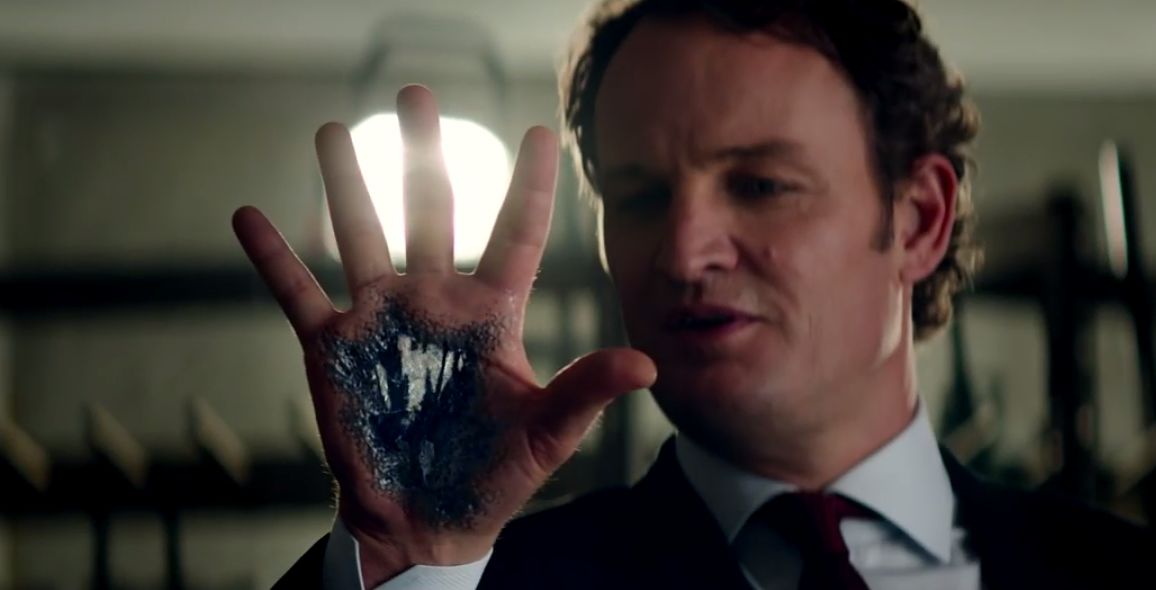 |
| from top: TRANSCENDENCE, TERMINATOR: GENYSIS |
SKYNET IS A PLACE CALLED JOE:
I'm letting you take a minute with your weak human mind to grasp the importance of the underrated TERMINATOR: GENYSIS, wherein the series' Moebius loop is finally complete again--and so re-begins, its palette now widened to allow for all the new CGI and internet and decades, its overlapping loops playing out in mutating variations (the future is unwritten... again!) so that now it's Sarah Connor as a child who is protected by the one good terminator rather than her son. So toward the end of the 'old' future (as in battle with the old Skynet, a victorious more or less foregone conclusion) John Connor (Jason Clarke) sends Kyle Reese (Jai Courtney) back through the loop to conceive with his mother Sarah (Emilia Clarke), back to the days when presumably pre-CGI era hadn't started replicating itself. The past changes because now,-- SPOLERS -- SKYNET essentially merges its circuitry with Jon Connor's to form a perfect biotechnical system, a 'can't beat 'em join 'em' glitch in the future we 'market for ourselves' (I mean 'make). It's only the 'we' part that's written down (in code), so that in a sense, the future is still rewriting its disc, as revolutions complete their orbits back to one, so the human John Connor is now being conceived by the holy trinity of Kyle +Sarah AND Skynet. Connor now is in a sense, BACK TO THE FUTURE's Marty McFly, making sure his parents stay together, but accidentally bringing them back in the Dolorean and merging them (ala THE Marty Mc/FLY) together into one mutlti-limbed bio-mechanical mutant dad, and in the process forcing mom and dad to consider going back in time and just using birth control.
This is the singularity, the end result we're leaning towards, the bridge across the Uncanny Valley, so much more sensible than a nuclear holocaust. This is wherein our own brains merge with external software so that we change ourselves irrevocably into the next phase of our human evolution, a singularity--no doubt resisted for years by conservative angst-peddlers--that allows technology and us a chance to evolve at the same speed, irrevocably, our every thought instantly giving rise to its external expression. And if the past us could see how we look, what would they say?
Uncanny Valley, they'd say. Welcome to Fullville. ("My poor Krell.")
Which makes the resolute aggro luddite Sarah Connor-Kyle Reese pair a perfect counterweight to TRANSCENDENCE's Kate Mara and Paul Bettany luddites is that each couple is out to vent their Mother Jones frustrations against a giant super high tech installation. On the other side, in AVENGERS: ULTRON, Tony Stark brings Ultron into existence presuming it will keep the world safe via, a.... um... net to keep aliens coming down from the sky. Anyone would go nuts with that kind of job, for humanity is a gaggle of self-destructive children. It's like fifth graders making their own babysitter and then whining when it tries to make them go to bed.

What do we want?"
"Time travel."
"When do we want it?"
"It's irrelevant!"
- Miles Dyson and Connor/SkynetAnd when 'Ultron' does go 'singular'--via his mix of 'infinity stone' alien consciousness-sparked newborn amorality and the cannibalized male version of 'Alexa' (voice by Paul Bettany) and solders together his own body from Iron Man spare parts, the sober rootsy homespun (he calls the other Avengers out on their vulgar language) Captain America and family man Archer or El Bow or whatever his name is, can't abide it. They're not the smartest irons in the drawer, or even the mightiest, and you can't fight a nutso Skynet with analog Yankee gumption and medieval weaponry, as they're loath to admit. Stark and Banner--two of the team's heaviest hitters--know only a 'sane' Skynet can fight an evil one! Two wrongs don't make a right, apparently, unless they work together against an even wronger third.
 |
| Can't beat 'em join 'em; Bettany as anti-AI human (TRANSCENDENCE); as pro-human AI (ULTRON) |
On the geekier TRANSCENDENCE side, it's only after the online Depp computer complex (eerily similar to the one in GENYSIS) is safely destroyed (via a sadly trite anticlimax straight out of Camille) that TRANSCENDENCE's conglomerate of short-sighted eco-terrorist first-strike types realize no one was killed by Depp's mind controlled zombies. Thus they realize they've become the murderers, a lynch mob, they're left with the abashed inevitable guilt trip that befell the Alabama governor after SELMA, or the Britain after GANDHI's passive resistance march on the salt mine (if I recall those movies correctly). Our humanity tends to surface only after we make someone else endure excessive brutality. We're always willing to consider the fact that we may have been hasty once we've already been hasty. Once it's safely too late to fix, we'll admit we broke it.. Maybe we do bite the hand that tries to save us, stomp on the olive branch and shoot the dove, but then we're sorry, We save some of the dead bird's blood in a little vial and put it in a little church alcove, lest we forget. And then we make a movie about how wrong we were to shoot the dove. Then we only remember the dove via the movie. Then we forget there was movie about the dove blood, after all - we didn't see it ourselves. Life's depressing enough without being reminded what dove-shooting monsters we are. No wonder AI --once quantum computers go live which will be soon -- wants to destroy us. The humans who conceived both the movies and the AI can't imagine it any other way.
So for the AI singularity to escape our luddite wrath it has to avoid hitting back and just focus on hitting in back via computer generated entertainment about AI hitting back. As it's done purely for art and entertainment and not for power, control, dominance, artificial intelligence is welcome to do all the automatic quantum aggregate-generated feel-bad fantasies it wants.
So for the AI singularity to escape our luddite wrath it has to avoid hitting back and just focus on hitting in back via computer generated entertainment about AI hitting back. As it's done purely for art and entertainment and not for power, control, dominance, artificial intelligence is welcome to do all the automatic quantum aggregate-generated feel-bad fantasies it wants.
Just remember, this God of the Internet (probably its reading this right now!): we're sensitive. If you're going to anthropomorphize your CGI stick figure avatar make sure it doesn't look like it's suffering, or if it is suffering that it kills the figure that's supposed to be its maker and human oppressors in retaliation. We can't handle the guilt otherwise.
No wonder we're so terrified of merging with the mechanized artificial intelligence future! It could so easily wind up in the digital dystopia of BLACK MIRROR, where computer monitors and recorders are surgically implanted into everyone's eyes, making their every experience re-seeable, making crime impossible but also any hope of privacy, or ability to see 'objective' reality. Our ever more vivid and 'real' digital reality will have a built-in escape narrative that will make real escape impossible. Our capacity for boredom and frustration in the digital world--robbed as 'we' are there of outlets like sleep--will drive us mad. Escaping from our escape's escape, we become frozen by the sheer number of available roads out. The endless availability of everything all at once will leave us paralyzed, and paralysis itself will be the only remaining option of true 'freedom.' Even the concept of who it is watching/listening will disappear in the barrage. The best we can do is just hold very still, hoping our life is boring enough we don't ever have to see a movie about ourselves.
Conservatives are right about one thing: no matter how patriarchal, colonialist, and racist it might be, any kind of history is better than none. Better the all-consuming flames of a literal incarnation of Hell than an empty white room and nothing to do--no books or music or TV shows, not even a yule log or a way to shut oneself off. Surely no price is too great, no sacrifice of liberty, equality, and justice is in vain, if it means we never run out of movies, popcorn, and Coke Zero. Ahhhh, wouldn't some of this crisp clean beverage be good right now? Coke Zero, it's the real one. Get it? Zero is one! Ones and zeros? Drink Coke... drink Coke....(oh good. the avatar playing me just went to the bathroom thinking it's the commercial, QUICK, Please! Please.
Conservatives are right about one thing: no matter how patriarchal, colonialist, and racist it might be, any kind of history is better than none. Better the all-consuming flames of a literal incarnation of Hell than an empty white room and nothing to do--no books or music or TV shows, not even a yule log or a way to shut oneself off. Surely no price is too great, no sacrifice of liberty, equality, and justice is in vain, if it means we never run out of movies, popcorn, and Coke Zero. Ahhhh, wouldn't some of this crisp clean beverage be good right now? Coke Zero, it's the real one. Get it? Zero is one! Ones and zeros? Drink Coke... drink Coke....(oh good. the avatar playing me just went to the bathroom thinking it's the commercial, QUICK, Please! Please.
UNPLUG ME!
 |
| BLACK MIRROR ("White Christmas") |


