Tuesday, May 17, 2022

The Imperturbable O'Keefe: ATOR: THE FIGHTING EAGLE, THE BLADE MASTER, THE IRON WARRIOR

D'Amato captures a near-Frazetta style color and lighting scheme here.

"The dividing line between goodness and stupidity is very, very fine." - Zor (David Brandon), Ator 2: The Blade Master

Watching the Oscars last night week month in my usual squirrelly Sunday night stupor, all I could think of was.... Ah-tor. Ahhhh-TOR! 

I'm getting too old and weird to want 'great' movies that remind me of how racist, sexist, damaged and otherwise screwed up the world is, nor do I want movies to tell me, and the nation, how love, hope, and the movies themselves can transform and effect social change. Moving itself to tears with its own humble self-congratulations, Oscar seems to insist on telling us what to feel: love. Movies cease to be escapist in their eyes, but vehicles for social and personal transformation. Zzzz

Here's an example of how bad it's gotten for me, personally, so you know how bad I need ATOR. As you know, Sword and the Sorcerer finally came to Blu-ray. I got a review copy and I started to watch it and was instantly bored and bummed by the mix of way too much predictable plot elaboration: an innocent naive and unprepared good king overthrown by evil magic-borrowing social climbing Richard Lynch, who's only real competition is a man called Lee Horsely who finds himself recruited in a tavern by an in-disguise princess offering sex in exchange for a hostage rescue. How misogynist! And needlessly complicated. It instantly forgets why we come to a movie with its title: monsters, magic, babes, destruction. Conan knew just how to give us all that in a straightforward mythic narrative. In short, it's a classic. It gets better with every viewing. It's dumb, fun, and full of monsters, magic, babes, and destruction. Roger Corman knew that, so we get Deathstalker and Sorceress in this period.

In Italy, of course, they're famous for that, and those films endure too. But there's also sometimes a kind Ed Wood-ish childlike simplicity that's totally endearing. The result: a Conan-clone so cracked it crumbles into dust with the strike of a gong and the gleaming golden skeleton of true myth is revealed beneath its B-movie bones. That's ATOR! (It's pronounced "Ahh-tor." AHHHH-tor). 

Save me Ator.... the pool of escape is shrinking under the global warming summer sun. Social change is irreversible. But hey, weed is legal, and shrooms not far behind, though made much milder than before. Is the psilocybin spirit changing itself with the times, too?

ATOR, THE FIGHTING EAGLE
(1982) Dir. Joe D'Amato 
****

Maybe it's his languid sexually uninhibited postures, the dreamy look in his eyes, the tastefully provocative fur loincloth, his golden toned skin and flowing 70s metal hair and copper/gold chest plate, but whatever, Miles O'Keefe cools the brow as Ator, the Fighting Eagle.  As Murray Ballstein says in Zoolander, he's dumb as a stump, but I love him. 

That love is important with the bad movies I keep on my emergency 'speed dial.' In order to make that hallowed list, everything must be right and not stir up unpleasant associations. That means no caged or abused animals, no 80s perms, no tacky Roman-style bangs over sweaty oil-based make-up, no complicated courtly treachery, no excessive stooging, no preening narcissistic male leads, fake breasts, tacky colors, realistic screaming or convincing torture. I don't mind intense violence as long as it's poorly rendered. Somehow, the meat-abstraction of the scene enables a healing release of fear. A tough order but Ator delivers, and so much more. 

Everything about it hits me just right. I love D'Amato's cinematographic palette of purples, golds, and yellows; the rumbling timpani and Wagnerian brass of Carlo Maria Cordio's ever-present score; the relatively short time frame; the long flowing wigs, golden skin, and cute fur boots and wrist bands on the young leads; the right lack of self awareness or narrative urgency; the endearingly clumsy fights (no stunt men were harmed--or even, apparently, consulted); the clever use of shadows and reflections--it all serves to both tap into my nostalgia (Alan and I made a lot of super-8 Conan-style three-minute epics). Squarely in a bloodless PG camp, somehow its lack of nudity and sex makes everything paradoxically sexier, more alive with a kind of erotic haziness. (1)

After a beginning set to narration over volcano stock footage symbolizing the dawn of time, we go to the happily bucolic village where Ator is raised. We learn he's in love with his adopted sister, Sunya (Ritza Brown). But how can they be married when it is forbidden? Don't worry, you're adopted, Ator! As the son of Torin, you are destined one day to defeat "the Ancient One" -(Dakar). And lo, there he is on horseback, with his Thulsa Doom-esque raiding party, riding in to break up Ator's hippie wedding, slaughter  the guest list, making off with cute Sunya, and leaving Ator in the frustrated dust. Quick, Ator, time to harness that sexual angst training with a mysterious stranger named Griba (Edmund Purdom, in a terribly hacked-up Mongol warrior wig), the same one who brought you to your adopted parents, Moses/Hercules-style, oh so long ago! But what of Sunya while this is happening? Don't worry. Dakar is too busy with his tarantula and keeping his single digit army standing around for hours.

Wherever Ator goes on his odyssey to free Sunya, hot girls want to sleep with him. Poor Ator! He's caught by amazons en route to the Ancient One's abode and forced to breed with the winner of a battle royale (with Ator as the prize) to decide who will birth their next leader. The winner is O'Keefe's co-star, Sabrina Siani --who is in nearly every early-80s Italian post-Conan sword and sorcery film, including Throne of Fire and Conquest) who decides to forego the mating and sneak out with him in search of the Ancient One's gold loot stash. A few scenes later and Ator is seduced by a foxy witch (Laura Gemser) after she leads Roon away in the disguise of a bounding deer. Poor Ator! But O'Keefe's sleepy gorgeous vacancy is hard to dislike or even resist. Made semi-famous playing the title character in the massively overhyped Bo Derek Tarzan, O'Keefe seems to regard every woman like he's just too sexually exhausted for yet another roundelay.


Stabbing, the easy way.
My affection for this all may have something to do with age and nostalgia. Alan and I would screen our violent Conan homages (around this same time, 1982) for his grandparents (who even had one of those portable screens that used to be in every classroom). They never got tired of projecting them again and again after dinner. They adored every minute. And now, 40 years later, when I watch Ator, I feel the same indulgent pride, like Miles and D'Amato are my grandchildren and Ator was filmed in the park across the street and so all its flaws and anachronisms are just part of its folk art/outsider charm. 

Take the stab above (upper left), for example -- you can tell O'Keefe is stabbing behind the guy rather than through him, but the guy acts like he's been run through, and somehow that makes it ceremonial, mythic, and adorable. Another example: though it's implied a long journey through the wilderness is underway the travelers never seem to need to get anywhere, and indeed double back over some stretches of where they've been (it looks like a relatively well-manicured park, replete with stone walkways and artificial waterfalls and mayne D'Amato's back yard). 


But even all that doesn't totally begin to explain the appeal, the pull of Ator. Maybe it can be summed up in the way O'Keefe rests a goblet on or near his genitals (above), splaying his legs out, when sitting in his would-be seducer's lair, as if trying to get some cool air flow to his balls in between 'obligations.' It could subliminally smack of loathsome frat boy/date rapey entitlement in the wrong hands (I'm looking at you, Lee Horsely) but O'Keefe seems like a very laid but still cool kind of guy. Each seduction is instigated by a very strong woman, ala a Howard Hawks or Jack Hill heroine. What would be unconscious sexual predation in lesser mortals is benevolent casual laidness with O'Keefe. Rumor has it that D'Amato was routinely frustrated with O'Keefe's continued listlessness during the shoot, but he was probably just sexually exhausted! There's no blood flow getting to his brain, if you know what I mean. 

In sum, O'Keefe is set at the perfect "low" setting for this kind of affair, and he even has a good (familiar-voiced) actor doing his dubbing, who manages to inject just the right note of deadpan knowingness to every cliche'd line ("First I must complete... what I was born to do.") without crossing over into camp.
Again and again, sex never happens but always almost happens --with Ator fought over as an object and too languid and reposed to resist, preferring to just rest his flagon near his pelted crotch as if a grail light for wandering maidens.

Michele Soavi was an uncredited co-writer and I'm guessing he maybe helped keep a kind of surrealist lid off things. Surely his absence is felt in the later sequels. The weird non-erotic eroticism vanishes altogether. 

Lastly, there's something about the look and feel of the film that reminds me the smell of 1980s Grateful Dead tour, in a good way, that sublime mix of patchouli, unwashed bodies, hashish, incense, car exhaust, and above all, the sizzling meat over charcoal. To my acid-sharpened senses, that smell was almost visible, audible, tactile. It was the smell of the burning ember in the center of my forehead, burning the wax blockage between consciousness and some ancient inner cave system, the sound of the sizzling of a tailgate grill cracking open the kundalini serpent egg so it crawls up the serpent spine. It's all there, too, in Ator, in the dusty purplish cave walls; the big googly eyes of the giant black fur covered spider hiding in the columns on the hill; the shadow Ator convincingly sword fights with; the shiny mirror flashes of his magic shield; the long dark hair of the Ramones-evoking blind blacksmiths; Cordio's grounding timpani and Wagnerian crescendos; the gorgeous but unfussy cinematography (by D'Amato himself, a master), the fog-enshrouded zombie scene that goes nowhere; the Zeppelin wigs, the nicely small cast, the endearingly clunky violence, the cute black fur boots on Ritza Brown, the golden smooth limbs of Sunya, Roon and Ator; the manicured park setting, the horned crown of Gemser, and every strand of oversized clothesline web. Paradise - on a slow chilled fire - forever, sizzling and comfortable.

ATOR 2: THE BLADE MASTER
(1982) Dir. Joe D'Amato 
*

We know we're in trouble from the get-to: the opening stretch is clearly from another movie, perhaps one D'Amato was starting to shoot, called Cave Dewellers (when Italians weren't ripping Conan in the early 80s they were ripping Quest for Fire, a big hit in Europe). To add running time, he keeps the cave men intro anyway (and even the US release is called "Cave Dwellers"), then eats up another reel of footage from the previous film, taking care to omit ALL of the female characters. Oh if only it were that simple, Joe. If only it were that simple.

Gone too is Ator's innocence. He's  no longer the once blank barbarian slate who just wanted to marry his comely sister and live a peaceful life in the country. Now Sunya is forgotten and Ator is a combination Lone Ranger / Batman and Obi Wan Kenobi, training alone in his cave with his faithful Asian sidekick Thong. We can only presume the reason Ator lives in a cave, and the king/wizard and his daughter live in a cave, and the bad guys hang out in a cave, is that D'Amato had reserved those caves for Cave Dweller and there was no refunds. So Ator and Thong read giant books and draw each other lifting weights in the mirror, you know, 'guy' stuff. Ator now knows about herbs and how to make explosives from what's lying around in the walls of his cave. And women have no place in his life, even as drinking partners. 

Gone too, his glorious Zeppelin hair. Now, as befitting sanctimonious acetic, he has appropriated a Japanese style samurai headband / top knot.  

Gone too--unless there's a nice Blu-ray out there somewhere in Asia or Germany or something--D'Amato's usual peerless cinematography. Those original's dusky Frazetta-esque interiors and dappled green park exteriors have been replaced by a scrubland murk, suffused with third generation VHS streakiness.. We also miss a cool pop song to pla over the end credits, and a score as fun and rich as Cordio's from the first film.

So, the pointless cave man intro and 'previously on Ator' scenes over with, the women excised from history (just like in the bible), we now learn that Ator's old mentor is keeping something called the "Geometric Nucleus" and the evil villain Zor wants it, and he's invaded and conquered. so where is it? Mila (Lisa Foster) the mentor's comely daughter, escapes to find Ator, now retreated from the world of men! To find him, he tells her, she must travel until so far "it seems that nature itself declines to follow you on your journey. Then you will have reached the land of Ator." Like nature itself, we may be also thinking of declining her, but for love of the first film, perseverance! Thong, my sandals!

With her vaguely nerdy informal accessible vibe; Lisa Foster takes her role as Mila seriously enough that she helps balance out the blandness around her. Her deep black eyeliner makes for a tasteful black VHS-blur smudge outline, so her white eyes seem to bounce right out of the screen. Her black headband, straight shoulder length dark blonde hair and black dress on pale skin makes a nice complimentary contrast that pops against the washed out and muddy analog mise-en-scene. Then again, in real life, she's Canadian, so kind of too balanced and nice to deliver that wild sexy-dangerous edge of someone like Sabrina Siani or Laura Gemser. You can't have everything. At least she's got that popping eyeliner. And though it's nice to see some diversity, Ator's shadowy Asian partner Thong (Kiro Wehara) barely registers as anything more than 'Asian' and the sudden detour into Japanese-ness in Ator's whole deal is odd in the worst of ways. Where the hell are they? Some of the foes they run into look like they just rode off the set of Kurosawa's Ran. Apparently they were working with no script, just kind of coming up with ideas, and it shows. They never really decide if they are in feudal Japan or the dawn of history.

So with Ator a bore, Thong a silent cliche, and Mila merely pleasant, it's a good thing they've got the wondrously fey David Brandon (left) as the bad guy Zor. With his Vlad the Impaler facial hair and a giant Black Swan helmet, he's like a mid-80s fusion of Mick Jagger and Freddy Mercury. I love Brandon as the fey theatrical director in Michele Soavi's Stagefright; I love his black-eyed Ariel in Derek Jarman's Jubilee; and I admire from a distance his alcoholic priest in Claudio Fragasso's Beyond Darkness (not to be confused with D'Amato's Beyond the Darkness); and I love he shows up as a werewolf aesthete in Avi Nesher's She. Too bad in Blade Master his lovely face is hidden behind the oversize black wig and mustache. That's his voice though, and he's serving charm and catlike menace. Enduring his old mentor's put-downs ("Patience is a virtue found only in the strong") with a fey grace ("you do amuse me") he's way more fun and easygoing than the cranky killjoy he's up against.

Alas, aside from some half-hearted cave-set battles, including a listless attempt at fighting with invisible warriors, most of the lazily-choreographed fights are outdoors in washed-out mist-whitened skies, a lot of time and energy is wasted on a side plot wherein Ator tries to convince villagers to fight back against the cannibal ravagers that demand monthly human sacrifice (the old conveniently decide to sacrifice their young), only to wind up drugged by some wine and tied to a pole, forced to watch as these town elders are (deservedly) massacred anyway by Zor and his goons (shades of Dogville). "Your eagerness for good deeds has betrayed you, Ator!," Zor chides back in yet another cave. If Ator had any brains, he'd side up with this cat immediately.  

This all leads to the best/worst interlude in the movie, one of only a handful of legit bad movie moments, though even it is undone by excessive bad screaming. Ator and friends are brought to the sacred cave or something where the prisoners from the village are thrown one by one into a pit with about six real snakes hiding in a corner and one huge coil of thick rubber hosing meant to be a giant snake in another. The female victims cower and scream unendingly, for what seems like hours as the life-size snakes avoid them on the other side of the pit. Watching these poor girls pretend to be scared and devoured by a couple of half-asleep boa constrictors would be hilarious, as would the dialogue of the bad guys ("And now, the fourth victim to appease our omnipotent god.") but it's merely irritatin. Finally, Ator and Mila are toswsed in the pit and a wondrous grimy time is had by all.  Except us, of course, since the scene is so dark in the video blur, we can barely see the outline of the snake. Was it so bad that D'Amato realized he had to keep it totally obscured by darkness, the way the giant spider in Ator hid in the shade of a colonnade? Will we ever know? And then--Ator is suddenly hang gliding. He's dropping lil bombs on Zor's fortress. Oy! It would be a great anachronistic WGAF mic-drop moment except it goes on waaayy too long. Then, at the end, he can't hang out with this cute Canuck as he's got to escort that dumb nucleus safely into no man's land where it mushroom clouds our way to a more hopeful tomorrow. The narrator has to fill us in over a nice mushroom cloud stock shot, I guess if trouble comes again we just got to look where nature itself wisely declines to follow. 

It's the pits, lacking everything that made the first film so endearing--but if anyone knows of a good Blu-ray import or something give me a shout. I can only find one on Amazon, but it's dubbed in Hungarian with no subtitles. Maybe I'm better off without one, maybe the world just isn't ready. Hungary aside.

ATOR 3: THE IRON WARRIOR
(1987) Dir. Alfonso Brecia
***1/3

"Eternity.... passes... quickly" 

Continuity is left miles behind in the third ATOR film, 1987's The Iron Warrior. Alfonso Star Odyssey Brescia has stepped in as director to save the series, almost against its will, from the ambivalence of itself. Actually there is almost no resemblance to D'Amato's Ator films at all, other than snatches of Cordio's score, O'Keefe himself, and the 'ATOR' brand name (which isn't even in the onscreen title).  Instead of the usual lunkheaded phallocentric post-Conan odyssey, Brescia gives us something far more high-fashion. It's got the look and vibe or what you'd expect if Vogue magazine took a fairy tale/barbarian hybrid fashion spread on location to the blazing Mediterranean. Haughty cinematography shows off every detail of the beautiful Maltese scenery and stresses the eye-popping contrast of bright red and green haute couture against the azure oceans and milky cliffs. Artsy tableaux take precedence over continuity: people swim across the sea but their clothes are dry when they emerge; the ocean wind allows the women's oversize dresses and Ator's oil rags to flutter evocatively, providing as well a good excuse for scarves over the actor's mouths allowing for easy substitution of stunt doubles, and preventing sand in the actors' teeth. Alas, no flowing hair--Brescia seems as trichophobia as a teenage hikkomori. 

Just to add to the challenge of discerning the plot, the editor hit upon the happy idea of running the whole soundtrack through (I think) a flanger: sword swings sound like jets; horse hooves echo like gun shots fired in a cavern; the roar of the ocean wind overflows like a swarm of drunken bees; the opening voiceover narration and any dialogue not shouted is drowned out by the rush of blood in the cochlea shell.  Composer Cordio--as opposed to his titanic work in the first film (some of which he lifts here)--has the bad habit of underscoring certain emotional moments with Morricone minor key schmaltz, and bigger battles with unfortunate major key John Williams Raider of the Lost Ark-style pomp. 

Luckily not being able to hear dialogue doesn't matter, because it looks marvelous. Every image is framable or ready for its Vogue frame. Witches pose in silhouette against boiling moons (below) issuing whispery directions from beyond ("Ator - you will have to manage on your own.") Princesses and handmaidens frolic like a merry fauns by the colonnade (below). Three color coded witches/fates pose in a black void, chanting the sins of the evil witch Phaedra (they have her imprisoned in a pair of revolving red hula hoops); Ator poses and practices his mighty sword in soaring, swooping helicopter shots atop a white cliff overlooking the sea. Ator, you're needed once again! 

Ator, the new men's fragrance by L'OrĂ©al.


Taking motifs from Sleeping Beauty, as well as Macbeth, ancient Greek tragedies, and Clash of the Titans, the story begins with the birth of Ator and his twin brother, stolen as a child by the evil Phaedra (Elizabeth Kaza). She's all wild gleaming eyes, middle-aged badass, flowing long cherry red hair, and mocking gestures, imprisoned in glowing red hula hoops for 18 years after stealing Ator's twin brother, which is just the right amount of time for a child to become Miles O'Keefe. The good witch, Deeva (Iris Peynado, Fred Williamson's pale blue-eyed love interest in Warriors of the Wasteland) activates brave Ator to set off against Phaedra's masked champion, the Iron Warrior (he commands all things iron). And if e'er Ator was "the Son of Torin" (as he was in the first film) or an ascetic student of ancient samurai ways, as he was in the second), now he's neither. He's not unlike Hercules in Cozzi's sequel (Adventures of), waiting in the ether for some immortal god to bring him into time and space to accomplish some daunting task. 

Furthering the aesthetic disconnect, there's a post-modern feeling of all eras going on at once. Brescia makes use of nearly all Malta's unique scenery regardless of the modern conveniences visible, so there's classical architecture, even "Sweethaven," the quaintly ramshackle cliffside fishing village build by Robert Altman for the disastrous 1980 musical Popeye, now a still-standing Maltese amusement park.) Seeing Ator hiding behind a dusty Chinese laundry store window makes one feel like he's wandered into the wrong century. We get rope bridge crossings, tunnels, caverns, and cliffs towering above the glowing blue ocean. There's even a brick castle replete with pane windows, sewer gratings, and probably trash cans and souvenir shops just off camera. Compared to the first two films with their timeless BCE ambling, Iron Warrior seems far more modern, willingly strange, rife with demented dream sequences and illusions) and prettier to look at than one might expect for a sequel to what was an impoverished sub-Conan to start with. 


There's also a strange gender-bent aspect about O'Keefe now. When I first saw him in a profile close-up (above)- with his hair pulled back in tight, small braids, a dangling thin straight earring, sharply slanted high cheekbones, straight graceful neck, all lightly dabbed in make-up with that serious expression, he reminded me of an androgynously striking tall girl I knew in middle school. In the first film Miles conveyed a kind of well-laid confidence and laidback languid cool that was refreshing, the hot guy who was even nice to nerds in high school. Then, in Blade Masteer, he was dour, grimy and self-important, his self-righteous activist college phase. In Iron Warrior, he's grown up, graduated, radiating a genial collegiate knowingness which suits the off-Broadway Vogue-ry on display. 

He and Jenna--the endangered princess he rescues--have a very sexy low-key chemistry that makes even dialogue like: "Is the king in danger?" / "Yes, Ator,"  seem like whispery come-ons. 


Taken all in all, I love most everything about this beautiful looking movie but with several glaring caveats: the cherry red oversize kaftan princess Jenna (Savina Gersak) wears is fine when it's billowing in the Malta wind, but strikes one as très gauche when worn at midnight dungeon soirees, especially with her hair pulled up tight in that hideous fantail top knot (above) giving her a kind of radis rĂ©coltĂ© look most at odds with all the flowing garments (and the one magenta eyebrow smacks of teenage poseur desperation). The flowing hair metal locks of "Ah-tor" meanwhile have similarly castrated into a reverse dread center braid (though a big improvement after his greasy samurai top knot in Blade Master). His signature gong-shaped chest plate is now obscured with an array of tattered garage floor oil cloth furs flung over football shoulder pads. Man, if this hot androgynous pair kept their hair long, and unbound, how gamely it would flutter in the wind! 

Hmm, did that have something to do with it. Did it get in your pretty, Ator? At one point the Iron Warrior's signature long red scarf blows up over his eyes and Ator has to patiently halt their to-the-death sword fight so he can pull it down. In several scenes the wind compels everyone to wear scarves over their mouths, which makes it easier to sub in a stuntman when needed. Like spinach for Popeye, that scarf makes Ator suddenly coordinated and dangerous, slicing through the slow-mo bad guys so fast they last only a few seconds. Then the scarf comes down so O'Keefe can show off an array of warrior poses. 

check out the hot witch in the middle, eating... something


Unlike the first two films, magic, dreams, and hallucinations reign supreme here. The Iron Warrior is so named because he can float, disappear, and make spears stick out horizontally from the wall, and even make swords reappear in his hand should he lose them. He can rise to the top of the cliff behind Jenna he's some kind crazy William Castle spook show phantom. And evil Phaedra has the power to assume any form, so can change ages (as young Phaedra she's played by Tiziana Altieri and she looks a bit like Billie Eilish crossed with Natasha Leggero). She can look like anyone, our evil Phaedra, even look like her witch rival, or the princess herself, if she chooses. When she starts eating ribs while gyrating pantsless in front of her captured throne, staring mockingly into the camera, surrounded by revelers in tacky red face scarves and owl skin should pads, you'll know you're in good hands. 

Here's a typical progression: Phaedra disguises herself as a young hottie, chased by a bunch of evil horsemen while Ator is posing nearby. He instantly changes armor and hair style and rushes to her rescue. Before you can say don't fall for it, Ator, he's passed naked out in her bed and she's getting dressed turning back into her old witchy self and setting the place on fire on the way out the door. The voice of Deeva the good witch (crystal-eyed Iris Peynado) from beyond wakes Ator up before he's incinerated. So off he goes to one of Cordio's tumbling synth timpani rolls as Jenna lies unconscious atop a stone bed on a cliff overlooking the Mediterranean; a magic sword hangs in mid-air over her neck as a bunch of skull faced jawas bang rocks around her stone altar bed.  Ator chases them off! Iron Warrior appears by floating up from below the cliff! An open smoke pot blows in the ocean wind behind them as they duel! The Iron Warrior vanishes and Ator stabs a pile of his clothes. Phaedra laughs from someplace outside of space and time. Now Jenna and Ator are wandering through the woods at magic hour as the setting sun sets. 

All this happens in about two minutes! Do you love it? I sure do.

Even when you can't hear it, the dialogue, shouted over the wind, is great in a wry meta/post-modern kind of way. Phaedra flubs a line, shouting "you are no--you are no match for me, Ator!" That the whispering oracle statue Ator and Jenna visit proves impossible to hear it over the flangered wind. Every time anything violent or cool happens things slow down to slow mo and the sound gets flanger-modulated. For better and worse and meta-awesome.


Brescia keeps the action and scenery humming. All the boring plot stuff and--after the opening narration which we can't hear anyway-- narration and plot continuity are gleefully stripped away and everything is whittled down a series of stunning tableaux vivant. Every shot is like a fashion spread by someone who didn't want to pay for hair spray. So what if there's no rhyme or reason to who these four masked riders are or why they're riding away with Jenna's splayed limbs tied between them like a flying draw and quarter, or why these spears are set up along the chase route so he can grab and throw them as he goes. It almost seems like some kind of race course set up just for him to practice his riding and spear throwing. Don't think about its Brescia-trademark absurdity. Just endure Coridio's hackneyed majestic action orchestration and try not to roll your eyes. It'll be over soon. 


A feminist matriarchal thread runs from text to subtext, making every sin forgivable. For example, at the end, the color-coded witches enclave talk about how Ator belongs to Jenna now. There's never a thought of Jenna belonging to Ator! And not to spoil things but this time Ator isn't running away. In a great penultimate shot we see her face as she embraces Ator (his back to us), looking dead at the camera with an "I got him now" kind of wicked smile. The inference she's actually Phaedra in disguise is instantly put to rest by the witches rhyming away like a Greek chorus in their multimedia black box theater beyond space and time, with Phaedra immobilized once again in her revolving red hula hoop prison. The implication can only be Jenna herself is sort of Phaedra in the making, as all women must be witch-like when ensnaring wandering faux-Ronin to their bosom clutches. Without feminine magic, all the young dudes would slink off into the nuclear sunset, back to showing off their swords in the mirror while sketched by their 'friend' Thong. 

-----

Ator's whole origin would change yet again for a fourth in the series, also knowns as QUEST FOR THE MIGHT SWORD (1988) with D'Amato returning to direct but O'Keefe inexplicably replaced by beefy Meatloaf-meets-Roddy Piper-esque Eric Allen Kramer. This new Ator seems to  have drunk seventy thousand beers too many, gaining about six inches of height and a hundred ponds of beef ("like he's ten years out of military service and eating his way through PTSD" notes Cheapsteak). He now has long light blonde hair, and a throne, which he quickly loses through one too many ill-advised trials by combat, much to the horror of wife and son. Ator, that's a terrible idea!

He dies, deservedly, and mom and his child end up on the run as their kingdom is claimed by the challenger (did this film inspre Black Panther?) The pursued mom decides to leave her son with an ugly troll in order to get a magic ring or something like that. The troll, a true douchebag kind of anti-Yoda (in a mask left over from Troll 2) drugs her on her, rapes her, blows her mind with magic, and sends her out as a sex slave, or something while young Ator grows up to, unfortunately, be played by Kramer, too. God, what a pair of parents. 

No offense meant to beefy Kramer. I'm sure he'd be fine in his usual role as a bouncer, wrestler, henchman or Meatloaf, but he's all wrong as either young or old Ator. It's nice to see that old Troll 2 mask trotted out again, but yeecch, what an au pair mom has picked for her son! It makes no sense. I could buy Ator gone to seed as an older dad, but not the son. How did this dude even get this part? Did D'Amato see Roddy Piper starring in Carpenter's They Live (from the same year) and think beefy Chicago/Toronto-style guys were 'in' as leading men? 

That shitty troll must really know how to pull some magic strings.

And so... after 6+  months, my 12 Days of ED WOOD CONCLUDED! Yer welcome. 


NOTES:
1. By now, with all the smash-cut rutting on AMC, and HBO ("HBO, where foreplay is forgotten!"), sex onscreen is no longer forbidden, and therefore not spicy. In ATOR it's always about to happen, but something prevents it, just like in dreams. 

Tuesday, May 03, 2022

Brokeback Barbarians vs. the Metalheads: CONQUEST (1983)

 "No one can rule the sun!"

As DJ Stevie Wayne said, "there's something in the fog."

It's Day 11 of the 12 Nights of Ed Wood, a series I began back in October. but inexorably, it gets bogged, fogged, and waterlogged. But, there's so much to see - even when seeing the same things. Just like melting polar ice reveals strange prehistoric tundras on our Google Earth, so too does the ever-clearer and ever-sharper HD 2K-4K restoration of once pixelated, panned, scanned and streaky old bad movies reveal whole new vistas.

Of course, not everything is better for all the clarifying. This is especially true for a lot SFX that involve overlays, where a sharp outline around, say, giant ants or insects in Bert I. Gordon movies or Harryhausen movies where the background rear projection of the live actors in the background now look faded, browned and blurry by contrast to the crystal sharp monsters.. Sometimes the harsh clarity of 4D after the comforting fog of analog VHS, makes films look like Blanche Dubois suddenly exposed by the bright lights of a 2 AM closing time bar. The film needs the blur to hide its seams. 

Luckily (?) no amount of HD sharpening can pierce the fog in the 1983 Lucio Fulci movie Conquest.  It's fogged forever. Maybe its volcanic rocky surfaces are still cooling; its oceans still condensing from the steam clouds. 

On the one hand, did they not check the film stock? 

On the other, why not believe it's intentional and embrace it? 

Watch it a few times and you gradually come to love the fog of Conquest. It lets the sun show as a big round disc, the rays from its setting and risng made tactile and many-colored. The light rays become a part of the frame composition,  Fulci and his cinematographer use the sun, and its rays, especially at dawn and twilight, as part of the frame's composition. The sun is a featured character; the film even opens with the villain, evil sorceress Okron, coming up from her cave, flanked by tall wolf men and dudes in black masks. In her warbling echo-drenched evil voice and with uplifted arms, she does make it rise, or so she convinces her followers. Aside from her monsters, soldiers, whatever and demons she has around, down the mountain a bit there's a scattered throng of hippies (or the protean equivalent) sitting around, strung out on their furs and blankets, waiting for Okron like they're waiting for Hendrix at Woodstock. 

With the sun and its rays such a prominent part of the mise-en-scene, Conquest becomes a big glowing, steaming fissure in the surface of the sword and sorcery genre. Genre traits and cliches creep out and/or tumble back in to be cooked and baked and boiled around it until the air is thick. Eventually all that's left is a sticky crust of dried blood, burnt fur, dead bats and bromance that survives beyond death. Not unlike the silhouette animation of Lotte Ellinger or some kind of primordial cave wall shadow puppet show, our unconscious projectionists eventually fills in the details the fog obscures. Like the cataract-eyed dead in Fulci's The Beyond, we may be unable to see reality, but we can see far deeper into something far darker. Meanwhile our convulsive four AM DT-addled mind just grooves on the absence of any detail that might derail our cozy disaffect. Even the gore has a kind of soothing poetry in the mist. Even primordial Tom Jones-style sexy meat eating, people being torn in half, or roasted on beds of coals, and ants crawling of out pus-dripping wounds, doesn't phase us out of our contented stupor. The ever-present fog makes such signs no more worrisome than a dream safely woken from with a clap of the hands or a pause button press.


Meanwhile, as our visual sense is impaired, our ears tune deeper in than normal to the soundtrack and are deeply, satisfyingly rewarded. Howls, squawks, distant animal grunts, whispered chanting, moans and murmurs. Claudio Simonetti's music churns up the mud with pulsing mellotron, an echo-drenched flanger and some gorgeous little synth moments. There's so little dialogue that when someone finally speaks it sounds odd, it's as if words have only recently been invented, like rivulets of inchoate coherence condensing from the fog of grunts and growling. With the soundtrack then just as rife with white noise as the pre-dawn imagery, what might be a wearying slog through blood and mud turns into the schlock cinematic equivalent of a really good bromide or hit of super-weed, especially if you watch it, as I like to do, while half-asleep, with good headphones on, and the setting or rising sun in blazing through your lidded eyes.


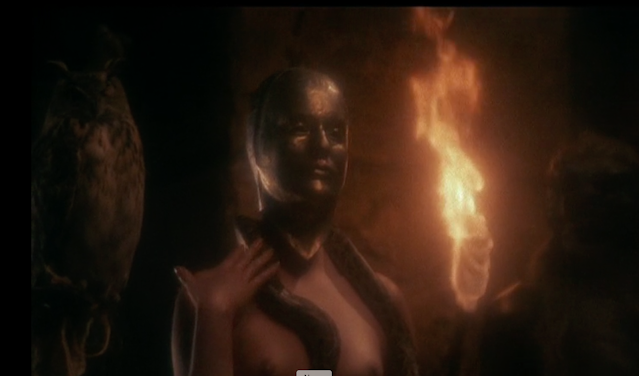
Naturally, good is up against evil in the plot: On the wise and 'good' side of the river, civilized but naive warrior youth Ilias (Andrea Occhipinti) is given a boat (looking suspiciously like a repurposed gondola prop) and a magic bow and arrow by his sophisticated peaceful villager elder (who, with his contingent, magically appear out of the mist).  Ilias seems to be going on some kind of evil-fighting pre-Edenic rumspringa.  Almost as soon as his foot touches her side of the river, the mystical reverie of our brain-eating sorceress Ocron (Sabrina Siani), is soured by images of him and his bow and arrow. He may not know it yet, but he's coming for her! Writhing in post brain-eating ecstasy with her python on her black feather cape/boa (her metal head making her look a bit like Shanghai Lilly giving reverse-birth to an Oscar), she sees Ilias (without a face) drawing that magic bow and arrow at her. Finding and destroying him becomes her new obsession.  Even the full head of a tasty, ripped-apart peasant girl can't allay her mounting dread over the wanderer with his glowing blue bow. Even while drugging it up in her Abel Ferrara-does-Thulsa Doom smoky cavernous orgy den, even after sending out her weird, wolf muppet Chewbacca-style raiders and their iron-masked associates to kill him (and get that bow) in wave after wave, she just can't shake his buzzkill psychic presence.

Even so, Ilias is gonna need help. Enter Mace, (Jorge Rivero) who wields a great nunchucks-bolo-sling shot combo-- bop bop bop. Mace will be the Xena to Ilias' Gabrielle, the Robin to his Batman, the Jake to his Heath (yes, I mean Brokeback Mountain, deal with it). And if you doubt: Mace can talk to the animals. 

One of Fucli's secrets--one of the reasons his best films hold up so well to time and repeat viewings-- is his gift for paring out all the boring linear story-advancing subplots and details and 'suspense' crosscuts and character arcs that follow the hack auteur's idea of what a 'story' is all about and instead filling the mise-en-scene with strange paranoid glances and foreshadowings that keep the viewer relentlessly off-kilter. He does this by presuming you're familiar with these fantasy worlds from other films, the influences he's borrowing from. We don't need to know why Mace can communicate with animals or how (because of The we've seen The Beastmaster --an influential hit in Italy). We don't need to know why Ilias is sent across the river or why he's so much more civilized than everyone else in this haunted land, because of One Million BC. We don't need to understand Ocron's raison d'etre because of Thulsa Doom in Conan, and so on. The more movies we see, the fresher Fulci's counter-melodies seem as common cinematic signifiers and progression are subverted. We're never quite sure who is who, or why, or what's going to happen, if the hero will die before the end, if evil will legit triumph--it's all on the table. Connecting tissue like character backstory and cohesive mise-en-scene are jettisoned in order to put the viewer in a mindset similar to tripping, being asleep, schizophrenic, or having a flu-boosted nightmare. If you need handrails to vault down the unlit cellar stairs into the primordial "total" abyss, maybe Fulci isn't for you. If you're ready to just jump, heedless of a fractured skull, down into the inky darkness because you're overjoyed to finally not know what's going to happen next, if you're OK with not even knowing what's going on now, if you can dig a movie where everything is wreathed in so much fog you have no idea who's doing what to whom, you're ready. 

Usually, as per Deleuzian cinematic theory, film editing either operates on either the 'time-image' or 'movement-image' principle. In the movement image, we see the protagonist walking from, say across the street and into the bank, from a neutral vantage point, perhaps from the second floor of the building opposite; we see him open the door and walk inside. The next shot is inside the bank. In other words, the camera POV is neutral, a mere chronicler of action. In the time-image, the camera sees what the character sees. We see the door from his perspective; we may see a close-up of his hand turning the knob (if the filmmaker can afford inserts, or cutaways to people he sees looking at him suspiciously, etc. Of course most films use both, but use them to absorb the viewer--to the point we're unconscious of them --we don't even notice how they work on our psyche.  But then crazy horror maestros like Fulci come along and use our familiarity with these methods to alienate rather than absorb, to slam our fingers in the window jamb of our structural cine-syntax and boom! A spike through the eyeball of the time-image. 

Unless they know it's 'art' before going in, mot American critics presume their feeling of alienation from the narrative is the result of 'bad' filmmaking, but others 'get' the disruptive 'nightmare logic' at work in his weird editing / story approach. Suddenly instead of a familiar progression we're in a world of vivid kinetic action and reaction--nothing is certain. That's why a film like Conquest holds up so well to repeat viewings... we never really see the same movie twice, regardless of how many times we watch it, because its pattern never follows a recognizable trajectory. It keeps us in the moment, borrowing motifs from other films like signposts but then abstracting what they add up to, simplifying yet complicating the overall impression by a refreshing lack of morals and messages or cumulative logic.  
 
Conquest gets a bad rap. The common consensus, even amongst Fulci devotees, is it's too foggy. Whatever. It deserves re-evaluation and all the fog would probably lend itself well to hallucinations if you see it on the right amount of the right drugs. I  love it, just as much for what it lacks as what it has. I love how deftly it stays free of the detailed ponderous plotting that oft bogs these things down. There are no intro plot scrolls about days of olde; no ponderous voiceovers, duplicitous courtiers, parents, children, despotic generals, mustered extras, horses, dopey sidekicks, slapstick escapades, rollicking tavern fights, mickey mouse scoring, dungeon incarcerations, jugglers, rape, or extended macho torture sessions. A lot of people and monsters die but mostly it's just two dudes who like each other on a journey of amiable forward momentum, pausing every half a mile to bash a bunch of thugs and werewolves squarely on the sconce with a satisfying crunchy sound. 


We never learn what is in the straw Ocron and her posse pass from nostril to nostril, 
but the slow languid heavy way everyone moves makes us wish we had some.

Weirdest of all is the Brokeback Mountain vibe between Ilias and Mace. A groovy if deeply repressed homoerotic subtext thrives on close reading, depending on how much you want to feel around for it in the white-out fog. Hunky Mace (the 'top', Heath) believes some rivers are best left uncrossed ("your world is better than mine," he bemoans at one point, "but this is where I come from.") He's even too repressed to suck venom out of Ilias's leg wound, the way, say, latter soulmates like Xena and Gabrielle would do in nearly every episode (admittedly a decade later). Mace probably wouldn't even give him mouth-to-mouth if it was needed. Luckily its Mace who drowns, but then sputters to life after dolphins chew his ropes off after he's crucified (?!) and doesn't need it either. 'Whew!' 

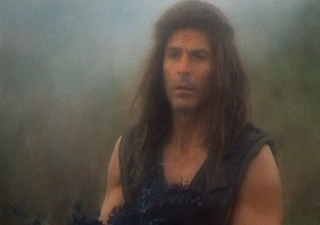
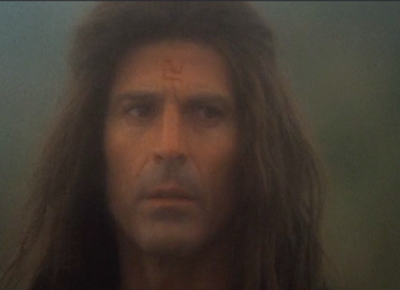
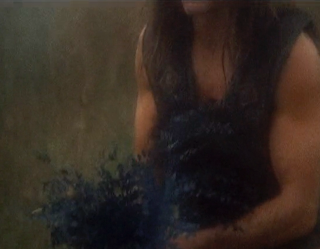
Still Mace is not afraid to pick his beau friend some healing lavender flowers when he's dying from a poisoned dart in his ankle (symbolism!). Look at Mace there (below) - gazing pensively around in the early morning mist while Ilias pines away in engorged agonies back on the riverside. As you see below, the mist adds an impressionistic, almost Matisse-esque lyricism to the image. 

How times have changed! The closeted-even-to-itself sublimation of the Mace-Ilias bond seems quaintly timid today (in the 80s it would have drawn homophobic fury from its target audience) while the choice of making the most powerful woman in the film a naked, faceless monster is problematic in its faceless objectification. Good thing that the sort of critic who would dig deep enough to be offended by either era's reading will probably never take this fogbound journey into the unknown. Long hard to see (figuratively as well as literally), it's been remastered and made available online and in Blu-ray only because Fulci has such a fervent following. But even Fulci disowned it, walking away right after shooting. Hardcore Fulci apologists would rather champion something like The New York Ripper, wherein Fulci finally justifies his misogynistic accusers, than this murky execrcise. Legend has it Fulci was losing his health and his damned mind and this was the proof. 

But what a run he'd had! Surely some of the classic Fulci magic had to spill over, even if no one saw it yet in that opaque fog on VHS. Now remastered and restored the fog has steam room magic all its own. And there are plenty of touches that make it unmistakably Fulci: the idea that he almost never films from the expected angle or distance. The camera is seldom at eye level; usually it's kept low so the boys loom as giants in the foreground with the magic hour sun behind their heads, or it swoops high up on a crane, as if some friendly giant beaming down at their foggy folly. The gore is always satisfying in its crunchiness. Callbacks to classic Fulci films abound: the way Ilias goes "yayayayayayaya" when batting away at the cave bats references Fulci's House by the Cemetery; the 'Eibon' symbol on Mace's forehead references Fulci's The Beyond; the gross close-ups of Ilias's venom and pus-engorged dart wound reference City of the Living Dead; the eerie center-screen-eyeless-head shot close-ups of the zombies resembles, you guessed it, Zombie. All in all, a Fulci capstone to a brilliant seven film / four year run. 

It's not perfect. I do wish we got to see Siani's pretty face, and I wish we got an occasional break from the fog. But any old film can be in focus, and we can see Siani in Ator, the Fighting Eagle and Throne of Fire. Two movies that are like the PG-13 daytime and Conquest is the R-rated night. 

I also find that, watching online, on Tubi or Youtubem with pop-up ads, is the perfect post-modern touch. Grubhub + half-asleep eyes + pareidolia fog + the Brooklyn accent of the voiceover artist doing Ilias's dub (the same guy who does Trash in 1990: The Bronx Warriors) + Chase Visa + the primordial synths + the Clan of the Cave Bear make-up on the cute girl who lives just long enough to almost shag Ilias + SoClean for sleep apnea +  someone getting ripped literally in half + the amazing cliff people emerging from their cliffside crevices, looking like cobwebbed Pillsbury snowmen and talking like Herve Villechaize. 

Maybe that scene sums up the appeal, the way it reminds me of childhood bonds: "Where is your friend?" the monster asks a crucified Mace. "I have no friends," Mace says. "You lie!" the monster shouts back.  It's so weird and basic and may evoke the realization that these guys are mentally ten years-old and making their first friend in school. Suddenly there he is: Ilias, he came back! As the moody Assault on Precinct 13-ish synth chords oscillate, he shouts up at his crucified friend "Mace, I've come back! I'm not afraid!" My fellow Conan-loving friend Alan and I would have loved this movie, had we not been such snobs about dubbing. We'd shout "I'm not afraid!" over and over at each other in key moments.

Prepared with rock bottom expectations, I loved it the first time I saw it, and I always will love it. I have been turning to it for sleep and stress relief ever since, to the point my girlfriend rolls her eyes when she hears some of those cycling Simonetti synth riffs. As B&S's Sam Panico says: "Conquest is either the worst film you’ve ever watched or a batshit insane descent into mythical archetypes. There can be no middle ground."  Studied through a jeweler's lens, it may seem a cloudy piece of junk, but we of terrible vision know it's a rare jewel whose facets are best appreciated via indirect gazes, i.e. like a shadow person you can only see in reflections on your silverware. Resist the brain's attempt to memorize and overthink it through its mythic parade of the warmly familiar and the forever unknowable and, like a half of a Remeron chased with a smoke shop shot of kratom--the next best thing to being asleep. In his Fulci book Beyond Terror, Stephen Thrower writes: "Half the fun of sleeping pills is in fighting the effects, staying awake to experience their weird pharmaceutical slurring: but few would want to feel that way while trying to crawl through a Conan the Barbarian rip-off. " (183). 

Count me as one of the few, the proud, the cataract-eyed crawlers. 

Mace! I'm not afraid! 


Monday, April 04, 2022

The Way Outsider: SHAITANI DRACULA

 
"Confusion has made its masterpiece." 
                                             - Macduff (Macbeth -Act 2, Scene 1 - Shakespeare)

Man, my 12 Days of Ed Wood has won ray over schedule (this is only night 10), but I have an excuse: India's Harinam Singh and his 1999 (sometimes listed as 2006 since that's when it was discovered and shared and embraced by the weird film community) anti-opus Shaitani Dracula (English translation: "Satan's Dracula"):  Actor, director, writer, presumably editor, Singh is a one man band of cosmic proportions. He knows not how to focus a camera, nor tell a story, nor direct a scene, nor--for a single moment--be anything but wildly hilarious. This is anti-genius of the sort that makes Ed Wood's best seem woefully coherent. Hell, it even make the Turkish Star Wars seem like 2001. 

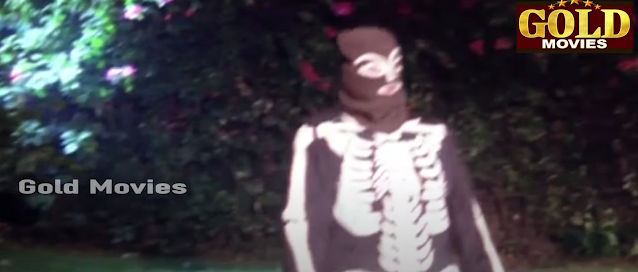
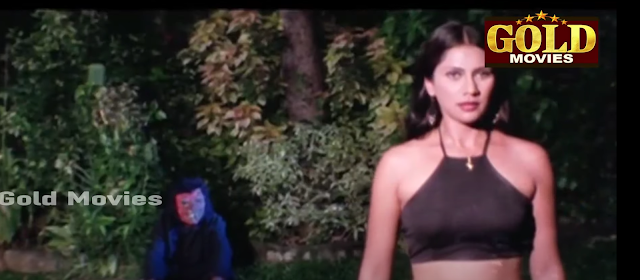
Consisting of mostly interchangeable set of blurry shots of monsters (dudes in masks, girls in plastic fangs and cut-out styrofoam cooler-lid wings) chasing people, the film pulses lightning, and hot girls cooling down in outdoor showers at night (fully clothed); dark cloud insert, lurches into daytime standing around by cars and girls arguing with dopey men. Crazy-lame howls and high-pitched titters, rain and wind effects fill up the soundtrack. Music and songs from old Bollywood classics start and stop in a random crazy quilt of overlapping and jarring noises and "booooo-oooo!" style spooky vocalizing.  Add mixed up time frames, interchangeable actors, inscrutable dialogue (none of his films, as far as I know, have ever been dubbed or subtitled into English), stir, rinse and assemble with a rusty splicer and a blindfold. The resulting mess can set you free. If you believe in madness. 

I know I'm not alone in my reverence. Diabolique's Keith Allison exclaims: "It is a film so far beyond the pale of anything we can recognize as a movie that one can hardly call it a movie. An experience, perhaps. Enlightenment." Dan Budnik of Bleeding Skull announces: "You can try to blink the crazies away but this film won’t let it go. It’s a child’s vision of a vampire movie that verges on a wet dream of epic proportions." And Teleport City declares Shaitani Dracula to be: "a film so bonkers on every single level that it has become a legendary work of art."  Wayne Butane exclaims "It's a perfect storm of filmmaking incompetence."  The Wood of Bollywood shall endure! 

Gaze into the eyes of your dark lord

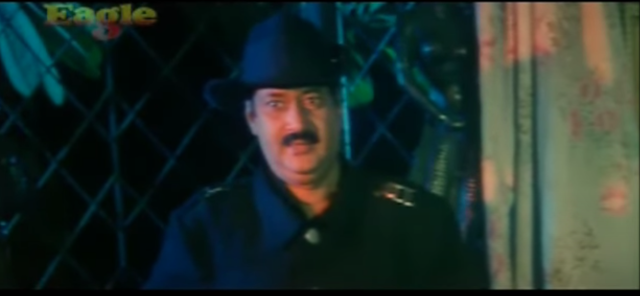
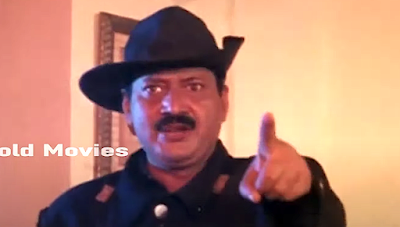
Singh himself plays the title role a middle-aged Indian man, ever-clad in a dark blue Union cavalryman's hat and coat (no cape, and no reason). With a jet black mustache, double chin, and twinkly eyes bouncing along on presumable cue cards to the left of the camera, age makes a lot of grand announcements--in booming echo--laughing maniacally and saying "Dracula" every other word, as if continually reminding himself and everyone else he's the star. He keeps his head centered in widescreen medium-close-up (ala above) moving slowly from side to side, giving the impression of being vaguely animatronic  Sometimes we cut to him wearing his dime store plastic fangs but he looks like he's always trying to spit them out (if you've ever worn them yourself as a kid, you probably get why).Most of the time though, is spent watching masked monsters wrestle with scantily clad young maidens while thunder crashes on the soundtrack, the horror movie archetypal primal scene stripped down to an eternal Halloween wrestling match. Stoop-shouldered men in skeleton sweatshirts and flea-bitten wolf costumes throw biker shorts-clad maidens to the ground for some air groping. 

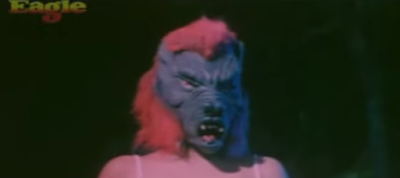
Here's an example: a pair of lewd older male buffoons walk through an emptied park at nighttime and are gobsmacked by the sight of a gorgeous girl taking a backlit shower (clothed). They walk behind her making lascivious gestures but then she suddenly turns around in a wolf man masks (with spiky red hair) and bat wings. They run! Next shot they're leisurely climbing into a van, all relaxed with about five other guys, as if Singh needed a shot of them escaping so just filmed them climbing into the van to go home after an all-night shoot. 

That's OK. You either love this film instantly or watch five minutes and turn away. Some of us just want to look in his big Harinam Singh/Dracula eyes, his very plain and unscary house, his stable of pretty girls in tight biker shorts, his mix of "where do I put my hands?" self-consciousness, delight with all he surveys, and nervousness his crew is fucking up, i.e. failing, as usual, to keep him (or anything) in focus.

As yes, focus. It's a problem that occurs all through the film, a problem that even the most incompetent western directors usually master fairly well. In fact, if a shot is suddenly in focus, the question arises of whether it was lifted from another movie, replete with incorrect (stretched or compressed) aspect ratio. But hey! Singh is making a movie, or something, and he's stocked it with babes who have to do what he tells them. Heh Heh. And what he tells them, presumably, is to take lots of outdoor showers, in the park, at night, with their tight biker shorts and halter tops on; and that later they should lie still on tables while he paws at them like the Indian Paul Naschy. As with Naschy, it doesn't track as offensive since it's so naive, so unfiltered. I remember when that Farrah Fawcett Majors swimsuit poster came out. I was ten years old and hat it on my bulletin board opposite my bed.  I used to gaze at her longingly the wee hours of the morning, flushed with a strange, delirious desire I could not explain, an all-consuming child's first rushes of lust, the sort that as yet knows not of any attached release or fulfillment, or shame.

Focus may be a big problem, and narrative may or may not exist since I don't know the language, but none of that matters when the soundtrack is so richly insane. Thunder crash inserts bridge each shot; wind howls; inappropriate orchestral cues surge and retreat. Sometimes the sound kicks out altogether or we hear dialogue leaking over from some long cut clip. For songs we hear the same classic Asha Bhosle/R.D. Burman song (from an older movie) played twice. There is no dancing or lip syncing whatsoever during these moments though. The movie keeps going, with scenes of yelling. We get a startlingly in-focus shot of a very attractive and well made-up girl yelling at a boy who doesn't seem to deserve her. The shot seems lifted from another movie. When the music ends there's demented laughing, bowed saws, lurching drums, and high pitched giggling, like a man trying to do an impression of a girl doing an impression of a laughing mouse. There's also the lamest werewolf howl ever heard, with the voice of the actor cracking feebly over the high notes. 

As is often the case with Bollywood films, within every few sentences of Hindi spoken, some basic English phrase flits by, like "I think you're right!" or "you understand!?" or "are you possible?"(just as French ears might perk up when we say 'noir' or 'oui' or 'zoot alors!"). Magically, this keeps our English speaking ears alert for more. The result: a sweet structuralist decalcification akin to Godard or Antonioni at their most 'whatever'-est. 

Fans of foreign films know that the trick around 'subtitle alienation' is to listen to the language, trying to understand the words spoken, using the subtitles sure, but not just reading them like a book and forgetting to listen). In somrthing like this, especially since there are no subtitles at all, the English phrases are constantly tricking us into auditory hallucinations. Our brains hear English phrases where there are none, assembling words out of the gushing torrent of syllables the way we might see strange messages in the white noise on TV. That they seldom make sense is part of the rapture, delivering fractured haiku and random Mad Libs surrealism galore. "She had a cabbage to you," was one I heard a lot, also "Jazzercize my bag handling," and--my favorite-- "the ladies are not a salter to your Brenda Lou." (2)

After long nights of mayhem we cut to the cast of young people hang around the park in, standing side to side in a long row so the widescreen camera can get them all in the shot, a shot probably from some other film since it's actually in focus (or the camera man has night blindness). Then it's night and there they are again, camping out in the middle of a brightly lit public park.  Don't ask why the local officials and park patrols allow such things-- that's not your business. Maybe they had a permit. Maybe they didn't. Maybe that's something people in India just get to do, like hippies up in Golden Gate Park in San Francisco, only with more (a lot more) make-up.  And don't worry, there are only maybe four or two daytime exterior shots in the whole film so don't let the focus throw you kid. Most of the time it's night and there's no time to figure out what's happening in the blur onscreen before some girl in a red-haired wolf mask leaps out of the bushes, or Singh's Australian cavalry officer Dracula comes floating by, laughing maniacally with hands outstretched, camera wisely not showing what's under his floating feet. Though there are plenty of people around, women still  have a habit of wandering alone into the darkness. Or sleeping, sometimes with big lights right outside behind their tent, making it seems like they just pulled over to sleep in front of some random backlit green screen during an all-night film shoot. This allows all sorts of weird ghost like things to occur, including a goose, and a foreground looming face with a big beard, a kind homunculus / Tibetan demon / half-gypsy combination lit up in red leering out at the camera. Chilling! Then you realize it looks like a bearded actor/red gel lighting combination recycled from Singh's Shaitani Atma (1998).

That crazy goose, though - no explanation.  Thank god, I don't think he was even trying to surrealist.

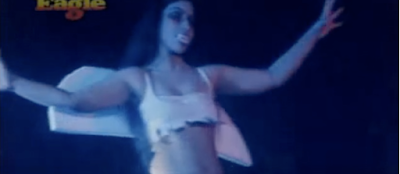
My favorite monsters are the girls in white with the bare midriffs (left) who sprout fangs, and badly-cut styrofoam wings and make little flying gestures with their fingertips, arms akimbo, wobbling uncertainly along, trying to keep their balance while standing up on AV carts (my guess) pulled along by people just below camera. 

 Though many are chased and mauled and pounced on, no one in film seems to actually die, nor bleed, and certainly no one comes back as a vampire, or seems to remember what just happened one minute to the next. At one point, while lustily rolling around on top of a nubile victim, our wolf man just stops, gets up, finds his wolf mask, which slipped off in the fracas, and puts it back on, camera still rolling, the girl patiently waiting for him to resume the scene. 

Rather than get up and go to the loo, Shaitani Dracula practically pees on itself with the desire to please, to deliver the kind of movie that can enjoyed in a blurry millionth generation dupe on a cell phone or in a movie theater so crowded with restless infants, chatter, and cigarette smoke that paying attention to anything longer than a single random shot or two is impossible. It's a movie that can be engaged with anywhere along its timeline. Slice off any two minutes of the film and you can grow a whole movie from the cutting. I doubt if there was script as such, just Singh running around giving impromptu directions while pulling feebly at the focus lever. Once enough chasing around the park occurs, enough layered laughing, howling screaming, and making wind effects have floated by, the expansive action constricts down to a long drawn-out, hilarious "fight" between the lead--a dishy lady in tight red vinyl halter top / biker shorts combo--and Dracula. There are lots of terrible fake punches. Her hot legs keeps dragging the camera down to them like they have a gravity no tightening of the tripod can forestall.  But then, in the middle of their climactic skirmish, he cuts away to a blurry shot of a guy walking aimlessly around in a skeleton hoodie. 

Why? We never learn, as we go right back where we left off in the ogling, cross waving, and the kind fake elbow jabs five year-old boys give each other after watching the 1966 Batman TV show. If that's the kind of thing you and your friends used to do at that age (as I did), you're liable to love it. It's ike sneezing out a chunk of your brain and finding a long forgotten breakfast cereal prize. What else, you wonder, might still be up there?

OTHER SINGHS

I've seen this film five times since my first viewing last month; I haven't pledged as much energy to his other films yet, which are viewable on YouTube in even worse shape. I did watch most of his Shaitani Aatma (1998) which seems like a dry run for the 'magic' perfection of Shaitani Dracula. None of them have subtitles on YouTube, but they don't entirely need them. The elements never waiver. A bunch of young people talking somewhere about the monsters, contrasted with monsters stalking and molesting the young people. That they are so enjoyable even without knowing the language proves their mettle. Without subtitles or dubbing it would be hard to stick with the average Bollywood feature, which is usually three hours long and suffers (in western eyes) from a tendency to bog down in soapy intergenerational melodrama, pastorale romance, and interminable and way-too-happy music numbers.  Harinam Singh's films clock under two hours and "focus" on what we want most: guys in monster masks chasing pretty people around through misty gardens at night while thunder strikes, wind effects howl, and someone goes "booo-OO--ooo." 

All that aside, like the average childhood recollection, folded into the mostly wholesome play violence and Halloween spookiness are some sexually unsettling moments. In one, we cut from some random scene into the middle of what is either a couple fooling around or the a kind of date rape. If you've ever been ready to leave a party and accidentally barged in on a couple getting busy in a bedroom where you thought the coats were kept, or something like, and you said sorry and closed the door and then later ib though: "Wait, was that woman trying to get away from him? Was she even awake, or so drunk she didn't know what was going on? Was their consent there?" You only saw for one second and then turned away and shut the door on embarssed instinct. What the hell do you do with this latent concern, besides nothing and then obsess periodically about it for the next 30 years?

But I wouldn't worry about that here. I doubt anything was even sexual, beyond all the leering and objectification. Anyway, why let it bum you out?

As Singh's voice shouts at the end of the film as the survivors walk out of Drac's house into the morning sun, "Ah-MIN!" 


BAZIN + HARINAM = Post-Structuralist Ecstasy

The origin of mise-en-scene as a concept comes from Andre Bazin, the father of French nouvelle vague and auteur theory, who came of age in the movie houses of Paris in the wake of WW2. Hollywood imports--freed from six years of Nazi embargo--were once again flowing onto French screens, but very few had subtitles or French dubbing. These kids were so cuckoo for cinema they sat through them anyway. Being able to enjoy a film without having any idea what anyone was saying was to appreciate it as true art, as a system of images and music and sounds, freed from all the distractions of language. A film might be about a murder and greed run amok after a bank robbery, but Bazin and co. knew it was really about a bunch of male actors sitting around in a shadowy room. Freedom from language made guessing what came next impossible, with the result every film was 'new' the way it would be to a child who understands very little of adult conversation. After subtitles and dubbing came in, Bazin would keep this alienation affect alive by hopping from cinema to cinema, walking in on movies halfway through and leaving as soon as he deduced where it was going, thus to keep the sound and images 'pure' of narrative (and all the unconscious hypnotism such narratives induce).

Artists like Brecht and Godard thought to use this sense of narrative hypnosis against itself, thus to wake us up from the unconscious pleasure/anxiety spectrum of narrative into something like truth, the truth of the real that lurks outside the Platonic cave. The truth can help us wise up to the signs and symbols our brains rely on to keep us asleep. It turns out our brain's willingness to plunge forward into the warm goop of story (the shadows on the cave wall) can be turned against itself, like holding a mirror up to one's own inner Medusa, letting Pegasus escpape from her neck and fly us to freedom. 

Brecht and Godard do it intentionally, but when that carrot and stick style film reward/punishment dichotomy is derailed by incompetence (Wood, Singh), it's a heckuva lot more fun. We become wise to the mechanics of our own hypnosis and thus free from the anxiety of our age, in both senses of the word, even while indulging in delirious nostalgia. We're delivered to a place of childhood rapture when even a threadbare thrill contrivance like Bride of the Monster or the YMC fair's rickety spook show ride could thrill our imagination while making us laugh and see through the contrivance at the same time. To be sure, there are monster movies that employ the same cheap latex Halloween masks and ratty bear suits, fog machines and haphazard editing of Singh. But dudes in masks chasing beautiful Indian girls in skin tight lame shorts, or women in masks or fangs and wings chasing middle aged gross men? Never. It's so basic, so primordial, so mythic,  it lives in the same happy place we find when 'remembering' our favorite classic horror movies, happier even then our experience watching the films themselves.

The catch with Singh's and Wood's kind of supreme WTF incompetence is is that it cannot be faked or even attempted. It either happens or it doesn't. When normal people try to make an intentionally weird/surreal film it comes off as just hack posturing, like Modesty Blaise (1966), Boom! (1968) or Casino Royale (1967). But when an incompetent weirdo tries to make a 'normal' movie, it comes out like Plan Nine or Shaitani Dracula. David Lynch is the only American filmmaker to really crossover in both directions, but he's still has producers and investors who need profits. Sometimes, like in Mulholland Drive, he can cross over in such a way as he brings even the middle class and bourgeois audience along into the blue box abyss. But someone like Harinam Singh or Ed Wood arrive there in the opposite direction, leaving the bourgeois in the dust, which is always better. They're so good at estranging us from the narrative's normal symbolic order that our whole set of filmic expectations goes out the window. What is left is a kind of giddy lysergic freedom from the bonds of language. It's better than being either safe at home or lost in the unfamiliar. It's finding one in the other and vice versa- the world finally locks into place by falling totally to pieces. Thanks Harinam! You broke it and fixed it at the same time! Ah-Min! 


Shaitani Dracula is currently only avail in various quality transfers with large "Gold Movies" or "Eagle" stamps on the edges of the screen and with no subtitles; the best I've found so far is here.

NOTES: 

1. HBO, AMC, IFC and their ilk rely wayyy too much on the 'smash cut rut'- my phrase for when two people meet somewhere, seem to barely like each other, and then we smash cut to them in mid pre-orgasmic rutting in some car or bedroom, thus skipping foreplay and everything else, their eyes usually glazed over and distracted. It was eye-popping / disturbing when they started doing it in the 1990s with shows like Rome, Oz and the Sopranos. Now it's so overused it's a wonder kids know what foreplay even is. HBO, you broke our society! No wonder dudes are such a menace these days (for more, see The Rutting Season)

2, - Considering my connection to girls with the nanes Susan Salter (a girl I crushed on in my PA elementary school) to Brenda Wiley (the Central NJ killer who was cousin to a girl I knew in NJ) to Lou- the nickname of an old (NJ) girlfriend - it's like an Tarot I-Ching to areas of my earlier love life my unconscious probably wishes I was more interested in. Yours may certainly be different, but listen and see if you can't hear about the old Salter to your Brenda Lou, too. 

See also the Other 11 Nights of Wood, and Wood-esquery:

Related Posts Plugin for WordPress, Blogger...