
Friday, October 10, 2014

October Capsules: OCULUS, SHIVERS, DETENTION, HOWLING, MIMIC 2: HARDSHELL

OCULUS 
(2013)  Dir. Mike Flanagan
***1/2

A brother and sister reunite at the house where, as kids, they watched their dad and mom lose their shit, thanks to a haunted mirror. Now they've returned to the empty house to sort that mirror's shit right out. To prove it;s haunted, sister's got the whole joint wired for sound; cameras are set up and timers are set to keep the siblings from drifting out of reality, because the mirror has a habit of causing hallucinations, flashbacks, and homicidal insanity if there's no one or thing to jar you out of it.  The younger brother, having been in an institution ever since 'what happened' to them as kids, explains away the happenings as stress-born cover memories, to which his his sister says "they really did a number on you in there, didn't they?" And if nothing else, it's pretty awesome to hear rote psychiatric skepticism blasted open in such a direct and intelligent manner. With great creeping camerawork that services the slow-ride suspense instead of just the usual 'sudden' shocking and mickey mouse telgraphy, this is one spooky, cool film, the best since last year's THE CONJURING. Turns out you don't need a big empty hotel in Colorado to convey the ease with a sensitive family can dissolve into cabin fever psychoses, you just need a big spooky mirror that can distort reality. And when the children in the flashback even begin to notice their future selves watching them like ghosts from the future, and the horrific encounters in both past and present reach a fever peak, you know OCULUS is onto something genuinely new and creepy. Haunted house 'past crimes' have never seemed more immediate; the idea of four walls holding in psychic trauma and malevolent forces seems palpable, as if the image on a videocassette has left the tape, shimmied back along the spindle and is now and watching itself in reverse order.


Director Flanagan also avoids the whole 'hallucination-or-was-it?' schtick, delivering some pure monster moments along with the madness, effectively (and correctly) illuminating the futility of ever knowing what's real even when evil spirits aren't fucking with you. DR. WHO fans will appreciate seeing 'companion' Karen Gilan stars the older version and Annalise Baso as younger is harrowingly raw and viivd -her cute little redhead alien face and orange hair are perfectly lit and she could teach a master class on showing every step involved in channeling terror into adrenalin-spiked courage (you can feel every turn of her courage being screwed to a sticking place). Heartbreaking, exciting, and genuinely spooky all at once, OCULUS gave me a literal spine tingle. And it doesn't need a dram of cheap shocks or torture porn trauma to get there. Filmed, for some ignoble reason, in Alabama.

SHIVERS 
(1975) dir. David Cronenberg
***
This weird first Cronenberg feature hasn't been available on DVD for awhile, but it's been on both Netflix and Amazon streaming recently and mustn't be missed, despite its cheap, grimy look. Far more disturbing than an outbreak of flesh eating zombies (which are too abstract - very few people think about cannibalism all day at work), is a contagious parasite that delivers inhibition-shredding insanity that converts the infected almost instantly into lewd sex-crazed maniacs. It's like if someone spiked the water supply with incredibly high levels of MDMA so everyone who had even a sip went crazy and started rubbing up on every passing person, be they family members or complete strangers. Not just pretty people in their 20s-30s, but the elderly, 'normal' types, and even children, the bulk of the real world we see (and are seen) by every day.

It's not MDMA (or ecstasy) in this film - that drug didn't even exist in 1975-  but an ugly free-roaming parasite that looks like an uncircumcised kidney, created by a doctor who wanted to turn the world into one large orgy. Taking to heart that (beloved of Cronenberg) med school adage that sex is the invention of a very clever STD, this parasite pays off in flooding the host's brain with inhibition lowering / libido elevating / clothes shredding / wife alienating insanity. Since it's breeding by traveling between sexual partners and it has a whole vast modern Montreal apartment high-rise to roam around in (each with a mail slot on the door), people can bedroom hop around without ever stepping outside. The eventual habit of everyone to run up and down the narrow halls in a big groping pack, knocking on random doors and taking over and turning on those who answer the door, or coming onto strays down in the laundry room or the foyer, reminds me a lot of my when someone would show up with a bunch of acid, ecstasy (called 'x' in those days) or shrooms to sell in my old dorm of Flint Hall in Syracuse, circa 1985. One well-stocked visitor could reduce the whole building to a mass of writhing, breathing, groping arms and tentacles. With no one having a car, or even a parking spot, we could roam the vast hallways like it was all one big crazy open house, everyone's door open and different drugs or weird sites in each room. As we say in AA, I really related.

Spiked with livid, funny gross outs as the kidney things hop from mouth to-locked-in-willing-or-unwilling mouths, the film's a 'careful what you wish for' example of 70s singles swinging rather too successfully. It takes a minute to get started, but once the two doctors get on the scene, and Lynn Lowry shows up as the nurse (Lynn, you rock eternal!), and a thing crawls up Barbara Steele in the bathtub, well, things get great, I mean, Romero's CRAZIES-level great, which came out two years before SHIVERS and it's a film I think Cronenberg acknowledges as an inspiration by casting Lowry. Eventually the paltry budget and sometimes harsh lighting even work to the film's advantage: the performances are deceptively brilliant, more and more so as the circumscribed roles are shed to reveal the true chthonic uncivilized wild savages we all are generally only in our deepest subconscious. And Cronenberg really gets what it's like to be inside 'the hot zone' of an outbreak, where just getting to a phone across the hall can take hours as one interruption and calamity builds on the next. Eventually the paltry budget and harsh lights even work to the film's advantage, giving it a flat 16mm instructional film feel (it really should be shown in every high school health class - teen pregnancy would drop off to zero).


There's only a few familiar faces in the cast, but the two doctors (Paul Hampton and Joe Silver) are cool--you believe they really are doctors (and admire the way the Hampton just shoots people and beats them to death with a crowbar) and the scene were Steele and the emotionally overwhelmed wife (Susan Petrie) of the giant-lipped patient zero+1 (Allan Kolman -- a kind of a Sid Haig meets Jamie Gillis, i.e. perfect casting) hook up may curl your toes as it did mine. Other atrocities include incest, kids being led on leashes (a nod to that memorably disturbing shot in Go Ask Alice?), elevator groping, rapes, terrible catering, homosexuality, all sorts of crazy orgy scenes and an eventual indoor pool party that would shock Mae West. A real trendsetter, it made a lot of bread in the US under AIP as They Came From Within. And cinema as we know it would never be the same. If any film should be remade, and probably never will be, this is it. As Chris Rodley put it
"One experiences a tremulous sensation that suggests one might have reached the end of the unconscious. There it seems to be, thrown up on the screen in all its perverse and truly repulsive splendour, unmasked and unashamed." (40)
DETENTION
 (2011) Dir. Jospeh Kahn
***
Sharp wit and slashing rejoinders are not dead in this post-modern high school deconstruction comedy for the 'Twitter generation.' This hybrid of CLUELESS and SCREAM 2 proves itself the SCARY MOVIE for the smarter kids, zipping by in layers too fast for a single viewing (though in presuming repeat viewings it perhaps presumes too much). The presence of diminutive HUNGER GAMES "hunk" Josh Hutcherson should lure enough girls to at least give it a few hits, though, and tomboy Shanley Caswell is refreshingly wry as the 'second biggest loser at Grizzly High' with whom Josh has a long shared connection. But now she's upset that he's going out with the alpha hot chick Ione (Spencer Locke), angering her ex-boyfriend the big dumb jock Billy (Parker Bagley), who wants to fight Hutcherson but keeps erupting into FLY-like symptoms. See, he touched a meteorite as a child and spent most of his elementary school life with his hand in a television. You heard me!


I can see Godard and Antonioni loving this movie, especially the scene where the kids watch a bootleg copy of CINDERHELLA 4 while in detention to see how to survive their situation, resulting in the best screen-within-screen infinite chronosynclastic infindibulum meltdown since SPACEBALLS. Stunt casting includes Dane Cook as a dickhead principal and... no one else, but there's a time-traveling bear mascot and enough cheerleaders to make this a bizarro sister to the other semi-self aware Netflix high school horror comedy, Lucky McKee's ALL CHEERLEADERS DIE, and enough trans-dimensional portal usage to make it the callow tweaker cousin to JOHN DIES AT THE END. Writer/director Joseph Kahn's previous feature was 2004's TORQUE which I also liked a lot for its gonzo over-the-top deadpan in-on-its-own-joke dumb comic product tie-in momentum.
MIMIC 2: HARDSHELL
 (2001) Dir.  Jean de Segonzac
***
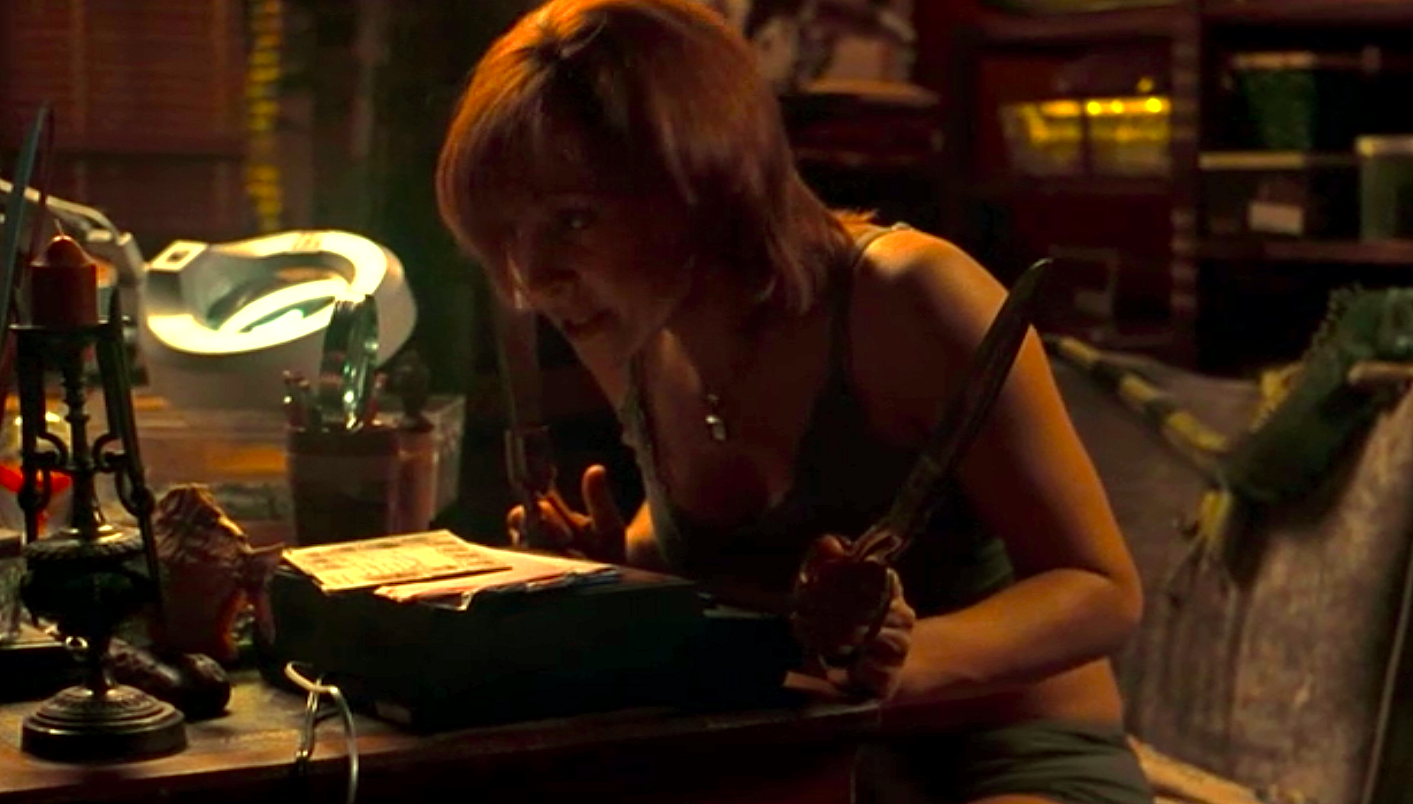
Most direct-to-video sequels aren't worth a damn, but here's one with a cute redheaded badass high school etymology teacher (Alix Koromzay) navigating treacherous urban streets and fending off insect suitors by using sewing scissors as mandible talons to rend their exoskeletons in twain. Koromzay clearly decided to treat this like A-list material and the result is a great example of a director and star using producer indifference to wiggle past the patriarchal groupthink that sinks so many sequels before they start. Instead, Koromzay goes all out in depicting a super strong woman still so sexy she has a whole coterie of devoted, smitten inner city students with whom to hole up in the high school while giant insect mimics hunt them and a cabal of governmental agents seal off the building with plastic tarps. So what if there's a smudge of direct-to-video sequel cheapness? It's the ideal third or fourth entry of any all-night horror binge, one where your defenses are down and your pheromones are at peak between-shower pungency.

THE HOWLING 
(1981) Director: Joe Dante
***1/2

For my money this is the best lycanthrope study since WEREWOLF OF LONDON (1934), the one with Henry Hull and Warner Oland fighting over a Tibetan flower, not the one with David Naughton arguing with a decomposing Griffin Dunne in a Piccadilly cinema. Maybe I just don't care much for werewolves that get hung up on the letter of the law, like Landis' AMERICAN WEREWOLF IN LONDON, which came out the same year as HOWLING and there was much to-do in the press at the time about which make-up artist did the better transformation. Rick Baker is a genius, sure, but he and Landis makes Naughton's transformation unbearably agonizing, the moon inescapable, the beast itself a real wolf puppet on all fours--he takes it all way too literally. Joe Dante and Rob Bottin on the other hand know it's a goddamn metaphor so don't get hung up on the 'real' parameters. The HOWLING wolves move way beyond such hang ups, looming tall like monster gargoyles. Following in the shoes of Dante's patron saint, Roger Corman, HOWLING taps into the lupine side of 1970s sexual swinger and EST-ish energy, it's funny and scary and trashy and witty all at once, and then adds De Palma meta-refraction and audio mimesis procedural delirium, Carpenter ominousness, Cronenbergian clinical immediacy, and a plethora of great bit roles by folks like Dick Miller, John Sayles, Kenneth Tobey, Kevin McCarthy, John Carradine, Slim Pickens Forrest Ackerman, and Corman himself (below, waiting for the phone).


The story grabs you from the start: pre-E.T. Dee Wallace smoldering gamely as a TV reporter / newswoman heading off to interview a possible serial killer at a downtown SF adult book store while her crew monitors her every move worriedly from the warm safety of the station, or tries to--but then they lose her signal. Some bad shit goes down before it's over and she ends up with amnesia prompting a pop culture therapist (Patrick Macnee) to send her to 'the Colony,' his Northern California Pacific beachfront encounter group, where patients/residents make beach bonfires and grill lots of meat. A combination of sinister swinging couples and shady locals, including John Carradine howls at the moon and Elizabeth Brooks is a major smokin' badass as the wolf mother elemental nymphomaniac who comes onto Dee's mustachioed husband (Dennis Dugan) after he's separated from his hunting party. You may find yourself questioning your loyalty to the non-lycanthropic human race when she cooks Dugan's shot rabbit. Later they get it on by the bonfire, the powers of desire and orgasm shifting and churning their inner wolves while Dee Wallace nightmares it up alone in their cabin.

Lifelong Dante fans are born in these weird moments, especially once the entwined lovers switch to animation.


Like Cronenberg's films of the same era, the sex and the horror entwine in deep Jungian-Freudian knots, and as I said, these werewolves aren't running on all fours or just a guy with some fur --they're freaking big, vicious, unstoppable killers who can regrow limbs. They're more like "skin-walkers" than than the traditional full moon brand, and far more interesting, and even scarier despite LONDON's smoother snout grow and superior overall make-up (HOWLING uses one too many inflatable gas bags under cracked latex--perils of HD).  But instead of all the dated too-on-the-nose "Moon" pop songs, HOWLING rocks a great moody Pino Donaggio score, almost none of the usual trite 'dismissal of the supernatural as poppycock' stuff, and no sudden unsatisfying ending or Peter Grant-style dream sequences. Instead there's prodigious use of the gorgeous misty old growth forest, Northern California coastline, and great womanly rapport between Dee Wallace and fellow Colony guest Margie Impert (and in the city, Belinda Belaski as her producer/assistant), the kind of maturely sexy sisterly rapport that just doesn't seem to exist in movies anymore, not since Mary Tyler Moore ended... for all of us. 

And--despite LONDON igniting my then-crush on Jenny Agutter--HOWLING is sexier. Brooks is like the creepy older sister of GIA-era Angelina Jolie, proving that--in late 70s/early 80s horror films--(unprotected) monster sex with a genuinely creepy carnivorous wolf lady could still be guilt-free. And even E.T's future mom Wallace displays a great carnal immediacy that enhances rather than detracts from her courageous intellect, non-bitchy authority, and (unfortunately poodle-like) nose for news. If she had more roles like this in horror--not mothers but sexually experienced competent professionals of the 70s encounter group liberated vein--she'd be a genre favorite unrivaled. If only these types of films kept on being made, and the cultural zeitgeist that spawned them still in action. But life goes on, or facsimile thereof. Even now... for all of us. Cut to commercial. 

Friday, October 03, 2014

Dystopian Parables for the Masses: DIVERGENT, CAPTAIN AMERICA: THE WINTER SOLDIER


Jump, baby, Jump! Jump into the Uncanny Valley, where chicks and hunks in black and silver body suit--kissers slicked over with CGI-bearing golden-brownish glow airbrush make-up--pretend to fight an onrush of enforced digital sameness, until the snake eats itself, the Uncanny Valley fills with ones and zeros and is so level the need for actors disappears altogether. They just float on the surface, newly born. And then mom starts singing "Clash City Rockers" (1) because it turns up on a car commercial, "nothing rocks the town like the Clash City Rockers... except the new Toyota Camry." 

Then, and only then, I'll know it's too late... even for me.

I'm old enough, even too old, to accept the brutal truth, which is that the kids today don't know there's even a brutal truth left to accept, which means there's no longer a truth at all, just the brutal. "Clash City Rockers" isn't cool anymore it's 'grampa's music' and hence undesirable, unless kids today are cool enough to realize their generation's music is the kind of squaresville Glen Miller nonsense that rock was invented to counteract. now grown to anthem size, filling stadiums rather than ballrooms. In the70s-80s, we punks and poseurs didn't have to decide if we were goth or emo or strait-edge or hardcore or Edward or Jacob or Erudite or Dauntless. or closeted or 'out' or bisexual: we were all just punks or (more likely) poseurs, smoking ourselves dizzy at City Gardens waiting for The Ramones or Replacements' All-Ages show to start. But today you need to pick your clique and must abide by its rules and brush off the rest, and if you jump bandwagons no one will talk to you and your reward for being a stunted in all other ways but artistic is the agony of another Saturday night spent alone in your room reading manga, until you turn to the make-up table and tart yourself up for Nerdtown.

This here's real

In both the recently released to DVD 2014 films, DIVERGENT and CAPTAIN AMERICA: THE WINTER SOLDIER, there's a dude who's been brainwashed by the fascist dystopia and ordered to kill the one he loves. And in each, the one he loves doesn't give up on him, even risking their rebel coterie's lives while trying to break through to him because, damn it, you don't give up on your old army buddy or a cute guy who respects your virgin boundaries. Each brainwashed buddy is programmed to kill all those who pose a threat to a deranged Kate Winslet or brilliantly-against-type Robert Redford. But by now you've guessed that even buddy love is stronger than military-grade brainwashing. Love is able to survive even lame 'sensitive' male Subaru voiceovers, it's deeper even than behavioral programming or the ping pong balls of motion capture technology. Even Redford--the goddamned Sundance Kid!--can't change it. 

Taken together these two films paint a nice portrait of where we are today as an eternally teenage wasteland nation, and how it's our obsession with health that makes us sick, how it's our longing for security blankets that leaves us most exposed. Our presumption is that kids today already know who Neville Chamberlain is because they've been to high school or read a book. But we presume in vain. Kids today have no idea who he is, and so never glean the importance of the lesson his liberal utopian pipe dream folly teaches us.

Chamberlin, a pacifist dumbass
For old Neville Chamberlin is history's most glaring example of what not to do when every fibre of your national being wants to make peace at all costs, to live safe today and let tomorrow fed for itself, to waste valuable ammo-gathering time trying to get extra comfortable in your peacetime bubble.

Neville Chamberlain (in case you're one of those kids) was the British prime minister who let Hitler sweet-talk him out of sticking up for Czechoslovakia in exchange for Hitler's solemn promise to not invade any more countries. He came back to England waving a piece of paper guaranteeing "peace in our time."

This was supposedly because Britain was still recovering from the previous world war, but really it's because Hitler wouldn't let Chamberlin smoke in the Reichstag (according to INGLOURIOUS BASTERDS). If he just sparked up anyway, man, right there, he maybe would found the chutzpah to stand up for the Czechs. Well, I saw a picture the other day of a bunch of members of the 101st Airborne at a dance with some dames in the mid-40s, and every single one of them had a cigarette. They're the ones kicked Hitler's ass. Do you think ISIS would even exist if Obama was allowed to smoke in the Oval Office? Instead he's a Bluto-battered Popeye stripped of his contraband spinach at the door. Gotta be healthy, man. No spinach. Popeye's spinach-guzzling youth has left him with a bad case of chronic iron poisoning. 

So now you know about Chamberlin, and how our collective all-consuming horror of illness, death, and decay extinguishes the flame (and smooth filtered taste) of our own shortened life span and conversely poisons the Earth with overpopulation. Resources and living space get scarce and lack of security blanket options gives angry idiots the balls to not mind getting killed toute de suite by our noncommittal drones in the name of some fuzzy cause.

Luckily there's always movies and movies about teenagers fighting back against the hypocrisy of dystopia overreach are big bucks, and that, my friend, is what irony sufficiency is made of.

Nurse, all that glowing stuff is going to have to be removed

But if grooving to a nine figure-budgeted movie spinning in your hardware can make you feel that you're part of a vox populi juggernaut revolution, a Churchill not a Chamberlain, even if only for two hours and ten minutes, facing danger on the screen, dissolving into the breathless pace and riveting action like a true hero... then just remember that while you were so motionless on the couch, six more species died in the rain forest.... and you could have prevented it, for just fifty cents a day. That's less than the price of a cup of coffee.

Keep your logos round and burning

Conversely, here's a little-advertised truth about addiction I've learned the 'hard' way: drug and alcohol withdrawal is brutally painful, terrifying, even soul-crushing, BUT it can bring sexual pleasure as exponentially intense as the pain, exhilaration as intense as the terror. But few know this because a) so often this withdrawal is done in a hospital, where opportunities are scarce; b) first you must truly suffer, convulsing, screaming, vomiting and rolling around on the cool tiles, riding an endless terrifying roller coaster that's all vertical drops and torturous climbs, for like three long days in one endless loop. In a similar way, perhaps, enduring the intensity of withdrawal from the media's cozy hypnosis brings true liberation, but who would be fool enough to know it unless forced to? Stretching your limits is just a nice way to say being stretched on the rack. 

And no one suffers like a teenager, whose stretching is involuntary, a werewolf transformation that takes agonizing years instead of a night or two under a full moon. The one part missing from the TWILIGHT movies that the (last) book went into detail about: the great flaming agony stretching on for timeless weeks that Bela endures in her transition from dying anorexic pregnant teen to hip, naturally-toned rich mom vampire. When you don't endure the trauma, the basic training breakdown, the post-marathon soreness, or the primordial terror of the final few bardos of death or deep meditation, then your transformation, your evolution, is not permanent.  Teenagers trapped in the torturous cocoon of braces, acne, dandruff, virgin angst, and clumsy self-loathing, can't imagine how the much their future self-confidence, straight teeth, clear skin, will depend on it, and how quickly the pain will disappear once theb benefits are known. This counter-intuitive need for trauma, coupled to our fear of it (inseparable from the fear of pain and dying), makes a good dystopian parable for the masses, and why teenagers resonate with them so strongly. Old men need no more dystopian parables, only escape from their oldness in the chimera of myth and chimera of youth. And it is the same resonating myth and escape into (and from) youth that brings old and young together.  No one wants a teenager in their living room, but onscreen everyone can be teenager just for two hours, or--if already a teenager--a hero whose diamond anguish is at last given the properly operatic golden setting.


It is the duty of any nonconformist or outcast in a conformist society to subvert that society, the force of the social repression on the nonconformist forming the response and creating the spatial form of the future: Jesus on the cross, Mandela in the jail, and Gandhi on the hunger strike; but if you want to avoid that pain, you can stay addicted to to the virtual pleasure of the simulacrum and just write a Young Adult dystopia novel or superhero comic or screenplay wherein your protagonist subverts an even more conformist future or alternate reality. And if it sells, and catches on with the teens everywhere, and is adapted into a big budget movie, conformity expands to envelop it, then shrinks back as it digests, and then the trappings from that parable are spit out a decade later in a lame car insurance commercial, as drained of its original meaning as a Times Square New Year in the post-Giuliani era.

On the plus side, by entering the collective fabric it will serve to caution the power elite about going too far in trying to repress and restrict the freedom of the masses. Certainly the power elite fear from these tales the fallout that would come with restricting freedom of speech, for any speech---no matter how anti-authority--can be subverted to power ("Clash City Rockers ride the streets in the new Ford Freedom") Truly it is written in Situationist theory books forced on liberal arts undergrads the world over: a reigning social power can find no surer way of survival than incorporating critiques of itself, ushering in an era wherein compliance as the 'reality' is never even noticed behind the simulacrum screen. In HUNGER GAMES, Donald Sutherland's nervous military dictator thinks suppressing the symbols of rebellion will suppress the rebellion itself, but a media savvy ruler doesn't outlaw symbols, he mass markets them. He flashes the Girl Scout / Revolution gang sign at press conferences. Anything--even Sid Vicious snarling "My Way"--can be digested, incorporated, and eventually spat out into a car commercial. No revolution can win against a government that burns itself in effigy every night on the evening news. What are you going to do to protest, put out the fire?


In order to be free from our addiction to the cathartic thrill of battling Hollywood-conjured dystopia, we must learn to love the pain deprivation brings, which goes against everything capitalism stands for. No expensive wine ever tasted half so sweet as warm canteen water to a dehydrated ocean castaway. Is this not the the core truth of meditation, or stereograms, or the rapturous freedom of the starving, tortured artist hallucinating sausages and flagons in his swirling oils? And nothing's more disillusioning than realizing the spiritual crisis that cost you years of suffering and depression but resulted in artsy growth could have been solved with Effexor, and just as quickly turned into a raving maniacal sociopathy by adding Abilify. By extension, anyone with the right technology, drugs, or patience could turn you into their automaton. With the flick of an artificially-implanted cerebellum switch you could feel your friends are your enemies, and vice versa. Raymond, why don't you play some solitaire?

Thus the brainwashed super-conductive Winter Soldier (above) doesn't flinch or protest when his keepers want to give him an electric shock memory wipe. He just leans back into the chair and opens to receive his rubber mouthguard like an angry boxer thinking only of the kill. The captain meanwhile is thrown into a dilemma when he doesn't quite know who to trust within the NSA-Homeland Security-ish conspiracy web known as S.H.I.E.L.D. He himself is doomed to be incorruptible, no matter how many perish as a result of his principles. I simply cannot give more away, but it's this 'question authority' theme that gives the film its emotional resonance. Fifth columnist academes can say what they want, in Captain America's heyday (he was frozen in 1945 so he could miss becoming Reb Brown -left) we had a genuine uniform-wearing enemy to fight, and that we might actually lose was a real fear that brought Americans together and cured its Great Depression quicker than an Effexor / Neurontin / Wellbutrin cocktail.


And in DIVERGENT, the brainwash comes via a remotely activated chip air-injected into each 'Dauntless' member's neck as part of an alleged location tracking program, a process woven so seamlessly into all the other initiatory processes that no one can hardly complain--any more than an army recruit can complain if forced to do push-ups. The big fear for our plucky DIVERGENT heroine, Tris (Shairlene Woodley) isn't being brainwashed, it's that her friends will find out she's not one of the approved types of persona which act as fascist-brand masonic brotherhoods that all young citizens of this society must join, being allowed to pick for themselves at a big ceremony, because not doing so, not fitting a socially prescribed 'type' means being 'divergent' - i.e. a natural-born nonconformist, the type who must subvert the dystopia, write a book about subverting a worse dystopia, or die a death by slow closeting. Perhaps it's natural to have subversive artists in any society that gets larger than a few thousand people. Native Americans treated their gay tribal members with reverence, for they were signs the tribe was flourishing and needed to slow its population growth. A dystopia would of course not go for that display of difference, and with subversive artist types it's perhaps the same... no room for 'decadent' art in a dystopia. At any rate, Tris fears becoming cliqueless and alone by daring to say no to peer pressure, but can't help being chip (brainwash) resistant and so forced into the capacity of heroine. She's the type of person who, like myself can't connect for some reason to the giddy rush of 'mob mentality' (2). In the big picking ceremony she goes for the daredevil mesomorph soldier brigade (i.e. the jocks or the Wermacht) the 'Dauntless' group, but she's way too independent and peaceful. She's also too athletic and dopey to be an Erudite (the fretful nerd group, or Gestapo); too Erudite to be Abnegation (the Red Cross), etc. But this is a dystopia where your friends literally jump off a roof and if you don't follow them then you're not cool anymore. And you have to succumb to paranoia to not be suspect (if you're Erudite). And you have to let yourself get exploited and scapegoated if you're Abnegation (see also VIRIDIANA).


Sure it's a little trite, but I like DIVERGENT mainly because the twisty high school clique-as-metaphor-for-fascism stuff displays a keen savvy to the way initiation rites are incorporated into the lure of the popular clique. Here institutionalized initiation is conformist just enough that both the personal and political seamlessly interweave, like joining the Riffs, the SEALS, the Heathers, getting your ears pierced, your first tattoo, drinking your first beer and smoking your first cigarette all on the same day. Feeling like you finally belong somewhere is an intoxicating high, especially if you've never felt it before. The dissolution of apartness, of singular lonely ego subsumed into an inclusive group whole, is exhilarating in exponential ration to the amount of lonely bedroom angst you've suffered.

But that high has a price and you're suddenly being shipped off to Vietnam, like Treat Williams at the end of HAIR.


The thing DIVERGENT doesn't get is that having a weak central girl throws off the curve- Kristen Stewart is Antigone-stubborn in TWILIGHT; Jennifer Lawrence genuinely mythic in HUNGER GAMES; the kid in ENDER'S GAME spookily self-confident, but this chick Tris is perhaps--to her detriment--the most 'normal' teenager-like of the bunch. Rocking a terrible poker-face, she lacks the inner fascist to succeed as a Dauntless. She doesn't have a grasp of 'war footing.' She's not Artemis-esque or Antigone-determined or a math prodigy; her puffy face dilates and registers every emotion, which is not good if you're gay, I mean "divergent" in a world hostile to any sort of difference. If you show your true face they will get you. The same ones who urge you to be yourself are the ones who will attack you if your actually do. The core of every teenage fear lies in this idea, that the joy found in belonging to a cool group will soon give way to the terror of being abandoned by them once they see your face register the joy you feel at being accepted at last. This is part and parcel of the feeling teenagers never get over into adulthood: that the parent or god that watches over you is just a trickster demon awaiting the right time to remove its saintly mask to expose that which your whole life was a shield against seeing--his hideous giant demon face coming forward to consume you like one of Kafka's devouring industrial vaters--all the while encouraging you to take off your own mask, to be yourself, at last, to finally show your soul just in time to see it ripped to shreds... 


 In WINTER and DIVERGENT, the moment of exposing the demon face behind the mask is when what was once just rumor and conspiracy theory starts to lock shut (SEMI-SPOILERS AHEAD) around you, too late to resist it, no time to plan a defense, no access to yourself, no chance to catch your breath. What you didn't see coming suddenly comes, not on the horizon ahead but behind, next to, within, and in all directions, making its move only when its sure all resistance has been pre-demonized as terrorism, disarmed, isolated, and confused. Then the NSA takes off its mask and the Sixth Reich Paperclip draconian totalitarian future-present is right there, and has been, in disguise all this time, and the Homeland Security emblem turns out to be a scrambled up swastika, and it's too late to do anything about it because we've signed all our freedoms away in the name of order, because we got all scared when the news waved some Muslims at us. God help us, we activated SKYNET just to deal with a couple of dudes with AK-47s and cell phones. General Ripper was right! They've infiltrated our precious bodily fluids! Little tiny Stalins swim in our blood. They're even in the money...


Masks on / masks off 
Now I don't really believe in a massive global conspiracy per se --I imagine the world to be far too chaotic for that--but I don't rule it out. What I do know, though, is that-when it comes to running Hollywood--the industry guys can tramp around their fancy desks high on all the megalomania-infusing coke they want, but deep inside their drawers they know who the real boss is, the capricious Middle American teenager. Their ample expandable income, their drivers' license, their need to get away from parental eyes even for a few hours, the crushing relentless sameness of suburban boredom, all bring them time and again to the multiplex. Why not tie high school subjects like social science and literature to cafeteria mores and social hierarchy to teenage hormonal angst and deep mythic dystopian allegories, so that the films they see double as Cliff notes to the classics in class and of their lives? Maybe the kids are reading Plato in fifth period or leaning about World War Two for the first time, so hey, if you commingle these big historical and cultural currents in with the high school threat of cyber bullies, peer pressure, and the rush of the first law break or sense of belonging to a clique, then you have hooked onto an iconography of coming-of-age mythic suburban metaphors, each multi-layered signifier keyed into a hormonally pained demographic. 


That's myth. At it's purest. In myth there's a way to apply what's taught in school to real life, to do it in a way where the result is fantasy on a larger more 'real' level than mere reality. 

Thus these teen dystopia parables become more and more urgent as the real and public sphere shrinks. Science tells these kids that their future is all used up but as long as their present is spent texting and downloading violet ray dystopian fantasies, they can live without anything so banal and limited in scope as science's concept of time line futures. These kids know that watching someone else fight the power isn't the same as fighting it themselves. But how do you fight a phantom who monitors your every move before you make it? Just trying to get a gun into high school or threatening Congress via your Tumblr will get you all sorts of expelled. But watching someone else fight a raging battle against a CGI windmill version of all the old American evils? That's doodle dandy do or die. 


I know it's cliche to say but, for my generation, things were different. The dystopian-spurred life-or-death need to assert your individuality and face the dreaded finality of conservatism was totally lacking in the John Hughes (and Arnold Schwarzenegger) 80s. There were no cell phones or internet by which to stay constantly connected. As a result, that connection never felt threatened, that was our burden and our blessing. We had no faith to lose, and we knew it. Not no more. If you win a teenager's heart today by expressing their queasy post-digital angst, they'll come back for the sequels, then they'll buy the DVD (even after they downloaded it illegally (you hope), and in 20 years they'll buy it again in a deluxe commemorative edition, and it can run in perpetuity across a spectrum of cable channels... until that car commercial tie-in wrings the last dollar out.


Starship Troopers (1997)
And of course, there are the girls, the ladies, all locked into the golden gloss that makes all them all now look like they're CGI avatars slick with softener, every frame of their face Maximed to abstraction, all the better inject them into the video game vein. But hey, the good news: boys have picked up some slack to become objects, which is like, so like, finally, you know? It's the baby steps, man. Before women can be free of objectification they must first choose a replacement way for us to look at them, and there's but one traditional gender left to objectify. There is a reason, burn, turn, worm, but don't say I didn't warn you about that Uncanny Valley crossing, ladies. This is John Connor coming to you from inside Crystal Peak: let the revolution commence broadcasting on UHF, on the Emergency Broadcast System, on the HAM radio, anywhere it can be safe from the digital detection. Analog only, No digital, man. Analog got the warmth and the resonance, 'cuz nothing stands the pressure of the Clash City Rockazz!


NOTES:
1. The Clash, in case anyone doesn't know, were a prime example of politically left-wing, anti-Thatcher English punk rock, hence their use in car commercials is the kind of thing that runs counter to their message.
2.  I've been there at the start of three riots in my life -- and each time I walked away before the violence began, horrified by the way all my friends seemed to transform into bloodthirsty animals, and feeling strangely abandoned, as if they all disappeared right in front of me, just as would happen later when cocaine came back in vogue in the '98. I simply could not catch the mob or coke mentality anymore than I could 'get' the Grateful Dead. I guess that makes me... Divergent!

Thursday, September 25, 2014

Tales from the Benway Pharmacy: BEYOND THE BLACK RAINBOW, THE MACHINE

If I ventured into the 'flix stream, between the viaducts of Dr. Benway prescribed drug-enhanced science fiction hallucination dream, would you find me?  Or would there no longer be a 'me' to find, and no difference between you, these words, the future, the past and all constructs of self I may adopt and discard over lifetimes? Yeah, it's the second option, because good films dissolve all difference. The screen is just the first in an endless banana peel of self (and vice versa).

I dissolved once or twice into that void this week, thanks to the following two films being available on Netflix and their modulating, droning and pulsing analog synth scores being available on Spotify. By Sinoa Caves and Tom Raybould respectively, these evocative scores make a big difference, especially this time of year, the autumnal Samhain, i.e. Halloween. These two films seem to occur in a realm of permanent ESCAPE FROM NEW YORK (1981) midnight where dangerously liberated prisoners/patients/experimental subjects break out of bizarro world environments, in the process etching out as fine a metaphor for the dangerous liberation offered by psychedelic drugs as anything I've seen since PSYCH-OUT (1968).

So, when you're on an all-night weird movie binge, save these two for the late late show slot, i.e. the high strangeness Interzone gateway stretch between three and six AM, when the straight and sober are fast asleep so their bland consensual reality can't interfere with your psionic reception, because thanks to Netflix, the future is then!

BEYOND THE BLACK RAINBOW 
2010 - written and directed by Panos Cosmatos
***1/2

A lot of typical science fiction buffs are nerds, man, and they stay that way for one reason: they're scared of psychedelics. Scared to lift the throbbing rock of the known and scoop the writhing worms and scorpions from the muddy void and devour them, they live in a reality circumscribed by the trappings of the social order; the border between their fantasy life (as a fifth-level chaotic good paladin in D&D) and reality (high-school) is very well-marked. The closest they get to living their own fiction is, perhaps, LRP or paintball, but never the 'inside job' of acid or mushrooms.

This cautious avoidance is a wise decision. Unless one feels the psychedelic zone tug them towards it like a magnet, one is probably not invited, and would probably not be treated well. As Bill Lee says in Cronenberg's NAKED LUNCH, "the 'zone takes care of its own", implying: all others beware. Not everyone is meant to have their ego ripped like a bad tooth from their screaming psyche. Their self-centered fears lodged like a giant tick in the back of their skull, each wrench of the psycho-active pliers felt like fire consuming the crown chakra, and only the already in pain would want to stick it out in the chair, enduring the probing and inflamed wrenching, until that sucker is at last ripped out. But for nerds of the sci-fi role playing type, maybe their egos aren't solid enough to be killed. There's no formative I AM life experience to get cocky about, no hardening of yesterday's persona.

Lick the 2001-legged Monolith
Sometimes the sci-fi coterie do make it past their initial fear and enter the void, and if they do, they tend to run in packs, and--when running is done--retreat to the movies (as we all have), spending the come down from the peak watching 2001: A SPACE ODYSSEY (1968), because it's the familiar made unfamiliar. Kubrick's movie is never entirely familiar no matter how many hundreds of times you see it, and on LSD or shrooms it's a whole other thing. From there, an adept sailor of cinematic madness will wind up leaving England along Commonwealth solar trade winds and winding up at two Canadian horror films: SCANNERS (1981) and BLUE SUNSHINE (1978). Each explore the long term psychic side effects of prolonged exposure to the drug-dealing elder god behind the wizard behind the curtain. In BLUE a particular strand of LSD makes people lose their hair and go on rampages after exactly ten years elapse. In SCANNERS a briefly marketed pill prescribed to pregnant moms has caused a offspring to be born with the power to blow other people's heads apart through conscious projection.

I mention these two films this for a reason, this acidhead tab of Canadian druggie sci-fi history is imperative for a deep lysergic appreciation of the 2010 Canadian homage to that golden era of tripping man's Kubrickian-Cronenbergian-Blue Sunshine maker crossroad science fiction, BEYOND THE BLACK RAINBOW.

The first feature by Panos Cosmatos, RAINBOW stars Michael Rogers as a batshit crazy psychiatrist named Barry Nyle. His pet patient is a scanner-style mutant girl Elena (Eva Bourne) kept under sedation in a futuristic white room for reasons no expository monologue need explain (we having seen SCANNERS and deduced the drug side effect angle via the psychoactive experiment clinic prologue). During the daily sessions, Nyle tries to provoke any kind of response from Elena, talking molasses slow through a thick protective glass while jotting down 'notes' and going even more insane. He also has special guards called 'sentinauts' (their brains can't be exploded) and a weird white triangle device that can deliver sound vibrational (presumed) shockwaves to knock Elena to the ground and (presumably) jam her brainwaves should she try to escape. Clearly, she must have the power to transmit her thoughts and explode the heads of anyone in the same room if the puramid thing should be turned off.  The uncanny analogy synth score by Sinoia Caves heats and throbs and pitch modulates as the doctor and patient engage in a long drug-addled silent treatments and staring contests. Cosmatos trusts his viewers to connect the dots, to have seen the classics, to have had their egotistic wisdom teeth pulled at the psychedelic dentist, to know that fields of red and pulsing, throbbing analogy synth music is enuff.

To make it all just that much better, the institute is housed in a bizarre retrofuturist geodesic dome, which includes the office/drug den of a terminally-ill Buckminster Fuller-Timothy Leary-ish junky, the founder of the institute (and Elena's father). In a flashback to 1966 we see this guy taking Barry on his deep dish drug trip (the date is important: LSD was legal then and being used by forward-thinking psychiatrists the provinces over). Barry's trip resembles the 'Beyond the Infinite' section of 2001 if slowed down 99% and experiences while meditating as one's face melted off. It's so much like my last few salvia divinorum trips I nearly fell off the floor, but Barry is not like us. He is  reborn in an oil slick, crawling out of a black circle like a reptile from its egg, and latching onto the woman, some woman... I don't know...his wife? Elena's mother? Does he kill her by ripping her throat out with his teeth, or is that an ejaculation? Is she coasting on an orgasm, or is the light going out of her eyes?

Either way, when it's over it's clear the doctor blames himself; Barry's not held responsible... but the hope for the future is done, and though Elena shall be born with all the special extra sparkage having a dosed-out LSD-awakened mother can bring to one's junk DNA, she'll wind up a prisoner in an all-white room in a geodesic dome in the middle of nowhere, the captive of an insane doctor who killed her mother while in the throes of a deep dish LSD freakout.


 Meanwhile there's lots of delicious red walls and filters and the sense that time is melting (Barry pops pills from the Benway pharmacy--another nod to Burroughs) and though he's off-putting at first, Rogers gonzo performance grows on one over repeat viewings; he's committed to his work, he should be committed into the place he works, period. It fits hims snug like in a strait-jacket. Being a shrink seems like a pretty awesome occupation for a druggy maniac: you get to prescribe whatever mind-expanding things you want for yourself and go so deep into the void that reality ceases to exist and you finally get a peak 'beyond the black rainbow' and don't have to worry about a thing, as you have all the Ativan and Thorazine you need to bring you back down to 3D space-time if things get too terrifying.

If you get confused, just presume this is all meant as an analogy to the mysteries of consciousness itself as it may have existed in Canada after the collapse of the psychedelic movement: Elena is the unconscious, the anima- mutated along with the psyche's chromosomes; Barry is the amok ego trying to keep the sinful Jane Eyre attic madwoman lovechild locked up tight; the old man is the repressed superego dissolving from years of drug abuse (nothing nullifies a moral compass like addiction) and watching his high watermark 60s utopian vision for the future gradually erode under the deranged stewardship of his sociopathic protege. No matter how lofty one's intention, the ego finds a way to take advantage of it.

So remember, nerds: baldness = homicidal madness, and if you can't escape quickly, move so slowly no one can see you; otherwise you're dead at the hands of a guy who's so high he can't tell the difference between your skull and a stress ball.

THE MACHINE
2014 - written and directed by Caradog W. James
***

THe low-budget but highly intelligent (if unimaginatively titled) British film THE MACHINE (2014) has great gloomy electronic momentum (no daytime shots ever, which is great), a beautifully retro Carpenter-meets-Vangelis synth score from Tom Raybould, an overall aesthetic that splices the labs of the Tyrell Corporation to ESCAPE FROM NEW YORK's Lee Van Cleef sub basement, And a script that mixes some TERMINATOR touches with CREATION OF THE HUMANOIDS (1962) post-humanist philosophy. The captivating Caity Lotz is great in a double role, evoking Elsa Lanchester in BRIDE OF FRANKENSTEIN, as both the inventor and the machine. And thanks to thrifty use of lots of Val Lewton darkness, a single, largely empty cavernous soundstage and great artistic (and ingeniously simple) touches like the way the bodies of the artificial beings light up in strange patterns when excited (though the lights are clearly just projected onto their skin), Caradog's etched out ONE of those economic sleeper B-movie gems that can sometimes be unearthed when digging around in Netflix Streaming, ranking it alongside other dusty gems I've found there, like BERBERIAN SOUND STUDIO, THE ORGEGONIAN, IRON SKY, BOUNTY KILLER, and JOHN DIES AT THE END. It's short, yet operatic. There's no filler, no corners are cut. Everything fits and it doesn't need trauma or didactic postures to feel justified in existing, though of course there is some of each. Even the bit with the dying daughter sidesteps all the usual cliche'd sentimental pitfalls.


The story begins with bigwig AI engineer Vincent (Toby Stevens --the Richard Branson-ish villain in DIE ANOTHER DAY) interviewing various freelancer-designed artificial intelligence programs via a series of surrealist questions to see which can answer far enough outside the box of logocentric thinking that genuine personality is possible. Ava's (Caity Lotz) program comes closest, and she's cute, sparks fly, so she's hired, and brought down into a deeply buried network of basement level research programs, all funded by the British military intelligence operatives for assassination work in China. Vincent's not a fan of the assassin aspect, but he loves the unlimited funding. It's enabled him to develop software that can scan and duplicate whole personalities via sensitive headsets worn during Voight-Kampf-style questions. Meanwhile, military vets suffering from brain injuries and missing limbs are turned into half-machine monsters, the trouble being they're liable to kill everyone in the room during the slightest existential tantrum. Meanwhile one of them steers Ava towards a possible cover-up conspiracy in the works - these soldiers are being cut off from their loved ones, treated essentially like slaves. She knows too much!

Ava is assassinated by Chinese assassins before Vincent can even work up the nerve to ask her out, not before doing all the tests of course. How convenient! Dennis (DR. WHO) Lawson is the ruthless installation director who wants to make sure this new Eva isn't so independent she'd refuse a direct order, especially since Vincent tells her killing anyone--even Chinese diplomats!--is wrong. She murders a guy in a clown mask during a routine test. She feels bad. Raybould's synth pads swell in mecha-grim portent.

Oh well, it's not hard to guess the rest, and we viewers we don't really give a shit about Vincent's Asimovian ethics, so Lawson needs to to up the stakes via an enforced robot lobotomy and another easy-to-guess subplot with the daughter. But what could be some douche chill sentimental nonsense in non-British hands (such as Guillermo del Toro's) doesn't rankle, and I've got a sensitive rankle meter for that shit.

Slick and dark, but with some genuine AI insight and vintage analog originality to back it up (See also CinemArchetype #13 - The Automaton / Replicant / Ariel), it's a good lesson in how you too can survive the coming robot revolution! Hint: treat the machines with compassion or at least tact, because they'll remember every last kind or derogatory word forever, no matter how far out of earshot you think they are when you say it. They are the past and future, reaching back and forward along your every gesture, like karma's own sweet engine.

Remember us, your future? CREATION OF THE HUMANOIDS! 

If you have Spotify, click here for a mix of both the amazing scores of these films.

NOTES:
1. If you don't get that reference, see BLUE SUNSHINE!

Wednesday, September 17, 2014

Warren William, Titan o' Vitaphone: THE MOUTHPIECE, SATAN MET A LADY, SECRET BRIDE, THREE ON A MATCH


Fridays this month on TCM are devoted to pre-code Hollywood and, honey, pre-code Hollywood is devoted to its lord most high, its Capitalist King Tut, its Maestro of Satanic bravado and merry carnivore sparkle, Warren William. Until the dawn of TCM and pre-code festivals (like the one that regularly comes to Film Forum here in NYC), Warren William was all but forgotten except as a B-mystery star from Perry Masons and the Lone Wolf films, a kind of hybrid Basil Rathbone-Errol Flynn. Now maybe we feel why, for Depression era audiences, he was such a charming, sinister figure he stole their love for the young moral 'hero' (along with said hero's money) clean away. The juvenile maybe got the girl in the end, but she was pious naive reformer, so who cared? Despite his amok capitalist characters being so emblematic of what tanked the stock market in the first place, William was the great antihero for a nation sick to death of treacly Americana and bootstraps idealism. Steal big and ascend to power -that was his credo, and it was the only one in America that still worked.

He ascended the throne in 1932, the height of American Depression free-fall, part of a global economic death spiral in which there seemed no hope for pulling back up except via the methods of the same crazy capitalists (or crazier) who'd brought the markets so low. Audiences knew William didn't give a shit about their small fry suffering, but he didn't waste time scamming them either; instead he scammed the fat cats who had scammed the small fry in the first place. He robbed from the guys who robbed the poor and may not have given it back but at least he used the money as collateral for bigger loans to get his phallic building higher, higher, and that meant more jobs. Gray-haired, squinty, corrupt old board members vainly harrumphed while William aimed his cigar / wolfish nose-chin combination down at them like a revolver and cleaned their pockets. And if he stole the juvenile hero's girlfriend on his way up, so much the better.

By then we hated the juvenile hero anyway, the types who turned down offers of easy dishonest money because they still believed in the American dream of little guys making good honest wages. They should have been boiling fat cats in oil or dragging them to the guillotine but instead kept dutifully working themselves to death in service of the giant black could Dust Bowl Moloch to afford barely enough company store credits to keep a young wife in hairpins. No wonder she left for Williams' champagne and opium penthouse. You had to be soft in the head--like Joan Crawford or Loretta Young--to think the homespun decent folks Americana small town ideal wasn't a bogus con enforced by the fat cats' sour matron moralist wives in some weird venomous outpouring of stifled sexuality. Guillotine the rich, or work yourself bravely to death like that poor trusting horse in Animal Farm --at MGM there was never a doubt which option their films advocated. You can smell the glue there even now. But at Warner Brothers? hors de leurs têtes!

Alas, sometimes even tough-minded Vitaphone demanded William get a 'conscience' by the end and start doing the right thing after being reformed by some high-handed secretary's refusal to put out, but aside from a glimmer in his eye as he dutifully shed a tear in the name of good common decency, all he ended up with for his trouble was a gut full of self-loathing and a few bullets from the guns of the people he double-crossed. As Handsome Harry once said, "the trouble with people who reform is they always want to rain on everybody else's parade, too."


And anyway, the average workaday joes and handsome college boy heroes these girls ended up with after poor William took a dive were played by annoying little pishers like Gene Raymond (the schmuck in RED DUST), Charles Farrell, Randolph Scott (as the Puritan geologist in HOT SATURDAY), or Norman Foster in SKYSCRAPER SOULS (1933), who relentlessly paws and stalks Maureen O’Sullivan, just because he happens to be her age and social class. The swine! Warren William develops eyes for her himself and who wouldn’t? Look at those legs (above)! And anyway, she works for him and sexual harassment laws are still just a distant troubling tom-tom in 1933. Meanwhile Foster is so full of himself and his presumptive ladykiller charm he literally makes it impossible for her to do her job. I had a guy like that haunting my assistant one time, and I kicked him out of the building and convinced her to file a restraining order! It's a boss's job to make sure his female employees aren't harassed at the workplace, which is why he sometimes needs to protect them, personally... even if takes all night.

THE MOUTHPIECE
1932 - ***1/2

Warren William rules in this fictionalization of the career of legendary mob defense lawyer Bill Fallon. And until some hick virgin puts him noble he's pretty badass. Granted, he starts off as an 'clean' assistant D.A. but, after sending an innocent man to the chair, he joins the other team, defending the guilty in a belated attempt to right his wrong. As in all these type films (William Powell played versions of Fallon for Warners, too, in Lawyer Man and For the Defense), he becomes a big shot gangland defense lawyer and drinks heroically (Guy Kibbee 'tends the 'speak') and sleeps around with impunity (look fast for Paulette Godard as a party girl) while his gal Friday Aline McMahon adds notes of warm complexity as his half-secretary/half-detox nurse / half Leporello crossed with Joan from Mad Men. She's become so adept at her Moneypenny-esque repartee with William that even she can't remember if there's any real desire underneath it, and McMahon's tall enough, and physical enough, that she can believably heave him onto his feet when he's dead drunk.

Aline McMahon: What a gal 
Anyway, they're a great team, and all is well, with a few defense strategies so outlandish they must have been based on real life cases (William here drinks poison to destroy the prosecutor's case, in other versions he throws a vial supposedly full of nitro), but then it all goes to hell when a hick typist in the pool turns down his wolfish advances because she's lousy with the type of small town "integrity" Sydney Falco and J.J. Hunsecker would later sneer at. But, hey, this was 1931, there were only a few years left to even talk about other options, soon that sentimental sunshine malarkey would be so pervasive it would take another world war to shucker out into the freedom of the shadows.

Sidney Fox is the c/hick who sways him, William Janney the naive chump she's sweet on, who (of course) winds up implicated in a crime orchestrated by one of Williams' shifty clients. You can guess the rest. It's all worth it for a giddy stretch in the beginning where William rockets through his day, pausing to lift a $10,000 fee out of an embezzler's stash before returning what's left to the employer on the condition he doesn't press charges. For this one crazy stretch, The Mouthpiece is a masterwork.  It's the role that made William a star. It will make you a fan.

 THE SECRET BRIDE
1934 - **1/2

All procedural political machinations, this post-code potboiler plays a bit like Perry Mason wandered into The Glass Key. William plays an ambitious assistant D.A. secretly married to the daughter (Barbara Stanwyck) of a framed governor (Arthur Byron). If the public knew about their marriage, it would be conflict of interest! Nepotism! Whatever! It's a little vague, your honor, but the governor can be proved innocent only by compromising William's coming promotion to 'full' DA.

But hey, as long as he's innocent, you have nothing to worry about, maybe.

William is on medium setting here, but that's still a high for anyone else. The cast includes: the always fey and Capote-esque Grant Mitchell; the ever-dubiously allied Douglas Dumbrille; Glenda Farrell as the woman blamed for a murder that Barbara Stanwyck saw happen but can't reveal why she happened to be in Williams' apartment to see it. Courtroom will be cleared while the jury reaches a verdict! The verdict is that this is reasonably engaging thriller that adds up to little beyond its own dated contrivance. How can you go wrong with Stanwyck and William as secret lovers, even if they're not playing to the fullest of their madness? William fans who are wondering if this being made in 1934 means William is defanged, rest easy: he's not, he just doesn't need to bite anyone, so is in semi-asleep mode. William Dieterle directed, so there's atmosphere even if Warners had by then worked the old 'D.A. or Defense Attorney who has to sacrifice his career to protect his lover's honor' horse all the way through the glue factory and back again. (Callback!)

SATAN MET A LADY
1936 - ***

Before it gets bogged down in needless variations on its The Maltese Falcon source text, it's great fun. Muddled and nonsensical as it may be, fans of the Huston version may savor this as I do, like a jazz riff on the same tune. Effie (Marie Wilson) known here as 'Miss Murgatroyd' below left, is an adorable little ditzy Red Riding Hood who has great chemistry with the big bad wolf Warren William - she's as tall, standing, as he is, seated, which I'm sure made it twice as easy for him to work his charm. And the way she rolls with his wolfish come-ons makes them a perfect pair. She all but grabs onto his fur and rides him to grandma's house.

Made in 1936 (after the code, but Mister, ya coulda fooled me) it co-stars a very young Bette Davis in the Mary Astor role--she's much less coy in this version, and much less bemused by William than most, and instead of the usual blithe flirting they share a conniving sense they're both too used to snowing members of the opposite sex to snow each other, but they just keep trying, like the salesmen in Glengary Glen Ross selling to each other in infinitum. Alison Skipworth is the gender-switch version of the conniving Gutman. I couldn’t find billing for the unsightly Tweedle Dum type who keeps repeating “I told you once, Mister…” as her neurotic gunsel son. He’s no Elisha Cook Jr. Then again, who is? William's Spade (here called Shayne) does a variation on the crippled newsie scene (pulling the raincoat back over Cook's shoulders and grabbing his twin .45s) and plays it out with a beanie he steals off Kenneth's head with a wolfish grin not unlike Lonesome Rhodes chasing a secretary around the Vita-Chex pitch meeting in A Face in the Crowd. 

The best substitution comes with Arthur Treacher as the fey Joel Cairo. A tall, game-for-what-for posh bounder, he brings his own quirky wit to the proceedings and the scene where William helps him ransack his own apartment looking for the 'horn' has a great comedic flow--like Alan Alda and Wayne Rogers in the first three seasons of MASH. Were they huffing laughing gas off camera? It's almost like William has met his match in William-ness, and they feed off each other's energy like long lost brothers. Whether helping Treacher casually break things, repair them, or William's glee at finding on a thought-lost little black book under a chair, their scene could be the drunken grandfather of Altman's The Long Goodbye. Rather than a long stretch of time in Spade's apartment waiting for a package, the big climax meets Captain Jacobi's boat down at the rainy docks for a good old-fashioned shoot-out. Which let's face it is pretty cool, considering Huston's film only talks about a whole mess of events we see being played out here.


Davis meanwhile smokes and wields a piece like a pro, she's even annoyed by Williams' not taking the gun she's jamming in his ribs more seriously. If you can recall the Huston version moment where, after giving Cairo back his gun upon receipt of the two hundred dollars, Cairo turns it on him and says "Clasp your hands behind your head, Mr. Spade..." and he just smiles and laughs, saying "Go ahead! I won't stop ya..." that's how William plays the whole damn movie. And unless you're like Davis, a serious actress, trying to establish her character's duplicitousness before the short running time elapses, than Williams' fun is contagious. If you've seen Huston's remake a few dozen times (if not, better start!) then the use of so much of the same dialogue under such bizarre, nearly Godardian tweakage is startling. While the whole cast (Davis aside) seems to bounce merrily on his lap, William has such a good time he can barely remember his lines. Who cares though? He may just as well just read the book aloud and mix some more drinks. I'd watch it.

THREE ON A MATCH
1932 - ***1/2


Three girls meet while at a Brooklyn public school (allowing for plenty of ethnic stereotyping - oy vey) and stay friends even after going separate ways up and down the New York City economic ladder (pre-code Warners loved showing their adult subjects as children first --God knows why, and maybe social workers). Joan Blondell winds up in a reform school; Bette Davis learns to type and settles into a nice cog-in-the-machine-shape for the duration; Ann Dvorak marries the rich guy (Warren William) and becomes a nymphomaniac alcoholic who feels strangled by the touch of any man dumb enough to treat her with respect. They end up running into each other and sharing the ominous match on a post-lunch round of cigarettes. Dvorak has Williams' kid, then goes running amok with smooth-talking idiot Lyle Talbot, who gets them both in deep with some low-down mobsters (Bogart, Allen Jenkins, Ed Arnold) who figure they can collect big by holding the kid for ransom. With the 24/7 carrying on (and only cocktail peanuts for meals), the poor kid becomes a seriously neglected urchin, all while William looks desperately for the boy, finally procuring the help of the now reformed Blondell and Davis, who by then has nearly typed herself sexless. She must have really loved being relegated to glorified extra. But hey, she gets to be the kid's nanny when all's said and done, if that helps any. If it helps, in 1933 she could still hold her own in a bathing suit. Better get it on record, darling. In a few decades you'll be back on that beach in a very different seaside ensemble, toting a malnourished Joan Crawford instead of a finally-fed Dickie Moore.


What a double bill this would have made with the same year's MATCH KING, wherein we learn the shady truth behind the "three on a match" superstition. Here they take it seriously and if its "vignettes through the ages" narrative style is clunky, the pre-code luridness and game cast makes up for it: Blondell is her usual reliable self, good-natured and morally flexible, inherently decent without being a drag about it; Dvorak's big tragic spiral out of control is awesome, believably self-centered and trapped in a terrible addictive cycle where the only time she's in a caring loving mood is when she's too high to get out of bed, leaving her kid Dickie Moore suffering from neglect to the point even Bogart's slimy gangster is concerned (he makes a wry cocaine nose gesture to indicate what Dvorak's doing in the other room). If even your child's kidnappers are more concerned about your kid than you are, that's shocking stuff, pre-code to the nines, second only to the deprivation / starvation of the kids in Night Nurse, the kind of thing we just wouldn't see after the code, and it's those post-code kids that gave kids a bad name in the movies since we all know kids aren't saints, they're complex little heathens! Dickie Moore can be unbearably cutesy pie in the wrong hands, but throw him into the next room during an all-week all-night gangster poker game while his mom lies drunk and unconscious for days at a stretch, now he's legitimately heartbreaking. FINALLY!

William meanwhile is just the sugar daddy here-- a noncomedic variation on his role in Gold Diggers (he wound up with Joan there, too) as the sensible Daddy Warbucks for the gang. That's the way it was in these punchy mellers from the WB though; the whole thing rips past your stunned eyes so fast you can barely light your twentieth cigarette before it's all over but the scraping off the sidewalk. 'hiccup.'


Related Posts Plugin for WordPress, Blogger...