Showing posts with label Alice in Wonderland. Show all posts

Wednesday, June 15, 2011

Some Kind of Mushroom: GO ASK ALICE (1973)


It's a heavy trip, being addicted to 'drugs.' In the case of the 1973 TV movie version of the 'anonymous diary' GO ASK ALICE, drugs are a vague mix of cocaine, amphetamine, quaaludes, Valium, marijuana, but mainly--weirdly enough--LSD. Moron says what, now? That's what happens to sweet Alice (Jamie Smith-Jackson, who's excellent) after she first blows off her nerdy high school friend to hang out with the cool kids. Her first trip occurs when she's passed a soft drink at a party. The kids around her chant "button button - who's got the button?" as they put the white cap-like object in their mouths. The cap, I guess, was acid. But how does that relate to the button-button? Alice notes in the diary voiceover later that night that once she let go of fear and symbolically died at that party she felt, for the first time, beautiful.

Dewey eyed lying in bed, she ponders (in her voiceover diary entry) never doing the drug again, or seeing the boy who gave it to her. Seconds after writing in her diary that she has no interest in ever doing it again, her new boyfriend calls and she goes running down the stairs and out the door and starts doing coke. A scene later and she is 'hooked' on a regimen of her mom's tranquilizers, speed, and acid. The confusion over what drugs she's doing might not be in the book, but I wouldn't be surprised if it is.A commercial break later and she's hooked on LSD.

It's right there one who is "experienced" smells a narc.

Do you know how hard I tried to be addicted to LSD in the 1980s? It's impossible. Those of us who tried to do it on a daily basis soon learned it just left us exhausted and stressed out (unless we micro-dosed every other day, like mature adults). There's nothing physically addictive about acid, and anyone knows that to be tripping your face off all the time would be horrible, we'd wind up like Jesus dancing on a tiny table top in the middle of a schizophrenic snake pit. And the idea of junkies shaking and scratching as they turn tricks to pay for their next LSD hit is ridiculous. Heroin or meth, crack or coke, sure - I've never been there but I can believe it thanks to to the spasming torture of alcoholic withdrawal symptoms. But psychedelics like LSD and DMT are totally different. LSD was used in the 50s as a cure for alcoholism. And yet 'acid' pills (?) are clearly the drug of choice in GO ASK ALICE. There's no mention of heroin, and when she's introduced to speed it's in pill form, which is the same thing as an upper, i.e. amphetamine, which the narrative states she'd been taking long before that. So what the fuck? Did this Alice, the anonymous author of the original tract, ever even see a drug?

the 'big' money
Certain scenes from this film were burned into my head from when I saw it in in school, circa third grade, in the seventies. None of these scenes make any actual sense (maybe that's why they registered with me as a kind of nightmarish alternate reality). They key thing I remember/ed is the brief bit where Alice and her fellow druggie runaway acid addict are in their nightshirts and on their knees on dirty grey shag carpet in some older couple's apartment, begging for LSD pills like doggies. Maybe I resonated because my brother and I played similar games with our babysitter, shhh, but that was for candy and, occasionally, stickers. Can you imagine wanting to do acid with leering adult perverts right in your own neighborhood, maybe in a tract home that is modeled the same as yours? Everyone seems like a leering adult pervert on acid to begin with. Also, it's the banality of the room and the look of the couple that make the scene so horrific, but it's also the wild, desperate, submissive look in the girls' eyes, their matching straight dirty blonde hair. It''s haunted me all my life.


But, as with the drug references, it's very (intentionally?) muddled. What pill exactly does the creepy sadist have in his hand if its not acid? Are the girls in withdrawal or just bored? What sick game is he proposing in his muffled voice, and why does one girl lunge at him while another spins around and races into the other room screaming? The effect is unsettling - as if the film is a nonsensical dream deliberately trying to upset and confuse us while making the crimes depicted impossible to duplicate, scrambling the details to a nightmare logic degree. The only other place one can find dislocated drug den space like this is in David Lynch movies, like the blue-light saturated, slowed-motion, after-hours coke parties at the local roadhouse.

This surreal melting extends to non-drug interactions too: one day Alice walks in on her boyfriend to find him in bed with someone else (see below) My fellow third graders schoolmates argued over whether it was a boy or girl in bed with him, for months! Watching it now, some 30+ years later, I can't help but think the vagueness is deliberate, to muddy the waters, to depict the druggie world as it must look in the brains of children for whom adult realities are constantly shifting and getting harder to navigate, where gay scenes are so shocking we may very well instantly block them out with alternate cover imagery.

What Alice Sees before leaving
What we see after Alice leaves
Now that I'm able to stop pause and make screenshots (above) I can see it's a deliberate switch: first a very dark-haired girl is in bed, flashing Alice a weird, creepy smile, then it's her boyfriend and another dude with their shirts off). Either way Alice steals his money and grabs a bus to San Francisco with her Kay Lenz-ish friend.

William Shatner eventually helps her get clean. I remember her outburst at a drug counseling group when a fellow addict seems to be enjoying his tales of glue-sniffing just a little too much (and then he offers her something called "a mixed bag"): "He's getting high just talking about getting high," Alice says, after storming out of the circle. "And you're getting high off of his high, and I'm getting high off of your high. And it's one big contact high!" That line seemed to me, even at the time, seeing this in first grade, as the one kernel of truth, and it haunted me all through my first AA meetings. In fact, remembering this scene kept me out of AA for longer than it might have otherwise. The grainy TV movie image of her walking away triumphant from the myopic addict circle was my badge of resistance against AA's cult reputation.

One area wherein this ambiguity and deliberate fogging device works (to promote childhood playground discussion perhaps of what really happened?) is family dynamics: The parents are oblivious to how zonked the kids are at Alice's birthday party, even giving them champagne. Later they prove blind to Alice's pain, and dismiss her real concerns about druggie reprisals (after she rats out a tweaked babysitter) with rote speeches about standing up for herself.

The result: someone doses her soft drink while she's babysitting (we're tipped to her being drugged when Traffic's "Dear Mr. Fantasy" starts playing on the soundtrack) and you know how the rumor goes about babysitting on acid (1). Alice locks herself up in a closet to resist the temptation (apparently overwhelming in 70s babysitters) to put the baby in the oven and the chicken in the crib. Luckily the lock holds and the baby is saved. When she comes out of it her hands are all bandaged from having tried to claw through the door, Poe-style. It's pretty ridiculous, putting herself through what would be hell even straight (rather than just watching TV and letting it pass) and leaving the infant unattended, rather than risk some abstract urban legend hazard, like now that she stopped doing it for awhile she suddenly believes the parental hysteria flame-fanning hysteria of the parent-baiting newscasters.

comes a straightedge
But for all that--the parents aren't the bad guys, which is sooo 70s. Parents were expected to have their own lives, and help their kids best they can, but not become dicks about it, or get all micro-managing and helicoptery. Therapists came with innate social stigma. If your kid was in therapy then your family had 'problems' and you were shunned, so you basically had to commit suicide before your mom would agree to send you a therapist, which is good and bad, I think.

At any rate, William Shatner is there to help her transition. Fake mustache or no, he's actually pretty wise, assuring her there's no easy answers, no specific thing she can just eliminate to get her life back on track. It's going to take ruthless self-honesty, work, and time. Damn, dude, time sucks.


Oh yes. That really is Robert Carradine, above, as the sleazy druggie boyfriend. Allow it.


In the end, for all its vague twisting and avoiding the gritty details, GO ASK ALICE was a major cultural touchstone of its time, seen by nearly everyone my age and that's enough to make it 'important' as a factor in the larger teen drug equation. It's the movie that taught us to fear psychedelics as much as we feared heroin, coke, pot, etc. and in the process taught us that our parents knew even less about drugs than we did.

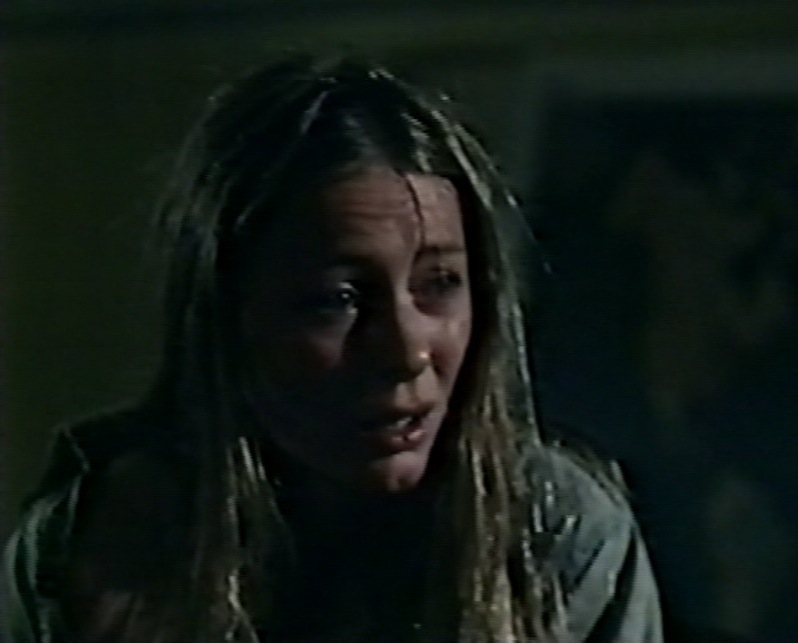
Yet for all that, ALICE still works: the performance from Jamie Smith-Jackson is spellbinding. She goes through so many changes so fast she barely seems like the same person from scene to scene (the closest comparison I can think of is De Niro's Travis Bickle) -- and there's no quick short happy ending, just one trial after another. It's because of these trials, though, that Alice endures, even grows as a person. Like the Airplane song goes, she is some kind of a mushroom, and so is the film surrounding her --both have adapted to find nourishment even in the mire of after-school message bullshit.

For if drugs were legal, Alice wouldn't be having these problems - that's the thing. If the deans just passed LSD out at graduation then the evil kids wouldn't have any more power to seduce, hypnotize, and destroy. Until adults stop demonizing what they don't understand, older kids with drug savvy will always have the most power; but if the parents have the drugs, and the kids want some, then forget it --they'll behave like angels.

As it is now, even if you have the most beautiful, spiritual experience in your life on acid, even if it brings you out of suicidal depression, you can't tell your parents because they'd just send you to rehab or call the cops. So the creeps who gave you the stuff become the only people you trust, the only ones who know the score, so when they say heroin and coke are even MORE beautiful, well the only thing holding you back are warnings from adults who warned you off LSD too. If you're taught to think all drugs are the same, and all bad, then all drugs become good once you have even a single good experience. And they're not. Some are downright evil.


I believe that if psychedelics and pot were legal a whole new shift in the drug war would take place and the scummy leeches like Alice's boyfriend would be down to just the nasty shit like crank and coke to make their living. Hell, I'd be anti-drugs then. But as long as you make spiritually transformative chemicals like DMT, psilocybin, and LSD as illegal and as demonized as the evil shit, it's like you're giving a bunch of grotty hairbag scrubs power over your kids, and then wondering why they're finding God for themselves in some rock venue parking lot, rather than being spoon fed God in some dozy Sunday sermon. Go ask Alice, I think she'll know... that you played yourself, America. You gave up logic and proportion, and instead trusted the shadiest drug dealer of all: the evening news, sponsored by Ortho.

NOTES:
1. The big urban legends on acid were 1) the kid who jumped out the 10th story window thinking he could fly, and 2) the babysitter who put the baby in the oven and the chicken in the crib.

Saturday, July 03, 2010

Acid's Greatest Shorts: WACKIKI WABBIT (1943)


That hair-raising hare, Bugs Bunny, is second only to Ms. Betty Boop in terms of psychedelic savvy, and of all the Bugs cartoons, few are quite as gone, daddy, gone as this psychedelic little 1943 masterpiece from Warner Brothers, WAIKIKI WABBIT.

I always had issues with this one just because, unlike Elmer Fudd who hunts only for pwesha, the two dolts hunting Bugs on this abstract tropical island are starving castaways. I empathize, that's my curse, even if they're drawings. I need a rationalization to cheer their humiliation at Bugs' paws, luckily there are several such rationalizations, as when Bugs hands them a fully cooked chicken disguised as himself and rather than attack it they get all cocky and set the table, even singing a round of "We're gonna have roast rabbit!" like bratty schoolchildren. And there's the issue of the carrots. Why can't they just eat carrots like our long-eared protagonist? They must grow on this Waikiki Island or else where did Bugs get his? In summation: the stakes are much higher here than with Elmer and his hunting license, and the savage Brechtian truth of "mankind is kept alive by bestial acts" has seldom been more poignantly illustrated.

The backgrounds are uncommonly surreal: psychedelic splashes of purple, red and yellow signifying foliage in the mind of a delirious, slowly dying castaway. Among the angry Kali-esque visions from the preliminary bardos: Bugs' po-faced tribal dance and a headless, cooked chicken rising from its plate to grab the starving fork away like an avenging angel of commercial produce to confront our castaways for their carnivore callousness.

Meat can be a gross proposition when you're tripping: you taste the ghost of your steak's dying mammal screams in every naked bite, while at the same time you're probably dehydrated and hungry and it's long past dinner, and probably even breakfast. So WAIKIKI WABBIT is there for you, guiding you gently towards vegetarian options even as it depicts life as a brutal prison of unending hunger and delirium, with the figure of Bugs as the last-laugh-having Kali avenger of the hunted and farm-raised animals of history. So either shed civilization's cocky coat of entitlement and learn to just bite down on anything you can grab without bothering to sing and set the table first, or even better grab a carrot and follow Bugs down the rabbit hole of veganism. And hurry, before the next burger you eat turns out to be your own juicy, glowing knee!

Thursday, July 30, 2009

Why don't we Go ASK ALICE?

The reverberating mythic chord struck by Lewis Carroll's "Alice in Wonderland" and "Through the Looking Glass" are the grand signifier for the "girl you'll be a woman / soon"-style myth of sexual awakening and of course, dropping acid. Alice was a catch-all signifier, not just a woman or a girl but any and all cute blond chicks on acid. The "anonymously" published memoir "Go Ask Alice" became a bestseller in 1972, it's "true" story of a runaway who hooks up with angry drug dealers spawned a hit TV movie that my fellow children of the 1970's may dimly remember seeing either in or after school. All I remember is seeing it in 3rd or 4th grade and falling madly in love with the straight blond hair, the denim, the glazed eyes belying an intelligence and unconcern that could topple nations in its disregard for American cornball value systems. It was probably not the intended message of the screening, but I was hooked for life.

The story of the anonymous and supposedly true book--an alleged diary of a runaway girl who gets mixed up with the wrong kind of hippie boys--drew parallels to Carroll's Alice and was itself based on the Jefferson Airplane song from 1967 of the same name, with its memorable catch phrase "Remember / what the doormouse said / feed your head." Has there ever been a healthier moment of zeitgeist than that collective recognition of a universal myth in action?

The motif of a "little girl lost" winding her way--more or less sans parental guidance or protection--through a maze of ambiguous and sinister (usually male) creatures while under the effects of disorienting drugs (or even just the introduction of sex and alcohol) is one that reverberates the foundations of the human psyche, from Red Riding Hood to Clarice Starling to Lindsay Lohan. Alice is the perfect symbol of everything at once kind and cruel in feminine innocence, in a man she stirs a mix of protective urges and wolfish desire, generating enough internal conflict that you may be uncomfortable. The worst is, you sacrifice yourself to protect her, and she forgets your name two minutes later. She has no respect for patriarchal values and hierarchy. She might only wrinkle her nose in bemusement at watching a city fall or a man lose his head ("How curious!") but then the next minute cry over a dead rabbit in the fridge. No adult male can hope to compete with a cute bunny wunny. To a guy like me none of it made sense, but she made being obliterated by a single smile into something way cool. As W.C. Fields once said, "I was in a love with a beautiful blonde once dear, she drove me to drink. That's the one thing I'm indebted to her for."

If the "mirror" to the (male) hero's journey into the underworld is the boy-to-man transition of the male psyche (and vice versa), the Alice iconography similarly is both a metaphor for the transition from child to adult and from accepted member of the social order to "outsider" and then back again, hopefully with some souvenir from the other world that will restore some much needed life to the stale society one left behind (i.e. we all seek the holy grail for our wounded fisher kings). But if no one wants to hear that "it's all about love, man! Stop the war, and just love each other" then one is left with a myth half-finished. Or they do like the message but end up commercializing the properties that exist through the looking glass. The Queen of Hearts is held for questioning, the Mad Hatter sent to Bellevue. The masses have been hypnotized by TV to not listen to wild-eyed blond girls when they rave about black holes and peace and universal love. Boys may trudge off to the woods and come back men with swords and gorgon heads in tow, but girls disappear into the void and sometimes--as in Peter Weir's Picnic at Hanging Rock (below)--are never seen again. Best to not encourage them.

The male heroes quest might involve bravado, swords and slaying of monsters, but the girl's journey requires more cunning and quietude. She must ensnare the male figures that wield swords to her will, not wield the sword herself. Thus she must beguile and entrap, the powers that she picks up along the way are often tied into accessorizing: jewelry, bags and shoes, such as the cursed Red Shoes, or the earrings in Valerie and her Week of Wonders (pictured at top). Her powers of allure are then displaced onto these fetish objects. Shoes in particular represent mobility, the phallus harnessed underfoot. She moves past you in a blur and suddenly you're empty. What did she take from your pockets in that split second? How come you are now so empty when all she did was smile wryly at you and continue on her way?

In the myths and folk tales collected by the Brothers Grimm and analyzed via a Jungian lens by writers such as Robert Bly, Maria Von Franz, and Joseph Campbell, the hero-boy on his long journey will often be met by princesses or maidens and given charms and curses: lockets, purity rings, tie-dyes, fruit, pills, magic armor, STDs, shrooms, money, keys, alcohol, friendship bracelets, sex, etc., that will protect and aid--or curse and bedevil--him on his quest. Seldom do these anima-based female characters proscribe a direct physical threat to our hero, the threat is in side-tracking their mission, an ensnarement from action into dolorous comfort. They reroute his phallic arc and castrate with their hot little dentatas. Odysseus wants to spend his Sunday practicing guitar and Circe coerces him into re-tiling the bathroom or taking her shopping. But the anima is always enigmatic, and in attempting to translate her strange edicts, the male hero will inevitably stumble. The woman's journey is much the same, except she doesn't have to ask "What do men want?" She knows. And as long as she can pretend not to want it as much as he does, or pretend to want it more than she does if she doesn't, she can drive him to any destination.

The girl hero actually faces a very different impediment from the shadowy male ego of her unconscious mind, the animus. This creature is violent, overtaking her in dreams like a sex-crazed wolf or a flying bat-like vampire. This incubus (ala PARANORMAL ACTIVITY, BEAUTY & THE BEAST and THE ENTITY) cannot be fought or conquered, it must be incorporated, harnessed, employed and/or drugged into a coma and ultimately, forgiven and incorporated into the self. If the girl learns to refrain from fear and react towards the beast with kindness and wary but benevolent affection, she will earn a prince. If she fails to incorporate this force, she can become a masochistic "perennial" victim, ala Deneuve in Repulsion (above), the type who sees predators around every corner and ends up alone, for life, except for her seven cats. And either way, if she's not careful, she'll grow up to be a woman who's certain she knows everything. Her animus will have learned to speak to her in her father's stern voice, and she will never let a real life man tell her any different.

Many girls are molested as children, which is horrifying, but of course there are also unresolved animus situations in many an unmolested girl's psyche, too. Girls who resist the terrifying advances of the shadowed animus--whether real or dreamt--can wind up in a state of perpetual siege --with or without any actual male yang besieging them. When the white rabbit crosses their trail, these girls adamantly refuse to follow it. To cover their fear and regret, they judge and decry: "Following White Rabbits down holes should be ILLEGAL!" The headlines rage: "I was made to eat mushrooms by giant caterpillars," raves hysterical looking glass survivor! But there's no shaming your own inner wolf-man, honey. He will not stop clawing through your skin disguises until you finally hug him, and love him even as he spiritually devours your little girl ego and leaves you blazing with crown chakra sunshine you never knew was always there, right below the black falcon enamel. You may wind up in the hospital from jumping off the roof thinking you can fly, or in jail for putting the baby in the microwave and the chicken in the crib while high acid but, in the end, it beats shopping for another pair of shoes you don't need. When the red queen's off her meds, do you really want to cling to logic and proportion? Go ask Alice if you want a woman's opinion. But do it quick. She'll be a woman soon, and then it won't be her opinion at all.
Related Posts Plugin for WordPress, Blogger...