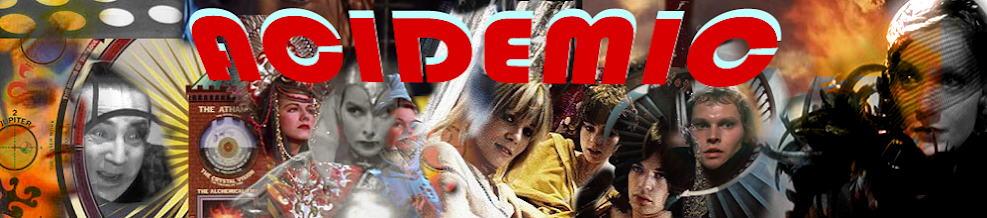
 The reverberating mythic chord struck by Lewis Carroll's "Alice in Wonderland" and "Through the Looking Glass" are the grand signifier for the "girl you'll be a woman / soon"-style myth of sexual awakening and of course, dropping acid. Alice was a catch-all signifier, not just a woman or a girl but any and all cute blond chicks on acid. The "anonymously" published memoir "Go Ask Alice" became a bestseller in 1972, it's "true" story of a runaway who hooks up with angry drug dealers spawned a hit TV movie that my fellow children of the 1970's may dimly remember seeing either in or after school. All I remember is seeing it in 3rd or 4th grade and falling madly in love with the straight blond hair, the denim, the glazed eyes belying an intelligence and unconcern that could topple nations in its disregard for American cornball value systems. It was probably not the intended message of the screening, but I was hooked for life.
  The story of the anonymous and supposedly true book--an alleged diary of a runaway girl who gets mixed up with the wrong kind of hippie boys--drew parallels to Carroll's Alice and was itself based on the Jefferson Airplane song from 1967 of the same name, with its memorable catch phrase "Remember / what the doormouse said / feed your head." Has there ever been a healthier moment of zeitgeist than that collective recognition of a universal myth in action?
The motif of a "little girl lost" winding her way--more or less sans parental guidance or protection--through a maze of ambiguous and sinister (usually male) creatures while under the effects of disorienting drugs (or even just the introduction of sex and alcohol) is one that reverberates the foundations of the human psyche, from Red Riding Hood to Clarice Starling to Lindsay Lohan. Alice is the perfect symbol of everything at once kind and cruel in feminine innocence, in a man she stirs a mix of protective urges and wolfish desire, generating enough internal conflict that you may be uncomfortable. The worst is, you sacrifice yourself to protect her, and she forgets your name two minutes later. She has no respect for patriarchal values and hierarchy. She might only wrinkle her nose in bemusement at watching a city fall or a man lose his head ("How curious!") but then the next minute cry over a dead rabbit in the fridge. No adult male can hope to compete with a cute bunny wunny. To a guy like me none of it made sense, but she made being obliterated by a single smile into something way cool. As W.C. Fields once said, "I was in a love with a beautiful blonde once dear, she drove me to drink. That's the one thing I'm indebted to her for."
If the "mirror" to the (male) hero's journey into the underworld is the boy-to-man transition of the male psyche (and vice versa), the Alice iconography similarly is both a metaphor for the transition from child to adult and from accepted member of the social order to "outsider" and then back again, hopefully with some souvenir from the other world that will restore some much needed life to the stale society one left behind (i.e. we all seek the holy grail for our wounded fisher kings). But if no one wants to hear that "it's all about love, man! Stop the war, and just love each other" then one is left with a myth half-finished. Or they do like the message but end up commercializing the properties that exist through the looking glass. The Queen of Hearts is held for questioning, the Mad Hatter sent to Bellevue. The masses have been hypnotized by TV to not listen to wild-eyed blond girls when they rave about black holes and peace and universal love. Boys may trudge off to the woods and come back men with swords and gorgon heads in tow, but girls disappear into the void and sometimes--as in Peter Weir's Picnic at Hanging Rock (below)--are never seen again. Best to not encourage them.
 The male heroes quest might involve bravado, swords and slaying of monsters, but the girl's journey requires more cunning and quietude. She must ensnare the male figures that wield swords to her will, not wield the sword herself. Thus she must beguile and entrap, the powers that she picks up along the way are often tied into accessorizing: jewelry, bags and shoes, such as the cursed Red Shoes, or the earrings in Valerie and her Week of Wonders (pictured at top). Her powers of allure are then displaced onto these fetish objects. Shoes in particular represent mobility, the phallus harnessed underfoot. She moves past you in a blur and suddenly you're empty. What did she take from your pockets in that split second? How come you are now so empty when all she did was smile wryly at you and continue on her way?
 In the myths and folk tales collected by the Brothers Grimm and analyzed via a Jungian lens by writers such as Robert Bly, Maria Von Franz, and Joseph Campbell, the hero-boy on his long journey will often be met by princesses or maidens and given charms and curses: lockets, purity rings, tie-dyes, fruit, pills, magic armor, STDs, shrooms, money, keys, alcohol, friendship bracelets, sex, etc., that will protect and aid--or curse and bedevil--him on his quest. Seldom do these anima-based female characters proscribe a direct physical threat to our hero, the threat is in side-tracking their mission, an ensnarement from action into dolorous comfort. They reroute his phallic arc and castrate with their hot little dentatas. Odysseus wants to spend his Sunday practicing guitar and Circe coerces him into re-tiling the bathroom or taking her shopping. But the anima is always enigmatic, and in attempting to translate her strange edicts, the male hero will inevitably stumble. The woman's journey is much the same, except she doesn't have to ask "What do men want?" She knows. And as long as she can pretend not to want it as much as he does, or pretend to want it more than she does if she doesn't, she can drive him to any destination.
The girl hero actually faces a very different impediment from the shadowy male ego of her unconscious mind, the animus. This creature is violent, overtaking her in dreams like a sex-crazed wolf or a flying bat-like vampire. This incubus (ala PARANORMAL ACTIVITY, BEAUTY & THE BEAST and THE ENTITY) cannot be fought or conquered, it must be incorporated, harnessed, employed and/or drugged into a coma and ultimately, forgiven and incorporated into the self. If the girl learns to refrain from fear and react towards the beast with kindness and wary but benevolent affection, she will earn a prince. If she fails to incorporate this force, she can become a masochistic "perennial" victim, ala Deneuve in Repulsion (above), the type who sees predators around every corner and ends up alone, for life, except for her seven cats. And either way, if she's not careful, she'll grow up to be a woman who's certain she knows everything. Her animus will have learned to speak to her in her father's stern voice, and she will never let a real life man tell her any different.
 Many girls are molested as children, which is horrifying, but of course there are also unresolved animus situations in many an unmolested girl's psyche, too. Girls who resist the terrifying advances of the shadowed animus--whether real or dreamt--can wind up in a state of perpetual siege --with or without any actual male yang besieging them. When the white rabbit crosses their trail, these girls adamantly refuse to follow it. To cover their fear and regret, they judge and decry: "Following White Rabbits down holes should be ILLEGAL!" The headlines rage: "I was made to eat mushrooms by giant caterpillars," raves hysterical looking glass survivor! But there's no shaming your own inner wolf-man, honey. He will not stop clawing through your skin disguises until you finally hug him, and love him even as he spiritually devours your little girl ego and leaves you blazing with crown chakra sunshine you never knew was always there, right below the black falcon enamel. You may wind up in the hospital from jumping off the roof thinking you can fly, or in jail for putting the baby in the microwave and the chicken in the crib while high acid but, in the end, it beats shopping for another pair of shoes you don't need. When the red queen's off her meds, do you really want to cling to logic and proportion? Go ask Alice if you want a woman's opinion. But do it quick. She'll be a woman soon, and then it won't be her opinion at all.


