Showing posts with label John Cusack. Show all posts

Tuesday, July 21, 2015

The Metatextual Exorcist's Assistant: MAPS TO THE STARS, CLOUDS OF SILS MARIA


Film as a medium isn't old enough that it has a set response as to how to handle the 'problem' of aging A-list actresses. But two 2014 films both recently released on DVD have shown the 'old' way can be made 'new' again through post-modern tweaks. The sexy young bitches of the 80s-90s have found work playing middle-aged actresses fighting to stay young and relevant, the way hot bitches of the 20s-40s did in the 50s-70s, by playing faded stars who go insane from being cooped up in their cobwebbed minds and mansions while the pictures (and cars) in the world outside get smaller, junkier, younger. Going 'Norma Desmond' allows for a kind of ageist exorcism which then makes the aging actress playing the unbalanced aging actress seem balanced by contrast. So Billy Wilder makes Gloria Swanson seem cool and Robert Aldrich makes Bette Davis seem fearless--they boldly go into the depths of their own potential madness as Hyde versions of their own personae. Skulking around their eerie mansions as theremins goose their every mirror-ward hiss, the well-aging actress playing the semi-well-aging actress playing the unwell (delusional) aged actress is cathartically freed from her own gerascophobia, exorcised with the help of a Chanel-scented strait-jacket (starring Jessica Lang as Joan Crawford). (1)

Maps and Clouds stars in an important drama about Alzheimer's
Now that we're all feminists again, the kind of lurid madness that made Baby Jane and Norma Desmond so indelible is too objectifying, too freakshow, for squeamish PC Hollywood. Age and narcissism mustn't be reduced to just another carny attraction-- not that Hollywood wouldn't make it so if we demanded, but you can't put the genie back in the bottle. So the producers must instead paint a sensitive portrait of Alzheimer's or some real-life tragic figure's descent to madness. They must be educational, touching, and earnest instead of high-camp shock-value horrific. We associate aging with importance now, middle-aged actresses with serious drama. In this way, filmdom solemnly leads them out to pasture rather than letting them shred the walls of a cinematic padded cell. With all projects not good enough for a dame of their stature, they wither from underuse.

Sensing an opportunity to fill the gap, however, scrappy maverick independent filmmakers circle the wagons around the A-list divas with a little money saved up (or will work for scale to get their attached to a truly edgy and 'now' product) who want to sink their teeth into something bonkers for a change, to work with talents unafraid to plunge into new dark depths behind the camera, irregardless of the PC putsch that so paralyzes mainstream Hollywood when it comes to bitches over 40. Canadians like David Cronenberg and Frenchmen like Olivier Assayas, keep the luridly self-reflexive spirit of Billy Wilder and Robert Aldrich alive, for they know a secret denied the average Hollywood hack: the 50s-70s 'horror hag' spirit need only be taken one meta-level further to resonate in our new century's junk TV-addicted consciousness afresh and leave the stigma of exploitation behind in the process: Julianne Moore and Juliette Binoche shall play Gloria Swansons playing Norma Desmonds now, instead of just playing Norma Desmonds trying to play Salome. Brian Oblivion would be so proud! 

THE CLOUDS OF SILS MARIA
Dir Olivia Assayas (2014)
***

Olivier Assayas uses the post-modern lesbian corporate thriller the way Jean Pierre-Melville used the French New Wave gangster film, as a gateway between high art and low genre for anyone with a Gauloises and Steadicam to glide through behind him. In his Boarding Gate, for example, scenes of Asia Argento walking through a vast bustling Hong Kong mall-flea market--each booth/stall a vast tapestry of electronics, contrasting languages and music all whirling together one after the other--are perhaps the most ear-boggling use of post-modern affect in all cinema, but then... what is there to when from why? We're left feeling cheated, confused, even irked.Assayas' biggest weakness has always been his endings, since demonlover, even. His best works, like Irma Vep, end in pure abstraction. His worst endings feel like betrayals - like he led us on, like seducing us into bed then running away going "I forgot I'm married" and runs away last minute.

Before something like that happens, Clouds of Sils Maria covers several layers of a power trio of strong female leads ranging along the All about Eve axis, each playing versions of themselves and their personal assistants in screens-within-screens. The catsuit Les Vampyres S/M gone corporate bitch-in-the-boardroominess of his dEmonlover and Boarding Gate coalesce against Summer Hours pastorale realness as two women play characters studying to be themselves and each other; the same weird mix of back-stabbing and compassion with which younger executive assistants are shepherded by older female employers into the abyss of self-awareness and ambition, breaking them down and being broken in turn in some twisted--even if initially altruistic--identity merge/melt-down. They have youth; you have power. But they can get power, what can you get, except older?

From the ongoing discussion between Maria (Juliette Binoche) and her assistant Val (Kristen Stewart) about Maria's character in the play that made her famous (she's now shifting from the ingenue to the older lesbian mentor, and she ain't happy about it). Maria's nihilistic interpretation of the character during rehearsals and discussions jibes with Val's hip youthful (American) interpretation of Maria's interpretation, which Val sees as solipsistic, as glorifying youth based on one's rose-tinted memories and attacking her own aging dignity. And Val isn't backing down even against Maria's contemptuous laughter which might have worked on her when she was Val's age, but Val is somehow more grown up than that.

It makes sense then that Kristen Stewart steals the show as Val, handling her personal assistant duties with startling cool, knowing just how to rile, soothe or otherwise push Maria's buttons while juggling deals and cars and hotel rooms and interviews and meetings with photographers, all without ever seeming to break her detached stride or smash her incessantly ringing cell phone. Chloë Grace Moretz plays the rising star playing the younger part in the play (the superhero masochist in the comic book film they see) who Val and Maria meet with later for drinks, along with the young dumb boyfriend, a writer whose wife tries to commit suicide and...hmmm.

If that's confusing, it's my fault. Let's just say it's Bette Davis' The Star meets Petra Von Kant rehearsing a lesbian corporate boardroom version of The Blue Angel in the isolation of Faro (where Bergman filmed Persona) so hey, that's a lot a layers of reference. What makes it work even if you don't know those films is the way the pair of actresses connect with such quiet force (we understand immediately why Stewart won the César) and the dialogue of the play they're working on resembles their characters' own relationship--and perhaps Stewart's real-life relationship with PA Alicia Cargile (left)--so much it's (intentionally) impossible to tell where one (the lines they're running) ends and the other (their actual relationship) begins, except that the line-running they do feels real while their sudden lurches into directly discussing their own relationship--Val complaining as Maria laughs at her impressions of the play's subtext--seems sudden, hamfisted. It's as if direct confrontation would be too much, too theatrical, so they just endure all they can like it doesn't bother them until they just bail. It begs an interesting question: how does one deal with having acted all kinds of break-up scenes with someone when you're suddenly actually breaking up with them, without it feeling cliche? Atsa lotta layers, Olivier! Maybe ats too much...

Maybe yes, for then comes that terrible Assayas anticlimactic 'resolution.' As the Binoche-Stewart personae (see what I did there?) merges into itself like a sssnake. along with the two characters they're rehearsing (via the actress and personal assistant they're playing), there's a sudden mystical shift that... well.. it doesn't work. Oh Olivier, you just had to keep adding layers until the whole thing deflated like an overdone soufflé... again. 


Maybe I'm wrong or nitpicking --it's just that jibing to Stewart and Binoche's chemistry through most of the film as I was, I felt genuinely saddened by the sudden flight into Peter Weir-ish fourth act mysticism. The big comparisons critics have been making of course are to the endings of Bergman's Persona and Antonioni's L'Aventura, but the former was abstract from the get go, there the weird ending made sense and in the latter they at least talked about the disappearance --it even obsessed them for awhile, until they forgot about it, and we didn't much miss the missing girl anyway, since it was Monica Vitti we were collectively falling in love with even at the start. Here in Sils that love equation is reversed, like L'Aventura if Vitti just left without a note toward the end and we spent the rest of the damn movie with the smarmy Sandro (Gabriele Farzetti). Some critics hypothesize Val kind of morphs into Chloë Grace Moretz, playing the tabloid-branded scarlet letter marriage-wrecker of years ago (see: Kristen Stewart in the Snow with Poison), but to me they're making excuses on Assayas' behalf. Mention art cinema 'modernity' vs. vérité realism if you want --it just plum doesn't work... for me at least. In interviews Assayas says he wanted to give the audience something to think about, but it feels to me like all he did was take something we were thinking about away. 

The scenery is staggering. I love this mountainous zone where German loftiness, Nordic depression, and French intellectual aesthetics sizzle together and align like a constellation. I was imagining what if Bergman were directing, that he might go full-on post-modern and we'd maybe get an interview with Alice Cargile in between takes of the film within the play about a pair of women in a play. That might have worked, but whatever - the Melville of post-affect cinema transcends such things as satisfying destinations. As with Irma Vep, Boarding Gate, Carlos and demonlover, the trip is where he works his magic. Once arrived, he's all out of rabbits.


MAPS TO THE STARS
(2014) Dir. David Cronenberg
***1/2

One can't imagine either Hollywood or the Sils Maria European bourgeois "artist" community making a film like Maps to the Stars. A lurid, slow-burn haunted-Hollywood saga of pyromaniac schizophrenics, hot young ghosts, egomaniacal stars, and abusive life coaches, it could only come from a Canadian indie auteur who doesn't need pretentious vanishings to craft a Brechtian dissertations on aging actresses being intimidated by the endless incoming waves of amber ingenues. As in Sils, the idea of female 'performance' leads to meta-split mirroring, passive-aggressive sabotage by the older insecure actress against her younger personal assistant, the Twilight connection (Stewart in Sils, Pattinson Maps), Stewart co-starring with Maps star Julianne Moore in Still Alice the same year (top), like an eerie reflection across continents, genres, and post-modern layers. 

Thing is, of the two films, only one is genuinely subversive and ballsy. Only one goes to places the jugular didn't even know it led to.


In both Sils and Maps there's the idea of being subsumed by another's ego, of being a young female assistant, trying to have her own life while working for a solipsistic middle-aged actress who's going insane from dealing with the dwindling roles / loss of youth, and so bullying their younger incarnation in an attempt to exorcise their own inferiority complex. In Sils the assistant takes revenge in the must cowardly way possible, by merely vanishing without even two-weeks notice; in Maps, well.. I can't spoil it, but it's far more satisfying. There's a sense of unyielding magnetism in Cronenberg's film that Assayas' was too high in the Alps to feel: the inexorable magnetized streak of insanity running deep in the fault line crust of Los Angeles, and the most expedient, direct way to drill down into it.

Sordid show biz underbelly chronicler (and Castaneda mystic) Bruce Wagner (Scenes from the Class Struggle in Beverly Hills) knows every inch of what his script is chronicling, and he can match the darkness, stab-for-stab. Agatha Weiss (Mia Wasikowska) arrives on Hollywood Boulevard by bus after being released from some juvenile mental hospital, and--like Melanie Daniels at Bodega Bay--her mere presence triggers the vengeful furies, here a series of ghosts: Her new employer, fading star Havana Segrand (Julianne Moore), is haunted by her crazy star mom Clarice, who set their house on fire when Havana was only a child; Agatha's estranged brother Benji (Evan Bird), a bratty child star, finds himself haunted by a girl who died before he could grant her Make-a-Wish Foundation request. Meanwhile, a new biopic is being made on Clarice's storied life and daughter Havana is  fighting to play her, even while claiming she was molested and abused. Ingeniously, the ghost of Clarice is played by luminous hottie Sara Gordon (above, in the bath),  and of course, it makes sense--why wouldn't a vain ghost want to appear younger than her own grown alive children? It's just the right kind of weird twist that shows a real subversive instinct that Maps has in abundance, the kind Assayas ultimately lacks even as it covers the same ground.

It's all in the genes.


With the kind of naive prepossession that does well in Hollywood, Agatha-- on meds and working the steps, tries make amends with her family, but that doesn't go over well with her bitter father (John Cusack) who still hates her for setting fire to their house as a child and feeding Benji a near-fatal overdose of pills. Since that ordeal, Cusack has risen to make a fortune as a platitude-spouting gestalt masseur (with clients including Havana whom he clearly hasn't told about Agatha or vice versa). He has demons of his own, clearly, exhibiting the typical violent denial self-help gurus often display towards their own hang-ups. 


Ultimately these two interlocked pyromaniac-and-narcissist-choked LA families crash into one another in a shocker climax so effective and satisfying it becomes the polar opposite to Assayas' Sils's (we saw them as a double feature this past Friday night - I'd recommend you do the same, in the order presented). We just don't expect such a shock because for awhile there Cronenberg made us forget we were watching a Cronenberg film and not some piece of Hollywood self-regard and near-whimsy about how all we need is a bus ticket and a dream. That's the Cronenberg touch at work, to be good enough at the one thing you forget it's the other. Stars has courage to go deep into the abyss from off a steep, high diving board, while Sils only splashes around a bit then crooks a finger towards Lars Von Trier's receding light. Even Maps' ghost appearances aren't trite or cliche. Although they're presumed to be just psychic projection, it's a movie first, so we understand that being actors anyway the haunted A-listers are conditioned to let their imagination get the better of them, to confuse their script with their life in ways only we were confused by in Sils Maria. In other words, even as actors playing characters who are actors, characters will mess themselves up in the name of a good performance, with the understanding that--above all--they're still in an "actual" film as well as a film about film, even when they know within the context of the (outer) film that the (inner) film is just their reality and not even a film-within-the-main film!

If that's confusing, consider the contrast: in Sils, Binoche is playing an aging Marlene Dietrich remaking The Blue Angel as a butch Emil Jannings, heading back to her classroom to sulk after her younger wife hooks up with the strongman. In Maps, the better option is finally presented: kill them both and burn the whole fucking cabaret to the ground! Clarice and Agatha, I tell they, by the power of Chuck D, Hollywood sur le feu!

NOTES:
1. PS - when I wrote this that AMC show FEUD hadn't even been announced! Was it ushered into existence because of this post? I like to think so (5-16-17). 

Thursday, February 20, 2014

Tripping to Tortura: IN A WORLD, ADULT WORLD (2013)


Two worth-your-time 2013 films with similar themes, color schemed posters and even titles, recently made themselves, like whores, available at home: IN A WORLD is a semi-autobiographical female voiceover artist trying to make it in a deep-voiced man's game tale, written and directed by and starring Children's Hospital hottie Lake Bell; ADULT WORLD stars Emma Roberts as Amy, a Syracuse University undergraduate poet who finally realizes she's not 'too good' for her job at an adult bookstore and is written and directed by men (a detail I will be addressing) and bearing a tacky tag line (make it out in above poster if you want, but I warned you). Both 'girl' characters start their films living with their parents, rent-free, and the films chronicle their respective launches into the real 'adult' world, reaching down for the big brass rings, stooping to conquer, and finding help along the way, mostly from sensitive boys and/or male mentors.

Why do I mention one film is made by a woman about a woman, and the other is about a girl made by men? I happen to be a pretentious Syracuse English major / poet who has done voiceover work ("Curve for Men... Curve for Women... New from Liza Claiborne" c. 1996) who applied at one of the city's many local XXX bookstores c. summer of 1987 ("the endless trains of the faithless" - spouts Robin Williams on the TV commercial playing behind me, advertising the Chevy Silverado, "Find new roads!") so I see deeplier (!) than most to these stories: so I can swear in court that Amy's adventures in that accursed "city with the concrete sky" may look right (the film was shot there) but just don't add up. She says she's an over-achiever with a straight-A average and is a virgin, yet she is also hot, and yet she wants to be a furious poet. She lets her car get stolen and then admits she has no theft insurance because she spent the money her dad gave her on SASEs, confident of her imminent fame as a poet. This in itself is very suspicious for a supposedly straight-A student, this being the age when most submissions are done via e-mail (and there's not enough poetry journals in the world to warrant such expense). Alas, a great many people are willing to believe real life girls living alone for the first time are idiots like this, ala Juno and Frances Ha! --neither I've been able to see more than five minutes of at a time. (1) The girls I know are cool, damn it, and too smart for this dumb shit, aside from Kirsten, or Jamie, or Veronica, or Liz.

But Amy is just the sort of girl a sexual anxiety-prone male closet-macho writer would create, i.e. a 'doesn't know how hot she is' naif who needs a smitten male bestie who's good at organizing to make exasperated sighs and treat her like a child. That's fine if you're not trying to show someone adapting to the real adult word, the reality of which is that there is no earthly or celestial way a girl as hot as Amy wouldn't get published, laid, and invited to endless readings, even if she shouts her stanzas like a sorority pledge on her third Molson.

Although it's never clear if Amy's in school or out of it, she latches randomly (by finding his book in someone's car) onto a disillusioned middle aged poetry teacher mentor in his -nth mid-life crisis named 'Rat' (John Cusack). This clown does his own sewing, wears a ski cap indoors (both sure signs of male 'capable' quirkiness), and uses the word 'cray' (for crazy). Luckily Cusack is a pro, and clearly had some input into his character; he takes a page from the Bill Murray playbook and modulates his usual aloof warmth to include a complete ambivalence towards towards nearly everything including his own sexual desires. The pleased smile that comes across his face after Amy trashes his apartment has few equals, you have to go back to the 1982 Betty Blue to find another guy as laid back.

He even sews / just like a woman
And yet he can't even be bothered to take her virginity, even as a favor to her. Jean-Hughes Anglade would never stoop to such petty morality! He'd sleep with Amy even knowing it would destroy her respect for him and lead to blackballing and hushed whispers in the dean's council. He would do it as a favor to her, because Amy needs disillusionment; she needs to realize sex needn't be earth-shaking to count as real world experience. These are good lessons that a truly good mentor wouldn't refuse. To paraphrase Wilde, the only thing to do with a cute student protege is make love to her if she's beautiful, and to someone else if she's plain.

The Hall of Languages, behind them, where 90% of all my classes were held

At least that element of ADULT is not overly cliche. But alas, there's a tall drag queen who lets Amy crash at her/his squat, and teaches Amy how to smoke weed and dance. Thank God s/he also doesn't get AIDS 2/3 of the way through and give Amy a parting monologue about reaching for the sky. Even worse: Amy gets a job at a homey mom and pop XXX-rated video store (an idea lifted from an old Mr. Show sketch) with a cute stockboy (Evan Peters), allowing for the bait-and-switch sordidness of the title and tag line but without adding up to anything truly subversive.  If this cute XXX store had at least one sleazy element the comedy might have had some bite. If there were rats in the squat, or she had to step over junkies to get up the stairs... something!

Adult World, yeah right.

True story: I applied for a clerk job at a XXX store when I was studying up in Syracuse and let me tell you, it was not a mom and pop operation. I remember filling out my application and talking to the fat suspicious owner, who loomed down at me from the tall counter, while what sounded like a woman reaching a lengthy orgasm or else being tortured with hot coals echoed from the back room. I knew I would go insane having to listen to that all day so I began to seem unreliable (not exactly a stretch). "Ever take a polly?" he asked. He meant polygraph test, to assess whether or not I had stolen from past jobs. I told him I would try anything once, but I think he could see I was turning pale after only ten minutes of listening to those shrill, echoing moans from the back. He probably had applicants stand there talking as long as possible to see if they could hack the toxic vibes and nonstop moaning from the peep booths for more than ten minutes (there's no such booths in this mom and pop place, don't worry, honey).

See, Adult World? That idea could have been a movie, call it "Ever take a Polly?" but every edge set up for cutting latent baby teeth in Adult World comes to us already sanded possibly through rewrites and second-hand sanitization: Cusack's mentor won't seduce her; the adult bookstore is really just a sweet homey place where everybody knows your name; the drag queen bestie (Armando Riesco) is just a droll nurturer ala that very first trans/gay/drag bestie John Lithgow in World According to Garp; the cute stock boy supports her and straightens her out as needed, patiently waiting to bust his move until at least an hour of running time and 'growth' has elapsed. The whole film is like a giant velvet crutch for a girl who is not limping.

I like a lot of things about Adult World, but it makes me miss another film, Art School Confidential, which is unofficially set at Pratt, where I reside now. Do you think Jim Broadbent or John Malkovich in that movie would have been so rude as to refuse m'lady's request for de-virginizing? The very idea of refusing such a hottie is hateful to Americans!


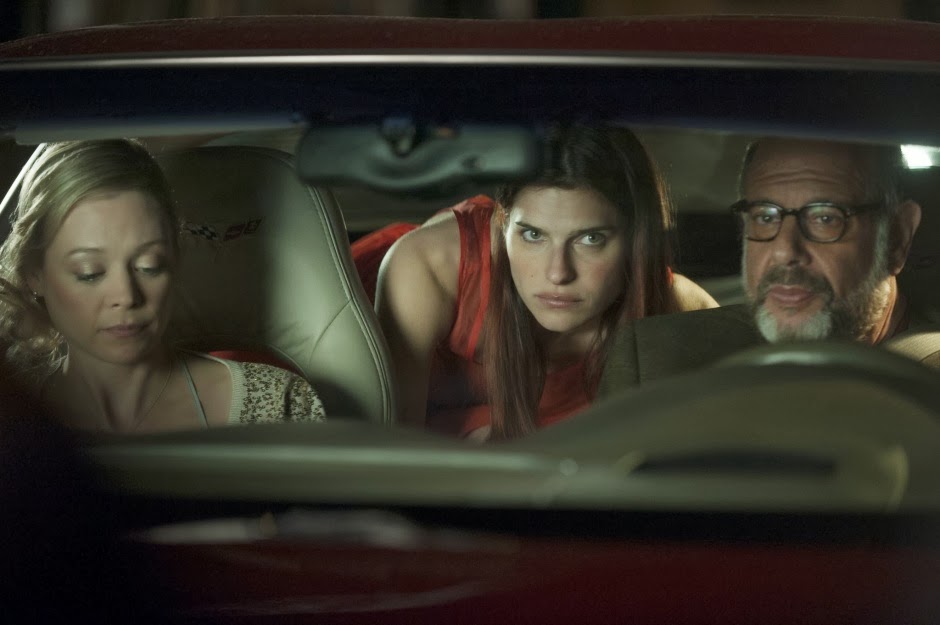
That's not a problem for Carol (Lake Bell ) in In a World. She goes right after fellow Children's Hospital star, Ken Marino, a successful voiceover artist who her father (Fred Melamed) has taken as a protege in some twisted effort to have a son (his only other child is played by the always amazing Michaela Watkins). Ms. Bell has always been my Children's Hospital favorite and here she ably carries the film in the tricky role of being both a success and a little disorganized, struggling to make it AND making it, getting by with a little help from her friends and dealing with a dad who desperately wants to keep her from being a success for reasons he is totally blind to. Dimitri Martin is nice guy sound engineer who helps her get breaks but is too shy to bust a move, though he in turn is helped by an actually cool lesbian wingman (now that's original), and when Carol does get a break it's from a woman producer (Geena Davis) who has her own problems with sexism. In short, it takes place in a genuinely adult world.

Many comedies are stuck on cliche auto pilot for women characters: either their ditzy or ball-busting career gals, vain actresses, or doting moms, and all idling around until some pasteurized thirtysomething hunk with soft eyes materializes in the midst of a shopping cart collision. But In a World moves forward three squares to capture the awkward phase past the 'ditzy klutz in search of a man' phase, to chronicle the 'what goes on between the lucky break and established success' period. Every time Carol wakes up in the film I found myself worried she had slept through some big gig or audition, because I've been so conditioned to believe that if a film shows a woman waking up alone on the day of a big career-making event, she will wake up late and have missed her chance. I won't spoil whether she does or not, but I think it's interesting that I assumed she would, due to movies.


Much as In a World seems remarkably astute in these areas, Adult World never feels quite real, quite set on a tone or era or even able to depict Syracuse as it really is: Amy's apartment is way too clean; there isn't adequate representation of how everything gets crusted over with salt, especially cars and shoes, or the way frozen slush rises up in a dirty brown wave in the wake of passing cars and stains your trousers, etc.  I did respect that her walls just had a Sylvia Plath poster above a mattress on the floor and she was half-trying to commit suicide (very Syracuse), and I like Emma Roberts overall and she's game to go the distance here, but she's still coming into her own as an actress of real gravitas; even when smashing Cusack's guitar she seems like she's just trying on acting class emotions. Of course, at that age, all poets are too young to realize they can't bum-rush greatness, so either she's an amazing actress or else just perfectly imperfect. Her dad is Eric Roberts! Julia Roberts is her aunt. See, that kind of thing would be cool to see in a movie.


It's that sense of playing herself that makes Bell score so much more points de la resonance. She takes risks and shows us things that might make her friends and employers mad if they think the characters are based on them. Of course In a World has problems too: Carol must be making money, so why she can't afford her own rent in a place as cheap as L.A.? She winds up getting a windfall of work, which is exciting, but a subplot with her sister cheating on her husband with a handsome Irishman doesn't really add up to much compared to the riveting central drama of the father screwing over his own daughter, who in turn is screwing the guy the father's screwing her over for. But half-baked side plots are not something to holler over, and the bitchy voiceover artist party at Ken Marino's house is worth the price of admission alone.

There it is again!
Moving back to the idea of men (and women) being uncomfortable with movies where women move ahead without men approving and helping them (a theme central perhaps to the strange hostility towards the movie Scarlet Diva -- see "Her Body, Her Ashtray"), another true story:

The year was 1987: I scored big at a Syracuse poetry reading, won acclaim and the plum spot opening for Allen Ginsberg when he came to town. Unfortunately my girlfriend got sick and sabotaged me. For my big debut the month before I had been drinking sangria with a lovely girl who had been letting me do all the talking - everyone before me at the reading was nervous and wobbly but I was a huge smash. I decided to always be drinking before readings from then on. In hindsight I realized it was the flirting that calmed me, not just the drinking.

But for Ginsberg, a month later, I had drunk way too much trying to get that magic back, and now I had a legit girlfriend, no more flirting so I was nervous, the auditorium was packed, and I drank too much (cheap liqueur) and couldn't get a buzz. My hand still shook holding the paper. I didn't stick around to go to the diner with Mr. Ginsberg after the show, as I had been invited to, citing my then-sick girlfriend as an excuse. I bravely ran away / away.

Flash forward: I didn't just leave it at not getting the XXX job. I also tried my hand at an erotic novel, figuring money might be found there (as Amy finds in Adult World). Mine chronicled a disturbing vision I had the year before at a Rochester Dead Show, tripping and having a major 'too many people' bad one, of a gigantic carnival of S&M torture, where people huffed laughing gas while chained naked on a spinning merry go round with an array of robot claw arms around the axis, whipping and smacking, hour after Bob Weir singing "Not Fade Away" hour.

A housemate had an old LP called Tortura inherited in a stack of interesting old LPs from his uncle. It was a very disturbing thing to listen to--mostly just the sound of whip cracks and impassioned screaming and moaning, but while tripping your face off it became oddly hilarious. On acid such ceaseless horror takes its toll, but only in a PTSD sort of way, and since we always had guests who wanted to hear it and we were always on acid our worldview devolved from peace and love to an endless torturing jail sentence. I began to feel that, outside our thin bubble construct of space/time, there was no stopping this deeply-felt soul torture, and that I had been tortured in the past and would be in the future, physically maimed and buried alive and hung upside down for days, and the album just ripped open soul scars I'd had far longer than my current incarnation.

That uncle also had a lot of Zappa, and his song "The Torture Never Stops" made its way onto more than one long drive / late night mix tapes and when it came on it inevitably seemed to be confirmation and extension of the grim existential cruelty begat by the LSD-enhanced Tortura. Zappa's low-sung lyrics about "flies all green and buzzlin' / in the dungeon of despair" seemed to reach me at around 5 AM, trying to fall asleep on some parking lot tent floor in a moldy sleeping bag, the cheap weed from some far off latecomer mocking my 'out of it'-ness. Everyone here was having a great time but I couldn't get past some block - so the trappings of decadence--LSD, weed, booze--that once liberated me from myself, seemed ot be a quicksand trap in which I could not swim out of but could not drown in either. And like the "torture" of Zappa, it never stopped. I could never get to sleep, the electric bars behind my eyelids blazing like whip cracks. Together with the album Tortura, the song also formed an apt summation of the painful truth behind the 20th century First World's curtain of blasé painless consumerist decency. My cult-starting tract, Shroomsadoplasticism, was never finished, and typed on a manual typewriter, so there's only one original - with the first and last ten pages long ago fell away... and now the pages are even out of order... so symbolic, man... hell, I'm not even sure I still have those soul scars. I still have the novel though, if you're interested. Wait, where you going, man?

A few years later I realized I'd never be a real poet anymore than a real erotic novelist, because I couldn't get into Hart Crane or Marianne Moore, and didn't really like much poetry or modern poets. Trying to understand Hart Crane was worse than tripping to Tortura. I did a bunch of open mic nights over the years but all that came of it was that the long-haired hippy freak M.C. of the event stole my hot girlfriend out in Seattle when I was much the worse of alcoholic wear. Then after a night at the Nuyorican Poetry Cafe (circa 1992), I realized I just could not endure the terrible onslaught of bad poets SHOUTING / in this same /STYLE / every other / WORD / of their / POEM. I'd really hoped Adult World's Amy was going to rant her poetry in that style. I'd be TALKING and THINKING in that STYLE for DAYS after a poetry slam. Didn't Emma Roberts even GO to a POE-etry reading to reSEARCH how to SLAM like a BAD poet? Clearly NOT.

Then in 1996 I lucked into voiceovers, mentored by a cool older lady from an ad agency that shall go nameless. Then I was told I needed to join AFTRA to do any more. I joined (cost, $1000) - then my mentor lady told me they weren't using AFTRA people, because of the writer's strike. I was on the road again... Screwed!

So in the early 90s, after I'd been graduated and loose in the uncaring world for a couple years, (working as a freelance direct mail copywriter), I read that our beloved poetry teacher Stephen Dobyns was suspended from Syracuse for using 'salty' language in the classroom. His suspension was picked up in the NY Times as the exhibit A of the new PC fascism taking over college campuses everywhere:
No one suggests that he offered to trade good grades for sex. He is not accused of sleeping with or propositioning students -- one says he tried to kiss her at a drunken party -- or of the focused protracted hectoring we might call "harassment." The allegations all concern language: specifically, what the committee calls "salty language" used outside the classroom at graduate-student parties. They involve attempts to be funny, and to provoke. There was one cruel sexual remark about a professor who wasn't present, and the suggestion that another might benefit from a "salty" term for a satisfactory sexual encounter.
Is this sexual harassment? Not in any clear sense, but those clear borders have been smudged by university policies that refer to "a hostile workplace," to "patterns of intimidation." "Hostile" and "intimidation" are subjectively defined, as they were by the student who testified (hilariously, I thought, though, again, no one seemed to notice) that he felt intimidated by my friend's use of a "salty" phrase. He felt he was being asked to condone a locker-room atmosphere that might offend the women present.
There was much talk of protecting women from blunt mentions of sex. And the young women who testified were in obvious need of protection. They gulped, trembled and wept, describing how my friend yelled at them in class or failed to encourage their work. Victorian damsels in distress, they used 19th-century language: they had been "shattered" by his rude, "brutish" behavior. After testifying, they seemed radiant, exalted, a state of being that, like so much else, recalled "The Crucible," which used the Salem witch trials as a metaphor for the Army-McCarthy hearings. --11/26/95 
My fellow students from his class, Abbe and Laurie wrote a letter to the Times citing an example of Dobyns' scathing honesty all three of us remember: there was a seething frat boy in class whose poetry was so seething with misogynistic sexual frustration that even though there was nothing sexual per se in it, just the phrase "huffing and puffing to her house on his Huffy Spitfire" brought waves of douche chill torture to our liberal arts cores.

"What do you think?" Dobyns asked us. "Should we try to help this poem or just take it out into the hall and shoot it?"

With that phrase, we loved him.

Out of politeness we refrained from applauding but most of us laughed. Dobyns didn't need guide rails from some PC Volturi to uncover a misogynist frat boy when he heard one and his fangs came out, albeit with his same measured quiet thoughtfulness. Times were different and poetry, at least in his class, still had a violent, dangerous edge. We went to learn poetry, to write it and read it, not to have our hands held on the road to incompetency's supportive slaughterhouse. Tall, cold, like a Howard Hawks and Max Von Sydow mixture but with no accent or drawl, Dobyns also taught us Chekov in a measured way that showed us one might be both masculine and sensitive, serious but with a self-effacing deadpan humor, quiet but with the kind of deadshot aim that means you don't need to waste words (or bullets), and an inflexible personal code that meant tolerance for everything but a deep hatred towards unconsciousness, misogyny and mediocrity. And with SU's thriving 'Greek' culture, date-rape, which didn't even have a name yet my freshmen year, was finally acknowledged as a fraternity ritual as ingrained as hazing. Were they persecuting teachers for language rather than returning to traumatic freshmen frat party experiences? When naming names might get you smeared and humiliated by the boys' rich lawyer father?


Adult World is clearly a product of Syracuse University's Dobyns-less lockstep thinking; it takes place not in my dangerous, alive, edgy Syrause from 85-89 but a PC dead zone of safety bars and bloodless ambivalence. Promising sordid or 'authentic' real world experiences -- squatter drag queens, XXX video stores, older poet mentors living alone and with darting eyes, teacher-student trysts -- it steers well clear of the disgust, disillusionment, the soul scars, the Tortura on acid afternoons, Amy really needs to grow into a decent writer but her ordeals are hardly horrible enough to qualify as soul-sharpening. Some PC chaperone must have shaved it all down from an R to a PG-13 like a furious Olympic curler. The drag queen doesn't even smoke pot in a joint -- it's bad for the lungs! --but uses a vaporizer - and has to let us know that it's medical. The XXX video store is just a friendly family of genial eccentrics, they all but sing "Lean on Me" in perfect harmony to encourage Amy to run after Evan Peters as he saunters off into the midnight rain to catch a flight. And a guy named Rat refuses to take advantage of a willing, hottie protege as if his name meant nothing whatsoever. This, the Adult World ain't! Dobyns! Dobyns... come back! 


In a World by contrast is blissfully matured past this kind of naïveté. Carol uses sex and the lack thereof with an adult's savvy of the world, knowing how it changes things for the good and bad every single time. Her scatterbrained aspects feel real rather than workshopped in some hack screenwriting 101 class. She still makes it to her big jobs on time, and knows how to not mess up good things by being 'flighty.' A real artist, she's fascinated with accents and determined to master them and to capture real dialogue and the naturalism of speech. Take the above photo for example: in it her sister's tearing her heart out like here is some big cry into your ice cream and talk about boys moment (hubby cheating caught on video) and Bell is quietly pressing play on her recorder to capture her sister's emotional tonality for future use in voiceover and dialect coach work. That's the real trick to becoming a success, not to keep your eye on the big prize but on each successive small one and to never put boys over art, to grant big emotions more power than your craft, to never miss an audition because you're expected by the male screenwriter to hole up in your apartment with a cat, an afghan, box of tissues, soap operas, wine, and chocolates. It's what I call the Keith Richards life preserver. A devotion to your craft--be it guitar, painting, writing--keeps your head above water even while the ship goes down all around you.

Cusack says as much in Adult World, but it's one thing to have an older man explain it to a young girl and another to see a girl just fucking doing it for herself with men telling her nothing of any value whatsoever. Cusack even tells Amy to make mistakes, to 'fail better' but Adult World in itself fails even the fine art of failing. There's something a little off about a joint written by a boy about a girl taking life lessons from another boy, and then not even following that advice, delivering a stale set of characters that only the strong acting of the players can freshen (unless you find the nurturing drag queen bestie of the frazzled heroine thing still subversive). 

If not, well, PC chaperones can clean up 42nd Street all they want, can ban smoking and can nanny state a poet's life into irrelevance, but in a real adult world the torture never stops. Suicide isn't just a joke, it's a real option many artists take. If Adult World Amy ever wants to really want to find out what that sort of true life experience is, what true poetry is, she'd best make some genuinely bad decisions, fast, like suffering through the voiceover of Prozac Nation, listening to Tortura on acid, or dying accidentally of autoerotic asphyxiation (as out guitarist did, two weeks before the Lockerbie bombing killed 30 of my classmates - what a year!). Finding a career writing erotica before you even lose your virginity doesn't really count as truth, he said, knowing of what he speaks, gesturing vaguely at the 'world' from the vantage point of his filth-encrusted podium of flies (all green and buzzlin'), rose thorn whip welts, funerals, and whores! (my voiceover demo reel here --interested parties contact erichk9@aol.com -- and weep). 


NOTES:
1. Strangely enough, those two films are very highly praised yet I can't stand them, but I love Jennifer's Body and Margot at the Wedding, which aren't.. hmmm
Related Posts Plugin for WordPress, Blogger...