
Showing posts with label sexism. Show all posts

Thursday, February 20, 2014

Tripping to Tortura: IN A WORLD, ADULT WORLD (2013)


Two worth-your-time 2013 films with similar themes, color schemed posters and even titles, recently made themselves, like whores, available at home: IN A WORLD is a semi-autobiographical female voiceover artist trying to make it in a deep-voiced man's game tale, written and directed by and starring Children's Hospital hottie Lake Bell; ADULT WORLD stars Emma Roberts as Amy, a Syracuse University undergraduate poet who finally realizes she's not 'too good' for her job at an adult bookstore and is written and directed by men (a detail I will be addressing) and bearing a tacky tag line (make it out in above poster if you want, but I warned you). Both 'girl' characters start their films living with their parents, rent-free, and the films chronicle their respective launches into the real 'adult' world, reaching down for the big brass rings, stooping to conquer, and finding help along the way, mostly from sensitive boys and/or male mentors.

Why do I mention one film is made by a woman about a woman, and the other is about a girl made by men? I happen to be a pretentious Syracuse English major / poet who has done voiceover work ("Curve for Men... Curve for Women... New from Liza Claiborne" c. 1996) who applied at one of the city's many local XXX bookstores c. summer of 1987 ("the endless trains of the faithless" - spouts Robin Williams on the TV commercial playing behind me, advertising the Chevy Silverado, "Find new roads!") so I see deeplier (!) than most to these stories: so I can swear in court that Amy's adventures in that accursed "city with the concrete sky" may look right (the film was shot there) but just don't add up. She says she's an over-achiever with a straight-A average and is a virgin, yet she is also hot, and yet she wants to be a furious poet. She lets her car get stolen and then admits she has no theft insurance because she spent the money her dad gave her on SASEs, confident of her imminent fame as a poet. This in itself is very suspicious for a supposedly straight-A student, this being the age when most submissions are done via e-mail (and there's not enough poetry journals in the world to warrant such expense). Alas, a great many people are willing to believe real life girls living alone for the first time are idiots like this, ala Juno and Frances Ha! --neither I've been able to see more than five minutes of at a time. (1) The girls I know are cool, damn it, and too smart for this dumb shit, aside from Kirsten, or Jamie, or Veronica, or Liz.

But Amy is just the sort of girl a sexual anxiety-prone male closet-macho writer would create, i.e. a 'doesn't know how hot she is' naif who needs a smitten male bestie who's good at organizing to make exasperated sighs and treat her like a child. That's fine if you're not trying to show someone adapting to the real adult word, the reality of which is that there is no earthly or celestial way a girl as hot as Amy wouldn't get published, laid, and invited to endless readings, even if she shouts her stanzas like a sorority pledge on her third Molson.

Although it's never clear if Amy's in school or out of it, she latches randomly (by finding his book in someone's car) onto a disillusioned middle aged poetry teacher mentor in his -nth mid-life crisis named 'Rat' (John Cusack). This clown does his own sewing, wears a ski cap indoors (both sure signs of male 'capable' quirkiness), and uses the word 'cray' (for crazy). Luckily Cusack is a pro, and clearly had some input into his character; he takes a page from the Bill Murray playbook and modulates his usual aloof warmth to include a complete ambivalence towards towards nearly everything including his own sexual desires. The pleased smile that comes across his face after Amy trashes his apartment has few equals, you have to go back to the 1982 Betty Blue to find another guy as laid back.

He even sews / just like a woman
And yet he can't even be bothered to take her virginity, even as a favor to her. Jean-Hughes Anglade would never stoop to such petty morality! He'd sleep with Amy even knowing it would destroy her respect for him and lead to blackballing and hushed whispers in the dean's council. He would do it as a favor to her, because Amy needs disillusionment; she needs to realize sex needn't be earth-shaking to count as real world experience. These are good lessons that a truly good mentor wouldn't refuse. To paraphrase Wilde, the only thing to do with a cute student protege is make love to her if she's beautiful, and to someone else if she's plain.

The Hall of Languages, behind them, where 90% of all my classes were held

At least that element of ADULT is not overly cliche. But alas, there's a tall drag queen who lets Amy crash at her/his squat, and teaches Amy how to smoke weed and dance. Thank God s/he also doesn't get AIDS 2/3 of the way through and give Amy a parting monologue about reaching for the sky. Even worse: Amy gets a job at a homey mom and pop XXX-rated video store (an idea lifted from an old Mr. Show sketch) with a cute stockboy (Evan Peters), allowing for the bait-and-switch sordidness of the title and tag line but without adding up to anything truly subversive.  If this cute XXX store had at least one sleazy element the comedy might have had some bite. If there were rats in the squat, or she had to step over junkies to get up the stairs... something!

Adult World, yeah right.

True story: I applied for a clerk job at a XXX store when I was studying up in Syracuse and let me tell you, it was not a mom and pop operation. I remember filling out my application and talking to the fat suspicious owner, who loomed down at me from the tall counter, while what sounded like a woman reaching a lengthy orgasm or else being tortured with hot coals echoed from the back room. I knew I would go insane having to listen to that all day so I began to seem unreliable (not exactly a stretch). "Ever take a polly?" he asked. He meant polygraph test, to assess whether or not I had stolen from past jobs. I told him I would try anything once, but I think he could see I was turning pale after only ten minutes of listening to those shrill, echoing moans from the back. He probably had applicants stand there talking as long as possible to see if they could hack the toxic vibes and nonstop moaning from the peep booths for more than ten minutes (there's no such booths in this mom and pop place, don't worry, honey).

See, Adult WorldThat idea could have been a movie, call it "Ever take a Polly?" but every edge set up for cutting latent baby teeth in Adult World comes to us already sanded possibly through rewrites and second-hand sanitization: Cusack's mentor won't seduce her; the adult bookstore is really just a sweet homey place where everybody knows your name; the drag queen bestie (Armando Riesco) is just a droll nurturer ala that very first trans/gay/drag bestie John Lithgow in World According to Garp; the cute stock boy supports her and straightens her out as needed, patiently waiting to bust his move until at least an hour of running time and 'growth' has elapsed. The whole film is like a giant velvet crutch for a girl who is not limping.

I like a lot of things about Adult World, but it makes me miss another film, Art School Confidential, which is unofficially set at Pratt, where I reside now. Do you think Jim Broadbent or John Malkovich in that movie would have been so rude as to refuse m'lady's request for de-virginizing? The very idea of refusing such a hottie is hateful to Americans!
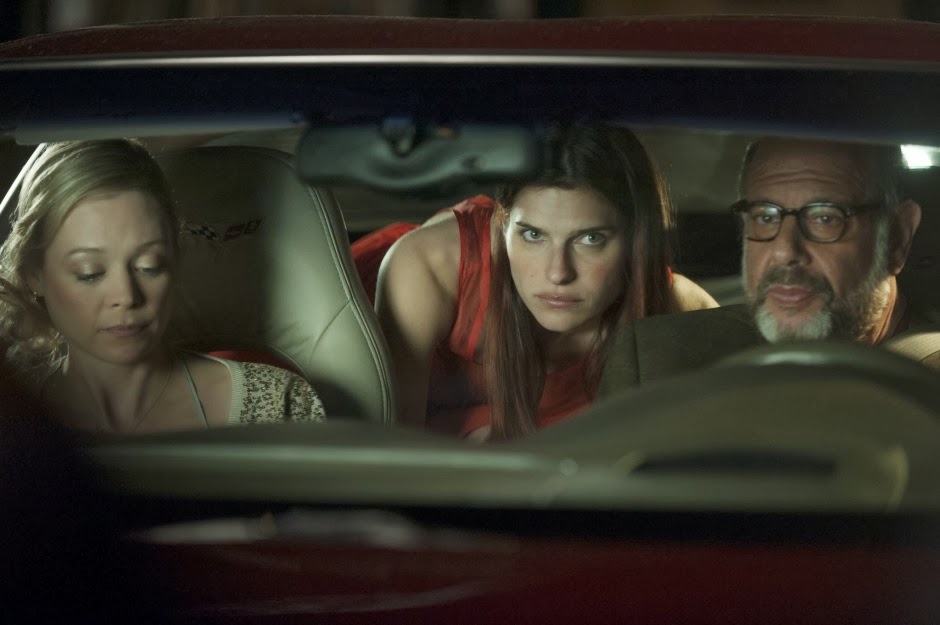

That's not a problem for Carol (Lake Bell ) in In a World. She goes right after fellow Children's Hospital star, Ken Marino, a successful voiceover artist who her father (Fred Melamed) has taken as a protege in some twisted effort to have a son (his only other child is played by the always amazing Michaela Watkins). Ms. Bell has always been my Children's Hospital favorite and here she ably carries the film in the tricky role of being both a success and a little disorganized, struggling to make it AND making it, getting by with a little help from her friends and dealing with a dad who desperately wants to keep her from being a success for reasons he is totally blind to. Dimitri Martin is nice guy sound engineer who helps her get breaks but is too shy to bust a move, though he in turn is helped by an actually cool lesbian wingman (now that's original), and when Carol does get a break it's from a woman producer (Geena Davis) who has her own problems with sexism. In short, it takes place in a genuinely adult world.

Many comedies are stuck on cliche auto pilot for women characters: either their ditzy or ball-busting career gals, vain actresses, or doting moms, and all idling around until some pasteurized thirtysomething hunk with soft eyes materializes in the midst of a shopping cart collision. But In a World moves forward three squares to capture the awkward phase past the 'ditzy klutz in search of a man' phase, to chronicle the 'what goes on between the lucky break and established success' period. Every time Carol wakes up in the film I found myself worried she had slept through some big gig or audition, because I've been so conditioned to believe that if a film shows a woman waking up alone on the day of a big career-making event, she will wake up late and have missed her chance. I won't spoil whether she does or not, but I think it's interesting that I assumed she would, due to movies.


Much as In a World seems remarkably astute in these areas, Adult World never feels quite real, quite set on a tone or era or even able to depict Syracuse as it really is: Amy's apartment is way too clean; there isn't adequate representation of how everything gets crusted over with salt, especially cars and shoes, or the way frozen slush rises up in a dirty brown wave in the wake of passing cars and stains your trousers, etc.  I did respect that her walls just had a Sylvia Plath poster above a mattress on the floor and she was half-trying to commit suicide (very Syracuse), and I like Emma Roberts overall and she's game to go the distance here, but she's still coming into her own as an actress of real gravitas; even when smashing Cusack's guitar she seems like she's just trying on acting class emotions. Of course, at that age, all poets are too young to realize they can't bum-rush greatness, so either she's an amazing actress or else just perfectly imperfect. Her dad is Eric Roberts! Julia Roberts is her aunt. See, that kind of thing would be cool to see in a movie.


It's that sense of playing herself that makes Bell score so much more points de la resonance. She takes risks and shows us things that might make her friends and employers mad if they think the characters are based on them. Of course In a World has problems too: Carol must be making money, so why she can't afford her own rent in a place as cheap as L.A.? She winds up getting a windfall of work, which is exciting, but a subplot with her sister cheating on her husband with a handsome Irishman doesn't really add up to much compared to the riveting central drama of the father screwing over his own daughter, who in turn is screwing the guy the father's screwing her over for. But half-baked side plots are not something to holler over, and the bitchy voiceover artist party at Ken Marino's house is worth the price of admission alone.

There it is again!
Moving back to the idea of men (and women) being uncomfortable with movies where women move ahead without men approving and helping them (a theme central perhaps to the strange hostility towards the movie Scarlet Diva -- see "Her Body, Her Ashtray"), another true story:

The year was 1987: I scored big at a Syracuse poetry reading, won acclaim and the plum spot opening for Allen Ginsberg when he came to town. Unfortunately my girlfriend got sick and sabotaged me. For my big debut the month before I had been drinking sangria with a lovely girl who had been letting me do all the talking - everyone before me at the reading was nervous and wobbly but I was a huge smash. I decided to always be drinking before readings from then on. In hindsight I realized it was the flirting that calmed me, not just the drinking.

But for Ginsberg, a month later, I had drunk way too much trying to get that magic back, and now I had a legit girlfriend, no more flirting so I was nervous, the auditorium was packed, and I drank too much (cheap liqueur) and couldn't get a buzz. My hand still shook holding the paper. I didn't stick around to go to the diner with Mr. Ginsberg after the show, as I had been invited to, citing my then-sick girlfriend as an excuse. I bravely ran away / away.

Flash forward: I didn't just leave it at not getting the XXX job. I also tried my hand at an erotic novel, figuring money might be found there (as Amy finds in Adult World). Mine chronicled a disturbing vision I had the year before at a Rochester Dead Show, tripping and having a major 'too many people' bad one, of a gigantic carnival of S&M torture, where people huffed laughing gas while chained naked on a spinning merry go round with an array of robot claw arms around the axis, whipping and smacking, hour after Bob Weir singing "Not Fade Away" hour.

A housemate had an old LP called Tortura inherited in a stack of interesting old LPs from his uncle. It was a very disturbing thing to listen to--mostly just the sound of whip cracks and impassioned screaming and moaning, but while tripping your face off it became oddly hilarious. On acid such ceaseless horror takes its toll, but only in a PTSD sort of way, and since we always had guests who wanted to hear it and we were always on acid our worldview devolved from peace and love to an endless torturing jail sentence. I began to feel that, outside our thin bubble construct of space/time, there was no stopping this deeply-felt soul torture, and that I had been tortured in the past and would be in the future, physically maimed and buried alive and hung upside down for days, and the album just ripped open soul scars I'd had far longer than my current incarnation.

That uncle also had a lot of Zappa, and his song "The Torture Never Stops" made its way onto more than one long drive / late night mix tapes and when it came on it inevitably seemed to be confirmation and extension of the grim existential cruelty begat by the LSD-enhanced Tortura. Zappa's low-sung lyrics about "flies all green and buzzlin' / in the dungeon of despair" seemed to reach me at around 5 AM, trying to fall asleep on some parking lot tent floor in a moldy sleeping bag, the cheap weed from some far off latecomer mocking my 'out of it'-ness. Everyone here was having a great time but I couldn't get past some block - so the trappings of decadence--LSD, weed, booze--that once liberated me from myself, seemed ot be a quicksand trap in which I could not swim out of but could not drown in either. And like the "torture" of Zappa, it never stopped. I could never get to sleep, the electric bars behind my eyelids blazing like whip cracks. Together with the album Tortura, the song also formed an apt summation of the painful truth behind the 20th century First World's curtain of blasé painless consumerist decency. My cult-starting tract, Shroomsadoplasticism, was never finished, and typed on a manual typewriter, so there's only one original - with the first and last ten pages long ago fell away... and now the pages are even out of order... so symbolic, man... hell, I'm not even sure I still have those soul scars. I still have the novel though, if you're interested. Wait, where you going, man?

A few years later I realized I'd never be a real poet anymore than a real erotic novelist, because I couldn't get into Hart Crane or Marianne Moore, and didn't really like much poetry or modern poets. Trying to understand Hart Crane was worse than tripping to Tortura. I did a bunch of open mic nights over the years but all that came of it was that the long-haired hippy freak M.C. of the event stole my hot girlfriend out in Seattle when I was much the worse of alcoholic wear. Then after a night at the Nuyorican Poetry Cafe (circa 1992), I realized I just could not endure the terrible onslaught of bad poets SHOUTING / in this same /STYLE / every other / WORD / of their / POEM. I'd really hoped Adult World's Amy was going to rant her poetry in that style. I'd be TALKING and THINKING in that STYLE for DAYS after a poetry slam. Didn't Emma Roberts even GO to a POE-etry reading to reSEARCH how to SLAM like a BAD poet? Clearly NOT.

Then in 1996 I lucked into voiceovers, mentored by a cool older lady from an ad agency that shall go nameless. Then I was told I needed to join AFTRA to do any more. I joined (cost, $1000) - then my mentor lady told me they weren't using AFTRA people, because of the writer's strike. I was on the road again... Screwed!

So in the early 90s, after I'd been graduated and loose in the uncaring world for a couple years, (working as a freelance direct mail copywriter), I read that our beloved poetry teacher Stephen Dobyns was suspended from Syracuse for using 'salty' language in the classroom. His suspension was picked up in the NY Times as the exhibit A of the new PC fascism taking over college campuses everywhere:
No one suggests that he offered to trade good grades for sex. He is not accused of sleeping with or propositioning students -- one says he tried to kiss her at a drunken party -- or of the focused protracted hectoring we might call "harassment." The allegations all concern language: specifically, what the committee calls "salty language" used outside the classroom at graduate-student parties. They involve attempts to be funny, and to provoke. There was one cruel sexual remark about a professor who wasn't present, and the suggestion that another might benefit from a "salty" term for a satisfactory sexual encounter.
Is this sexual harassment? Not in any clear sense, but those clear borders have been smudged by university policies that refer to "a hostile workplace," to "patterns of intimidation." "Hostile" and "intimidation" are subjectively defined, as they were by the student who testified (hilariously, I thought, though, again, no one seemed to notice) that he felt intimidated by my friend's use of a "salty" phrase. He felt he was being asked to condone a locker-room atmosphere that might offend the women present.
There was much talk of protecting women from blunt mentions of sex. And the young women who testified were in obvious need of protection. They gulped, trembled and wept, describing how my friend yelled at them in class or failed to encourage their work. Victorian damsels in distress, they used 19th-century language: they had been "shattered" by his rude, "brutish" behavior. After testifying, they seemed radiant, exalted, a state of being that, like so much else, recalled "The Crucible," which used the Salem witch trials as a metaphor for the Army-McCarthy hearings. --11/26/95 
My fellow students from his class, Abbe and Laurie wrote a letter to the Times citing an example of Dobyns' scathing honesty all three of us remember: there was a seething frat boy in class whose poetry was so seething with misogynistic sexual frustration that even though there was nothing sexual per se in it, just the phrase "huffing and puffing to her house on his Huffy Spitfire" brought waves of douche chill torture to our liberal arts cores.

"What do you think?" Dobyns asked us. "Should we try to help this poem or just take it out into the hall and shoot it?"

With that phrase, we loved him.

Out of politeness we refrained from applauding but most of us laughed. Dobyns didn't need guide rails from some PC Volturi to uncover a misogynist frat boy when he heard one and his fangs came out, albeit with his same measured quiet thoughtfulness. Times were different and poetry, at least in his class, still had a violent, dangerous edge. We went to learn poetry, to write it and read it, not to have our hands held on the road to incompetency's supportive slaughterhouse. Tall, cold, like a Howard Hawks and Max Von Sydow mixture but with no accent or drawl, Dobyns also taught us Chekov in a measured way that showed us one might be both masculine and sensitive, serious but with a self-effacing deadpan humor, quiet but with the kind of deadshot aim that means you don't need to waste words (or bullets), and an inflexible personal code that meant tolerance for everything but a deep hatred towards unconsciousness, misogyny and mediocrity. And with SU's thriving 'Greek' culture, date-rape, which didn't even have a name yet my freshmen year, was finally acknowledged as a fraternity ritual as ingrained as hazing. Were they persecuting teachers for language rather than returning to traumatic freshmen frat party experiences? When naming names might get you smeared and humiliated by the boys' rich lawyer father?


Adult World is clearly a product of Syracuse University's Dobyns-less lockstep thinking; it takes place not in my dangerous, alive, edgy Syrause from 85-89 but a PC dead zone of safety bars and bloodless ambivalence. Promising sordid or 'authentic' real world experiences -- squatter drag queens, XXX video stores, older poet mentors living alone and with darting eyes, teacher-student trysts -- it steers well clear of the disgust, disillusionment, the soul scars, the Tortura on acid afternoons, Amy really needs to grow into a decent writer but her ordeals are hardly horrible enough to qualify as soul-sharpening. Some PC chaperone must have shaved it all down from an R to a PG-13 like a furious Olympic curler. The drag queen doesn't even smoke pot in a joint -- it's bad for the lungs! --but uses a vaporizer - and has to let us know that it's medical. The XXX video store is just a friendly family of genial eccentrics, they all but sing "Lean on Me" in perfect harmony to encourage Amy to run after Evan Peters as he saunters off into the midnight rain to catch a flight. And a guy named Rat refuses to take advantage of a willing, hottie protege as if his name meant nothing whatsoever. This, the Adult World ain't! Dobyns! Dobyns... come back! 


In a World by contrast is blissfully matured past this kind of naïveté. Carol uses sex and the lack thereof with an adult's savvy of the world, knowing how it changes things for the good and bad every single time. Her scatterbrained aspects feel real rather than workshopped in some hack screenwriting 101 class. She still makes it to her big jobs on time, and knows how to not mess up good things by being 'flighty.' A real artist, she's fascinated with accents and determined to master them and to capture real dialogue and the naturalism of speech. Take the above photo for example: in it her sister's tearing her heart out like here is some big cry into your ice cream and talk about boys moment (hubby cheating caught on video) and Bell is quietly pressing play on her recorder to capture her sister's emotional tonality for future use in voiceover and dialect coach work. That's the real trick to becoming a success, not to keep your eye on the big prize but on each successive small one and to never put boys over art, to grant big emotions more power than your craft, to never miss an audition because you're expected by the male screenwriter to hole up in your apartment with a cat, an afghan, box of tissues, soap operas, wine, and chocolates. It's what I call the Keith Richards life preserver. A devotion to your craft--be it guitar, painting, writing--keeps your head above water even while the ship goes down all around you.

Cusack says as much in Adult World, but it's one thing to have an older man explain it to a young girl and another to see a girl just fucking doing it for herself with men telling her nothing of any value whatsoever. Cusack even tells Amy to make mistakes, to 'fail better' but Adult World in itself fails even the fine art of failing. There's something a little off about a joint written by a boy about a girl taking life lessons from another boy, and then not even following that advice, delivering a stale set of characters that only the strong acting of the players can freshen (unless you find the nurturing drag queen bestie of the frazzled heroine thing still subversive). 

If not, well, PC chaperones can clean up 42nd Street all they want, can ban smoking and can nanny state a poet's life into irrelevance, but in a real adult world the torture never stops. Suicide isn't just a joke, it's a real option many artists take. If Adult World Amy ever wants to really want to find out what that sort of true life experience is, what true poetry is, she'd best make some genuinely bad decisions, fast, like suffering through the voiceover of Prozac Nation, listening to Tortura on acid, or dying accidentally of autoerotic asphyxiation (as out guitarist did, two weeks before the Lockerbie bombing killed 30 of my classmates - what a year!). Finding a career writing erotica before you even lose your virginity doesn't really count as truth, he said, knowing of what he speaks, gesturing vaguely at the 'world' from the vantage point of his filth-encrusted podium of flies (all green and buzzlin'), rose thorn whip welts, funerals, and whores! (my voiceover demo reel here --interested parties contact erichk9@aol.com -- and weep). 


NOTES:
1. Strangely enough, those two films are very highly praised yet I can't stand them, but I love Jennifer's Body and Margot at the Wedding, which aren't.. hmmm

Saturday, June 08, 2013

Cuspidor of Greatness: DIPLOMANIACS (1933)

The red man was the big man
and then came the great big white man 
a white man? / that's the right man.
The whites got the reds and the reds got the blues, 
and the red white and blue was born. 

The above is a snatch of song sung by Wheeler and Woolsey, with dancing Native American maids all in rows, and while sardonic as fuckall it's rather callous, as if casting a bloody stain on America's conscience is the same as patriotism, and no one really seems to care, because now Native Americans have oil wells and gambling and educated spokespersons. But where exactly do Wheeler and Woolsey fit in? In DIPLOMANIACS (1933),  Woolsey can best be imagined by picturing a lipless George Burns aiming for Groucho Marx's arrogance and way with a cigar; Wheeler is like Nathan Lane pureed together with Frank McHugh, and slid under Charlie Chaplin hair oil. Always, always there's the sense that these guys are really stage show vaudevillians more than film stars.

Some great comics like W.C. Fields, Mae West (pre-code) and the Marx Brothers (at least pre-DAY AT THE RACES) have stood the test of time. They are eternal. Others, popular in the early dirty turn-of-sound 30s---Eddie Cantor, Jolson, Wheeler and Woolsey--have not been so lucky. They have faded into niches were only freaks like me do scrounge. But thanks to the Warner Bro. Archives, a horde of their surreal pre-codes are finally available on DVD, and man you can learn a lot about the era's social stigmas and stigmatisms and all the things the code would wipe away. I've already written about one such eye-opener, WONDER BAR (1934). Why? How do I know? I follow my bliss, and online reviews: my hunger for pre-code surrealism is, however, always accompanied by my liberal PC brainwash afterburn.

Open the closet door!
DIPLOMANIACS (1933) came out the same year as, and is very similar to, the Marx Brothers' DUCK SOUP, and was co-written by Joseph L. Mankiewicz, who wrote W.C. Fields' MILLION DOLLAR LEGS the year before, and that it can be compared to them is an honor, for Wheeler and Woolsey have not aged as well as Fields or the Marxes. Unless you like both the Marx Brothers and Laurel and Hardy you might find yourself put off by the freaky squareness of these boys, even if only in some uncanny way you can't explain. Me, I don't care for the grotesque infantile tantrums of Laurel and Hardy. Something about them creeps me out. And there's something similarly sticky about Wheeler and Woolsey, some uncanny quality that makes their resemblance to other comedians of the day most disturbing.

And man do they love to play dress up. Wheeler and Woolsey share the same sense of infantile queerness as Laurel and Hardy --is that why they creep me out? They lack the amok heterosexuality of the Marxes, or the singleminded pursuit of oblivion that elevates Fields. Woolsey does get drunk in one scene but he's really more interested in..... ugh.... soup. By the second time he asks for more soup in the first class dining room I'm feeling the polar opposite of watching Fields grab all the table service bottles on his way off the roof of INTERNATIONAL HOUSE (1933). Booze = funny. Soup= yuck! Why? Because food, like life, is gross. Drunkenness, divine. And as someone with near fifteen years sobriety, I should know!


That said, if DIPLOMANIACS landed on the college revival circuit the way the Marx Bros. and Fields films did back in the late 60s-80s, it too might have garnered a hipster cult. The pair do, after all, go for the weird with unhesitating brio, as in the still above where they're sent aloft by being tossed up in a Native American blanket (from here on in I'm switching to 'Indian' for reasons that will be made clear) en route to the Lausanne peace conference or when they battle a tribble-like crawling scalp. Fans of Broadway shows like THE PRODUCERS, or revivals like ANYTHING GOES (which I saw in London in 04) will probably feel themselves on very familiar ground here. Some of the numbers have a lived-in, well-rehearsed feel, especially the big shipboard number where Wheeler tries to shake a lovestruck vamp named Dolores (Marjorie White).  A definite scene stealer, she arrives in villain Louis Calhern's stateroom wrapped in plastic after the following bizarre and racist exchange between him and Hugh Herbert as Calhern's Fu Manchu sidekick, trying to pass Yiddish off as Chinese:


Calhern: I need a vamp
Herbert: What kind?
Calhern: ...a female vamp!
Herbert: What color?
(...)
Calhern: A white one.
Herbert: White ones get dirty much too quickly
Calhern: Well, for this job she'll have to get dirty.

It's funny thanks to Calhern's robust delivery of the phrase "have to get dirty." But of course they make a mistake in presuming the boys are straight rather than ensconced in an infantile, closeted misogyny, which renders any vamp's come-ones powerless to sway them. They have the closeted queer's malice towards straight sex, presuming brusque burlesques of hetero courtship will satisfy doubters as to their manliness. The boys sleep in the same bed, and Woosley is clearly the top, you can tell by his big erect cigar and Wheeler's BIRDCAGE-y nightgown (below). And then rather than getting their morning drink on like real men they're more concerned with mani-pedis. "If we can get away with wearing these pants we can get away with anything," notes Woolsey, and when someone overhears him whispering that something's a secret, he asks "What's a secret?" and he replies "A secret is something you tell everybody, confidentially," you know he means the celluloid closet! (1)


Working in the film's favor is the feeling that the filmmakers just saw the amazing LOVE ME TONIGHT (1932) and presume the audience has too. The song sung during the boys' first Parisian morning clearly apes the famous opening montage of Parisian noises that ends with Chevalier saying "Pariee / you are too loud / for me," and shutting his window. Here the lyrics include, "from the taxi honks/ it might be the Bronx but no / this is Paris." (also Wheeler sings a bar of "Isn't it Romantic" while rushing through a montage of lyrics). Another favorite moment occurs after the bulk of first class passengers leave the dining room, and the captain of the Geneva-bound ocean liner gravely addresses the remaining gentlemen at his table: "As we are men of the world, let us consume alcohol." I knew that if I was seeing this with my fellow Fieldsian Max while splitting a 1.75 of Ten High, we'd have looked at each other in stunned delight, but he's married now with a kid, I'm long sober, and these guys are lightweights. Where's my Sean Regan?

That all works maybe, though, in the context of the film, which I saw by myself at three AM high only on herbal tea and cigarettes, after finishing my big previous post on isolationist themes in the films of John Monk Saunders. For if nothing else this film, like MILLION DOLLAR LEGS is really about America's post-WWI contempt for Europe, and the buffoonery of defeated nations still bristling against the post-WWI border alterations and expecting us to give a shit.

What is being satirized in short, is the world political scene immediately prior to the Nazi's re-mobilization, a build-up contingent on that very same weary unwillingness of the allies to step in again. So these films provide an illuminating time capsule look at something that no longer exists, a sense of out-of-touch posturing in Europe that American comics saw as a great chance for satirization, and Hitler saw as a perfect chance to defy restrictions. When a bomb goes off at the Geneva conference in DIPLOMANIACS it just turns into an excuse for a crazy blackface musical number, one of the reasons maybe this doesn't get screened very often, and an insight into the idea of 'deathlessness' in comedy, ala Laurel and Hardy and the Three Stooges, wherein explosions and accidents that would kill or cripple or kill a normal man just leave one with blackface and maybe an exploded cigar. Wishful thinking like that kept us neutral!


The second vamp is named Fifi and her kisses make men literally smoke under their collars and fall to earth a burned-out mess. We're supposed to believe that one kiss from the lipless Woolsey's makes her smoke and fall to the ground, too. More believable is the concept that a mincing French attendant is considered too oafish when the boys get their hair and nails done in Paris, and overall there hangs some horror movie oddness to the caricatures, reminding us that an element of the grotesque was alaways assumed in pre-code comics. For an example just dig the monstrousness of below poster, the eyes of all of them bugged maniacally or shadowed with lewd conspiracy. DUCK SOUP also satirized war, but it bombed; by then, apparently, the ominous tom-tom of a second world war wasn't comical.

Then there are the other odd reminders of the pre-WWII sense of anything goes, As Dreamland Cafe (from where I lifted these images) points out:
"One of the unnerving aspects of the film for a modern viewer is that there are several swastikas in the Indian costumes. Apparently swastikas were actually common in Southwest Indian design work until WWII. The Nazis had come to power in Germany by 1933, but it doesn’t appear that the film-makers were associating swastikas with them, even if the threat to world peace was on everybody’s mind."
World peace was on everyone's mind, and it's important to note that swastikas weren't just Native American (and Buddhist) symbols, but universal good luck charms (in 1931 Joan Blondell sells swastika key chains in BLONDE CRAZY).

The strange thing about the celluloid closet is that by hiding in plain sight and 'passing' their racist, misogynist mincing off as American straight, gay Hollywood broadened the scope of what 'straight' was. Now such business--prancing, mincing, jumping into one another's arms, avoiding women like the plague but presuming they could get one to fall for them no problem if they cared to-- seems pretty queer - when we see that behavior in contemporary film and TV (ala Sal in MAD MEN) we spot it right off and it causes a shudder of realization about the parameters of 'masculinity'. These characters/actors might be unconscious even of their own closetedness; it happens, and probably happened an awful lot back then. But there's a side effect of the recent decades of positive social change: men still afraid of seeming gay can't do half the things they used to do, like mince and sleep in a negligee in the same bed as their best buddy. They also can't be racist, sexist, or crude without catching instant PC flak. Everything is, in short, reversed. Depending on what state you're in, of course.

It's not that I'm PC myself, just trained like a bird dog to sniff and point. Thus Wheeler and Woolsey linger on the lip of the cuspidor of greatness, alongside Al Jolson and Eddie Cantor, defeated in the end from draining down into the pot of cine-hipster rediscovery by their own propensity for blackface and closeted mincing.


Well, thanks probably to Mankiewicz, at least their politics are hilariously bleak, the script sharp, lyrics clever,  the men very old, the women warm, the champagne cold, but over all lingers the presumption that hetero masculinity will continue to encompass this kind of infantile feyness in the century to come instead of delineating certain attitudes and actions as either gay or straight, and either choice preferable to the double blind sneer of the unconscious closet. And so it has come to pass that what was once a good luck charm is now a symbol of racism so vile it's permanently stained the fabric of our conscience, and our PC evolution has rightly rendered blackface and 'red man' tomfoolery accessible only via Warner's DV-R archive by those brave few willing to shell out for the strange and dubious privilege. But there is justice in popularization: The Marx Brothers (2), Mae West, and Fields deservedly endure in the mass produced DVDs and if that's in part from avoiding racism, closeted queerness, fascism, and misogynist objectification through most of if not all their films, well, I'll drink to that any day... So Oooga Booga to you too, you upstart! And if there is such a thing as a tartuffle, then you are just that thing!

NOTES:
1. I should say at this point that I find an out gay person is a thing of joy and beauty, but a closeted 'lover' unaware of the vile misogyny underwriting his straight burlesque is most dispiriting (see also: MONTE CARLO)
2. Since posting I've been thinking about the moments of blackface in Marx Brothers films but they are brief and serve the story: in DAY AT THE RACES they cork up to hide from the cops, but it's after a big dance number that basically expands the "All God's chillun got guns" section of SOUP's "Going to War" number, where are all the black people come to the rescue of the brothers, and sing and dance wondrously and are at least legitimately black. Racist or not it gives work to a vast stock of blazingly talented and legitimately black singers and dancers and one senses throughout a kinship between the black cast and the Jewish Marxes --a well documented simpatico extending even to Al Jolson. And one need only watch the sassy black maids sashaying after Mae West as she struts around her apartment in I'M NO ANGEL, and hear her rich bluesy voice to know that in other circumstances West could be their maid, and not feel at all chagrined by the reversal. W.C. Fields splits a bottle of whiskey with an Indian, appears in blackface only to hide from a constable (in a scene edited from TV prints), and means Native Americans when he talks about carving through this wall of human flesh, carrying his canoe behind him. None of it seems 'unconsciously' racist --it is indirect, and more to paint Fields as a scalawag and mountebank full of nosegay, than as a tool for enhancing one's sense of Aryan superiority. Amen. 

ADDENDUM. Don't let this rant stop you from seeing DIPLOMANIACS! Woolsey might be a lipless freak but Manckiewicz wouldn't let you down. I'll even sell you mine! xo

Thursday, January 31, 2013

Andes Hard: NIGHT FLIGHT


"Fog... darkness.... surrounds us like a prison," intones John Barrymore  to a row of aviation board trustee silhouettes, "but no more!" Above him glows a giant topological map of South America, like a comforting artsy lighthouse beacon. He's sending brave pilots like Clark Gable and Robert Montgomery over and through and around the Andes! Up and down the South American coast from Rio down to Buenos Aires, even with zero visibility in the dead of night without enough lift to make it above the troposphere! He's prepared for the inevitable crashes but not for a minute lateness or a single mechanical slip-up. The mail must go out on time! Or a pilot must lie dead, a plane lost. This is history! This is happening! "In spite of ya, night flying is going on!"

The trustees wince in fear -- Buenos Aires is fogged-in and the Andes are dangerous even in clear daylight due to treacherous wind currents  -- but with JB at the helm, flights leave on schedule even in ceiling zero! And the planes aren't all fancy like the poster above, they're bi-planes, and Andes' air currents hit them "like an elevator!" (there's some exhilarating aerial footage of Mongtomery's little plane bobbing up and down in the wind currents over endless white caps). Gazing contemptuously one last time in their piddling humanitarian direction, Barrymore snarls at the row:  "If it wasn't for me you'd still have one plane, a ferry service across the river to Montevideo." Yo, I took a three hour (?) hovercraft ferry across that river! And its entirety is (a natural) light coffee brown! When the water sprays up it turns the whole sky a surreal setting sun pink... I felt like I was on Venus or something. Instead, just the opposite end of the world.

Long unseen due to a rights dispute with author Antoine de Saint Exupéry's estate, Night Flight (1933) turns out to be quite the dreamy-poetic and modern meditation, full of great cool midnight moments, particularly in the Robert Montgomery sections; he seems to really grasp that elusive mix of bravery and wistfulness the movie is going for. After nearly dying in the valley between two mountains, he lands at the BA airport with a kind of calm benevolence. More than almost any other actor in any other moment he underplays the cosmic relief of being safe on firm ground after so long hovering over the maw of death, while conveying to a level approaching poetry, or at least early Hemingway. Unfolding over one long night it has curious poetic-noir fairy tale qualities-- a film spent in the pajamas, if you will, occurring in a land where most everyone else is sound asleep, recalling They Shoot Horses Don't They? and nothing else. So there's Clark Gable--isolated in his pilot seat--a radio operator down below him passing up notes up on weather and direction--clears the fog and emerges into a clear night sky. A full moon above, he loosens up on the wheel, leans back in his seat, tunes in a radio station of tango orchestra music on his operator's headphones, and looks up at the moon and stars like they're a girl he's about to kiss for the first time. His smile is so wide and the moment is precious and so pure you understand the appeal of risking one's life in a rickety biplane just to deliver mail. But that's no guarantee he or any other pilot in this film is going to survive the night. Just our luck if anyone dies it won't be dopey William Gargan. All I can do when I hear him is remember how he goes on and on about how great "Babs" is (Mary Astor) while she's off shagging Clark Gable in Red Dust! And now he's got the divine Myrna Loy, and he leaves her for a week to ten days without so much as a radio. Meanwhile Helen Hayes is talking to Clark Gable over a late supper, but he's not there, is he? Her maudlin insanity is worrying to the maid and any viewer averse to overly theatrical acting. Her endless sobs invite the same sort of passive sleepiness as the drone of the planes. "Like an elevator!"

Better moments: Robert Young's slow, careful dismounting from his plane after he nearly crashes deep in a canyon. Bumming a cigarette from the prop man and slyly kissing of the ground, Young tells him "air current... dropped me into a canyon... just missed the rocks. It's as if the mountains were crouching ready to spring at ya.... not a thing moved... almost too quiet.... as if a secret..." and he catches himself, pulling back from conjuring a silent demon incarnation of the Andes. Again the moment is leisurely, dreamy, Young makes vivid the high strangeness of what it feels like almost dying in the middle of nowhere without a creature stirring for hundreds of miles and how the landscape itself starts to seem like some giant, sentient ambivalent god (maybe if you've ever driven alone through an empty stretch of Montana or Wyoming while almost out of gas in the dead of night know too wanting to kiss the ground). "It's too good to be alive... on such a night." Young says, and his gratitude-drenched sardonic laugh feels real and beautiful. He even goes to dinner with Lionel Barrymore, an old codger who can't stop scratching his eczema and fining pilots for being even ten minutes late in the darkness, fog, and wind. But Young says he's "not half-bad" and you feel some joy because hey, life is precious when death is so daily courted and maybe that's why it makes such a dreamy, fascinating, hypnotic film. Meanwhile the wives and girlfriends pine at home, fretting every unreported hour. And Dr. Irving Pichel waits in Rio for the medicine to come by plane - which a child needs or he won't live the night!


But oh, there are some worried wives, the coolest of whom is Myrna Loy (of course) married to most uncool man (Gargan) and the most uncool (Hayes) inhabiting big ether-misted greenhouses of monologues, bugging Barrymore to bring her man home in one piece, as if he can somehow stop the weather or the night. Even if he could, Barrymore refuses to let sentiment get in his way. He doesn't even know that package of medicine waiting in a foggy Buenos Aires for the Rio-bound plane, but he does know only a ruthless iron determination can create the impossible dream, and that night flights are already going on in Europe and North America and we have to keep up! Up! UP!


Aside from the beautiful muted poeticism there's a giddily unabashed look towards death that reminds me of The Little Prince, which makes sense since that book too was written by aviator-poet Antoine de Saint Exupéry; you can tell its written by someone genuinely in love with the moon, the night, flying, the Andes and living on the lip of death. I like death too films that occur in the middle of the night--that say fuck you to normal sleep schedules--really soothe my ruffled brow, and I love that for some stretches there's no talking in Night Flight at all, just the tick-tock of clocks and metronomes, the whoosh of turbulence, and weird ethereal vocalizing in amidst the lullaby soundtrack, it's like my white noise machine in film form. Even the wives pining at home are helped by the deep dark spaces; their shadowy boudoirs are like big warm airy wombs. And as they all hover between life and death, love and loss, goodbyes and going back to sleep, a really dreamy, opiate sense of floating coheres.

While it's packed with MGM stars, ala Grand Hotel or Dinner at Eight, any sense of Night Flight being an ensemble film is undone by how seldom two stars share more than one scene. The pilots are off on their own, up in the clouds, bathed in darkness, fog, and moonlight; their wives are home alone, eating dinner and crying into their champagne; over at the Buenos Aires air station, Barrymores try to hold it all together while gazing up at the big board, lecturing abstract silhouettes, and fining sleepy pilots, as if each actor only imagines the others exists but in reality they're all asleep and the empty night sky is the dream canvas. At home, the silence and dark tendrils of sleep seem to creep around whining Helen Hayes and gorgeous Myrna Loy like loving arms of night. In the air the moon is the like a big comforting mother cradling the plane like a baby, and the BA tango music picked up on the radio is perfect in its ghostly lullaby allure.

Some of the comments around IMDB encapsulate what is wrong with the film as far as conventional drama, and they are all quite right, but for me personally these same 'flaws' are why the film's so cool and beguiling. Michael Elliot writes:
I think the biggest problem is that the screenplay really isn't all that impressive and most of the drama never comes because the story never builds up any emotional connection to any of the people we meet. The Gable character is meant to be the backbone of the drama yet we never get to really meet him and we certainly never get to know him as all of his scenes are in the air and he's given very little dialogue.

But Michael, that's the point! These characters we meet in this period are all isolated, adrift in their little pocket of the world, sleeping in dark art deco rooms or crying in front of the nervous maid, waiting weeks for their husband to drift home for a few days where all he does is sleep and look wistfully out the window at that old devil moon. It's like the modern age is being born before our eyes and the sad faces of the old widows and brides as their men take off to sea in Moby Dick are here frozen at their fullest blossom in nightshade honey and spread across die dunkelbrot nacht

So thanks, TCM, for rescuing this film, and assisting in getting the licensing issues between Exupéry and MGM resolved, allowing it to emerge from its 75 years inside the dark cloud legal limbo like Amelia Earhart. We can almost feel the lack of eyes that have been laid on this, the way it feels is like a person comfortable with being a lonely artist, most awake and productive in the hours between midnight and dawn, when everyone else is asleep so they don't clog the airwaves with petty junk, and he can subliminally harness their dreamy calm. Many critics and fans who've wanted to see it for decades were perhaps expecting too much, I wasn't expecting anything except that it wouldn't measure up to the brilliance of another film about treacherous night flying over the Andes, Hawk's Only Angels Have Wings. And perhaps it's in the comparison, as the Fail Safe to Wings' Dr. Strangelove. In fact the two airlines could very well be connecting to each other along the South American flight plan! They might never meet, either, just a pilot once in awhile comes through Barranca, buys some drinks, waits til the storm clears, and takes off again.

And you can find much breadth of vision between the two if you compare the warm camaraderie of Hawk's film, which takes place almost entirely in the cozy bar/saloon/airfield owned by Sig Rumann, with the shadowy isolation of the command center of Night Flight, wherein the only 'fun; moment occurs when Young and Dorothy Burgess drunkenly sing "How Dry I Am" as they drive up to the runway in her convertible. It's a single moment of merriment like a daring final laugh in the face of mortality, vs., say, "The Peanut Vendor" in Angels, or the various macabre toasts, "Hurrah for the next who dies!" in The Lost Patrol (see my analysis of the WWI anti-war aviation films of the early 30s).  In this one, the song comes when the sun is just coming up, and Young puts his flight suit on over his tuxedo and gives his girl in the convertible a farewell kiss, and off he goes into the horizon, still drunk off his ass. Even in these early days of commercial cinema pilots went to work drunk! Why not? It's not like there are pedestrians or stop signs in the sky, and you're already taking your life in your hands just going up there. You need courage, by the quart if needed. And god knows you can't even be nice to Lionel Barrymore's inspector, lest brother John hear about it and break up the friendship with petty fines, so that it will be easier sending the boys into their death. What a dick.


But now that planes can fly fly fly up high enough to coast right over the Andes, thanks to pressurized cabins (and even heroes like Denzel get dragged over the coals for cockpit drunkenness) the opportunities for a man to sneer at mortality are far between. And the weird disconnect between all the stars' big scenes (like each actor was shot in a day or two on a soundstage where they didn't have to run into each other) is perfect for the subject matter. In careening through the inky blackness of the night sky instead of coasting through the inky dark dreams of sleep with their Argentine wives, these brave men of the air mail routes are, just like Exupéry's Little Prince, unbound up by the laws of gravity, sleep schedule convention, or the normal routines of human relationships. Refusing to choose life over death or home life over the air or vice versa, if they go down, they go like men, with only bobbing jellyfish parachutes for gravestones, free forever of their overbearing bourgeois wives.

Some more lines from Moby Dick maybe encapsulate the true kernel of poetic treasure within the seemingly disparate scenes of Night Flight:
"There is a wisdom that is woe; but there is a woe that is madness. And there is a Catskill eagle in some souls that can alike dive down into the blackest gorges, and soar out of them again and become invisible in the sunny spaces. And even if he for ever flies within the gorge, that gorge is in the mountains; so that even in his lowest swoop the mountain eagle is still higher than other birds upon the plain, even though they soar."
Like those birds on the plain, other MGM star-studded prestige pics like Dinner at Eight may soar critical esteem but they're in familiar ground, while Night Flight--even when it nosedives, is way up in its own gyre. Where conventional airplane dramas tend to just take a spin around the void, throw in some flares and then ride off back to safety, Night Flight plunges straight down into the black abyss, landing lights off, harpoons at the ready, all to get the postcards and insulin to Rio at the scheduled time. Call it crazy, call it suicide, but it's the kind of black art that stirs me up like Ahab's electric oratory. It's no surprise then that I'll defend the lonely black night beauty of this film, though it crushes me to the core like gravity's ticking metronome....

And, like flying itself, is often boring.

Wednesday, December 07, 2011

Bellamy the Deflowerer: THE WEDDING NIGHT (1935)


If you want to see the cruel extreme barbarism of the sudden implementation of the Catholic Legion of Decency's enforced production code (which overtook Hollywood in 1934), look no further than 1935's THE WEDDING NIGHT, starring Gary Cooper, Ralph Bellamy, and Anna Sten (the 'other' Garbo). It helps when considering the Christian backlash hooplah about the 'morning after' pill to see a film like this, and realize the extent of female subjugation in pre-industrial European culture, and the way it survives today in xtreme Catholicism, fundamentalist Islam and with some Mormons.


Ralph Bellamy with his wild hair, expertly applied peasant-stock eye-liner, and traditional Polish farmer garb actually gives Cooper a run for the money here in the god-like looks department. He's way too good looking to be so dumb, and what's this brood of crafty Polish tobacco farmers doing up in Connecticut in 1935, living next door to dissolute drunk writer Cooper's getaway lodge? Well, you can guess when Cooper's going to do when he dips those ink-lined lashes Sten's way.

See, Cooper's wife has stayed back in New York City, but Cooper moves up  to the lodge, you know, for inspiration for his next book? Anna Sten and her family's provincial Polish culture is just the ticket, he thinks. The film thus sees the code mandate of 1934 as a property dividing line, between the home-grown social 'dissolution' of the post-WW1 Depression era of women's equality and hurrah for the next who dies, and a very fundamentalist old world patriarchy proletariat still thriving and yet to be smashed in Europe by the Nazis. Without that common enemy, those old-school Poles get mighty narrow-mined. Their dissolute neighbor next door is demonized as brutally as the Nazis would later do the Jews; meanwhile the property-greedy father and his obsession with land grabs hints at the outmoded values soon to be be read as the very reason for the barbarism inflicted upon them. As The farmer says to his daughter when she refuses to harness herself to the Bellamy plow, "stop making me hit you!"

Cooper's never been too convincing as a writer, but here he at least is convincing as a self-hating intellectual for whom literary 'research' has been the rationale for seducing women, book after book, so now he can't even remember whether the book is in service of the affair or vice versa (like a male Catherine Trammel) Sten is a fine actress and Sig Rumann is properly terrifying in an unusual role (for him). The code-enforced shock ending is of course that Sten must die, because her father pledged her to Bellamy, and was paid the dowry, and she refused to run away from the ceremony before saying "I do," which is the only proper thing for a bride standing on the lip of the 20th century. She blew it. That she loves Cooper instead but still goes through with the Bellamy wedding spells her death under the draconian rubrics of the code. But if she'd just run out to the car and driven off and grabbed Cooper and fled to the city before saying she did, well you could roll the credits right then. But the post-34 censor had his eye on adulterers, even if they'd been forced into a marriage that was only minutes old.

And so... in the post-34 world of Hollywood, once-free women starting dropping like flies. At least they had time to take long Garbo-esque death scenes, but there's a thin line between good death scenes and the bitter aftertaste of deaths being forced by a code no one making the film has any faith in.  Religious censorship bleeds into the nature of the post-code era's stories -- where women marry even knowing it means their death, because marriage is the ultimate validation of woman, and then she may breed and create more Christians who can carry forth this fine, wretched, evil tradition of yoking the women to the Bellamies. Imagine the tale of Little Red Riding Hood if the Catholic Legion of Decency decided to update the story so that Red gets a chaperone through the woods, and the woodsman--her husband--regularly belittles her in a smirky way when she's caught talking to wolves. That wolf would be played by Cary Grant... the woodsman? That's right! It's no accident Bellamy is in THE WOLFMAN playing just such an impotent hunter.


To drive the point slamming home, the titular night of the film is a long wedding night for Sten and Bellamy at Rumann's house. Upstairs: Sten, joylessly, is being 'prepared' for deflowering by the glum matrons of the clan upstairs in her room. Downstairs Bellamy gets drunker and his cronies (and even Sten's father) encourage him to get up there and lay some pipe like they're the sloppy seconds-craving would-be-rapist brothers of the groom in Peckinpah's RIDE THE HIGH COUNTRY. The message is clear: the boys get to drink and goad each other on in lusty gang rape-tinged misogyny while the women, depressed and apathetic as if dressing a deer, prepare the next virgin for her code-sanctioned marital assault. Again, the message is that not only does marriage legitimize sex so you can have it right under your parents' roof, it frees you from the uncertainty of 'taking possession' of your spouse in copulation. In other words, she doesn't get to say no --only the dad does on her behalf. Even screaming for help they'll just laugh and roar below.

Fundamentalist Christian adages against a woman's right to choose her own mate seem barbaric to most free thinking people these days but after the WEDDING NIGHT you may understand its origins better. It's not really the fault of the Bellamy - he's not a bad guy. He's been led to expect he will get a wife handed to him via her father, and his confusion when it's otherwise is not his fault --empathy takes the ability to think outside one's own immediate social mores, which he is mentally unable to do. Though many conservatives are desperate to pass bills that would revert woman's rights back to the patriarchs, nowadays at least, they can't get very far. The best they can do is close an abortion clinic now and again as they lament the loss of their old property, the Fertile Womb, so squandered in the hands of its wasted young women owners.


So yeah, drooling sexual relatives are written into the rocks of Plymouth but when a sensitive poet soul like Sten's comes along, that kind of violent burlesque of socially controlled reproduction is shocking and un-American. It's one thing if the girl is plain and not very bright and maybe can't get a date on her own. But if she's a smart, poetic beauty, her assigned Bellamy will crush her like an orchid under the plow. When choosing between the Bellamy for life (in Albany, too!) vs. Gary Cooper for a just one weekend in Manhattan, is there any real choice? You got to grab Cooper.


The worst that can happen is he'll dump you and you'll wind up destitute and abandoned on the streets of the East Village, but that is nothing in comparison to being kept down on the farm under the yoke of Bellamy's unconscious, never-been-outside-of-the-box sense of entitlement. Just ask One-Eye: (see: Bob Hope Vs. The Canadian Svengalis).


Thus the Coopers and Grants are like missionaries of pre-code enlightenment, bringing hope to the dark areas of the New England tobacco belt. Now more than ever, we need to ridicule our Bellamies, ban the incoming burkas of our immigrants, and rescue Mormon girls before they're married to lecherous cult leaders, or mangled and castrated by hideous outmoded practices. I don't blame the Bellamies, or even the Rumanns --this is all they know. But the chain's gotta break somewhere. For too long our tall beautiful men and fast-thinking wabbits have held back, given the Bellamies and the Elmer Fudds the benefit of the doubt, presuming their old ways must have some merit. Our reward has been a trail of broken Stens. I say no more! Not one Sten, Bellamy! Not one Sten...

Thursday, May 05, 2011

pre-code capsules 5: WHITE WOMAN, RED DUST, GIRLS ABOUT TOWN, THE PURCHASE PRICE, MANDALAY

WHITE WOMAN
(1933) - ****

Fans of KONGO, ISLAND OF LOST SOULS and/or Charles Laughton: Alert! Here is a film you should see. Lurid and steamy and darkly funny, there's really not much in the way of miscegenation but Charles Laughton as a psychopathic but otherwise borderline lovable rogue who operates a rubber plantation far deep in the tropics more than makes up for it. Employing escaped convicts and wanted men so they don't dare ever leave him, he bribes the natives to kill anyone who does, if the crocs don't get them first.

A truly marvelous scene occurs early wherein Laughton seduces Lombard while he's out in Saigon or wherever getting supplies. Coming off all down to earth and humbled by the loss of his wife, he's  truly touching. She's being booted out of port almost as soon as she arrives thanks to snooty governors' wives, so needs a place to crash -- and Laughton doesn't mind a shady past, in fact he depends on it. Then, as soon as they're married and he has her deep in the bush, he becomes a bully in high MUTINY ON THE BOUNTY / BARRETTS OF WIMPOLE STREET style. However, I think he's better and more sympathetic here than in either of those films, especially in his bemused rivalry with fellow jungle rat Charles Bickford, who shows up out of the soggy swamps looking for a job (as "overseer") and making no bones about his intentions to steal her out from under his portly employer. But Charles would much rather have an honest-about-his-shady-intentions rogue as his rival than the mealy-mouthed 'moral' pretty boy who does steal Lombard's heart (Kent Taylor).

Laughton is always hilarious and you feel the hurt over his new wife's revulsion towards him and his futile jealousy over the young Kent underneath his bravado and smirking. You hate him for shooting the porter's monkey but you'll cheer his poker-faced Englishness during the big native attack finale. Can you believe Laughton made ISLAND OF THE LOST SOULS the same year? Talk about a roll!

RED DUST
1932 - ****

More remote rubber plantation action with Clark Gable in the Laughton role, so he does much better with the ladies, particularly Mary Astor (wed to a naive white fever victim) and traveling 'salesgirl' Jean Harlow (she takes her famous rain barrel bath). The plot is the usual W. Somerset Maugham-style steamy love triangle, in the jungle where white Christian decency melts in the tropical heat and monsoons. MGM keeps the lurid indecency on a tight chain but they keep it hungry too -that one rainstorm kiss between a soaking wet Astor and Gable is hotter than hell, and no one who sees this film, even once, has ever forgotten it.

I like what Rupert has to say about it on Classic Movies Digest:
As Barbara, Mary Astor is even more unwillingly libertine in her adulterous lust for Gable's Denny when one knows the background of the actress' torrid and infamous real life amours. The fireworks are in their scenes together as well. Early on when Astor slaps Gable hard for a verbal offense, he enjoys it, grinning that Gable grin from ear to ear. Then she can barely conceal her growing desire for him as she watches the strong, dark and commanding Denny hold her fair and weak husband, nursing him back to health from the fever. The comparison of the two is indeed notable to the tingly Astor. Then in the scene immediately following, Vantine happily and boldly watches Denny undress for bed, only to be told to go to her own, which she does in disappointment. These two ladies have it bad. 

GIRLS ABOUT TOWN
1931 - ***1/2

I saw this at the Film Forum about ten years ago during their first pre-code festival, with a packed, delighted audience, and it was a hoot and a holler and a half. Seeing it at home is still good, though it helps to have seen a lot of other pre-codes first so you understand the haphazard amorality brought on by the Great Depression, when so many women were broke and on the streets and hustling in a kind of gold-digger limbo between outright streetwalking and showgirl social climbing. Like Liz Taylor in BUTTERFIELD 8, the GIRLS also have a phone service to get their dates, and while one or two of them get happily reformed by the end the final shot is of our fearlessly amoral survivor calling that number for yet another victim. Kay Francis and Lillian Tashman are the girls. Joel McRae is the reformer, Eugene Pallette is the A-list sucker, Lucille Gleason his hard-luck wife. George Cukor directed with his champagne touch already in evidence. Similar in a lot of ways to BED OF ROSES and dozens of other features of the early sound era, the story is predictable but pre-code to the core. Sure Francis reformed at the end but Tashman gets to keep her diamonds and booze, thus pleasing everyone long time. 

THE PURCHASE PRICE
1932 - ***

Barbara Stanwyck has probably never looked sexier than trying to seduce dumbass sodbuster George Brent in this weird pre-code crowd-pleaser. Tired of life as a New York City singing slickster, Babs runs away from her clingy gangster lover Lyle Talbot by switching places with a Montreal hotel maid who was supposed to marry Brent via long distance matchmaking newspaper ads.

It's not quite fair the way Brent gradually changes from sullen hick to merely a college grad who's designed his own new kind of wheat germ but needs a bunch of money to pay the mortgage. Paramount's resident pre-code sleazebag David Landau (he was the villain in the Marx Brothers' HORSEFEATHERS - "Here's to dear old Darwin!" the same year) wants ti step in, buy the mortgage and get Babs as his, um, 'cook,' in the process (things aren't going great in the Babs-Brent marriage - she fends off his one lamely busted move and he sulks ever after).


The story's strictly from hicksville and Brent's too much a mealy-mouthed pretty boy to convince as either a hick or a horticulturist, but Wellman gives us, as is his wont lots of great pre-code nitty city and farm town grit, including: one pretty good barroom fight; a vividly etched and very drunken shivaree; burning cornfields, terrible wallpaper; and lots of leering through open doorways. No grit in the world is so nitty it can best Stanwyck in a negligee and thigh high stockings, though. Seldom before has adult sexuality seemed so tangible, vulnerable or rock-hard tough, via a young, rail thin and undressed woman who's still wearing all the pants in sight.

MANDALAY
1934 - ***1/2

If you're suspected of killing the guy who ran out on you, and get exonerated, and then the guy shows up alive, are you allowed to kill him? That is the question asked of many a pre-code heroine but few have handled it as coolly as Kay Francis in MANDALAY.  Ricardo Cortez is the charming gunrunner fiancee who leaves her behind in a Burma nightclub to pay his debt to shady club promoter Warner Oland. At first she refuses to stay, but then gets a hang of the game, changes her name to 'Spot White' and is soon so deep in the bedrooms and pockets of the rich and famous that the wives move to ship her farther up river (the way they do Lombard in WHITE WOMAN). But on the riverboat to Mandalay who should show back up? Old Ricardo... and right when she's trying to make it with one of the ubiquitous archetypes of these jungle expeditions, the drug-addicted (or here, drunk) but good-hearted doctor (Lyle Talbot) heading up river to work on yellow fever victims, which--as we learned from W. Somerset Maugham's PAINTED VEIL--is a great way to pay off your malodorous malpractice or adulterous guilt.


The code came in around halfway through 1934, so the whole RAIN / PAINTED VEIL-ripped subgenre of commonwealth sin would soon be extinct in place of frilly frocks, domestic breakfasts, nannies, priests, and angelic children, but here in MANDALAY things are still allowed to be rife with all the lurid trimmings: drugs, booze, depravity, prostitution, gun-running, miscegenation, and murder. Michael Curtiz directed so you know there's nary a dull moment, even when nothing happens, and Kay's seldom looked lovelier. Dig that slinky Orry-Kelly gown above! Oh you kid! Awooga!
Related Posts Plugin for WordPress, Blogger...