
Well here's the last stop on my currently habit-imprisoned train, this is where I aims to be, claims to be.... this is the place that we aim for, we artists of pen and brush and neurochemical excess. Don't mistake our sexual aloofness for inhibition but rather a cumulative loathing based on excessive debauched memories, ghosts and horrific hangovers. Our souls are glutted with the ecstasies and agonies of the flesh, so now we'd rather just contemplate the wreckage for awhile. The aesthete's disregard for solace and emotional baring allows him to scuttle gender's narrowing limitations and so, instead, the aesthete's raison d'etre, the last standing ideal he can find in his shit-kicked can of carded houses, is the collapse of the ground between each pigeon hole; boredom and small-mindedness are his only enemies, and he knows to beat them he must join them, love them, forgive them, as he can seldom totally escape them. His goal is to be so far out that even the maniac charging him with a knife is not a foe; even death's wicket absinthe demon vestments are nothing to fear.

 |
| John LaZar - Beyond the Valley of the Dolls |
 Sometimes the trappings of an aesthete are just for show. It's easy to cover one's tracks in all sorts of shady business by cultivating an air of mystery and eccentricity, but such a creature is easily found out for he has not faced the true aesthete test of either perfect aloneness or perfect acceptance. He must face the demon staring back up at him from the toilet at which he is kneeling in rueful dry heave hell, and survive. He must drink his demon under the table, then drink the table under his higher power, or else rear back in moderation like a golden stallion. The aesthete has a morbid acuteness of the senses and the vile laughter of ruffians on the street in passing is like gunshots to his ear. So he must either shut himself away behind his romantic wall with only mad sister Madeline for company, or accept, love and forgive the ruffians one and all, like Scrooge does, and has to do every year, because slowly over the course of the fiscal countdowns he doth forget his Xmas spirits. The Swimmer didn't ever figure that out, and he ended up locked out of his own empty castle in the rain, like a poor ass Kafka. In short the aesthete must either open his heart so completely that it turns inside out or endure the pain of it slowly crumbling into a brown dwarf star.
1. VINCENT PRICE
"Sometimes I feel like I'm playing the subconscious of the entire human race" Price once said, "and I love it." Is there a more perfect choice for Roderick Usher, for Poe in general, than Price? As Little Italy and De Niro were to Scorsese, so Poe and Price to Roger Corman. But Price is velvet voiced, with a rare balance of open-hearted gentleness with mephistopholean grandeur that we lovers of cinema gobble up like sin itself. We're not really scared of his characters, but we're sometimes horrified by the depths of madness they sink to, which Price embodies with a glint of mania that shows us the fun, the joy in madness that all monsters should feel, at least twice, and in doing so he helps us transmute our own despair at death's inevitability and life's incessant slog, the constant closing of the door on paradise as one recedes into the cold marble wasteland, into something like a hot cocoa and slippers by the fire.

2. Rupert Everett - My Best Friend's Wedding (1996)
That's what makes Everett's character so transcendent. He is delighted with the normal folks he meets, even the bride and groom's clueless family, and not in a cynical snide way. His heart is joyous enough he doesn't need to even express it, except to feign heterosexuality as needed while still exhibiting his peerless flair (including leading the extended wedding family in a rendition of "Say a Little Prayer for You"). And he flies back to the wedding just to rescue her, with no intention of sleeping with her... ever. Unheard of in most films today... alas.
"George's maturity, considerateness, tact are intimately connected to the gayness that sets him apart from the social norms, permitting him a wide distance from the practices and conventions in which those around him are entangled. He is able to talk to Jules in a way that would be impossible for a heterosexual man, offering her always an intimacy that is all the closer for being nonsexual.... (his) public speech to her... constitutes a veritable proposal, the commitment to a relationship that will be permanent but nonexclusive, , built upon a much sounder formation than sexual love or romantic attraction. -- Robin Wood (Hollywood from Vietnam to Reagan - appendix p. 306)

3. Robert Downey Jr. - Sherlock Holmes / Game of Shadows
The master of 'macho fey,' Downey's Holmes is full of warm, insouciant charm while still being a true badass and just a little bit of a shit. Highbrow types dismiss any blockbuster as without merit and vice versa, but just ignore them and dig the steampunk detail, the interesting 'pre-figured' fight scene inner monologues, the colorful but imminently deadpan nonchalance, the fast-flowing Wildean witticism, even the acrid tang of Gunga Din-ish misogyny. Guy Ritchie gets it right and Downey Jr. finds a character that he can bring the full brunt of genius eccentricity to. His Holmes is how I wish someone would play Algy in The Importance of Being Earnest. Ah, a man might dream...

4. Judy Davis as George Sand - Impromptu (1991)
The 80s was a bad time for aesthetes, but like all things must they ended. Then, 90s: Nirvana, metrosexualism, and this great gender-bent love story: I fell in love with Hugh Grant's gentle brilliance as Chopin courted by Davis' wild, dressed-like-a-man rogue Sand. The chemistry is like top shelf champagne. A robust story of artists, love, gender and the wives of disinterested nobleman who support the arts mainly to forge illicit love affairs with wild bohemians while their mutton-chopped men are off shooting grouse, it made huge impression on me when I first caught this on cable when I was a drunken poet back from Seattle, heartbroken and unemployed and ready to find validation for my cockeyed theories about how truly cool artists are beyond gender duality. I had a total man crush on Judy Davis, as apparently did a lot of people as she was in a vast array of cool artsy films in the early 90s, but she was never quite as sublimely macho fey and endearing as here - the film that opened her doors to Naked Lunch, The Sheltering Sky, Husbands and Wives, Barton Fink and --alas--The New Age.
5. George Sanders
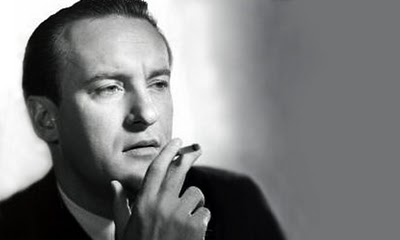
"Dear World, I am leaving because I am bored. I feel I have lived long enough. I am leaving you with your worries in this sweet cesspool. Good luck."Thanks George, for swimming (for however long you deigned to) in our cesspool. With that warm dark cultured tone in your voice, at once comforting and threatening, you made us secure as well as nervous; you made the room seem fraught with possible greatness, your characters were the type to become exhilarated, roused from their wit and gin-soaked ennui at the thought of a fight or a scandal. As a kid I was bored and uncomfortable by Rebecca until your Jack Favell shows up. You're just a conspiratorial voice at first, chummy with the chilly Ms. Danvers; the next minute bounding through a window to greet the stressed new Mrs. De Winter. We learn you were not just Rebecca's cousin but her lover, and while none of her supposedly scandalous deeds could be mentioned since it was the age of the nervous censor, plenty was implied through the code's symbolic registry and every timbre in your delicate yet manly voice. Did you catch her in a lesbian tryst with Danni and blackmail your way into an incestuous threesome? Were you the one who debauched Rebecca initially? Against her will, at first, at some ancestral summer place when the adults were all out on sail? We never know, but that's what makes an aesthete an aesthete: he shows you just the tip of his depravity, and that may be more or less all there is of it. We just don't ever know.
Under the mantle of the code, homosexuality was the sign of a depraved mind so gayness went part and parcel with a litany of evils. A gay person by definition was abnormal; she or he had orgies, killed hired girls during laudanum blackouts, and smoked pot with jazzbos up in Harlem --in for a penny in for a pound.
So while on the one side Rebecca offers the rare perverse sickness of Olivier, a gay man in a lavender but presumed loving and tolerant marriage with Vivien Leigh, displaying great moral outraged sickness on learning the truth about Rebecca's bilious private life; on the other hand there's Favell's rougish waggery, like a breath of fresh air, like Hopsy running back to the comparable honesty of Jean Harrington at the end of Lady Eve.

6. Clifton Webb as Waldo Lydecker - Laura 1954
(Contains SPOILER) As a guy who loved good drinking movies but had yet to write one word about film outside a college class, I felt iffy watching Laura for the first time, the sickly jasmine air of the theme song and the girly name implied a certain 50s fashion show dullness, but meeting Waldo Lydecker early on, in the bath but typing away and narrating, was like being rescued from what you fear is going to be a very dull party by a one man cadre of Algonquin wits. That Waldo turns out to be the killer is just the icing on the cake since he's the first one you like and the only one you identify with. The others are little more than ciphers until Laura finally shows up out of the rain, and the flashbacks, into her own murder mystery, and the drinks come out in full. Greatest of all is the way his homosexuality or status as 'out of the running' for her hand in marriage or sex isn't really mentioned or deemed important, and he even out-aesthetes Vincent Price, here having a wild time as an upscale freeloading gigolo suspect. That's what gets him: Laura going for a two-fisted heterosexual neanderthal like Dana Andrews isn't threatening - it's a whole different thing; but Waldo can't brook another aesthete sniping in his stall - the effete intellectual in her life must be Waldo or no one!
"In true aesthete form Waldo loves a beautiful, intelligent young creature but in a way that's beyond the grotesque fumbling of the earthbound mortals in unconscious thrall to their boiling reproductive gene pools. His, my dear Dana Andrews, is a life of the mind! Of the spirit! Of art and beauty and truth and poetry, but when we aesthetes see our muses stoop to breed or date an inferior subject, or worse throw us over for another effete aesthete, well we lose our continental minds worse than if we were just an ordinary jealous suitor! It's happened to me personally not once, not twice, but thrice! Ladies, you know your names! Call me! ."

7. John Dall as Brandon and James Stewart as Rupert - Rope.
"Hitchcock’s Rope was scripted by gay playwright Arthur Laurents from a 1929 play by Patrick Hamilton. In his memoir Original Story By (2000) Laurents discusses how the screenplay was to go. “The three main characters in Rope are homosexual. Brandon and Phillip are lovers who carry the Nietzschean philosophy learned from their former prep school teacher, Rupert, to its outer limit: a murder committed to prove superiority. Rupert is a good friend and probably an ex-lover of Brandon’s; his is the most interesting role.” In fact, Rupert seems based on Wilde, and it’s clear he has played (if inadvertently) Des Esseintes and Lord Henry Wotton to these two impressionable youths. Made three years after Lewin’s film, Rope is essentially Hitchcock’s Dorian Gray. The screenplay calls Rupert “distinguished in appearance, manner and thought”, and stresses his dandyish aspect: “He is completely self-possessed and elegantly detached. His manners are beautiful, his speech is eloquent and his tongue can be sharp.” Of course, as a Wildean figure, he also has a sinister aspect: “[Y]ou cannot really be sure whether he means the extreme ideas he propounds or whether he is joking. Just as you cannot be sure whether Rupert is essentially good or essentially evil.”
Laurents probably had in mind Wilde at the height of his fame and immediately prior to his downfall. In 1894 Wilde wrote for an Oxford undergraduate magazine an egregious piece which he called “Phrases and Philosophies for the Use of the Young”. Here are two of its maxims: “Wickedness is a myth invented by good people to account for the curious attractiveness of others”; “Nothing that actually occurs is of the smallest importance” - Ken Mogg (Senses of Cinema)

8. Dean Stockwell as Ben - Blue Velvet (1996)
There's a spectrum of aestheteness and at the gutter end lurks Ben, a nightmare fever dream monster of an aesthete, the sort who could believably entomb his sister in the family crypt just because the demon fairy in his absinthe bottle whispered he should. I don't think David Lynch intends him or his buddy Frank and their other cronies to be 'real' in a concrete Lumberton sense... They are prototypes for the non-corporeal dancing dwarf-style beings to come. Ben is how nervous 50s children would imagine a gay hipster beatnik and Lynch and Stockwell let that idea of an "entered" "sandman" "crooning" "In Dreams" run free of quotes! You need to see this movie again, and again, wiederholungswang style, until there's that 'pop' and you get the whole Oedipal jazz fairy tale in a heated flash, and suddenly you're free.

9. George Sanders' brother - Tom Conway as Dr. Judd in
Cat People (1942), The Seventh Victim (1943)
In Tom Conway, Val Lewton found his quiet spokesperson, his ego ideal, suave, literate, educated, a little too polished to ever convey his full measure of world-weary sadness. As such he appeared in three films, two as Dr. Judd. In Cat People, Judd proves his aesthetehood by deciding to seduce Irina himself, understanding that a well-meaning putz like Bill with his endless patience is not what she needs to come out of her dark anxiety. She needs dark stranger who's in love with death enough that he won't be too bummed out if she really does turn into a panther and kill him. Until then, he dismisses her fears as a kind of ancestral unconscious conservatism, but he acts on the mythic level in seducing her, because a) Bill's already left Irina by that point so he's not necessarily cuckolding and b) maybe it's unethical but it's okay as it's unethical done altruistically - i.e. his is an unselfish selfishness. A 'good' doctor would never be able to cure Irina, because he couldn't step into the dark sexual surrogate role with the shadowy elan of an ideal Shavian / Jungian. Inversing the usual dynamic of the good moral person who harbors dark sexual secrets, beneath Judd's caddish whims and dark sophistication lurks a beautiful altruism.
He was back for The Seventh Victim, which--since he was already dead at the end of his last film--reveals New York City is purgatory, a bardo of deserted late night subways, overcrowded missing persons' offices, strange make-up companies, and Satanic cults coaxing each other deeper into the abyss. Dr. Judd may be still a bit of a cad, but his apparent womanizing secretiveness once again harbors a real heart, and his rendition of the Lord's prayer at the climax is enough to make even a jaundiced old pagan like me throw in an extra five dollars when the plate's passed at his next AA meeting.

10. John Astin- Gomez Addams - The Addams Family
If you want to understand the divide in America you have only to watch an episode of The Addams Family vs. an episode of the Munsters, one abided the tedious status quo of 50s-middle class family dynamics, warping Universal classic horror signifiers to a banal framework approved by the moral right; the other depicted rich decadent surrealist eccentrics that mocked the moral light, showing how the oddball freaks could be far more tolerant and good than the 'normal' people who lashed out at anything outside the norm. And at the head of it all stood the vaguely entrepreneurial aesthete Gomez Addams.
Gomez's love of wife Morticia is the prana for the whole show. She loves him too but she's too legit crazy to provide the show with its Wildean compass the way Gomez does. If you were a normal shlub longing to be considered different while never stepping anywhere near the edges of society's freshly-mowed block, The Muensters was your show; if you were a total freak who couldn't sandpaper down your edges anymore than a leopard could change its spots, who didn't care about being accepted either by the normals or the crazies, but liked them both anyway, who felt that the intolerant moral conservative neighborhood voting committees out to get you were really just kooky lovable monsters like yourself, turning the other cheek all the time and setting it on fire with love and matches, then you found a home in that kooky mansion, with Gomez making sure you always felt welcome, regardless of what bit of occult statuary was growling at you.

11. Jean-Paul Belmondo - Breathless (1959)
He plays at being a thug, but if you pay close attention to his words, Belmondo's character in this premiere Godard feature is a hopeless aesthete, one who has severed all ties with the law-abiding world, shooting a cop and going on the run as matter of course, but unlike the murder committed by the two encoded Compulsion-style thrill killers in Rope (who hoped to prove their "beyond good and evil" superiority), Belmondo just drives outside the frame of the film and into your lap like a William Castle skeleton, pointing out the beautiful architecture of the theater before chasing after the gorgeous (and androgynous) petit-bourgeois NY Tribune-hawker, Jean Seberg down the aisle like some obnoxious yet eloquent Harpo Marx. My favorite line is near the beginning when he's driving along in his stolen car through the country and he says to the camera, "If you do not like the country, and you do not like the city, and you do not like the sea... then get stuffed" ---that was the old Fox Lorber subtitle, which I like better than the Criterion "then go fuck yourself," but either will do. Belmondo acts the vagrant moocher, the ruffian, but his fatherly need to point out the joyous beauty around him reveals he's really an aesthete, with Paris his playground boudoir.

12. John Waters
He voiced the first openly gay character on the Simpsons, and when he dropped by just to do novelty dances with Homer and fawn over Marge's corncob drapes it just seemed natural and delightful, and even those of us without the stomach for Pink Flamingos knew there was no escaping our love for Uncle John Waters. I forget where I read that his favorite films were Boom! and Faster Pussycat Kill Kill, but I know it was in high school, and it took me 10 more years to have any chance of seeing them (early 80s) and so he set me up with a life mission.
While certainly shocking and subversive, Waters' films always have a vitality and openness that leaves you elated rather than dispirited. The charm of this openly gay aesthete finds its delirious yet always coherent flowering with Hairspray, which blasted free the Peyton Place-level repression of Baltimore with the bomb of sock hop music, in the process inviting fat chicks, drag queens, beatniks, black folks and creepy senators into the prime time light - just dance and all is forgiven, honey, and that goes both ways. He's the all-inclusive candidate who finally dissolves the pinched face intolerance of the moral snipe red state thin white hypocrite establishment to a wicked witch black puddle, but then, like John Lennon at the end of Yellow Submarine, invites the sad blue meanie to the party. When we are all-inclusive we cannot fail. God bless us all! xoxox


