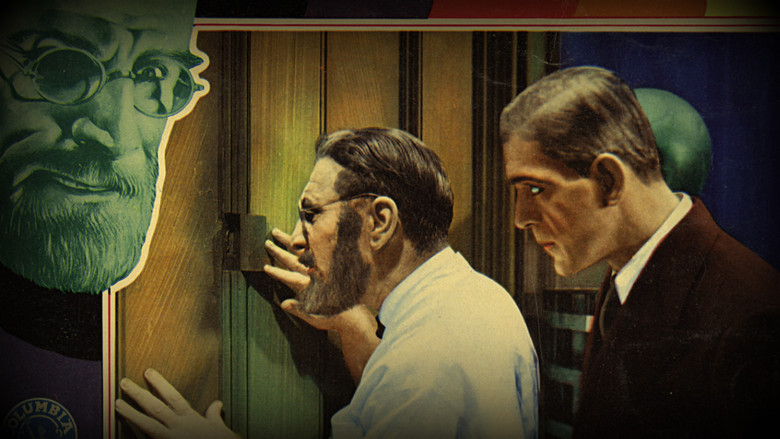

THE MAD GHOUL
1943 - **1/2

But again, the threat angle is dubious. The worst the cops and press can do is concern themselves with his effect on the bereaved ("He always chooses a new corpse"). Though the ghoul doesn't kill, merely raids the funeral home larder like an unscrupulous med student or mad wax museum sculptor, he's still a menace... for some reason! Catching him "may be the means of saving the deceased from a horrible mutilation!" (I'm sure the deceased would be grateful). It all seems especially gross, since the censor won't let us learn \ why Bruce would need to eat hearts in the first place, as opposed to normal meals (is he getting high on embalming fluid?), or why we should care if an already dead person is used for something other than feeding worms or crematory ovens. Is it really so important these recently deceased hearts stay un-pilfered? Corpse eating shouldn't be further demonized, considering civilians were probably doing the same thing in besieged Leningrad the same year this came out, just to survive the winter. Calling it monstrous is shaming to our temporary allies!
Zucco has fun with all this grisly business, as much as he can, but the plot is the same as all the Universal monster B-pics of the time: an exploited killer and his evil mastermind handler take their frustrations out bitchy critics and romantic rivals while a snappy reporter goes undercover to catch them. In this case, it's Armstrong posing as a funeral home cadaver to catch his "man." "Whatever you do, don't mar this coffin!" exclaims the undertaker.
Anyway, the make-up is interesting, the shambling effective, the suspense music fine, the heart-eating uncanny chiefly for its glaring elephant-in-the-room vagueness. The lighting is competent but needs more shadows and darkness. Hasn't anyone ever heard of expressionism? Where are all the German immigrants? A dark set could save on electricity! I guess the censors wanted to make sure no phantoms were having sex in the corners or eating things they shouldn't.


Two
disparate artists - one of murder, one of sculpture -- are brought together by fate to rage against the bile of snooty art critics determined to rob them of revenue in this unofficial BRUTE MAN sequel. Real-life German political refugee Martin Kolseck plays a poverty-stricken mad sculptor and his model, the (real life) acromelagy-ridden Creeper, Rondo Hatton is his muse and friend. Rondo was in a string of Bs (including the Sherlock Holmes film PEARL OF DEATH). He died and his career is very sad, but his name lives on in the Rondo awards. I was once nominated for one once! I didin't win but I'm still feeling honored about it. Your image will outlive us all, fair and lovely Rondo.
Kolseck's tortured, shadow-dwelling expressionist sculptor--a genius but unknown and scorned by the critics--has an interesting shadow in an All-American bland boy hack photographer (he takes pretty girl's pictures for ads). There's a great dissolve between the hero's subject--a hot vacant bikini model-- and Kolseck's subject--the magnificently disfigured Rondo. Beautiful and complicated Rondo vs. bland blonde!

I started watching this in good faith but its tale of a mad scientist working on early forms of cryogenics-- leaving a trail of bodies wherever he goes--is so dull and flat it only made me mad I'd ever even bought this set. I began to long for the comparatively ingenious touch of PRC or Monogram. This one stars Lionel Atwill as the titular doctor, marooned with some dislikable specimens on a tropical island. One night he saves the chief's wife with an adrenalin shot (not into the heart, I guess to not shock those heart-phobic censors) and from then on he's got the tribe's witch doctor gig, which means experimenting on the natives and then, when he wants to work on 'higher' forms of life, the white castaways. Now he's gone too far! They'd have probably loved this film in Germany or the Jim Crow south.
I''ll say it again: THE MAD GHOUL is the best PRC horror movie that Universal ever made. It's every bit as strange and oddly engaging as any Poverty Row monster movie of the 1940s that you can name, but it's got all the brand-name (B-unit) trappings of Universal Studios to give it that little bit extra and deliver a lasting, satisfying, and fun film. Although it was probably pretty forgettable as the second-banana feature in the cinemas in 1943 to SON OF DRACULA --- Shock CinemaRose Hobart is in it, somewhere. I didn't see her though. There's not even eight people in the whole cast, aside from some disheartened gravediggers. Hang in there, boys!

MURDERS IN THE ZOO
1933 - ***1/2
Somehow this Paramount film wound up in the Universal Cult Horror collection, to all our benefit. The beautiful Kathleen Burke (the Panther Woman from Paramount's same year ISLAND OF LOST SOULS) is to kill for, especially. when her hair and make-up are reigned in. It's the old familiar tale of maniacal jealousy between an older, domineering man and his younger, lothario-magnet wife but with one welcome addition: this is pre-code so the animal-related murders and lurid come-ons of cuckolded husband Eric (Lionel Atwill)--the big game hunter / zoo owner-- are truly perverse. "Yes, Eric, I know," Burke says, voice trilling with anticipatory sexual panic, after he kills her latest lover with a mamba bite, "now you're going to make love to me." Cutaways from the human actors to pent-up animals in cages, all the better to symbolize a panorama of human emotions. Atwill sits with a chimp in his lap and looks quite comfortable and is clearly the sort who wants to be master of the flora and fauna. I've been the delusional boyfriend of the hot girl every man in town feels obliged to hit on, and it's very nerve-wracking. It's not like you can do much about it without making the situation worse, and you know you do the same thing all the time--beauty like Burke's enchants men to the point they don't even know where or who they are. That West Side Story 'love at first sight at the dance' effect where all the rest of the world blurs/fades away.
Unfortunately, there's too much comic relief in Charlie Ruggles as the zoo's dipsomaniac PR agent. He hems and haws for whole bathroom break-long stretches at the thought of l-l-lions and t-t-t-igers! and there's boring straight man stuff from Randolph Scott as a straight arrow herpetologist so smart he accuses the killer to his face, while they're alone in a room filled with venomous snakes, and then turns his back on him, and all before bothering to phone the cops or tell anyone else of his suspicions! Hahaha! Eric is not one to squander such an opportunity.
Luckily Scott's toxicologically-savvy assistant (Gail Patrick) isn't as much of an idiot, and saves the day. Her black oil slick hair doesn't make a good contrast with her pale face. Other bummers are the subtextual animal cruelty, such as turning a lot of big cats loose in a cramped room or keeping them in their tiny cells is heart-wrenching. reminding me of bummer Philly zoo trips in the 70s. But hey, Burke is so lovely, alien-looking and haunted that her terror leaves a queasier taste than it might otherwise. Her misery being married to Eric has put her in a state of somnambulistic terror so irresistible you may want to risk having your mouth sewn shut in Malaysia just to 'save' her. Don't do it! Even if you succeed, some other banal handsome white cipher will be waiting to turn you into just another jealous Eric.
HOUSE OF HORRORS
1944 - ***
Kolseck's tortured, shadow-dwelling expressionist sculptor--a genius but unknown and scorned by the critics--has an interesting shadow in an All-American bland boy hack photographer (he takes pretty girl's pictures for ads). There's a great dissolve between the hero's subject--a hot vacant bikini model-- and Kolseck's subject--the magnificently disfigured Rondo. Beautiful and complicated Rondo vs. bland blonde!
"Now I have a feeling of power!" Kolseck rants, inspired. "Limitless
power!"
As someone who labors greatly for this little site, I'm always having mental dialogues where my innate grandiosity is tempered with rage at a relative lack of public recognition compared with some of my mainstream hack fellows. These thoughts fuel a whole cycle of dejection, bitterness, anger, humility, redemption, and finally artistic inspiration fueled by grace, which quickly becomes overstuffed with grandiosity, followed by bitterness my magnificence isn't more fully appreciated, and the cycle clicks a spoke anew. Sometimes I take this journey in a single breath! Limitless power and unbridled creative flow, and its twin flip-side, blocked insecurity. Thus I appreciate the frustrations of Martin Kosleck as the moody sculptor. An anti-Nazi German who fled his homeland one jump ahead of the Gestapo, Martin would, ironically, spend most of his years in Hollywood playing the very Nazis he fled from. Here he's clearly relishing a chance to embody a more tragic, three-dimensional figure (ala Conrad Veidt in A WOMAN'S FACE -my 2008 Bright Lights appreciation here)
I like this from Memphis gadabout John Beifuss: "Those
who do not appreciate true art will probably call it ugly,"
rationalizes the film's mad sculptor about his work -- a useful comment
that could function as an inadvertent slogan for all the undervalued
directors laboring in the sometimes disreputable horror genre." I
like that Burns and Allen's regular third wheel and announcer,
Bill Goodwin is cast as a cop, for no earthly reason. And there's a great
existential sadness that hangs over it all, which Beifuss again nails:
 The clarity of the DVD image bears this out, exposing the relative poverty of the bland 'good guy' sets vs. the attention to moody shadows and alive flickering in Marcel's studio. Rondo's reputation as
the Creeper is well established by his supernatural ability to slip silently around brightly-lit empty corridors; and sneak up right behind people before strangling
them and breaking their spines, with only his tall twisted shadow to give him away. Rondo's earlier Creeper engry, THE
BRUTE MAN ends (I dimly remember) with the Creeper, shot and falling into the East River, which is where our sculptor finds him and fishes him out and brings him home to his studio like a lost puppy. It's touching, not unlike a similar scene early on in 1941 Peter Lorre classic FACE BEHIND THE MASK. The film eventually ends on a note of unsatisfying predictability, but for awhile it really soars in satisfying directions with a great moral: if you want to
kill a bunch of your enemies, just be kind to a half-drowned hulking monster! The war was in fullest flower in 1944, and it's to the film's credit that it understands the need for being kind to that which horrifies us for ultimately higher ends, i.e. allying with the thuggish Stalin against a certain Austrian hack painter.
The clarity of the DVD image bears this out, exposing the relative poverty of the bland 'good guy' sets vs. the attention to moody shadows and alive flickering in Marcel's studio. Rondo's reputation as
the Creeper is well established by his supernatural ability to slip silently around brightly-lit empty corridors; and sneak up right behind people before strangling
them and breaking their spines, with only his tall twisted shadow to give him away. Rondo's earlier Creeper engry, THE
BRUTE MAN ends (I dimly remember) with the Creeper, shot and falling into the East River, which is where our sculptor finds him and fishes him out and brings him home to his studio like a lost puppy. It's touching, not unlike a similar scene early on in 1941 Peter Lorre classic FACE BEHIND THE MASK. The film eventually ends on a note of unsatisfying predictability, but for awhile it really soars in satisfying directions with a great moral: if you want to
kill a bunch of your enemies, just be kind to a half-drowned hulking monster! The war was in fullest flower in 1944, and it's to the film's credit that it understands the need for being kind to that which horrifies us for ultimately higher ends, i.e. allying with the thuggish Stalin against a certain Austrian hack painter.
As someone who labors greatly for this little site, I'm always having mental dialogues where my innate grandiosity is tempered with rage at a relative lack of public recognition compared with some of my mainstream hack fellows. These thoughts fuel a whole cycle of dejection, bitterness, anger, humility, redemption, and finally artistic inspiration fueled by grace, which quickly becomes overstuffed with grandiosity, followed by bitterness my magnificence isn't more fully appreciated, and the cycle clicks a spoke anew. Sometimes I take this journey in a single breath! Limitless power and unbridled creative flow, and its twin flip-side, blocked insecurity. Thus I appreciate the frustrations of Martin Kosleck as the moody sculptor. An anti-Nazi German who fled his homeland one jump ahead of the Gestapo, Martin would, ironically, spend most of his years in Hollywood playing the very Nazis he fled from. Here he's clearly relishing a chance to embody a more tragic, three-dimensional figure (ala Conrad Veidt in A WOMAN'S FACE -my 2008 Bright Lights appreciation here)
 |
| The Rondo award prototype is complete! |
"House of Horrors" is little more than efficient in terms of its staging and camerawork. But it's utterly absorbing in its alternately dismissive and sympathetic attitudes toward art and abnormality; as the story volleys between the healthy Steven and the weird Marcel, between the vibrant Joan and the grotesque Creeper, it functions almost as a dialogue. On the surface, Yarbrough seems to encourage the conflicted viewer to embrace the film's rote 1940s endorsement of wholesomeness; yet it's the almost Steinbeckian duo of Marcel and the Creeper that engages our identification.


STRANGE CASE OF DR. Rx
1942 - *
This is the one where the guy kills all the people who were exonerated for crimes with which they were clearly guilty. I say, good work, Dr. Rx! Mantan Moreland is of course the best part as a a lazy butler, jiving with delivery folks and generally deserving to be fired despite being the best thing about the movie. My favorite moment is when he's supposed to pick up his blandsome hero boss from the airport in the morning, but sleeps through his alarm instead. Finally in the afternoon, Mantan wakes up to find his boss--having had to come home in a cab--now at his bedside, strangling him: "Why didn't we meet me at the airport?" the hero snaps.
"Boss!" blurts startled Manton, "I'm on my way right now!"
That's the only good line. Similarly there's only one tiny little dark patch of horror in the film (pictured above), a kind of a cheat (like using an arresting image from a dream sequence montage for your movie poster) wherein we see Dr. Rx pulling a MAGIC CHRISTIAN-esque freak-out on the captured hero with the help of a gorilla suit, but it's just one small heavy metal oasis in a desert of tedious lite muzak. Things only gets worse with the arrival of a feminism-sabotaging, first amendment-violating hack reporter who tries to gaslight her detective husband out of the crime-solving racket. Yecchh.
"Boss!" blurts startled Manton, "I'm on my way right now!"
That's the only good line. Similarly there's only one tiny little dark patch of horror in the film (pictured above), a kind of a cheat (like using an arresting image from a dream sequence montage for your movie poster) wherein we see Dr. Rx pulling a MAGIC CHRISTIAN-esque freak-out on the captured hero with the help of a gorilla suit, but it's just one small heavy metal oasis in a desert of tedious lite muzak. Things only gets worse with the arrival of a feminism-sabotaging, first amendment-violating hack reporter who tries to gaslight her detective husband out of the crime-solving racket. Yecchh.

MAD DOCTOR OF MARKET STREET
1942 - *
The Mad Doctor of Market Street presents us with such lousy specimens of the human animal I am tempted to think that Martin's script was trying to sneak in an existentialist subtext. Certainly, life couldn't seem more absurd or meaningless than it does at the end of The Mad Doctor of Market Street. Only Martin's colossal incompetence at every other facet of screenwriting keep me from taking such an idea seriously. - Horror Inc.
I actually stopped watching about halfway through in disgust. I paid real money for this set, after eyeing it for years on TCM's site, thinking the price would go down or I could get them to send me a review copy. For $44 or whatever the list is they should endeavor to give us at least four decent films instead of only three. These last two 'doctor' films are appallingly bad. We all know 1942 was a grim period for the horror film thanks to evil censors (in both senses of the term) but Jeeze! I don't mind ineptitude but I hate anemic triteness and soul-killing racist boredom.
 Maybe it was the war. Nothing could compare with the Nazis and Japanese as far as horrors. (By 1944 it was okay since we realized we would probably win, eventually). At any rate it does make one wonder if anyone at TCM even saw these films, or were just scrolling the available titles in the Universal roster and picked anything with 'Mad', 'Strange' or 'Horror' in the title. A pox on them (but not too bad a one, don't want to spook the censor), when there are so many other worthy titles they could have included whose names may not have stuck out. In closing, if you're wondering whether this set is worth the money, here's my breakdown:
Mad Doctor of Market Street - value - $0.00
Strange Case of Dr. Rx - value $0.00
The Mad Ghoul - value: $3.50
House of Horrors - value: $15.00
Murders at the Zoo - value: $19.99
Maybe you can find the last two separately? (POST-SCRIPT: Now you can!)
In the future, TCM, here's my recommendation for a great five film horror set, PRE-CODE JUNGLE HORRORS:
KONGO - 1932
EAST OF BORNEO - 1933
WHITE WOMAN - 1933
BLACK MOON - 1934
THE INTRUDER - 1933
Yr welcome!
Maybe it was the war. Nothing could compare with the Nazis and Japanese as far as horrors. (By 1944 it was okay since we realized we would probably win, eventually). At any rate it does make one wonder if anyone at TCM even saw these films, or were just scrolling the available titles in the Universal roster and picked anything with 'Mad', 'Strange' or 'Horror' in the title. A pox on them (but not too bad a one, don't want to spook the censor), when there are so many other worthy titles they could have included whose names may not have stuck out. In closing, if you're wondering whether this set is worth the money, here's my breakdown:Mad Doctor of Market Street - value - $0.00
Strange Case of Dr. Rx - value $0.00
The Mad Ghoul - value: $3.50
House of Horrors - value: $15.00
Murders at the Zoo - value: $19.99
Maybe you can find the last two separately? (POST-SCRIPT: Now you can!)
In the future, TCM, here's my recommendation for a great five film horror set, PRE-CODE JUNGLE HORRORS:
KONGO - 1932
EAST OF BORNEO - 1933
WHITE WOMAN - 1933
BLACK MOON - 1934
THE INTRUDER - 1933
Yr welcome!