Showing posts with label Herbert Marshall. Show all posts
Showing posts with label Herbert Marshall. Show all posts
Monday, April 23, 2012
CinemArchetype 13: The Skeevy Boyfriend
This summary is not available. Please
click here to view the post.

Wednesday, November 16, 2011
Pre-Code Capsules 9: BEHIND THE MASK, DR. X, TROUBLE IN PARADISE, BLESSED EVENT, THE BLUE ANGEL
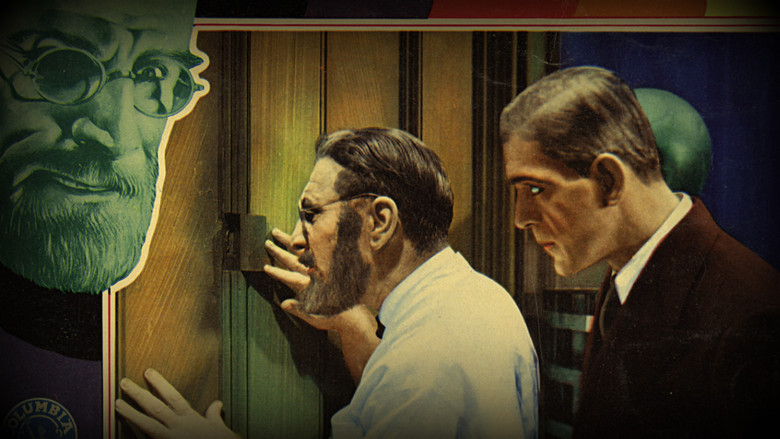
BEHIND THE MASK
(1932) Dir. Francis Dillon
***
The great forgotten Jack Holt (Tim's dad) plays a terrible federal agent in this pulpy thriller. Endangering his
witnesses and letting himself be snowed over by any old disguise or
pretense, Jack's saving trait is a masochistic yen for deep undercover work, enduring a stint in jail and posing as a convict just so he can win the trust of nervous flunky Boris Karloff and thus can score a job in a racket that hides dope in caskets and is masterminded by a shadowy doctor. Edward Everett-Sloan factors in somewhere and there's a vast spy network full of dark-eyed bit players. Constance Cummings tries to save her dad, a doctor in 'a lot of trouble' and she's capable with a .45, which is a switch for these things.***
It all climaxes in a scene where the masked evil doctor makes a great show of refusing to give the tied-down Holt anesthetic for a planned vivisection, because he wants him to experience the magic moment when excruciating pain becomes ecstasy. Batailles-esque philosophy and dimestore pulp come together within the casting confines of the Universal horror stock company! But it's not until the last five minutes that it approaches the cock-eyed madness of any five minutes of DR. X (1933). Before then, well, coincidence and imbecility, the foundations of any hack job adventure tale, reign supreme. Lots of cool atmosphere though, via NOTORIOUS cinematographer Ted Tezlaff.

BLESSED EVENT
1932 - Dir Roy Del Ruth
***1/2
***1/2
If you've been always a bit cold on Lee Tracy (as I have been for many years) this is the film that will make you warm up. As the quintessential fast-talking brutally candid gossip columnist, he's like Jimmy Cagney crossed with an adenoidal scarecrow, singlehandedly ushering in a new low in journalism via the ratting out of 'blessed events' - i.e. children born less than nine months after the couple's been married, or outside of wedlock, or etc. Remember when that was a scandal? Me neither. But Tracy sure does wreck a number of lives. In a staggeringly well-played monologue he scares off Allen Jenkins' mob hitman by telling him about an electric chair execution he witnessed; he's so good he brings Barrymore in TWENTIETH CENTURY to mind, his imitation of the wobbly walk to the chamber, voice cracking with hysteria, body spazzing sharp and speed freak-jerky as he describes the anguish of waiting in hopes of a reprieve, the shaky steps of the last mile, puking up the last meal, the rigor mortis and hair burning. It's the sort of thing that only the pre-codes could delve into, and this delves so deep you're quaking along with Jenkins by the end, and all traces of your dislike of Tracy have been obliterated.
 Roy Del Ruth directed and the rapid patter pace is awesome except when Dick Powell's lame songs slow things down. Edwin Maxwell, Ned Sparks, Frank McHugh, Allen Jenkins, Ruth Donnelly, Jack La Rue, and Rita Cunningham all bring plenty of moxy too as either Tracy's cronies or victims. There are references to Jews, ("Do you know many Jews there are in New York?" - "Oh, dozens!"), Amos and Andy, and a wild-eyed girl 'in trouble' begging for a reprieve from Tracy's damning pen. Played with deranged ferocity and desperation by a ragged-looking creature named Isabell Jewell (left), she's pretty unforgettable. It all coheres into a whipsmack pre-code that makes your scalp stand on end. PS - You will also come out of this film learning what 'nadir' means, and may have a hard time readjusting to the dumb hack substitute for 'wit' passing as dialogue elsewhere in the world.
TROUBLE IN PARADISE
1932 - Dir Ernst Lubitsch
****
****
It took awhile for this pre-code Paramount to resonate with me, but now I dig that it doesn't 'Americanize' the dialogue like so many lazier Hollywood films, instead playing up the linguistic difficulties where everyone in Europe is constantly searching for the one language each of them knows just a little bit of, as in the excited way the Italian hotelier translates E.E. Horton's story of how he got robbed in his room and how this Babel effect makes a suave all surface crook get away with tons of goods.
 Many viewings later I love the elaborate conveyance of gossip, so that Miriam Hopkins is getting verification requests from duchesses mere minutes after being spotted in the lobby of her lover by a nosy count. (and it's all rot, of course). While Herbert Marshall isn't Cary Grant, or Melvyn Douglas, or even Ronald Coleman, he swoons well and convinces you through two layers of subterfuge that he's genuinely confident in his sexuality, and genuinely in love with the moon (he wants to see it reflected in champagne) and the women around him are each more beautiful than that moon.
And who wouldn't be in love with both Hopkins and rich perfumier Kay Francis? Hopkins displays her wide, loose midsection proudly in some tight-clinging dresses--she "moves from the center of her cunt," as old Jill Parsons used to say--and I love the way their first kiss on the couch seems to make them slowly dissolve until the couch is empty; and Francis is at her most glamorous and poised, even while maintaining some of the concave androgyne aura she had in earlier films like THE COCOANUTS (1929). As always, Edward Everett Horton and Charlie Ruggles are effete, bitchy suitors; Gustav Von Seffeyritz humbugs as the chairman of the board who suspects Marshall is a crook. But who would be able to resist robbing Kay Francis?

THE BLUE ANGEL
1930 - Dir Josef von Sternberg
***
***
Either way, Emil Jannings is a damn unsightly kind of creepy crawler, way uglier and uncharismatic than Beery ever was, and it's clear Sternberg can't stand him, so rather than stir our sympathy, Jannings' out-maneuvered Herr Professor inspires nothing but disdain. His smug judgment of Lola and her postcards (which he finds in his student's schoolbooks) makes his downward spiral far less interesting; his slow motion expressionist pantomime reaches for grand tragedy in a way that makes you think Chaney is down to his last few faces. With his bug-eyed outraged head facing the camera from the same angle over and over, his round glasses and Satanic facial hair swirling, Jannings works very hard at keeping his head always in the center of the frame while his body twists and turns like a big old bug caught in a spider web. But to what effect? Nevah vanted doo.

Shot in Weimar Germany just before her Paramount-ordered nose job, molar removal, and strict diet, the Dietrich we see here could be her own sister, the one who stayed in Berlin mit die schwarzwaldkuchen und bier. And partied with (eventually) real-life Nazi Jannings. But Von Sternberg is in fine form; he lights the Blue Angel club like a crazy expressionist side show and if you focus in on the lighting and shadows as opposed to Jannings mug, it definitely does become the masterpiece so many claim.
Still, more than in any subsequent films, Sternberg's masochism in DER BLAU ENGEL is a downer. Always portraying the suitors of his lovely star Dietrich as buffoons, bug-eyed blowhards, shameless masochists, or authoritarian bullies (or else they rarely speak at all and operate as sex objects themselves, like Gary Cooper in MOROCCO), Von Sternberg's obsessions can sometimes make his films feel like a jealous, angry lover is behind the camera, defacing effigies of his rivals even as his studio bosses insist he cast them (Cooper was one of Dietrich's many lovers). One would normally say of a Paramount pre-code that it's fun and a little sleazy but is it art? But in DER BLAU ENGEL we know it's art, and it's sleazy, but is it fun? Nein!

Doctor X
1933 -Dir Michael Curtiz
***1/2
***1/2
Time and digital re-colorization has been kind to the early Technicolor hues of DR. X. What used to look blurry and muddy and depressing now glitters with glowing emeralds, murky pinks and streaks of deep, bloody red that make it like a candy fountain of shadowy death. Fay Wray plays the daughter of Lionel Atwill, hamming fit to storm a barn as the titular Dr. Xavier, out to trap the "full moon killer" amongst his atmospherically-lighted collection of scientific colleagues, each of whom grows more indignant and suspicious the longer we hang out in their labs: Dr. Welles has made a 'study' of cannibalism and keeps a heart alive in an 'electrolysis solution' but his missing arm preempts further suspicion; Dr. Haines was shipwrecked for years on a desert island and his tasty, plump colleague was "never found"; Dr. Rowen studies lunar rays' effects on criminal minds but notes that "the lunar rays will never effect you and me, sir, because we are 'normal' people." Mmm...hm.

And dig the post-modern self-reflexivity of the the climax, with the doctors all chained to their chairs, their pulses linked to vials of blood that overflow like a buzzer at the top of a Coney Island strength tester when they're aroused by the murder tableaux staged before them, just like you in the audience! Scream ladies and gentlemen! The Tingler is in this theater! The duality inherent in language gets a lot of subliminal attention too: Xavier's outrage over each of the new accusations of his colleagues belies its antithesis: "Dr. Rowen could never never be the guilty one," means the opposite, while Lee Tracy regularly promises not to do something as he bribes morgue attendants and security guards to look the other way. On the other hand, Xavier's grave pronouncements of things like "There can be no doubt about it, gentlemen - this is cannibalism!" are allowed no argument since they carry his medical weight. And now that you're not annoyed by Lee Tracy anymore (see BLESSED EVENT) maybe you wont want to tear his picture apart with your bare hands when you learn he gets Fay Wray in the end. Chained for your own amusement, indeed.

Saturday, July 30, 2011
The Blossoming of Judy Jones: FOUR FRIGHTENED PEOPLE (1934)

A cherished lump of stocking coal for Cecil B. DeMille devotees, FOUR FRIGHTENED PEOPLE (1934) is remarkably lapse on realism for being such jungle-set escapade: no one seems to actually move through the jungle, or deal with any real danger, i.e. dehydration, tigers, or malaria. The frightened four's trusty guide whips up a camp with ladders and tree houses latched from vines and trees every night and the next day the men are free to mope after the 'blossoming' Claudette Colbert. A chimp (in Malaysia!) steals Claudette Collbert's clothes while she showers in a waterfall--the big DeMille money shot of 'did we or didn't we see something' prurience--and her emergence in a costume made of leaves, like an amazon queen, is greeted with slack-jawed approval by the now lusty journalist and irritated Englishman. It's fine, but it's not TARZAN, or RED DUST, or even art. So what is it? A portrait of a beat-down librarian who finds her groove in the jungles of Malaysia? You betcha.

Even in the days of the pre-code, nudity was a very rare commodity. One needed an excuse for the censors, and enough doubt and blur to cover all 'ahem' bases; the best excuse was 'naturalism' - i.e if you want to show naked women, go to remote locales where scanty (or no) clothing are the norm. D.W. Griffith's THE LOVE FLOWER and THE IDOL DANCER (both 1920) starring Griffith's then love, Carol Dempster, are prime examples. The legitimate stage meanwhile was dank with productions like Rain and West of Zanzibar. And into this mess comes Four Frightened People. It was originally a novel, but was then adapted by Bartlett Cormack (writer of plays like The Painted Veil and The Racket) and Lenore J. Coffee, turning into something far more like a play, which suited DeMille's silent film-bred ambitions. Old Cecil liked to lens elaborate tableaux as opposed to kinetic action so we move from a scene of the lovers tied to a tree and surrounded on all sides by shadowy black figures moving closer--the lovers romantic and enraptured as they face certain deathn-- to being back with our island matron who's enlisted the entire female population of some remote Malay village in a proto-Planned Parenthood. No one actually ever moves anywhere, except off or onscreen.
 So while not officially an adaptation of a play, FOUR FRIGHTENED PEOPLE makes sense when you imagine it in this context. We must read the palm of this film like a reverse fortune teller: one went to the theater in the 1920s to see what silent cinema couldn't give them, a story wherein people actually speak, and to see hot live girls in sarongs so the menfolk in the audience could lust after them via opera glasses. Jungle films allowed, nay enforced, a strict dissolution of the then extreme moral code. One simply couldn't sleep in separate bedrooms when on the jungle floor with snakes and tiger and lusty skulking natives all around. It was too hot to wear a corset, and good luck trying to keep your full-body swimsuit intact should you stumble on a swimming pool or waterfall.
Now you get the picture, and it's one that's been clouded in the misty waterfall of modern society. Who cares about waterfalls and chimps swiping your threads these days? Now you can be gay and interracial in public; now you can sleep with a girl in a hotel room and not need a marriage certificate or have to worry about the hotel detective barging in; you don't have shotgun-toting fathers dragging you to the all-night justice of the peace; you don't need to be lost in the jungle or stranded in a remote corner of the tropics to be 'free' to let your hair down, take your glasses off, or fall in love with... gasp... a poesy-spouting Herbert Marshall.

There's a great gag where the rich old matron is taken hostage for a sack of rice equivalent to her weight (which is why they chose her instead of Colbert's Judy Jones, with her skinny but shapely arms) to be delivered in a month (or they eat her) - and the matron might give you the impression she's a pushover, but she's a saint! I've never agreed with a crazy old society committee type before, but I'm all for planned parenthood, and it's a nice bit of inverted morality (going against the code by implying the need to use protection if you're going to be tumbling in the jungle rather than just lecturing against it). The matron also gives Judy her makeup bag before she departs (with her little dog too) and as the remaining three move closer and closer to Edenic savagery, Judy Jones stumbles on lipstick, eyeliner, facials, and, one imagines, contact lenses. Out of nowhere come wooden cups and things that might take one some little time to make if they didn't have a massive crew of technicians just out of frame.

So while the BLUE LAGOON / CASTAWAY fantasia has been forgotten in the last 20 years thanks to loose morals, it may in the future re-emerge as our fantasy of life without cell phones Now that we've so overrun the globe that 'getting away from it all' isn't an option even in fantasy, the only way to imagine getting out from under the suffocating flag of debt and demand is to bring the whole edifice down in an apocalyptic crash, so you might be free to roam, hunt, and take whatever junk you can find without worrying if you can afford it, living debt-free, and most of all, shooting back and shooting often, fishing without a license, and drinking and driving, all without guilt or anxiety.

Until all that happens, we still have these relics, these outstretched palms ready to predict the past, this breadcrumb trail down through the years to an era when fantasy was attainable merely by escaping from a plague-stricken ocean liner in the dead of night. The funky aroma of the jazz age lingers all over FOUR FRIGHTENED PEOPLE, and if it seems static, just imagine you're watching it on Broadway, and the close-ups are seen through your trusty opera glasses. Now maybe you understand the appeal that silly waterfall scene might have onstage. Now that's a blossoming, am I right, bud?

Subscribe to:
Posts (Atom)
