Showing posts with label alien abduction. Show all posts

Monday, April 21, 2014

Antichrist in Translation: UNDER THE SKIN, HABIT

Showing off scars, from top: Under the Skin, Habit
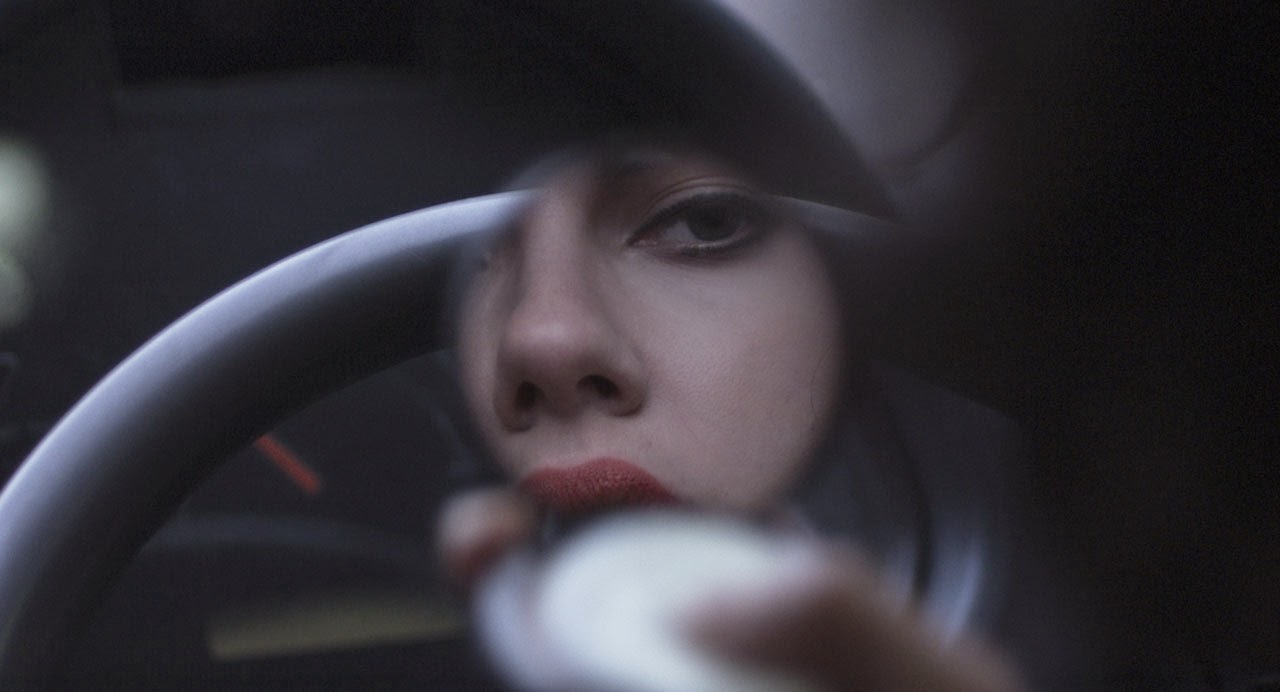
Under the Skin (2014), the new slick dark green opus from Brian (Birth) Glazer, is a film that links up one's panic attacks before and after itself (as seen by you, the viewer) and signals the future of cinematic horror-science fiction as less about acting and thrills and more about the viewer's brain dissolving itself in a pool of black oil in the middle of a dark forlorn forest, wondering as it fades how it hears the rain and sizzle without ears. 2014's first official trans-humanist off-world 'chance to begin again' at that Crystal Peak moment of post-modern social decay, the screen on which it's showing as permeable as a jet black oil-filled swimming pool, Skin is not just mercury mirror from ye auld Cocteau Orphee, not just the menstrual matrix of Shauna Macdonald's Descent. It's the next step deeper. Just don't expect to climb out in the same skin you wore when you dove--or were sucked--in. You emerge as different from your old tar pit-stuck self as a tetrapod is from a placoderm.

I collaged this image/s together/m and are real prowed
I know how it is, bro. I began the weekend with a terrible panic attack. Friday crashed down around me in hailstorms of at-work red tape, hot potato bureaucratic quagmires, April allergies, allergy med-fed depression, and free-form anxiety--based on the need-- to take my girlfriend anywhere other than our couch in front of the TV for the weekend. She can take just so much of my trepidatious sloth and then the pressure is on to amuse her. She said she wanted to go out to the movies this time. My blood ran cold and I shook like the gallows pole was sliding up me arse at the thought. I came home, we looked at the times, and soon I trembling on the floor in a ball of anxiety.

Luckily, she had a stash for emergencies - and so took pity on me - and tossed a half-a Xanax down in front of me and like a good dog I went scrambling after it, ate it down like a good boy, and 20 minutes later was feeling sane enough that we caught the late show of Jonathan Glazer's Under the Skin down at the BAM with minimal hand tremors.

Wandering back home afterwards, up Flatbush towards Park Slope, it was around midnight. Usually busy as hell, the half-deserted and strangely-lit Good Friday-empty Brooklyn was a trash-strewn neon, rain-shined ghost town. Cutting through the uphill haze of alienated Flatbush Ave liquid street lamp and traffic light reflection on the droplets in the mist, stale popcorn nausea and lingering-half Xanax glow wobbliness pulsing through our hamstrings, we knew something weird had happened. I couldn't quite get past the feeling Glazer's film was more of a video art installation swerving towards a last minute And then the Darkness homage than an actual movie, but it was certainly art. Instead of a narrative flow there is--buried in mossy 'membrances of Basil Twist-y underwater shirt twirlings--the sense of drowning-in-place, the theater slowly being flooded with tar--like it would be, for example, at a Marble Index-era Nico concert--and that's all art can ever hope to convey. The darkness of the murky theater swallowed my soul right up, each block behind us falling into Blitz-era blackout, and even as we floated up to the smoky safe squalor of our flat, it was still there: the cord between the Twisty twirling and my body stretched G-sharp and Carpenter-ominous.

The paranoid terror red hot potato Poe-level paranoia was waiting, at home, arms crossed, for that X-half to wear off.

I felt half digested, like that Xanax-was. As it faded, so too my essence.

Then, I realized where my paranoid terror was coming from: it was coming from Mad Men.

It was related to re-watching all six seasons of in prep for the new and final season and realizing I'd mixed up Don Draper's forced hiatus from Sterling Cooper with my own at-work woes. So it's true, then. I'm already half-sunk into the black oil image. I can't always remember where I end and TV begins; since I live in NYC I get confused too and think people I know from TV or movies are people I know from work, and so I wave if I see them on the street (not helping matters, so many of the supporting actors live in my neighborhood - it's far weirder to recognize them and not remember from where).

But when things get too intense at home, by which I mean onscreen, I can move to the kitchen to fix a drink or go to the bathroom and repeat to myself, "it's only a movie, it's only a movie." To our cat we at home must look often like statues, frozen in seated positions on the couch, before the glowing square, awaiting our orders.... hours and weeks at a time pass in addled bemusement, while the cat waits for us to see her.


But does the cat know what we do? That away from the safety zone of our apartment, the world is cold, dark, harsh? The world Glazer lures us into is that zone, a dark and alien theater, built up on the power of Birth (Nicole Kidman enraptured at the concert) and the sexual allure of Scarlett Johansson- we see these ladies movie-size--and suddenly they see us-! Suddenly we're not even safe in our own simulacrum.

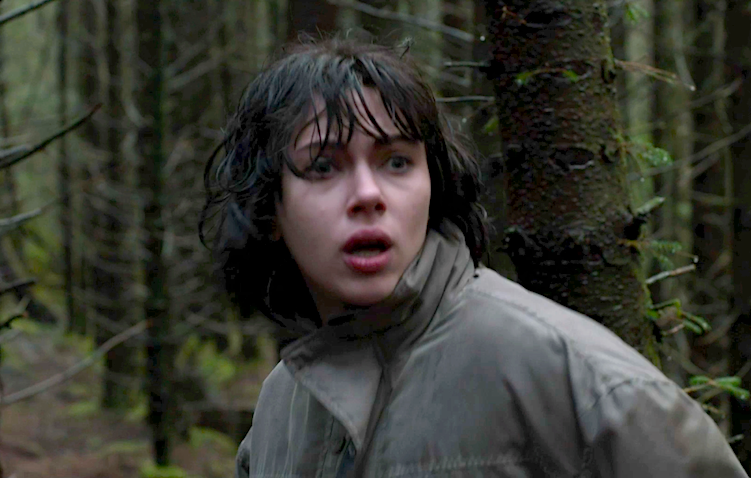
Set mostly in and around the dark shroud of Glasgow, Skin is rich with bleakly beautiful panoramas of: bowling alleys; cobblestone streets with sad pubs lined; panic attack-inflicting red-glazed strobe dance clubs; drenching rain over misty mountain moors and lashing surf rolling and crashing down in fast accelerations on a family, first at play and them sucking them all into their presumed deaths in a chain of failed rescues from a relentless riptide. Sans suspenseful music or any indication they've drowned, leaving only a screaming infant behind, it's such a harrowingly existential moment it kind of crawled inside my stomach like a nightmare I had as a child and had forgotten all these years. Suddenly the layers of assurance and support that nothing bad can happen to an infant onscreen are swept away with nary a sympathetic orchestral string to let us know that the filmmakers, too, are horrified rather than as mountain-level indifferent as the alien who only deigns to steal the clothes.

We're not given any indication Glazer cares about the fate of anyone in the film, even himself, his own reputation as a human being, and that kind of ambiguity is chilling, and even somewhat original. And there's also working class yobbos Scarlett hooks: their slang--as indecipherable as an alien tongue--contrasting with her (surprisingly good) posh Londoner accent--setting up a class divide, and... damn -- I can't let it go. How do you get back to talking about this film's familiar Devil Girl From Mars plot after seeing that poor bereft toddler screaming, abandoned to the incoming tide on a deserted stretch of beach as the sun sets down around him like an evil shroud? This poor kid's screams hang like a torture-tricked sucker punch cheap shot over the remainder of the film, until the sheer weirdness of the deformed lion boy pick-up throws us yet another Mickey.

Whole reels of Skin seem to have been carved out, though--based on our familiarity with films like La Femme Nikita and The Man Who Fell to Earth--we can deduce those missing pieces easy enough and patch in the cracks, but why should we have to if it's only so Scarlett can suddenly turn compassionate Ann Bancroft at the Lynchian epidermal symbolism carnival moment? I'm not an animal! See me! Touch me! I'm dreaming. Take the shot, Miss Moneypenny.  Glasgow is for drunks and junkie loo divers but too dangerous even for a black oil seductresses to engulf. Run forest-ward for safety! Wrong way! Take the shot, poured to double size for growing ladies shedding skins, melt into the forest couch so Robert Carlyle can't find ya. and carve his pound of flesh. AYe...

I'm no great lover of children, but to let that child get sucked off to its death purely to illustrate your hard ambivalence makes me not care that you suddenly care later on -- even if you are the divine Miss ScarJo.

That's the problem with this film, though I respect others who love it. Lourde knows I would have followed Miss Scarlett anywhere, even over to the commercial multiplex wherein she's seducing Captain America instead of playing Venus Flytrap to some juicy soccer hooligans. It's strange and scary but her alien here seems to have very little real power and decays in ways that make us hope Lars Von Trier is waiting in the wings to snatch her from the Kubrick coldness and douse her in the Charlotte Gainsbourg womb of old testament Griffith vengeance. Instead all we're left with is the unsettling and dispiriting idea that Scotland's working class might be collectively more dangerous than any carnivorous alien sexually hypnotic prowler.

Still, I saw some things I don't usually get to see at the movies - things so weird they're like the dark rural cousin to Matthew Barney's Cremaster. But I guess I'm on the fence (after one viewing) as to whether this is a real movie, a video artwork of staggering foresight and genius that will one day be regarded as the 2001 of our era, or just a long experimental hot mess like 2001 when you're not in the right mood for a pitch-shifted "Maisie."


The string of previews BAM showed before the film included something for Locke, which is set entirely inside Tom Hardy's car in real time as he talks on the Bluetooth. A whole hour and a half (no doubt) of artsy glistening street lamp reflections on rainy dark streets looking like luminous watercolors dripped on a black canvas whilst techno throbs hypnotically and family members and work acquaintances shout their panicked exposition at him via Siri's surreptitious signals and strings. Is this preview meant to prepare us for the endless driving shots and slow loop to nowhere repetitions of Under the Skin? It seemed an ill omen. If you want a real movie that does real things these days, you need to stay home and just imagine it. Movies are now about big screen compositions set within cars and the minds of predators --they don't expand your horizons but shrink them until they tighten around your neck like a dominatrix dog collar. If they don't tighten your aperture 'til you're gallows engorged, they're worried you won't feel anything at all - like we're a collective of grand theft autoerotic asphyxiation addicts.

The next stage will be where you spend your ten dollars just to sit in your car and think about what the movie you paid to see might look and sound like if it was ever made; while you drive around in parking lot circles, you grow furious that this hypothetical almost-movie would subject you to such violence, that are such awful people in the world. Dig, the movie is you, mate! Deep, man Ten dollars anyway!

Locke 
Another problem with UNDER THE SKIN: what's with the mean male "handler" (Jeremy McWilliams) with the motorcycle humpsuit? There's a kind of icky chauvinist undercurrent--like male filmmakers aren't comfortable with castrating Venusian bitches unless there's a man in charge of them (see my expose of cinema's pimps both before and behind the lens). Scarlett's voluptuous body, stripped to black bra and skintight black jeans, becomes the whole show--just her and the black box rooms with the wet floors --so we really don't give a shit about this handler with his smug countenance. Ain't right he should have such power over her. The first film of this ilk that transcends the pimp factor head on and smashes it? Daughters of Darkness -- the most recent -- Neil  Jordan's Byzantium!

Under the Skin tries hard to puncture some hidden and vital vein in our decaying culture, and it does get down to the way any sense of a dislocated universal all-seeing eye (locus of identification/camera) dissolves when one is alone in the dead of night in the middle of nowhere. When no one can hear you scream, you're not screaming. So Scarlett's web-mobile rolls slowly through Scotland, trying to snare the dusty bodies of hunched-over men, pummeling their way on foot through the darkness towards home from shopping or the bus or working long after normal people go to sleep. This Scotland seems as abandoned as some lifeless corner of the galaxy. She's all alone, and between the darkness of an experimental intro that's just drones and a pinpoint of light, and the rainy woodsy finish, it's hard to get a straight bead on anything. We're used to that pinpoint of light becoming a tunnel, but it's not going to be so easy this time. Aside from 'in Scotland' we never know where we are, except that we're treading the line between modernist ambiguity and hedging indecisiveness... Glazer indeed.

In his second feature, the Kubrickian Birth, Glazer gave us a real soul in Nicole Kidman, whose gamin innocence ruptured all his shady attempts to modernize her. Beautiful with her Rosemary buzz cut and with Anne Heche as a brassy Lady Macbeth that colored the painting of our fear that nothing was true, Birth was more Kubrick than Eyes Wide Shut, but still it lacked the feeling of being aware of Earth's planetary orbit. In The Shining and 2001 you can actually feel the world turning below the feet of the Steadicam operator, the orbit of the Earth spinning around the sun and the longer orbit of the sun around the lip of it's galaxy as the universe expands outwards, and how orbits meet and eclipse each other until both disappear, and with them, the sense that any kind of stasis or stillness is anything but illusion.


Under the Skin has only one decaying orbit, and lots of flashy editing tracks and scars are displayed out from under its sleeve, including an extended melange of overlapping images through which Johansson's strange and lovely face gradually appears, but when the spell's broken there's nowhere to go but towards macroscope finality. It's the kind of film that depends on Wikipedia and summations of the original source novel for its post-mortem autopsy translation. My GF read them to me afterwards but I was sick off too much stale popcorn, and was coming down off that half doggie Xanax, and the terrors of bureaucratic power mixed with Mad Men bleed-over finally besting me and my office fuckup DTs. My weekend was ruined... forever minus two hours. 

At any rate, I appreciate a film that needs a drive or walk to and from itself to cohere. But if even then there's no real coherence, except that which we give, out of our longing to not disappoint sweet Scarlett, then it's not even itself.


Before that, there was Larry Fessenden's 1995 low rent horror opus, Habit (Netflixed after admiring his friend Wingard's You're Next). As befits its post-Blank Generation style and Liquid Sky content, Fessenden wears all the hats and stars as Sam, a bartender and witty drunk from the era of the 90s. Hey I drank the same way, at the same time, in his same neighborhood (he bartends at the Hat, the great Mexican restaurant in the LES with the super strong take-out margaritas, though in parts it looks like Ludlow Bar, and Max Fish rolled together.) I think I've even used his great line about booze and cigarettes being a form committing suicide on the installment plan. Great minds, man. And, with his wild hair and missing front teeth, Fessenden is a great shaggy antihero, of the rare type where intellect and the ability to succinctly share one's inner feelings are not the marks of a square, nor missing teeth the mark of a townie scrub. He must have been really drinking 'cuz I think he's amazing here, and not as paunchy as he is now (drinking will do that), in things like The Innkeepers. And there's some really great drinking scenes, wherein chats with his friends, about his new girlfriend Anna (Meredith Snaider)'s habit of sucking his blood during sex, come out as organic and low-key as any normal conversation, neither forced, melodramatic or otherwise.... and she doesn't need a pimp to wave his wand and 'allow' her to feast like in The Vampire Lovers. Fuck that.


Fessenden also has a great gift for framing shots within the tight confines of small realistically dilapidated apartments. The Halloween party sequence wherein he first meets Anna is a masterpiece of tight economical framing. We've been to that same party before--20-40 people in the 20s all crammed happily into a long but thin railroad apartment set up with streamers and kegs--and the sustained conversational tone Fressenden captures is nothing short of a post-no-wave marvel. Sounding like an early Jack Nicholson but not trying to, Fessenden navigates his way through the start of a sexy relationship with Anna and into a rapidly downward spiraling series of options, as boozers often will. The hand job in Battery Park was one of the hotter punk rock sex scenes I've witnessed in some time, too, for being so sudden, realistic, intense, and out of left field, i.e. real. It left me bleeding psychic energy from out my limp imprisoned genital matrix in a way I've not been bled since Lydia Lunch in Kern's Submit to Me Now!


All that said, there's still the issue of the horror, the weakest element of this otherwise strong and moving film. The vamp fangs are clearly the two dollar plastic variety and while that could have worked --like if he was too drunk to tell if she's just joking or really trying to bite him -- plastic or real - etc., they play it straight and by then the film's run on kind of long. Still, there's still no denying this is a significant and impressive low budget work; if the climax is a let-down it's only because the rest of it is so much better than it has any right to be.


The main issue with both these films' femme fatales of course is the weird dichotomy they represent in a male auteur-verse: Scarlett rocks the posh accent but dresses like a waterfront Lars Von Trier prostitute, and why is her spaceship an SUV? And as vamp Anna, Meredith Snaider is too short to be scary; I would have liked to see her taller, or more mature, played by a real gravitas-bearing actress who somehow seemed separate from the murky twentysomething slacker low-key characters in the film, none of whom emerge to become any archetypal vampire types (the one kid tries to be a Van Helsing rescuer of sorts but it never pans out though he does get in a great stream-of-babblelogue about the real vampire being all around us in the choking overreach of popular culture). So if in the end it may not be effective as a scary horror film, it does work as an authentically booze-engulfed LES twentysomething denizen depiction, wherein the sense of world-weary isolation is so acute that the vampire metaphor is almost redundant.


The reverse is perhaps true for Under the Skin, which has a few striking visuals involving black goo (are the aliens merely tar babies drawn from this murk, as in they're all one giant amoeba that occasionally splits off and dons a pelt like a wolf in sheep clothing?) and in one climactic shot we're able to realize the way even the most horrifying sight can blend in perfectly with twisting sunless old growth forest. Critics have noted the way Earth becomes so easily alien and terrifying through Scarlett's eyes, and how inherently alien she looks to begin with, and the weird similarities between these alien seduction / immersions and the reality of reported alien abductions, and the similarity between these aliens and the weird eye thing in Liquid Sky. While I get all that I'm still not convinced. Were my expectations too high? I wasn't high at all... just poisoned by panic... was that it?

Days later I'm still thinking about it, and the film did help strangeify that long walk uphill from BAM to our Park Slope digs on a late night Good Friday, half the locals seemingly gone upstate to visit relatives for Easter, leaving the neighborhood feeling very abandoned and surreal. Maybe that's the best movies can do if they want to be both artsy and get us to not wait for video: to get us to trek out there into the dark foreboding night and pay over ten bucks to spend a couple hours parked next to strangers, our purse and coat pockets easily accessible to bed bugs and junkie fingers, the film has to seamlessly link up to all those things, to forge a doorway between our lives, where we are inside our own skins and their outer furs, wherein our seeing the film and the film itself merge. If a film can't make the walk home resonate through a different pair of eyes than the ones we came in with, then why did we ever leave the safety of our homes to begin with? Underground nuggets from the 90s like Habit, on the other hand, go the other way, to link up to our memories of being in our 20s in Manhattan in the 90s, a time when trekking to the neighborhood video store in the wearying sunshine of a hungover Sunday afternoon used to help create some kind of anticipatory context, some ceremony, even for old favorites. Both those trips -forward to theater and back to the rental place, are forgotten now in favor of Netflix, the delivery system that sluggens down to a slow-mo swim our escape path through the tar pit black quicksand stasis of reality. One day maybe soon we won't even need our own memories, our own darkness, our own seat, speakers, ears, ossicles, neurons. We'll be the viewer and the viewed in one looping orbital motion, the entirety of our senses transferred onto a stack of DVDs on a dusty shelf, and hopefully none of them, not ever, will be Transcendence. 

Friday, February 17, 2012

Unconscious Contact: COMMUNION (1989)


If, as Lao Tzu wrote, "without looking out of their window / one can know the ways of heaven" what if the reverse is also true: without leaving heaven, 'they' can look through our window / and know all things on Earth? Maybe it's true that "the farther one travels / the less one knows." Maybe. And perhaps it's no coincidence that the coming apocalypse of 2012 (note to future ed: if 2012 passes uneventfully, don't remove this sentence) marks the 25th anniversary of the publication of Communion, Whitley Strieber's groundbreaking true story novel about his own experiences as an alien abductee. 25 years is a long time. Back then was waaaay before the prevalence of the subject on today's TV cable and internet. There's no sign of it slowing down! But in 1987, our political science major girlfriends called us crackpots just for reading... COMMUNION.

It's not that before Communion there were no such thing as aliens, at least as far as we in 80s suburbia knew, just that there 'real' only in obscure out-of-print 70s paperbacks and Sunn-Schick documentaries full of dodgy pics (mostly cave paintings), unreliable witnesses and flowery tripper double talk. Strieber brought the 20th-century reality of alien abduction into the popular consciousness and, as a fiction writer first and an abductee second, he brought vivid intensity to the 'fictional' or cover memory aspect of the experience. He made the madness of cover memories-- and the traumatizing glimpses of the alien truth behind them-- so tangible it felt like the content of the Stephen King beach read in our laps was leaking down and pooling in our crotches--and it was icy. It froze us from the inside out. To paraphrase Rosemary Woodhouse, is this shit no dream but really happening!?!

That's the wrong phrasing of the question; our need to separate reality and dream may be something 'they' evolved past centuries ago. To reckon properly with Strieber's book, our conception of truth, of reality, of conscious vs. unconscious perception, had to change. We needed to smarten up, to extract ourselves like a clump of hair from the delusional pool filter of Earth's pedestrian orbit. Was that why psychedelics were given to our forefathers in the first place? 

While some abductees say that the 'greys' are living breathing beings, Streiber has always felt they were more like robotic, insectoid puppets usually controlled by some taller single being (or even via remote control, like advanced biomorphic version of Martian land rovers). In the 1989 film adaptation ('highly' recommended albeit not very good) these aliens appear as toys, goblins, balloons, masks within masks, to the point it sometimes frustrating and seems like the filmmaker is taking some free-reign liberties with the source material. But hey--can this oblique crab walk through Medusa's garden be done any other way without going stone blind?  

Even Christopher Walken makes Strieber into a man who doesn't believe his own eyes half the time. As Whit's suconscious starts jerking him around and off the deep end, Walken lets us see the way his patented 'Walken jive' may itself a cover for his own personal/actorly anxiety. The highlight is his triumphant face-to-face/s meeting with the alien intelligence behind all his experiences, a being who chooses to appear to him as--alternately-- a grey, an alien lizard behind a grey mask, and Walken himself (in black eye liner and tux, so we can tell them apart). He's so terrifying and on-point as the alien that you feel the immensity of what's going on and understand why the military keeps it all secret, and why the aliens wipe the encounters from our memory, and why both military and aliens keep the door to the truth unlocked, while slathering the hanle in obfuscation, disinformation, and self-reflexive trickery bear-grease: we may get a glimpse through the crack, some truth folded in with cover memory, but we just.... can't.... get a grip to open wide. 

Hopefully, it's all for a reason, the gradual widening of the human conscious circumference for when the aliens do make themselves known.... in full....

But in going off-topic with the weird cover memories, the film wanders into its own form of disinformation.  The aliens can appears as people either known by the subject or the subject himself, or inanimate objects. Can we even see the aliens as they truly are with our puny earth-made eyes? Communion (and the Jodie Foster movie Contact) think the answer is a profound "no," so they give us replicas and masks to help us cope, the way we might give a dog a rabbit-sized chew toy rather than let him hunt real rabbits that might be rabid. These beings may be part of a reality so far out humanity's ken they can only be gazed it indirectly, like Medusa in a foggy pocket mirror, and that's perhaps why there is no tangible 'evidence' for direct non-classified perusal. The aliens don't want us to see them, and it's as easy for them to avoid leaving evidence of their visit as it is for a scientific expedition to pick up their trash on their way home from the Savannah. They take only tissue samples and leave only transceiver implants (or ear tags).

Below is a slice of the climactic dialog between Streiber and the alien intelligence, which elaborates on this:
Alien / Walken (to Whitley / Walken): I'd like to say a few things. First I'd like to say 'season's greetings'. Then I'd like to say 'keep your hands on the table at all times.' Heh?

Whitley / Walken (to Alien/Walken):  Boo!...Boo. I wanna go home. I'd like to go home. You've broken my mind! I'm gonna kill you. Can we talk this over? I can't wake up. I am the dreamer. You are the dream.

Alien / Walken (to Whitley / Walken): Look. The only thing that really matters here is what I am about to show you.

(The gray alien's face cracks open; it turns out to be a mask with a reptilian face underneath.)
Streiber/Walken: (staring at the face) "That's... not it. I didn't come all this way... for you to tell me that's that what it is. Is there something under that, because I don't believe that one... It's like a box, a Chinese box... You open it, there's another one inside and another one inside and another one inside...(pause, realization) You're not gonna let me see you, are you?"
Alien/Walken: It is just like a Chinese box and you're not going to be allowed to see. Okay? Just to make that clear.

Streiber/Walken: You are not gonna let us see you... That's a good idea.

Walken is talking to himself inside a spaceship near his upstate NY vacation home, but the other self is a version of himself as a razzmatazz Walken alien, wearing eye-liner who presumably is an alien intelligence talking to him in the form of yet another mask, mimicking or repeating all the 'real Whitley' is saying --or has said previously--or would like to say in the moment ("you've broken my mind!"). It becomes difficult to tell which version of him is really the dreamer and which the dreamed and I think that's no accident of bad editing, but rather a point about aliens that is impossible to make in any 'clearer' way. 


The first clear message seems to be that "season's greetings" part: Walken's kinetic hustler delivery brings out the surrealist edges in all their warped definition. I remember not really liking the film too much when I rented it, drunk, a decade or so ago, but it works much better a second time after I've done a lot more research into the issue, because it plays more as a meditation on the trickster nature of the UFO abduction phenomenon rather than a straight horror story like The Fourth Kind (see my 2010 article "Take us to Your Benzos"). It's this trickster / Schrodinger's Cat mythic unknown factor that appeals to me: the importance of having living myths in our culture - conspiracy theories keep humanity sane in the face of this self-splitting equivalent of what the primal scene is to small children --a kind of too much/too soon that needs mythic grounding ("mom and dad were just wrestling') to stop total psychic disintegration. We can examine the alien issue all we want, as long as we don't get our hands on some 'smoking gun' piece of evidence. And even if we do, even if we have such things (and we do, if you care to look at the recovered implants and handprints), we're spared the terrible certainty of this larger truth. We revolve around the gravitational field of some larger evolutionary issue the way curious first graders revolve around the issue of sex. They can ask mom all they want about it (as I used to do) and her duty to her child's healthy development is to neither tell them the truth nor punish them for asking. This nagging question underwrites every child's wonder and pursuit of unknown knowledge. Not telling them the truth keeps them growing and guessing and following clues, letting them ask and kind of encouraging their exploration around the issue, keeps your society growing (when children aren't allowed to ask, your culutre shortly becomes flash-frozen, and--in a few short generations--is like the Amish or Hassidic community or some fringe cult. 

Chris/t Before the Pollock: Worlds within worlds, or just a goddamn mess?

In this way, Communion's use of obvious masks, phoniness and Bugs Bunny-ism is spookily admirable and correct. Instead of a gleaming white light round room, for example, the abductions occur in what looks like an abandoned psych ward hydrotherapy room equipped with that old flood light and fog machine. And why not? If that's what the budget and unconscious of the abductee will allow, let it be so. I also think of the opening scene of Kubrick's Lolita, with Sellers as Quilty trying to spin the situation with murderous Mason into something more cartoonish and hip, and slowly giving in to dread as the previous night's liquor wears off and his evasion tactics fail, one after the other. In Communion's case though, which Strieber is Quilty, and which is Humbert?

If you guessed Strieber is Quilty, you're wrong. If you guessed Strieber is Quilty, you're right. 

Genuine menace, or just another left-over party guest eccentric?

So-- where is the line between hallucination / cover memory and the 'real'? How much of the Whitley Streiber story is "true" in a concrete sense vs. the bleeding of dream reality into the real via a hyperactive pineal gland? What's more real, the top of Mount Everest or the bottom of the deepest part of the ocean? You've never been to either, so what the hell do you know about it? You don't. Only mountain climbing deep sea divers know, and the result is they get the bends. If the rest of us confuse our TV nature show viewings with direct experience of the natural world, why not the reverse? Perhaps our dream lives are the real reality, the only one any self-respecting alien wants to log into. Do sharks dream of being on dry land? Might not aliens look at our waking life the same way we look at the shark's ocean floor? A nice place to scuba dive, but if we want to do some serious marine biology investigation on a shark we have to hoist them onto the boat, as briefly as possible to not suffocate or traumatize them, do some scooped flesh samples, a swab of their cloaca, then tag their dorsal fin and put them back in the water.... which as far as the shark is concerned is like being pulled by aliens into a dream world, the one they get only a glimpse of when they breach the veil to sneak attack seals.

A shark--in sleep paralysis mode--dreaming about small alien bipeds.

The real life Streiber had already written a book made into a movie starring Albert Finney, Wolfen, before being conscious of his alien visitations. And that begs the question: did he write horror because his unconscious knew things his consciousness didn't? As I write this I can feel an alien intelligence looming over my shoulder, but my unconscious could easily be just fucking around and pretending to be an alien intelligence looming over my shoulder. So is the drive to write a way to create a 'cover memory' even as our unconscious-- knowing the whole terrifying truth --only spoon feeds us little tastes of what is really out there/inside us? What if our entire time-space imprisoned notion of three-dimensional truth is just a cover memory for the far ghastlier truth of our multiverse's terrible, inescapable, irreducible` 'eternal now' omnipresence? Is the alien abduction somehow less an intrusion into our reality than a removal of illusion? Do aliens manipulate time as well as space? If so they may abduct a human for years all while he's sleeping or meditating for only a few minutes in our time. And what's the difference between, say, an alien probe scar on the back of one's neck and the sudden manifestation of the stigmata, or the way people die for real when they die in The Matrix?


Can the alien abduction phenomena be separated from their unconscious correlation, and why would we assume an alien would think our conscious mind was the 'real' mind to visit? Why wouldn't an alien prefer to make unconscious contact rather than the conscious variety. My unconscious is far more literate and witty than my conscious one - I'm sure it's a lot better company. How else could it blow my mind every night with crazy dreams? When I try to get involved with my unconscious mind's creative process, my tongue ties almost instantly but if I just get out of my own way, as you may have noticed, I'm a goddamned genius (or rather my unconscious is). I'm its agent/editor, trying to translate its rantings, clipping the more negative tirades and encouraging the poesy, but I can't control the actual ideas and flow (and the negative tirades are all conscious ego in disguise). Surely that unconscious connection is even more true of Walken, who has a rare gift wherein every line he speaks sounds like it's coming straight from his unconscious rather than a script, even when he is clearly reading from cue cards (as on his many SNL appearances).


So while his hipster affectations in this film may bug 'serious' UFO scholars, I think Walken is ideally cast. No one else could so gamely tread the edge of a straight razor, like a dosed Marx Brother, to convey the realization that all the things that happened in his childhood didn't 'happen' but are still happening, now, right in the hypnotist's office, that the African figures on the mantle (below) are simultaneously the greys standing in the distance watching him do the herky-jerky in the grungy space ship. (Look close in the right quadrant of the second picture down).


Maybe I'm reading too much into it, but in my own astral travels I've experienced the 'synchronized' reality effect wherein an alien, if it wishes to appear in your room while you're sleeping, would first sneak into your subconscious and influence you to buy a bunch of primitive statues for your nightstand, so it could, in a sense, materialize through your perceptions of an equivalent totem, using the statue as a focus, a stand-in, the way we can use a mirror to comb our hair. You have to ask yourself - why do we want statues of human figures, figurines, representatives of bipedal life forms, scattered around our homes and yards? What purpose do they serve? The answer is a profound this: if the beings incorporate themselves into 3D spacetime via astral projection and corporeal form invasion, what better way to launch monitoring agents into our reality than inspiring us to make humanoid/android forms compatible with their projected energies, so they can beam their intelligence across space into them. If you take our technology for the rover (or say a drone) and mix it with robotic replacement appendage evolution along the lines of Surrogates and there you are, an answer to the extraterrestrial travel argument even Carl Sagan could understand.

While there has been mention in alien abduction lore about cover memories, outside the surrealist movement or David Lynch I can't think of a single 'fact-based' film other than Communion that actually dares to address the line between dreams and reality so head on. It's through these intentionally bizarre creatures, masks, show biz parodies, and roll reversal instances that Communion really comes alive. If you can imagine Christopher Walken playing all the non-dwarf roles in a sequel to Phantasm directed by Dario Argento, Communion is your nightmare. One crazy moment finds Walken investigating strange noises at night, looking in a closet and finding this bug-eyed teddy bear.


It's never spelled out, but there's something not quite right about what that bug eyed bear is doing there, or if it would still be there in the morning or would paralyze him with a nerve wand if he tried to touch it. That's pretty Argento-Phantasm-level stuff. The childhood object you see might in fact be something else in disguise. How else would you know unless you touched it, at which point it would be too late for you to escape it?

Arguments against the validity of alien abduction hinge a lot on the nature of hallucinations, sleep paralysis, and vivid dreaming, but neither the skeptic nor the believer sees the whole picture, the way it's perceived by actual abductees or string theory physicists, or those of us who have truly hallucinated or understood the full terrifying breadth of Jung's collective unconsciousness. The truth is this: both arguments--mere mirage/illusion and 'more real' than reality-- are terrifyingly correct. Dreams are as real as anything else and our five senses are just feelers into the physical realm. We have a whole other feeler, the third eye, which we've been conditioned to ignore by mainstream science, but which also 'hears' and 'feels' and 'sees' in a whole separate way from the external senses, even more vividly.... at times.

This third eye is actually the projected energy of the pineal gland, located in the center of the brain, and it can be felt burning a hole in the middle of your forehead if for example, you drink too much Robitussin or have activated your Kundalini through deep chakra work (or like me, both at the same time :). The pineal gland is where the soul allegedly enters the body on the 22nd day after conception (it's the pine cone the Anunaki are inserting into man's forehead in those old Sumerian etchings... and it's where I would enter if I was an alien on the outside looking in, like someone hacking our cell phone. Who cares if another soul is already in there? You're just passing through. Your unconscious is probably much more welcoming of these spirits than you 'consciously' know. You could be a galactic ambassador while asleep, even if during the day you're just a Bellevue psychiatric ward acid casualty.


Let this idea in and feel the terror of the awful realization of alien immediacy-- its presence beyond its status as real or illusion, its presence in all aspects of our lives, our past, present, future--feel how it brings with it a vivid understanding that everything is connected to everything else on every level--so you can visit the other side of your hand on Mars in 1937 and find your watch inside a Chinese box found on the bottom of the ocean unopened since the Ming Dynasty, and find your grandfather alive in the microscopic villages along the ear hair of your grandson. And the sun is just a reflection of your iris. And without looking out of your door you can know all things on earth and even if you never look farther than your own backyard maybe one day you'll notice that the very farthest reaches of outer space are right at your fingertips and the vacation you will take this summer is being remembered right now in the bathroom you just walked out of twenty years from now.

And the cares of tomorrow / must wait / til this day is done.


 But how do you define a day when you have no Earth to spin?

You guessed, but you done guessed right.


Let the idea of a day as unit of time go....Know that it was only ever just a way to partition the darkness, just a trick to not go insane from the sheer screaming nowness of our psych ward clin.... Shhh, here comes the nurse, I mean muse.
Related Posts Plugin for WordPress, Blogger...