Monday, September 19, 2011

You Can't be Coughing on a Moving Train: CONTAGION and the Soderbergh/Assayas Post-Post Post


If you can't wait and must see Steven Soderbergh's disaster movie CONTAGION (2011) in a theater, be sure to sit next to a guy who won't stop coughing  --it's what this movie needs to really 'hit you' with that William Castle 'Percepto' aural 3-D meta feeling, and Steven Soderbergh must have known a coughing person in every showing was all but assured based on its early autumn release --in 2011 of all years, right before the 'man comes around'  in 2012.


As a product of one of indie-dom's few prolific auteurs, CONTAGION makes me worry Soderbergh's bottomed out in the post-affect school of eternal jet lag, i.e. he's become a permanent tourist, enamored to the point of idiocy by the brooding post-modern thrill of hustling from airport to airport, convinced setting humans in rapid motion through public places-- timed to a cool ambient techno track; editing taking advantage of every corner; every reflective surface singing with Antonioni alienation--will bring meaning to the vaguest and most anemic of shaggy plague dog tales.

But Soderbergh forgot that some of us don't just automatically root for the cardboard humanity on display, especially if we're population control advocates. In the end, the only characters we end up feeling bad for are the animals --frightened pigs and traumatized monkeys are tortured and slaughtered in the name of science, all so a few million more people don't die, like we really need them not to; it's like jettisoning all the oxygen tanks in an airless spaceship to make room for a dozen more shallow breathers. Not that I'd prefer to get to know each and everyone of them - their families, hopes and --oh brother---dreams for the 'cough' future. OK OK Sorry I said anything!


And as far as that prized post-affect 'moving sidewalk to the next gate' jet lag genre goes, Soderbergh's just tagging along in the brisk footsteps of French filmmaker Olivier Assayas, the genius behind the influential post-affect films BOARDING GATE (2007, above) and DEMONLOVER (2002). As long as Soderbergh is focusing on the progression of the disease--making the virus itself the star--a hand smear on a door, or the fingerprint smudge on a subway pole, bus strap, door to a store, hand-rail down the subway stairs, apron to shaking hands to panhandles--it's fine: the virus is like Jason Bourne or Will Smith in ENEMY OF THE STATE (1998), tracked by satellites and security cams patched into the nexuszzz. But there's always dumb human--dare I say Spielbergian?--moments that seem far more contemptible than the riots and looting, like the Matt Damon righteous father making a big beeyootiful prom space for his isolated daughter and then crying in the closet looking at his wife's pictures from Hong Kong, which he should have turned in to the feds for ID-ing and sterilizing and so forth, but then we wouldn't have all this 'perfect' meta Baudrillardian closure. 

Soderbergh himself has become so post-post that these scenes scan trite as one of those irritatingly homespun Peter Coyote ipad2 commercial voiceovers. Forget it Peter! No folksy drawl is going to bring back the open plains and prairie flowers. Over in France, Olivier Assayas is too smart for such sentimental rot: he finds humanity in the running from it. The secret to the post-post cinematic time-image affect lies in its total transparency. Soderbergh can't show the virus coming home from work after a hard day of dodging the men in the white hazmat suits, so he does the next worse thing. Won't somebody please think of the janitor!? Look at this picture of his small boy! Tell him about the violin lessons for a-his dead-a mama to be a-so proud of a-him.


Moving out to a metatextual wide shot: CONTAGION will not promote international tourism (you will not want to visit Hong Kong after this film); it also doesn't encourage cinema-going in a city like New York, especially if you took the subway to the theater and forgot your hand sanitizer. One moron in our row at the BAM coughed more or less nonstop until his date made him go outside and get a drink of water. At first he just joked and pretended to be super sick like he thought she was kidding. Three minutes after his brief sojurn he was back again, coughing away, oblivious.

I'm sure I wasn't alone in wanting to kill him, with plastic gloves on.

He confirmed my worst suspicions about humanity's decline into the abyss, and Soderbergh's suspicions seem confirmed as well, for what we see in CONTAGION is not the truth, not even a fantasy, but a problem that is the result of our overpopulated, horrifically over-linked social order --the end game 'nonfiction/fiction' collapse of interpersonal borders. With Soderbergh's smug liberalism in play, even our fictional minor characters are too important to let die, so everyone lives to endanger humanity as a whole, swamping the lifeboat. The meltdown 'melting pot' of genres and styles as well as communities ensures that no one can escape the thresher with a golden ticket--no women and children first, boys, with sailors brave enough to threaten to shoot Molly Brown if she tries to row into  the drowning panicked Titanic melee. The sorrows of the individual are the ambivalent solution of the many and so seldom vice versa, thanks to Spielberg and Ford, rather than Hawks and Assayas. Mere life takes effect and no one is allowed a vegan or special dietary restriction option on their in-flight meal.There are lives at stake and you blather about leg room?  Not a chance.

But I betcha Soderbergh never flies coach --otherwise he might feel different.

Not to be a devil's advocate, BUT... If contagious diseases can spread this fast because we're so super-connected, wouldn't it help to be less connected? To lose sixty percent off our world population total and revert to an agrarian hunter-gatherer post-apocalyptic paradise? A couple billion people could die on this planet and--if you didn't know them--would you miss them? Would you weep with frustration at the big statistics in the paper or would you breathe a sigh of relief that real estate prices are finally going down? We could lose half the current population and still only be back to where we were in the 1970s --when we were allowed to worry about these things without being branded as anti-human. And what about the pigs, chickens, goats, cows, and fish who die by the billions daily to feed our combined appetite? Won't someone think of the innocent turkeys and pigs that might have more on the ball than the slack-jawed cradle-to-graver who assumes his red meat just comes magically from the back of the supermarket and gets indignant when an activist shows him photos of an abattoir? If any and all humans weren't 'entitled' by the meat welfare system to a lifetime of free meals they are way too stupid to ever catch for themselves, natural selection might have a fighting chance. To use the TEXAS CHAINSAW analogy, we're a nation of comatose grandpas, too weak to even lift the hammer but still guaranteed a piece of Marilyn Burns, and thus the Burns's are chopped up by the thousands at the Leatherface brand Marilyn packing center. But if a single grandpa dies, oh the humanity!

CONTAGION brings these feeling up by ignoring them, never realizing the animals seen in the film are the only humans worth rooting for, and their welfare is in the hands of sadistic liberals who would kill an entire population of chimps if it might save temporarily extend the life of a single elderly pedophile.

12 Monkeys
If I was king I would free these monkeys, move them to an animal sanctuary and use convicted felons and pedophiles and stoner volunteers for lab rats instead: one monkey freed for every criminal convicted --making a reverse monkey jail!  Reverse Monkey Jail monkeys: you shall be free...

In a way I'm secretly proud of my fellow humans that so many of them seem genuinely concerned for the welfare of those people in places like Indonesia or Rwanda, places they only read about on the news but still feel, by 'virtue' of having read the stories--connected, outraged, and personally responsible. They don't need even to see the faces of the suffering; the statistics alone awaken compassion. Maybe, though, it's all  just a pose they've been taught at their bourgeois private schools and somehow Soderbergh's seems enamored of the pose rather than the solution that would make compassion unneccesary.

I personally think that genuine compassion must engage the issues of overpopulation, cruelty to animals and depletion of resources. If you only have food to feed three people, why struggle to keep 30,000 more mouths alive, knowing that in a few years that number will swell to 60,000 because America's fundamentalist Christian bloc won't let you give them condoms? And they'll still be right where we left them, yelling "pan pan pan!" and mimicking eating motions like the beach kids in SUDDENLY LAST SUMMER.

And it's that stony, long range humanism that marks a great genius like Assayas, the abandoning of the publicity-garnering, short-sighted moral high ground in favor of a prismatic retreat that the not-one-domino liberal quagmirism of CONTAGION fails to encompass, and thus the whole film falls flat unless you, here and now, turn vegan!

Compare for example Assayas' CARLOS (2010) with Soderbergh's CHE (2008): they're both multi-part biopics about globe-traveling revolutionary terrorists, both are set in the 1960s-70s, both have one word name titles that start with 'C', but the lines dividing them are so basic, so elementary, they go back to the basic dividing line of all pop culture - the Stones/Beatles dichotomy: Assayas and Carlos the Jackal are the Stones to Soderbergh's Che Beatles. Like the Beatles, Soderbergh seems to believe in humanity as it currently defines itself, never losing faith in 'Us' - believing that love is all there is and the love you take is equal to the love you make and still confident in the possibility of utopia, an inclusive exclusivity underneath the waves.  Like the Stones, by contrast, Assayas knows you can't always get what you want, but if you keep moving forward, keep lunging through the crack in every closing door, keep rocking and balling, never saying no to a drink or drug, always showing sympathy to the devil and jiving sister morphine, then maybe you might at least get laid or super high in the process of fighting for truth, as you define it. There's no belief the possibility of a fair system for Assayas because he knows any system in itself doesn't exist... and never has. Men live and die by ficciones.

Che, top / Carlos, bottom
Even when doing non-fiction like CARLOS, Assayas isn't too concerned with 'real' people and integral consistency: his Carlos changes as a character from moment to moment as calmly as Travis Bickle or Lawrence of Arabia, fluctuating along lines that erase all distinctions between social and personal action, and maybe the only difference between terrorism and heroism lies along these same lines. Soderbergh's Che must always struggle for the people, for the cause... and that means tending to the wounded even if it means staying behind and risking capture, and of course never smiling because even one person is starving somehwere for freedom from capitalist oppression. Both characters delude themselves in their quest for a 'better world' and how to get it. But at least Carlos knows--deep down--there wouldn't be a movie about him if he wasn't dangerous. Che can't allow such honesty to corrupt his self-righteous Marxist buzz. While Che would be making bandages, showing you photos of the poor people of his village and reading aloud from Das Kapital, Carlos would be hiding his bazooka under your bed, drinking all your whiskey, and stealing your girlfriend.

demonlover
This is why Assayas' heroines--like Asia Argento's assassin in BOARDING GATE or Connie Nielsen's corporate spy (above) in DEMONLOVER--are so much more alive and sympathetic and even realistic than the 'good' girls in CONTAGION like Winslet's epidemi-vestigator or Marion Cotillard's Stockholm-syndrome hostage (her run back to her abductors in the airport comes off phony and bleeding heart self-righteous) or Jennifer Ehle's spunky little biologist (top) in her cute orange outfits and blue-green dishwashing gloves, cooking away in the sterilized lab kitchen-- the ultimate petrochemical-armed mom as envisioned in Laurie Anderson's "O Superman." In their noble missions to save as many space-wasting lives as possible Soderbergh's chicks are the bleeding hearts that stop human evolution in its tracks -- not that they shouldn't save the planet but they could at least acknowledge the paradox: If they could go back in time and prevent the bubonic plague, would they? or the Spanish influenza, or even small pox? I can see some idiot out there saying of course they should! Life would be so much better if our global pop. was 12 billion instead of only six! They're all for it until, of course, someone expects them to share their bedroom with a homeless family and their chicken.

That last image I cribbed from Dr. ZHIVAGO, and like that film, CONTAGION is the kind of moving train Howard Zinn decided awhile ago you can't be neutral on, though by now this train has become so crowded you can't even sit down, let alone remain neutral, or anything but suffocated. The only time a seat opens up is when someone dies but then Soderbergh's doctors run up and save them for a few more stops, until the only ones allowed to sit are the dying which never quite die thanks to those 'heroic' medicos... and soon there are many trains on the track they all have to crawl slower and slower until they're nearly as torturous as the 4 'express' at NYC rush hour, and people are hanging off the sides like the commuter to Kolkata.

And people wonder why we're broke, and why our democratic system is so crippled by fear of change. Being from France, Assayas moves much more freely through the post-affect landscape: his characters get off the train and sneak down alleyway shortcuts. Soderbergh might ape the New World Order / Assayas post-modern gridwork image-within-image paradigm, but he's still a tourist, and CONTAGION is just another stack of high-res postcards from the edgeless.

Saturday, September 17, 2011

'Transgalactic Delta House Ebullience,' Comic Book Evolution, and Timothy Leary's Head - PAUL (2011)


Like most people I know who follow exo-politics, I thought PAUL (2011) looked grim from the outset. First off, this is supposed to be a brom-com about a surviving Roswell alien, and here his huge eyes aren't dark black. The black eye on grey aliens is, as we now know now, a kind of DNA-implanted contact lens, as if we humans decided we loved Raybans (tm) so much we had them surgically grafted. Without the dark eyes Paul looks just like a big E.T. / Close Encounters love doll - and it turns out he was the inspiration for both films (we learn this thanks to flashbacks of long chain-smoking phone calls he had with Spielberg in the 1970s) which makes perfect sense from a disinformation standpoint (if you see an alien on the street eating Reese's Pieces, you're a lot less likely to get taken seriously when you report it to the cops).


I remember well at the age of around 15-16, gazing at my surly, bald, bespectacled comic book store owner (Quality Comics in Somerville, NJ, if you were there, you know him) and thinking: 1. I'll never stop being into comics no matter that they say people grow out of them, and 2. I hope I don't end up looking and acting like this surly bald bastard. Back then 16 seemed suspiciously old to still be into comics, even if you were into the sophisticated stuff like Frank Miller's Daredevil. And now... these clowns.

In other words, seeing what I'd look like if I stayed friends with my Frost-ish pal and never discovered sex, drugs, and rock and roll is kind of crushingly weird and terrifying. And Yet -  they actually grow as characters as the film goes on, how emotionally un-arrested of them! And Kristen Wiig is adorable, as the NY Post's Paul Smith noted: 
There may come a day when I tire of Seth Rogen’s shtick but I hope it doesn’t come soon. (Yes, I loved “The Green Hornet”). His sarcastic insults and Transgalactic Delta House ebullience keep things rolling along (even if the gay jokes are a little stale) as the boys pick up more enemies and a kindly one-eyed fundamentalist Christian (the indispensable Kristen Wiig) who says of Paul, “He’s not evil. He’s just a bit rude.”
  (Read more)
"Transgalactic Delta House ebullience" - I think we can all aspire to that, both as writers and as people. The ultimate message of this cosmic trip then becomes this: stoners are the smartest of all humans. Paul's very advanced, yet he acts just like a stoner slacker crossed with a less spastic Kermit the Frog. What does that tell you if it's not that stoners rule?!! That's what got me out of being a comic book nerd, I can tell you - drugs and alcohol were my socializing and talking to hot girls without blushing and stammering spinach. And as drugs, bass, and babes became the major force in my life, all the other comics stopped for me except Love and Rockets, Dan Clowes' Eightball (below), Pete Bagge's Hate, and old Zap! reprints. I yelled excitedly when I saw this guy (below) on one of Pegg's awesome T-shirts. That's a Clowes!


It would have been cool in Paul to see examples of other aliens or humans working inside the alien vessels to further advance the notions of a global elite conspiracy but it's great the way the CGI alien interacts with the humans so flawlessly--on the level of Andy Serkis' Kong and Golum, rather than the stilted dread knots of Jar Jar Binks and SyFy channel stuff. It works so that you forget altogether he's just a CGI hallucination. So see PAUL with a bunch of friends late night after the young person's AA meeting, or while getting hammered and it will treat you right. There's a subtext in there that any dope fiend or former dope fiend will take to heart, and it's traceable back to--what else?--a comic book:

The one big genre-buster comic I know of that deals with the issues of life after death and the universe and aliens, the only truth that sets one free, is Timothy Leary's Neurocomics (Last Gasp, 1979) which describes the circular DNA arc of life with the following being indicative of where our Paul is on the evolutionary scale:


In this strata, the hippie stoner is a whole evolutionary cycle above the family man preacher (below) who is the end game on the highest level of 'terrestrial circuits' while the stoner is the lowbrow level of post-terrestrial, so a whole DNA sequence higher on the celestial step ladder.

(Read the full comic  here or download here)

This should be good news to the moms of stoners and trippers everywhere, and explains why the religious right considers psychedelic drugs such a threat. It's because the 17 year-old mushroom dealer is a whole circuit higher on the DNA chain than freakin' Jerry Falwell or Michelle Bachman, or even Osama Bin Barack, or whatever his post-Bohemian Grove mind control reptilian takeover name is. And that's enough that those comic book geeks Pegg and Frost should really grow up and start doing some drugs. Paul's got a great magic power where he can send you all the cosmic truths in a big rush of DMT that will take the dogma crust off any cutie pie conservative, and it makes a good point for arguing that the bible belt might come around and be less closed-off if they got a nice dose of LSD in their morning cup of joe. If you want to 'see' the truth, you know who to trust, and it's not those Bohemian Grove owl-worshiping conservatives and their masochist leatherboy slave Antichrist, but the real deal, Tim Leary! LEARYCON, now that's a comic convention worth believing in. Vote Leary's frozen head for president in 2012! 

Thursday, September 15, 2011

"Glum Sex Reigns" - Choice Sin Cine Eulogizers


Every new review on Bleeding Skull (which I heaped grossly understated praise on here) is a cause for celebration, a celebration so choked with existential ennui that it prevents me from doing much of my own writing. Today they're discussing the infamous Chesty Morgan movies from relentless auteur Doris Wishman. I know I'm not alone in feeling bad for that poor Chesty, especially I feel her spine, what a curse, gravity making you ever about to fall forward, and a world gone mad for grotesque exaggeration ensuring you never get a reduction. One considers Chesty and one considers the safety zone of the long lost awesome giant breast, normal-size seemed gigantic to our childhood eyes, so Chesty matches our original perspective as toddlers for whom everything else but mom was terror and uncertainty, and now they're taking those breasts away and trying to trick us into standing up for the very first time. Yeah. It's crushing, and we abandon our mom's ever-shrinking (as we grow) breasts until we dwarf her like a mammoth of muscle next to a droopy camel.

Luckily Budnik and Zembia never gave up on the dream of one day returning to that bizarre foyer between life and prenatal embryonic stasis, and so they make sure the wall-mounted VHS-TV combo in the corner of Hell's waiting room shows only Doris Wishman movies, and after a whole Something Weird double feature, the 9th circle of fire can't come soon enough, for me at least. The Bleeding Skulls are built tougher. They say bring it on:

Zembia on Deadly Weapons:
You can do a lot of things with your free time. But none of those things will ever provide the abstract satisfaction of a film starring Chesty Morgan and directed by Doris Wishman. This is where it all begins. And ends. Because you will probably stop watching movies after seeing Deadly Weapons and/or Double Agent 73. Isn't ruination beautiful? (more)
Budnik on Double Agent 73:
"... the use of Chesty's pair is a lot like an all-boob version of Freaks. They're out...a lot...we spend long strings of minutes looking at them and they're never, ever anything but odd looking. One begins to feel sympathy for her after awhile. Does her back hurt? Is it comfortable sleeping? People must stare at her a lot, many of them in confusion. Does Doris feel the sympathy? Probably not. All this strange leering is simply the way Doris does her thing. (cont.)
Budnik notes that Chesty "looks a bit dazed at times" but he doesn't know why? May I suggest it's the same reason John Holmes seemed dazed all the time? It's all about blood circulation! That blood's got to go way out on a limb. If you've ever taken Cialis or Viagra, you know what I mean... you may f---k like a champ with a rocky rod, but you look pale, even bluish, like a hungover smoker.


Another favorite of this site: Tenebrous Kate, a deliriously good writer with an eye for detail so sharp it reminds us just why retro-bad still matters, and who today discusses the mighty giallo-ish Spasmo (1974): 
That dialogue (...)  It's supposed to be clever and flirtatious, but mostly sounds like a verbal game of non-sequitors. Witness, for example, some seductive talk between Christian and Barbara during their tryst, alone in Christian's car, parked somewhere in the woods:

C: That moon doesn't bother you?
B: There's no moon in my hotel room.
C: I was right, you're a sweet sweet whore.  OK, let's go.
B: But you have to shave your beard off first.
C: What?
B: Your sweet, sweet whore doesn't take any payments, but she does have her limits.
C: You're crazy.  I could have you now, here, and you'd like it even with the beard.
B: I have a razor in my room: big, sharp and sexy.

...And they drive off to the motel.  END SCENE.  Do these people like each other?  Is Christian a mad rapist?  Is Barbara actually a whore?  These are the questions posed just in these few lines of dialogue.  Every time a character talks to another character, more questions like this arise, until ultimately the viewer questions his or her own mental well-being.  I'm going to go ahead and give the benefit of the doubt to the five scriptwriters responsible for this material and assume that this off-kilter sensation was their intent. (more here)
A new favorite writer of mine, Budd Wilkins showed great masochistic patience in seeing nearly all the Chaney silents that recently screened on TCM (last August, on Chaney Day).

 The Unholy Three (1925) boasts a top-shelf premise, a crackerjack first twenty minutes…and then plummets steadily into the comforts of respectability. Introducing its titular trio of sideshow attractions mid-performance–Professor Echo, the ventriloquist (Chaney); strongman Hercules (future Ford fixture Victor McLaglen); pint-sized Tweedledee (Harry Earles, star of Browning’s undisputed masterwork, Freaks [1932])–the amusements come to a grinding halt when an irate Earles kicks a taunting child in the face and an all-out brawl ensues. (more)

And on EAST IS EAST:
The first suggestion of peculiar sexual undercurrents glimmers through the scene where Haynes, crouching on the floor like a tiger poised to pounce, and daughter Toyo play safari. The vibe is very much crypto-incestuous, a notion only reinforced by Haynes’ reaction when Toyo introduces him to her intended, Bobby (Lloyd Hughes). Haynes’ scarred face contracts into a scowl of disapproval, his sexual possessiveness and jealousy obvious.
His Obscure Object of Cinema is well worth checking out, as are his reviews over on Slant. 

The always insightful and incandescent Samuel Wilson from Mondo 70 tackles The Story of Temple Drake (1933), in the context of Faulkner's book (Sanctuary), which he's actually read (turns out I have the same edition but was unable to read it without falling asleep):
Miriam Hopkins is too old to play Temple but gets the spoiled, scared essence of the character right, and she looks fine in the pre-code actress uniform: lingerie. Her ordeal is one with which anyone of either sex who ends up stuck with dubious strangers on a vanished friend's initiative can empathize. Jack LaRue plays Trigger like someone's prophetic fever dream of Humphrey Bogart -- maybe Bogart's own -- but he doesn't live up to my reader's recollection of Faulkner's Popeye. (more here)
 My own review for Drake, from way back in the day, is here. And one of my weird collages from way back, which I think kind of says it all:


PS: And how about a shout-out for weirdness... and water? Meanwhile I'm moping at home to Kristofferson, so let me know who I missed today (erichk9@aol.com), and I'll add you, slyly. I'm not proud, at least not until the Rain stops... Damn you, water! You're a poor substitute to that source of mammalian nourishment we only vaguely remember, until Wishman gets her wish, and our capacity for masochistic self-denial stretches from the mud all the way to the stars, as we escape, escape, escape from the hell of our own blind Willendorf Venus crypto-incestuous safari, and suddenly are even willing to shave our trembling, distended beards. Spasmo reference! 

Tuesday, September 13, 2011

LSD Godfather: Don Fanucci in the Vestibule


Mobsters and LSD: don't doubt that they mix! But forget about Scorsese's mobsters for a minute--they're the cocaine generation, disco and cloth napkins--and instead let's sink down into Coppola's deep dark studies and smoky dens full of fissured old faces half lost in shadow, aka the1970s. I'm talking about the LSD generation's addled children, all tentacled with wild murk. I'm talking about Godfather Part 2 (1974). As Chico Marx would say, Ahsta mana gatsa - Aye shalom!

He's got Giuliani's Smile

The key figure in it all for lysergic resonance is not, as one might suspect, Michael (Al Pacino) or Vito Corleone (Robert De Niro), but the original padrone, Don Fanucci (Gastone Moschin). A monstrous, sinister yet vaguely comical representation of the old country, Fanucci extorts local Italian businesses as an alleged finger of the shadowy organization known as the Black Hand. In the TruTV.com Crime Library, Anthony Bruno lays it all out:
At the turn of the 20th century in America, Italian immigrant extortionists used the mysterious name, the Black Hand, to scare their targets into paying their demands, lest they incur the wrath of some vast underground society.  In fact, these Black Handers were freelancers with no affiliation to any criminal organization.  Nevertheless, the innocent Italian immigrants they targeted believed that a Black Hand organization existed and knew very well that these extortionists generally followed through on their threats when they didn't get what they wanted. (more here)
For frightened immigrants with no grasp of English, a figure like Fanucci could easily step in as an arbiter of the law, a go-between. What Vito Corleone did that made him such a powerful figure (as we see over the course of his part in the film) was to destroy the ties and traps that still snared lesser men, like the guy who introduced him to crime in the first place, Clemenza. Perhaps unwilling or unable to play the assassin as needed, even crooks pay their tribute to Don Fanucci and his mysterious old world crime ring, without even giving it a second thought. It's the willingness and the ability to kill without getting caught that puts Vito into the position of being Clemenza's boss in the years to come. Note too the complete lack of a police presence in the entirety of both films, except for the corrupt police chief Michael shoots in the first film. 

Similarly, the protagonists of 1970s young turk movies (like Coppola's) operated outside the illusion of government. The anti-establishment attempts of Easy Rider (1969) were the only law or 'rightness' in that film. Captain America and Billy maybe never made it to Florida, but Friedkin, Scorsese, and Coppola did. They pulled back the curtain, took one look at old Frank Morgan as Oz, and popped a cap in his cheek (and a tab on their tongues). They busted free. And until they fell down, bloated on their own evil budgets (and coke), operating out there, in the jungles, going insane like Coppola's Kurtz (or Friedkin in the rainforest making Sorcerer; Cimino making Heaven's Gate out west), man did they soar.

The realization that one's own fears, one's fight-or-flight need to feel like someone out there is in charge, that reality means something concrete, makes one a slave, and the guts to just cast off the chains and leave the parade, to realize no one's coming to chase you, that's the big LSD awakening. It not only gives you the awareness of that terrifying 'no one is in charge / reality is an illusion' truth, it gives you the guts to handle embodying its lessons, to follow the Fanucci in your life, and pop a few in his brain and heart -- symbolically of course.

At the same time, you realize you are the Fanucci. You feel every bullet.


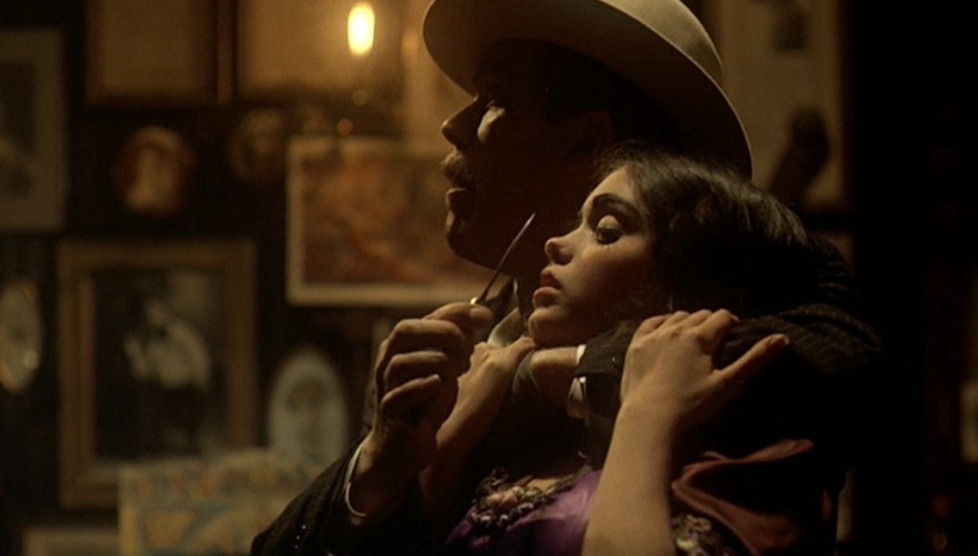
Watching this scene on my analog blurry (and cropped) VHS dupe, the bullet holes Vito makes in Fanucci's head and white vest in the infamous vestibule scene seem absurdly tiny for his massive bulk. When shot, he whirls around like a puppet whose master has tangled his strings; his mouth all a- grimace, a bit like Monotsatos, the evil servant of Sarastro, in Mozart's The Magic Flute. And like Monostatos, from a mythic archetypal vantage, Fanucci too is an 'evil servant' - he's chosen personal gain over altruism and what's worse, he thinks that all he wants is a little love, a little respect, just enough to whet his beak.

In the muddy 90s, this section of the film always seemed to be popping up late at night when I was reeling from the effects of some mind-bending substance (I think it came on after 'Psych-Out' on my VHS), and Fanucci's face looked on my blurry VHS like a grotesque theater clown, His last gasps, a mix of profound awareness, surprise and seeming attempts to react in a heroic manner, are all undone by his rapid loss of blood and bodily functioning. He tries to snarl and chokes on it. He realizes, it seems, in a split second, he's going to die before he even gets to spit out a single syllable of some defiant curse at his killer. At the same time, seeing this while in the post-peak period of an LSD trip,  thrust outside the reach of the linear space-time guardrails, we too are unable to give full expression to the intense sensory input one is experiencing in the dark auburn Gordon Willis lighting of the hallway that is the late night of our lives. We all have our Fanucci moment: the death of a loved one, a brutal break-up, a car accident, or taking a whole tab when you should have taken a half, the question is, what do we do with it? Do we cower, or do we stand up and dissolve into the ether like a man, a blood-soaked, pain-wracked but still standing mobster? It doesn't matter to the world, but it matters to us -well not even us, and that's what's so freeing, so terrifying, yet so comical.

It's interesting also to note how Fanucci's death scene mirrors the opening of this particular Vito period segment: it begins at the theater, with the poor Italian immigrant opera singer threatening to kill himself (above) because he just learned his mama is dead back in Naples. In the scene immediately following, Fanucci steps backstage and threatens Vito's skittish paisan's alleged girlfriend for her papa's box office money.  Meanwhile the character onstage in the play has lost his mama, but what's really got him down is the realization his tie to 'home' in Italy no longer exists, Mama Mia! We never see the mother die - it is only a letter, a signifier of something he'd otherwise not know about, just as the idea of 'the Black Hand' doesn't really exist beyond the imagery conjured up by Fanucci. Note that this scene may have been based on a real life case involving Caruso:
It wasn't uncommon for a child to be kidnapped and a severed finger delivered back to the parents to convince them to pay the ransom.  In 1905 a Brooklyn butcher was gunned down in his shop for ignoring an extortionist's demand for $1,000.  The famous opera tenor Enrico Caruso paid a demand for $2,000 when he received a threatening letter signed with a black-ink palm print.

There's the Black Hand cultivating wives' tales with their propensity for violence and then there's that old wives' tale of the LSD user eating a live cat for the 'experience,' a fable I'm not sure I believe so much as remember from my halcyon days. Not that I did, but while you're peaking even a stalk of celery can seem like you're eating a live cat. You can hear the screaming in the crunch, feel the claws in the severed tendrils of the inner stalk. The piece in your hand is like Rhode Island being unmoored from the North American continent, like Jupiter adrift in space; every gesture leaving trails that make it seem like you're wielding a dozen arms, like Vishnu on a bender. In the amber dimness of the apartment doorway where Fanucci is gunned down, a similar collapse of time and space occurs, making my many views of it under the influence in past decades no mere accident. What collapses is not just a man, but the distance between the busy throngs of Manhattan and the Catholic ceremony going on outside in the street. The old world theater, with its constant shuffling of crowds in and out during performances, collapses into itself like a dwarf star, shrunk away into nothing but a few red holes in a white suit. Every time Fanucci dies in that streaky VHS dupe, even if I'm not having a bad trip on too much acid, I still feel the bullets; I burst out laughing from my chest at his grotesque expression, at the bewilderment and anger pulsing out of his face and mine, the realization in the second before he dies that he'll never get to make his last macho boast, his last beak-whet, his last salut.


Thus the Fanucci murder sequence is  the LSD breakthrough moment, the hinge on which turns the wheel that cuts off the head of the imprisoned delegates of the old world, the quintessence of what I like to call "The Dissolving Father" of 1970s cinema.

The concept of the dissolving father is best elaborated in two stages: before and after. The before is the Mad Men era of JFK, the authority figure the father who enjoys the finer things --smoking, women, and martinis-- but who is also a family man at a time when that meant being a provider to a housewife and children, and maid, and maybe gardener. He must be a benevolent and canny ruler who can mix business with pleasure while asserting his dominance without tapping his manly reserves. His womanizing is part of his charm and so he is always partly exposed to judgment, but society hasn't caught up with him yet. He is silver fox-stage Cary Grant or Gary Cooper, mixing drinks in their state of the art Manhattan bachelor pads (the wives are up in Westchester) for girls young enough to be their granddaughters. 


The after, the historical finish of the dissolve, occurs in the 1980s, with all such behavior in our leaders thought of as suspect and the attention turned to an endangered child--poor Vito alone on the boat to America--vulnerable to predators because both his parents work or are dead and so en absentia, the grotesque 'anal father' of Freud and Lacan returns from the shadows, a patched-up Fanucci unaware he's about to get re-punctured by his hockey mask-wearing bastard (or Cimmerian barbarian) 'other' son, the lost prodigal who's been in gladiator school. The only survivor of this 1980s purging is the 'final dad' - he mirrors the slasher movie 'final girl' in his sexless androgyny. To survive he makes his voice high and effeminate when he talks to his kids, deferring power to the mom in all things, a meek co-breadwinner terrified of being rejected by his offspring to the point they have no other choice. 

The dissolving father is the tragic figure of the 1970s, his once inarguable power now slipped away. The institutions he used to signify are now little more than meaningless totems.  Of course this is supposed to happen anyway if you are to fully mature and able to become the father, recognizing it's not a trap or a duty but a symbol, something you represent in the lives of others but don't actually have to 'perform.' In LSD parlance, you become 'experienced' and hip to the whole cosmic flim-flam. It's as if there are two--you and your dad-- in a sealed room, and then just one. But like Poe's William Wilson, or, say, Scanners, it's not like you are still there, and yet neither did you leave. So just how did you absorb the other person? What was the alchemical formula that dissolved you both, did you get absorbed into the 'Father' or did the father get absorbed into you?  When you put a murderous old world Italian crime boss and an innocent (as far as killing) but canny new world upstart into a vestibule, and only one emerges, didn't both really die?  Or didn't you realize, until this very day, it was Barzini all along?


Historically, the father dissolved as a result of changing dynamics in the workplace and at home. As the suburbs became more and more isolated, the nuclear family was more and more cut off from older generations. The outer world grew colder and more hostile. With the arrival of cable TV and VCRs, the family's lack of direct participation in each others' lives reached new heights. Since both mother and father now have to both work all day, the children grow up watching TV, and if the father comes home at all, the best he can do in the way of demonstrative mastery is change the channel from cartoons to the news - an effective display in the 1970s when there was only one television in the house - but by the 1980s we all had at least two, so we kids just trucked it upstairs, fatherly bonding averted. Though it is certainly accidental, this loss is mirrored brilliantly in the arc of the Godfather films. The cleansing fire grows out of control and at the end leaves only dead trees. Fanucci is the old world father, makes a grandly conspicuous show of his connection to the people; he waves and nods to the crowd as if everyone is listening to him, even though we never see a single person do so, he is the anal father of Lacan, the devouring primordial father killed by the sons for his hogging all the women, enjoying conspicuously, Above him stalks Vito along the empty rooftop, alone, the grim chimneys and windows like fortress battlements or tombstones, a place no one has bothered to 'fix up' to look-a nice, a place without symbols and ceremony, where all traces of pleasure and decadence, anything to cloud a man's judgment and purpose, have been excised. The Corleone family will always be on the DL, restrained. We never see Vito laugh or crack more than half a smile. 


To bring it back to The Magic Flute, the murder of Fanucci is akin to the passage of the lovers through the test of Sarastro: the journey through the underworld with the writhing figures menacing from all sides, but are they even really there? Close your eyes and no monster can scare nor vixen lure you. Vito realizes the same thing, that Fanucci's threats just the phantoms of the underworld, all he has to do is be secretive, remove himself from the public eye, and kill the dragon and then he inherits the burden of authority. He becomes the shadow Fanucci, no one can kill him in a vestibule since he lays so low, so discreetly. He has been given the secret, which is of course that there is no secret.  There is no special power that comes with the job of 'Ultimate Signififer', only the belief held by others that there is such a power there, behind the visible. Vito's offering of the self as representative of order, as someone who is not afraid to stand in front of the chaotic void, pull back the curtain, and take over the wizarding. Rather than a big scary projection, it's his surface humility --his steely reserve and secretive 'normal guy' nature -that instill confidence there is a deep power structure below his feet--even the witch pays him, or her monkeys might suddenly go on strike, or wake up with her shattered crystal ball under her sheets. Best to not find out whether that would really happen.

Only you, the new void stander, knows the truth: old Oz has actually been dead for years, and you're the one who shot him! You see the blood on your hands, or at any rate, in your hands, swimming through the blue veins, ever ready to come out and turn red in the grimy air of Emerald City. The darkness always is waiting to engulf you, always just a broken bulb and napkin-wrapped pistol away. But the others, the small fry, your familia, they see only your iron skin. This gives them the assurance they need to go on --it's worth any amount of secret violence to prevent your loved ones from knowing what you know, the full measure of your/the world's horror, is it not?


LSD reveals all these things, because it draws back every curtain and if you cling to outmoded morals and fear, pay Fanucci or get all paranoid about the passing cops, you're headed for a bummer trip, little better than the kid who's afraid to cross the street against the traffic light even though there's no car for miles, or refuses to jump off the cliff when all his friends below are splashing away without him, citing the lack of a lifeguard. Authority is a placebo, as all the LSD kids know this, and so does Hyman Roth. Michael, we're bigger than US Steel. You'd never guess Roth was rich the way he lives, or that he hates the Corleones by the way he acts. There's no need to be mean or a braggart when you're fully awake, by which I mean ever-aware of your own mortality, and that of others. There's so much blood out there, all just waiting to be let. That it stays where it is, most of the time, is a miracle. To paraphrase Joni Mitchell, if you manage to know what you got before it's gone, you realize you may have to steal everyone else's just to keep yours from being stolen away. What you got is a parking lot over paradise, but the question is, who gets the contract for the concrete pouring??


Fanucci is the old world type of deep oak patriarch, the one called 'the terrible father,' the odious ruler who makes a spectacle of his own enjoyment, who insists on being seen enjoying. Witness his conspicuousness at the Sen Gennaro festival at the puppet show when he makes a joke about it being "too violent" for him, and turns around expecting the whole crowd to meet his gaze and break out in approving laughter. When they don't there's a flicker of shame that passes over his face, before he blocks it away with a smirk and moves on. This grandstanding exposes Fanucci as an easy target for a man as streamlined and rid of all personal pleasures as Vito, who has developed the mix of exterior compassion and the canny ability to use the granting of favors as a kind of paperless, untraceable, untaxable currency, and who has mastered the ability to repress anger and then kill in cold blood. This is the 'gift' of bravery, and it's what any successful space cowboy also has, for he must keep a straight face when, for example, his walls are crawling with mutant tentacled wallpaper pattern demons and has to walk past oblivious parents in order to get to the sanctuary of his bedroom, and they're bound to come in and pester him with banalities and he knows one wrong word and he'll be laughing hysterically on the floor while they phone the rehab.

The look of a cobra, couched

CODA: What takes the old world's place? We never really know until it's too late, and Vito's son has distilled and distorted the teachings of his father into remorseless sociopathy, all the familial sense of togetherness totally severed, by Roth's machinations and his own poor choice in a wife (Diane Keaton, ever thinking she can snap Michael out of his 'Sicilian thing' with a New England schoolmarm scolding), the spaces of Las Vegas and Tahoe relative to the crowded earthy space of NYC and NJ. It's a mark of the jet age that families no longer live together in their old neighborhood, but spread out to new horizons and eventually reunite only at Christmas. The values of the Vito age aren't tangible, apparent, easy to bottle can can, and so dismissed. Thus our sense of family, happiness, and wholeness, paradoxically shrinks, dissolves and dissipates, the more our new world expands, solidifies and devours. The ultimate signifier. disappears with only a few shots from a flaming napkin. But the red dots on the blotter that set you free, and threw back the curtain on the bullet-riddled corpse of your paternal Other, are now wearing off. You're coming down, down... and somewhere, up the street, some angry youth is making his way towards you, stalking you like a panther from the high ground rooftops. When you see him--that murdering little snot-- admiring his dilated pupils in the mirror, all young and stupid, don't snort in derision. He's about to pull back your wizard curtain and blat blat blat. So get out the gift bag, pass him his diploma, and then die... die like a real-a Fanucci! 

Related Posts Plugin for WordPress, Blogger...