Friday, November 25, 2011

Men Who Are Frozen: FOREVER YOUNG, CAPTAIN AMERICA, A MATTER OF LIFE AND DEATH

Top to Bottom: Forever Young; Captain America; Matter of Life and Death
Is FOREVER YOUNG (1992, top) in its blessed ignorance of the 9/11 to come, a sequel out-of-time to CAPTAIN AMERICA: THE FIRST AVENGER (2011)? Taken together they form a Moebius strip: AMERICA begins with a psychedelic steampunk abstract version of WW2--replete with octopus swastikas--and ends with a de-thawing in 2011;  FOREVER YOUNG begins in 1939 and ends in the then-current moment, now our own past: 1992. Both film's stars death defy (Mel Gibson in YOUNG is a test pilot, Captain America is a commando) and both are deeply frozen in their (and our nation's) prime. One is motivated by grief, one by game self-sacrifice, but either way a part of what's best in the American mythic male is flash-frozen with them.


In this way there's also an echoes in both of Powell and Pressburger's A MATTER OF LIFE AND DEATH (1946). Bombardier David Niven isn't deep-frozen in that one, but he does hang suspended between life and death in a frozen ice court/operating room after he has to jump from his burning plane without a parachute. Moments before he jumps he falls in love with June (Kim Hunter), a radio operator with Bomber Command, trying to guide him in through the fog. Their chemistry in their scene is terrific -- they aren't really in the same scene at all, or even the same altitude, but they convincingly fall in love just the same. She loves his poetry-even-in-the-face-of-certain-death gallant sweetness (he dictates a cable to his mother to her) and when he asks if she's in love she notes "I could love a man like you, David." tears in her eyes "I love you, June. Your life and I'm leaving you." - And just like 'that' - they're in love - They're both in love with a voice, and with the pregnant mythos of the moment, a flame they agree has struck in this vast opaque fog-enshrouded darkness. In wartime there is no room for waffling and being coy. When love strikes, the victims don't wait to give it their whole selves but grab on tight in great spasms of each-breath-may-be-your-last intensity.

After surviving he washes up right on the beach where June is cycling home - no coincidence, as anyone who's been in love and found fate thrusting themselves together over and over has experienced. They recognize each other without even needing to hear each other's voice. Is it a dream? We soon learn he was not supposed to survive. His psychopomp lost him in the fog. The thought of having to die a second time and not be with June is too much for Niven to bear, though his the heavenly soul-bearer consoles him he may get to meet her again... when she's 97 and comes up to the heaven at least. If he had managed to get a different operator at BC, he might not mind dying at all. But 97... she won't even be the same person.

So the age thing comes up again. Men are forever young, but the women age, and you come to heaven looking the same age as when you died, so growing old on Earth isn't always the smartest course if you're vain. So the man puts himself into a nice mylar bag with a non-acidic tape on the flap, to stay in a crisp NM condition. In keeping himself on ice he avoids the long-term wear and tear that erases the youthful bloom from the woman. And what happened to the lady Captain America (Chris Evans) left behind in the 1940s, Peggy Carter (Hayley Atwell)? I appreciate her hot Brit sass but unless I missed something in the credits, by the time 2011 rolls around, she's presumably wicked old, or dead.

In1992, meanwhile, Mel Gibson lives the geriatric-romantic fantasia. He races against time to find his old bitty. What was romantic in the early 90s becomes in 2011 not even worth asking about --a mere regret. Captain A. notes to Nick Fury, Agent of S.H.I.E.L.D (though Fury too, presumably was frozen since he fought WW2 as Sgt. Fury and the Howling Commandos), "I had a date." According to the Comicvine, Peggy Carter is "residing at the Larkmoore Clinic due to old age and possibly Alzheimer's disease."

You think Mel would have let that stop him?


Luckily for Mel's lovelorn pilot he starts to rapidly age soon after he's thawed from his (co-invented with George Wendt) cryogenic prototype. Thawing him, by accident, is a plucky young boy (Elijah Wood) who helps Mel reach his eighties right as he reunites with his lost love, who just happens to have a landing strip-sized front lawn. For Captain America, however, there can be no such strip and no such Wood. Seventy years is just too damned long to pick up the pieces. The next time a WW2 'greatest generation' member awakens from the ice, there will be so much distance between his waking date and WW2 that his lover will be long since turned to dust. And so it is on this past Thanksgiving I celebrated via CAPTAIN AMERICA: THE FIRST AVENGER a country built on the urge to escape... from religious oppression, from time, from the ice (or into it) and, most importantly, from girls our own age.


But as Americans, we don't stop there. Even in our new safely-escaped-to haven we know that to be free and safe and cozy we must go deeper still, up the tinsel-and-celluloid palm trees, into the pulp novel of the cocoanuts and comics, into 3-D and Cinemascope, ever searching for a new excuse to get out of the house over the holidays, to escape from prying parents, screeching spouses, needy, nagging children, loud neighbors, lack of air conditioning. The theater is where we escape on those horrid summer days when our AC gives out. Is it not so? Freezing ourselves, as Americans, in film, becomes the new sky-diving, the new crack, the new Coke, good as a quart of bourbon and a W.C. Fields tape. You just drink and watch until Fields' double vision quadruples, and when you wake up technology and changing tastes and inflation have altered the landscape so drastically you may as well be on Mars.... hangover averted.


In all three of these 'frozen man' films it's hard to scrape together even one worthy bad guy to compet with the real enemy: time. Hugo Weaving's Red Skull works towards RAIDERS OF THE LOST ARK meets WILD WILD WEST/JONAH HEX-style world archeological domination as best he can, but since he kills his own Nazi overseers how bad can he really be? He's more into world domination than genocide, so is he any worse than, say, Stalin?

Captain America of course can't understand that kind of high-end politics. His very name and uniform color was always a throw-back to the dawn of comic books, the 1940s, when nearly every superhero tangled regularly with the Axis, including: Captain Marvel, Captain Midnight, Captain Blackhawk, and so forth, and the colors of their uniforms needed to be bright and distinct from the backgrounds for the crude newsprint color printing process. In order to preserve his generic 'every man superhero' quality for modern times-so he can magically do battle alongside the Avengers--without making him seem hopelessly square (ala DC, rather than hipster Marvel), he needs a reason he didn't lose his integrity, the apple pie gleam. But it's a cop-out. He froze because he couldn't develop a sophisticated approach to relationships, political and personal. He was still working up the nerve to hit on Peggy before a chance to sacrifice himself bravely came along and let him off the hook. "Phew!"


And seriously, does anyone really love Captain America? No. He seems like he was created by some drab civics committee to deflect flak about juvenile delinquency. Comic book fans in the 1980s loved, as I did, the Fantastic Four when drawn by Kirby or John Byrne. We loved the X-Men as written by Chris Clarendon. We loved Frank Miller's stint with Daredevil, but Captain America (I presume since I never read him, even though I had a complete run of The Invaders) could never get too dark. He stood for something, and thus seemed wooden, like a support rod for a tomato plant.

And some might say that--in the modern light of things--the baroque steampunk version of WW2 is, in vaguely disrespectful, 'too soon'. In the 1940s comics it was okay to give Nazis gigantic death rays, but it seems now to diminish the true heroism of the men and women who fought and/or died in that war-zzzzzz. And when I see villains wasting time staring at glowing green or blue power sources I begin to think of Red Sonja (1985). Man, I knew that comic fairly well, too, and I really wanted that movie to be good. But it wasn't. Each bad scene and haircut (they gave her a mullet for god's sake) stretched time to tedium where freezing oneself to get to the end credits faster seemed to be already happening, but in a botched version where we're conscious the whole time. Red Skull fares only moderately better in that regard. Red does not mean hot in these cases.


Like Captain America, Red Sonja even as a comic character seemed exist solely to indulge some base instinct (patriotism as the last refuge of the sexually frustrated). Perhaps it is the mark of pure quality when the motivation for a character's creation isn't embarrassing in its committee-conscious contrivance.

On that note, a little background: In the summer, in the early 80s, as a sulky 13-16 year old, I used to put my feet up on both sides of the central air vent in the corner of my room, letting my crotch cool from the blasts of arctic frost while reading all the above comics in my bean bag chair, as well as all the DC war titles like The Unknown Soldier, Sgt. Rock, All-Out War, Weird War Tales, and Enemy Ace. What I mean is, I never had time to have a child thanks to permafrost sterility. And all my old real life crushes and lost loves now since aged into dreadful moms and withered forty year-olds. It's enough to make me wear a beard, and a mask of a younger man to cover my too-late completely blushless mummy skin. If I freeze myself until their grandchildren are over 38 is it skeevy to hit on them when I am woken? These are no longer just the concerns of 140 year-old hunk vampires, but of cryogenic America, a country built on the freedom to defy authority, natural aging processes, time, space, heat, humidity, and the lessons of history. 

Freeze me, then, Big Red Sonja Skull, so I can miss Christmas and airport anxiety and just magically get to the time when that AVENGERS movie is finally released... as an eye drop of digitally encoded biotechnology that lets me dream it in 4-D. Freeze me, December, and let me remember a time when I, too, felt human... and 22.

When I was 22, I had a very good year.

Prepare the blue ray and let's pull this spinning plastic disc planet to a stop. But.... wait...
Lois Lane crawls through the bushes,
looking for her Indiana Jones blue pill, but
there is no blue pill. That's what no one told Neo.
The blue pill was a sugar placebo.
There never was a choice of not burning in blushing bushes of idiot reject hell.
Every decade spent hiding in the cold, reading comics while we slowly froze our sperm just postponed our spasmodic initiation,
and now, alas,, the girl we finally worked up the nerve to ask to the prom is too old to dance,
and long since crumbled to dust, or worse, become your mom.

Xmas is coming, son, the least you could do is hit pause.

Thursday, November 24, 2011

Thanksgiving with the Matriarchy: THE DARK SECRET OF HARVEST HOME (TVM-1978)


This rare and delightfully strange TV movie, based on the Thomas Tyron novel, makes fine post-autumnal equinox-style viewing. It's all in the name: harvest, home, and it's about family, and agrarian matriarchal cults that bring back the old ways via agrarian paganism... but.... I've said too much already. They may be listening, the cornucopia held up to the door to hear my whispered clacking.

Anyway, 'tis a strange feminist-phobic film of some fair equality about the evils of both city life and the older, simpler ways. David Ackroyd (no relation to Dan) stars and sounds just like a hopped up Cassavettes as the nosy parker who can't stop investigating the mysterious death of some shunned girl seven years past. (He's an artist, writing a book about the place). Normal New England life carries on without but cross the covered bridge into "the Coons" and you're in another world. Co-starring a young Rosanna Arquette as the daughter, quick to drink the Kool-aid so to speak, and Joanna Miles as the wife whose years of expensive therapy can't compare with a few simple home remedies from the town's matriarchal leader, the "Widow Fortune" (Bette Davis, having quite a time of it). Similarly Arquette has asthma in the big city but viola - one massage from Fortune and she's better than any inhaler can make her. TV vets like Linda Marsh as a neightbor, Lina Raymond as a sexy single brunette with scary eyes for Akroyd and a 'touched' daughter with second sight who picks the corn maiden and corn king every seven years. Michael O'Keefe, rocking a great New England accent, plays the first choice for king, but his fancy longing to use tractors instead of horses proves his undoing. 

I haven't seen it since I was a kid, and I never saw the end. Mother made me go to bed beforehand and I didn't dare displease her. I missed the ends of countless movies in those hard years, a symbolic blindness all my own. But I heard the end from mom at breakfast, and in this way I never forgot THE DARK SECRET OF HARVEST HOME.


It's a long slow burn over two nights --we get lots of weird little touches but the horror elements do take their time to arrive. What did the blind neighbor--once an outsider like Akroyd--see too much of?  Who cut out the tongue of the nosy ragman who keeps snooping and poaching in the forbidden woods patrolled by trigger-happy bootleggers? Why do women run everything like some Neil LaBute nightmare come to life? Why is Akroyd's tone-deaf ignoring of the idea that some secrets are better left unknown not result in a sooner shunning? It all builds to a slow relentless head on 'Harvest Home' the big secret ceremony of which only women are invited and no man may witness, except the corn king, of course. 

This wasn't the only late 70s matriarchal TV going on in the late seventies - there was also STAR MAIDENS (A 1976 British-German TV series about a planet where women dominate) and ALL THAT GLITTERS (Norman Fell's evening soap with a similar theme). Is it pure coincidence none of the three are on DVD, or even VHS, or are ever screened? Same goes for movies like FRAULEIN DOKTOR. What are the men in charge of shepherding TV and film to DVD so afraid of?

Is it the perfect family film to see on YouTube while your dad watches football, or your grandparents aw gee over the family fare that chokes TCM on holidays? It would. Long live the sisterhood of the scythe!

Tuesday, November 22, 2011

Twilo When I was Young: TWILIGHT: BREAKING DAWN Part I

"Sexuality is a murky realm of contradiction and ambivalence. It cannot always be understood by social models, which feminism, as an heir of nineteenth-century utilitarianism, insists on imposing on it... It cannot be "fixed" by codes of social or moral convenience, whether from the political left or right. For nature's fascism is greater than that of any society." - Camille Paglia, Sexual Personae
"I can't help it / if you might think I am odd
If I say I'm not loving you for what you are
but for what you're not." -- Bob Dylan, "I'll Keep it with Mine"
 Haters love to dismiss the Twilight films, sight unseen, but they do so at their own peril. The New Sincerity, you can't escape it, any more than my parents' collective rattletrap beachfront condo can escape the wrath of 2012's rising tides. Will you be drowned in the pool of tweenage tears, or stand up and be counted, neck seared by the puncturing flames of angst along the water's edge? I have my answer. I am walking on air.

When I flew down to visit my mom and grieve my late father this weekend, pictures of all white jogging outfit-clad Kristen Stewart rubbing her flat white belly were all over the USA Todays and NY Times papers floating around the airport. In the rush of pressurized cabins and the endless boarding calls, these pictures took on an unheimliche aura that I found irresistible.  Then, watching ECLIPSE and NEW MOON on my mom's huge flat screen in our off-hours, I could appreciate the films' sublime mix of gorgeous scenery, operatic brooding, and mythic family dynamics. The latter in particular is so strong --the sense of belonging or wanting to be belong, or about to be initiated into a pack of cool older kids--and so central to any alienated youth fantasy's success you'd think it would be a regular feature of teen movies, but you'd be wrong, and that in itself shows what idiots most filmmakers are. Like overpaid hack Joe Ezterhaz's Catherine Trammel, who is given Lecter-like powers of manipulation thanks to her 'Bachelor's in Psychology', Mormon author Stephanie Meyers wins by default, because her fantasy world is genuinely Jungian, not Freudian, not smarmian, not dickheadian. It never snickers or leers, and even when confronted with a bunch of muscled Native American males, there's never a wolf call. Just as the douche bags and dillweeds never make it past the chicken wire fence of our psyches, so too is the Pacific Northwest of Meyers' imagination a perfect mirror of a genuine dreamworld. That it's a 15 year old girl's dreamworld and not mine matters not. In dreams we are all ageless, and gender is as flexible as set and setting, we all dream Tiresias. All that matters for true myth to function is that the chivalry of Camelot meet the wild woods of Hans Christen Andersen; that the nightmare projections of lonely girls making out with their tear-stained pillows in the dead of night sometimes come to life in white-as-a-sheet complexioned animae; that cool music by Bon Iver and Mazzy Star-studded chanteuses find ultimate visuals in the misty mountain hops of the Pacific NW.


As an older viewer I identify neither with the Edwards nor the Jacobs, but with the moldy old-growth forest bearing witness to their duels; the Merlin-Green Man bearing fathomlessly patient witness to the unfurling events from the vantage point of the fern camera. And since most straight guys in their 40s like me wouldn't give the Twilight films a viewing even if they were forced to on a plane, I take it as a duty to flaunt my championing, even as I question the 'rightness' of it. I'm not sure I'll ever actually pay to go see Breaking Dawn in the theater, but I salute its existence eventually on DVD rental. And when I'm old and enfeebled like T.S. Eliot I'll probably buy the complete set on blu-ray to watch all alone in long sittings when I'm emotionally disturbed and afraid to leave the house. But until then, come with me into my past writings on this great series. First, ECLIPSE:
"...the realization of modern myth requires teenagers to resonate, as all fairy tales involve the very young. Never forget that in the days of King Arthur, the oldest person–Merlin–was probably in his early 30s...  Considering the sexist neoconservative consumerism-product placed orgasm-oriented flicks that predominate so-called ‘women’s pictures’ or rom-coms, TWILIGHT alone understands the supernatural power that can be had in rejecting bland hand-me-down values. The pro-virginity aspect is the 21st century Antigone move, the way not being a virgin was in the 1920s. I know very well the way a woman you haven’t had sex with can inspire like no other muse, and the way a 100-year old lecher in a teen idol’s body can wreak merry havoc on pouty-lipped teenager brain stems, and I know these things to be true, and that as an artist or writer, that kind of inspiration should always trump the pitiful and misleading call of the proprietary orgasm. Edward knows it too…. sigh (Bright Lights, 1/11)
Then, on the first two films and the general 'concerned mom' backlash over the second film I wrote the feature length (for Bright Lights Film Journal)

"Eternal virginity via sacrifice in the Twilight-verse thus equals the preservation of youth, of sparing a beautiful creature the passage into the world of cruel, devouring nature. This is essentially what Edward works towards in refusing to punk Bella out to the vampire way of life, to prevent her from having any traumatic or otherwise significant experiences, to keep her isolated from "the real." Yet the imaginary level he exists in hinges on promises of danger, sex, and being turned into a vampire for it to hold any interest at all. For Edward to, in a sense, "exist" in Bella's life, she must stay virginal; the blood he drinks is supposedly from animals or something, but it's clear his spiritual power is derived from keeping Bella sustained in perpetual adolescence." - "Someone to Fight Over Me." (Bright Lights #68, May 2010)


I bring in this Neil Diamond song as 'Shilo' is an excellent anima example, Shilo as the Edward to Neil Diamond's Bella: "When no one else would come / Shilo, you always came."And of course, Twilo (left) was a once very popular, now closed, mostly gay but extremely hetero friendly all-night dance club - the place to go when the rest of New York was finally closed, and the pink dawn was breaking, and you were still too high on ecstasy and/or cocaine and/or acid and/or shrooms to consider going to sleep.

That breaking dawn vibe of your heart beating like mad at the thought of bedding one of the three girls still up with you and how to sneak away from the others, and where the hell your keys are but you're so high you don't care, that's what the Twilight films conjure up for me, that and the aching soul vibe that my mom's LP of Neil Diamond's 12 Greatest Hits gave me as a six year old in the 1970s, where Kate Jackson was my Shiloh, and she always came, after I had to go to sleep though (Charlie's Angels came on past my bedtime)

And, from 1/7/08 (The Beautiful and the Darned) after the first film came out:
"TWILIGHT it must be remembered, has nothing to do with "real" high school or "real" horror films - it's a fantasia of maturity deferment; a snapshot of how pregnant with dangerous, giddy possibility the world seems before one gets their first "bite." It's permanently frozen at the moment of rapture/rupture, right before the disillusionment of the first sexual experience (see also: THE VIRGIN SUICIDES) with a guy who promises you the world, then splits. The idea of an ageless vampire here becomes an excuse for the eternal virgin prepubescence; an eternity dwelling at the edge of the cliff that all your friends are now beginning to dive off of (and looking kind of busted when they resurface, if they ever do).

"Aren't movies primarily vehicles for escape? In the case of TWILIGHT, what the girl demographic is escaping from is their own wooden stake penetration, the pink dawn of the mighty crowing cock. Who can blame them? I remember my revulsion at seeing hairy 1970s nudist magazines being circulated in elementary school. Could people really be doing these things with their... ? It seemed unsanitary, violent and most of all, painfully humiliating. The giddy night of the prom starts out flowers and anticipation, it ends up pig's blood and Trip Fontaine splitting before you wake up in the wet grass of the football field.

"What eased the fear of this sullied maturation when I was of TWILIGHT age? Pamela Sue Martin as TV's NANCY DREW, Kate Jackson in CHARLIE'S ANGELS...much of TV at the time fostered a dependable sexlessness, the promise of an eternity of hand-holding and chaste confessions of love and adoration, as opposed to a humiliating orifice merger."
  Finally, from 1/20/09, Tortured Longing is the New Coke:
"TWILIGHT fuels the fire of sadomasochistic alchemy wherein torture becomes pleasure, denial becomes acceptance, submission becomes freedom. Through recognition and release of the associated fear, not having becomes having it all. The girls of TWILIGHT ween themselves off desire through recognition of its impossibility. They’ve been set free, like Jonathan Pryce at the end of BRAZIL, looking out at the clouds while one of his torturers (Michael Palin) sadly realizes, “he’s gotten away from us, Jack!” These TWILIGHT girls have gotten away from us, Jack. They’ve found a streak of neo-Victorian repression that leads them clear away from Big Brother and his sublimation dream wheel."

And PS - there's nothing gay about... THE IMMORTALS!

Wednesday, November 16, 2011

Pre-Code Capsules 9: BEHIND THE MASK, DR. X, TROUBLE IN PARADISE, BLESSED EVENT, THE BLUE ANGEL

BEHIND THE MASK
(1932) Dir. Francis Dillon
***
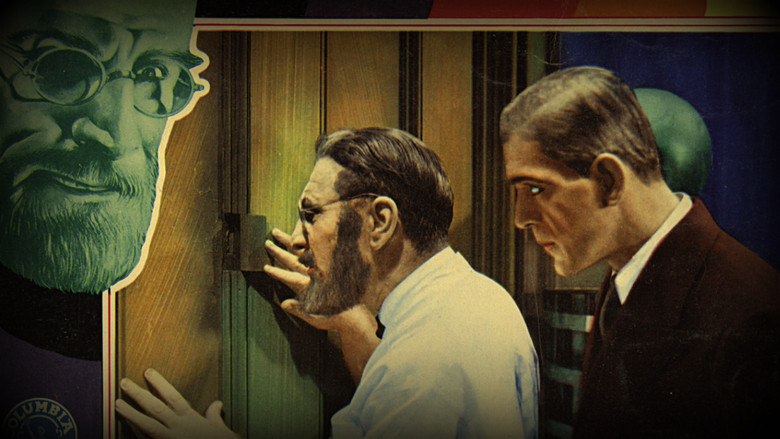
The great forgotten Jack Holt (Tim's dad) plays a terrible federal agent in this pulpy thriller. Endangering his witnesses and letting himself be snowed over by any old disguise or pretense, Jack's saving trait is a masochistic yen for deep undercover work, enduring a stint in jail and posing as a convict just so he can win the trust of nervous flunky Boris Karloff and thus can score a job in a racket that hides dope in caskets and is masterminded by a shadowy doctor. Edward Everett-Sloan factors in somewhere and there's a vast spy network full of dark-eyed bit players. Constance Cummings tries to save her dad, a doctor in 'a lot of trouble' and she's capable with a .45, which is a switch for these things.

It all climaxes in a scene where the masked evil doctor makes a great show of refusing to give the tied-down Holt anesthetic for a planned vivisection, because he wants him to experience the magic moment when excruciating pain becomes ecstasy. Batailles-esque philosophy and dimestore pulp come together within the casting confines of the Universal horror stock company! But it's not until the last five minutes that it approaches the cock-eyed madness of any five minutes of DR. X (1933). Before then, well, coincidence and imbecility, the foundations of any hack job adventure tale, reign supreme. Lots of cool atmosphere though, via NOTORIOUS cinematographer Ted Tezlaff.

BLESSED EVENT
1932 - Dir Roy Del Ruth
***1/2

If you've been always a bit cold on Lee Tracy (as I have been for many years) this is the film that will make you warm up. As the quintessential fast-talking brutally candid gossip columnist, he's like Jimmy Cagney crossed with an adenoidal scarecrow, singlehandedly ushering in a new low in journalism via the ratting out of 'blessed events' - i.e. children born less than nine months after the couple's been married, or outside of wedlock, or etc. Remember when that was a scandal? Me neither. But Tracy sure does wreck a number of lives. In a staggeringly well-played monologue he scares off Allen Jenkins' mob hitman by telling him about an electric chair execution he witnessed; he's so good he brings Barrymore in TWENTIETH CENTURY to mind, his imitation of the wobbly walk to the chamber, voice cracking with hysteria, body spazzing sharp and speed freak-jerky as he describes the anguish of waiting in hopes of  a reprieve, the shaky steps of the last mile, puking up the last meal, the rigor mortis and hair burning. It's the sort of thing that only the pre-codes could delve into, and this delves so deep you're quaking along with Jenkins by the end, and all traces of your dislike of Tracy have been obliterated.

Roy Del Ruth directed and the rapid patter pace is awesome except when Dick Powell's lame songs slow things down. Edwin Maxwell, Ned Sparks, Frank McHugh, Allen Jenkins, Ruth Donnelly, Jack La Rue, and Rita Cunningham all bring plenty of moxy too as either Tracy's cronies or victims. There are references to Jews, ("Do you know many Jews there are in New York?" - "Oh, dozens!"), Amos and Andy, and a wild-eyed girl 'in trouble' begging for a reprieve from Tracy's damning pen. Played with deranged ferocity and desperation by a ragged-looking creature named Isabell Jewell (left), she's pretty unforgettable. It all coheres into a whipsmack pre-code that makes your scalp stand on end. PS - You will also come out of this film learning what 'nadir' means, and may have a hard time readjusting to the dumb hack substitute for 'wit' passing as dialogue elsewhere in the world.

TROUBLE IN PARADISE
1932 - Dir Ernst Lubitsch
****

It took awhile for this pre-code Paramount to resonate with me, but now I dig that it doesn't 'Americanize' the dialogue like so many lazier Hollywood films, instead playing up the linguistic difficulties where everyone in Europe is constantly searching for the one language each of them knows just a little bit of, as in the excited way the Italian hotelier translates E.E. Horton's story of how he got robbed in his room and how this Babel effect makes a suave all surface crook get away with tons of goods.

Many viewings later I love the elaborate conveyance of gossip, so that Miriam Hopkins is getting verification requests from duchesses mere minutes after being spotted in the lobby of her lover by a nosy count. (and it's all rot, of course). While Herbert Marshall isn't Cary Grant, or Melvyn Douglas, or even Ronald Coleman, he swoons well and convinces you through two layers of subterfuge that he's genuinely confident in his sexuality, and genuinely in love with the moon (he wants to see it reflected in champagne) and the women around him are each more beautiful than that moon.

And who wouldn't be in love with both Hopkins and rich perfumier Kay Francis? Hopkins displays her wide, loose midsection proudly in some tight-clinging dresses--she "moves from the center of her cunt," as old Jill Parsons used to say--and I love the way their first kiss on the couch seems to make them slowly dissolve until the couch is empty; and Francis is at her most glamorous and poised, even while maintaining some of the concave androgyne aura she had in earlier films like THE COCOANUTS (1929). As always, Edward Everett Horton and Charlie Ruggles are effete, bitchy suitors; Gustav Von Seffeyritz  humbugs as the chairman of the board who suspects Marshall is a crook. But who would be able to resist robbing Kay Francis?

THE BLUE ANGEL
1930 - Dir Josef von Sternberg
***

BLUE ANGEL might best be understood as the chrysalis between the caterpillar of the silent era's 'deformed circus freak loves pretty trapeze artist' Lon Chaney Sr. plot boilerplate (which Acidemic contributor Budd Wilkins has termed the "masochistic melodrama" genre. See his fine Chaney reviews here) and the sound era pre-code butterfly of the Hollywood Sternberg-Dietrich collaborations. As such it's neither here nor there, like watching Wallace Beery get stuck in the doghouse door trying to sneak out of the cast of MGM's FREAKS to defect to Paramount (though in truth, he went the reverse direction).

Either way, Emil Jannings is a damn unsightly kind of creepy crawler, way uglier and uncharismatic than Beery ever was, and it's clear Sternberg can't stand him, so rather than stir our sympathy, Jannings' out-maneuvered Herr Professor inspires nothing but disdain. His smug judgment of Lola and her postcards (which he finds in his student's schoolbooks) makes his downward spiral far less interesting; his slow motion expressionist pantomime reaches for grand tragedy in a way that makes you think Chaney is down to his last few faces. With his bug-eyed outraged head facing the camera from the same angle over and over, his round glasses and Satanic facial hair swirling, Jannings works very hard at keeping his head always in the center of the frame while his body twists and turns like a big old bug caught in a spider web. But to what effect? Nevah vanted doo.


Shot in Weimar Germany just before her Paramount-ordered nose job, molar removal, and strict diet, the Dietrich we see here could be her own sister, the one who stayed in Berlin mit die schwarzwaldkuchen und bier. And partied with (eventually) real-life Nazi Jannings. But Von Sternberg is in fine form; he lights the Blue Angel club like a crazy expressionist side show and if you focus in on the lighting and shadows as opposed to Jannings mug, it definitely does become the masterpiece so many claim.

Still, more than in any subsequent films, Sternberg's masochism in DER BLAU ENGEL is a downer. Always portraying the suitors of his lovely star Dietrich as buffoons, bug-eyed blowhards, shameless masochists, or authoritarian bullies (or else they rarely speak at all and operate as sex objects themselves, like Gary Cooper in MOROCCO), Von Sternberg's obsessions can sometimes make his films feel like a jealous, angry lover is behind the camera, defacing effigies of his rivals even as his studio bosses insist he cast them (Cooper was one of Dietrich's many lovers). One would normally say of a Paramount pre-code that it's fun and a little sleazy but is it art? But in DER BLAU ENGEL we know it's art, and it's sleazy, but is it fun?  Nein!

Doctor X
1933 -Dir Michael Curtiz
***1/2

Time and digital re-colorization has been kind to the early Technicolor hues of DR. X. What used to look blurry and muddy and depressing now glitters with glowing emeralds, murky pinks and streaks of deep, bloody red that make it like a candy fountain of shadowy death. Fay Wray plays the daughter of Lionel Atwill, hamming fit to storm a barn as the titular Dr. Xavier, out to trap the "full moon killer" amongst his atmospherically-lighted collection of scientific colleagues, each of whom grows more indignant and suspicious the longer we hang out in their labs: Dr. Welles has made a 'study' of cannibalism and keeps a heart alive in an 'electrolysis solution' but his missing arm preempts further suspicion; Dr. Haines was shipwrecked for years on a desert island and his tasty, plump colleague was "never found"; Dr. Rowen studies lunar rays' effects on criminal minds but notes that "the lunar rays will never effect you and me, sir, because we are 'normal' people." Mmm...hm.


And dig the post-modern self-reflexivity of the the climax, with the doctors all chained to their chairs, their pulses linked to vials of blood that overflow like a buzzer at the top of a Coney Island strength tester when they're aroused by the murder tableaux staged before them, just like you in the audience! Scream ladies and gentlemen! The Tingler is in this theater!  The duality inherent in language gets a lot of subliminal attention too: Xavier's outrage over each of the new accusations of his colleagues belies its antithesis: "Dr. Rowen could never never be the guilty one," means the opposite, while Lee Tracy regularly promises not to do something as he bribes morgue attendants and security guards to look the other way. On the other hand, Xavier's grave pronouncements of things like "There can be no doubt about it, gentlemen - this is cannibalism!" are allowed no argument since they carry his medical weight. And now that you're not annoyed by Lee Tracy anymore (see BLESSED EVENT) maybe you wont want to tear his picture apart with your bare hands when you learn he gets Fay Wray in the end. Chained for your own amusement, indeed.

Related Posts Plugin for WordPress, Blogger...