Monday, January 23, 2012

Quilty Makes This World: 12 Tricksters (CinemArchetype #1)


This post commences a series on Jungian archetypes in film and media, wherein we gather an assortment of characters, icons, and public figures who all fit the same functional mold, the better to unravel our iconographical lexicon. The first archetype celebrated here on Acidemic is, naturally, 'The Trickster' for he is the most psychedelic. Just ask Ken Kesey or Timothy Leary, if they weren't dead....Trickster makes this world (by Lewis Hyde).

For sake of polarization of type we've limited this to males, but of course the trickster is by nature beyond gender, beyond personal gain as well. He lives in a state of identity flux, bound to no one persona (though perhaps he can be in service of an abstract cause, like 'the paper') and is seldom on the level as far as sincerity and yet this allows him perhaps greater leeway in his altruistic ambitions, for he need gratify no urge, for him there there is no one persona to 'want' anything. You are most likely to meet him on the road to knowledge, and if a trickster helps you on your way, be grateful but not indebted. And beware: for every two or three favors he gives, one wry screw-over is guaranteed. But you can't just walk away after two favors, what if the third is legit, too? Dude, turns out none of them are favors, they're gin and tonics. He'll confuse the simple and clarify the incoherent, and never justify anything, let alone means or ends. Take Elliot Gould's doctor in MASH for example,who seamlessly incorporates an operation on the child of a prostitute into his Tokyo boondoggle and just as effortlessly employs blackmail of the resident officer to make it happen. He expects no reward from the mom and brooks no condemnation from the Army, he demands neither a freebie nor accepts a guilt trip; he doesn't think ahead or crave validation - he's just a dancer in the Shiva flame. That's a trickster.

1. Peter Sellers as Clair Quilty - Lolita (1962)
"The woman always goes for the trickster, because he cannot be shamed; he is too transparent, always able to drop his 'story' the moment it gains any weight, embodying instead a series of roles each easily discarded for the next. The James Mason types by contrast inevitably resort to violence, for they presume their warped idea of dignity and ownership is an essential right, worth killing over, no matter how abstract. They feel justified in the use of firearms against the trickster who mocks them — and in the 1960s it was because the repressed guy was closeted, or abused, or a mélange of the two like in Bertolucci's The Conformist. The trickster's game involves exposing these straightedge characters for the damaged bullies they are, and so they can't help but leap across the mess hall table and start strangling Donald Sutherland (Burns in MASH) or shooting Quilty, so we realize the whole time said losers have been festering in their self-made prison of masochistic desire. But even here the trickster's power is healing and transforming — his opponent's straightedges have been rounded off against their will. Maybe after some time in the booby hatch, Burns will learn to smoke pot and lift weights in his garage, like American Beauty or get a motorcycle like in Wild Hogs!" (All Tomorrow's Playground Narratives)
2. Michael Keaton as Beetlejuice (1988)
"Instead of accepting 'the fate' as is, Beetlejuice attempts to create his own rules. Beetlejuice's ostracism is the result of his anarchic 'supernatural' politics; his mindless rebellion against any mediocrity (both worldly and underworldly) and, ultimately, his powerful unpredictability."-- Helena Bassil-Morozow, The Trickster in Contemporary Film (Routledge)
3. Heath Ledger as The Joker in The Dark Knight (2008) 
The meta-textual similarity of Joker's burning money scene to the wasteful expenditure of the film's vast budget and its justification via huge box-office profit -- all for what amounts to a big loud explosion of nothing -- is eerily prescient. Dark Knight pays lip service to how "Gotham needs a hero" but it's just a really a big, loud, leftist version of Death Wish, with our sympathies reversed. When Joker sets fire to his half of the money we can imagine Batman rushing in to save it, cradling it in his arms and screaming to the sky: "Damn you, Damn yoooou!!"In this one scene, Joker proves he's the only truly sane man in Gotham, the only "true" soul in this dark mess, the only one with inner Zen stillness and joie de vivre; the only one not hypnotized by his or her "life story." No matter how harshly he's screamed at (Batman growls and shouts until he's hoarse), the Joker never loses his mellow-gold cool; he's already at peace with himself and his mania. He's in the flow like one of those old drunken masters in the Shaw Brothers films. (see: "Burn your money!")
4. Groucho Marx
"Let me know when you want to be attacked and I'll be there five minutes later to defend you."
5. Bugs Bunny
"Bugs Bunny gets a charge out of driving people crazy. And that may be why he lasts. He doesn't seem like a character of the '40s, but rather a character of today. His wisecracking, gender-bending, anti-authority antics broke ground long before punk rock, or David Bowie, or Jerry Seinfeld. He's impossible to pin down in any specific sense."  --J.J. Sutherland, Trickster, American Style
6. Johnny Depp as Captain Jack Sparrow
"Me? I’m dishonest, and a dishonest man you can always trust to be dishonest. Honestly. It’s the honest ones you want to watch out for, because you can never predict when they’re going to do something incredibly, stupid."
7. Eli Wallach as Vacaro - Baby Doll (1956)

Vacaro wins Baby Doll via a constant ebb and flow of masculine aggression, a flow that pushes her boundaries and then moves back a bit to let her catch her breath. He chases her but when she stops running, he stops chasing. When she chases him, he runs. Genuine play is introduced into the mating ritual, letting Baby Doll assume a more pro-active role. Once he has her where he wants her (trapped on an attic beam) instead of demanding sex he forces her to sign the statement against her husband; she's disappointed. Why this film outrages the Catholics may lie more in this area than in the idea of a man obsessed with an "under-developed" woman (Baker doesn't seem the least bit under-developed, merely inexperienced). There's an implicit notion in code-sanctioned romance that the sex must be dealt with quickly - one dissolve between a kiss fade-out and a cigarettes-in-full-dress afterwards-- and then move on with the story. BABY DOLL lives in the twilight realm of that fade-out. The "did they or didn't they" ambiguity is allowed to drive the censor stand-in (Malden) to a point of sweet insanity. --The Tell-Tale Dissolve

8.Robert De Niro as Conrad Brean - Wag the Dog (1997)

Conrad: 
And it's most certainly NOT about the B-3 bomber.
Aide:
There is no B-3 bomber.
Conrad: 
I just said that! There is no B-3 bomber. 
I don't know how these rumors get started!

9. Elliot Gould as Trapper John  - MASH (1970)

Peterson:
You can't even go near a patient until Col. Merrill says its ok
and he's still out to lunch.
Trapper John: 
Look, mother, I want to go to work in one hour.
We are the Pros from Dover and we figure to crack this kid's
chest and get out to the golf course before it gets dark.

10. Cary Grant as Walter Burns - His Girl Friday (1944)

Walter Burns: 
Look, Hildy, I only acted like any husband
that didn't want to see his home broken up.
Hildy Johnson: 
What home?
Walter Burns: 
"What home"? Don't you remember the home I promised you?

11. Roy Scheider as Dr. Benway - Naked Lunch (1991)
 "You'll see how elegantly this works (he mixes black powder into water or juice for Bill to drink). The black will disappear completely. There'll be no smell, no discoloration. It's like an agent, an agent who's come to believe his own cover story. But who's in there, hiding, in a larval state. Just waiting for a time to hatch out."
12. Max Von Sydow - The Magician (1958)

Bergman's film itself refuses to guess whether Sydow's character is a poor beardless blonde actor begging alms for his attempt to entertain and terrify, or the actual mystical creature he appears to be in the beginning and by the end. Even the embittered empiricist for whom most of it all is being performed can't tell which if either are the act, but he's at least wise enough to see that the denuded magician / beggar is just another persona. There is no 'single' true self with him.

Thursday, January 19, 2012

Vampire Morality Blues: WE ARE THE NIGHT, UNDERWORLD: AWAKENING


We all love vampires, but what's the deal with all the 'good' ones in films like We are the Night (2nd down from top, below), Interview with a Vampire, The Lost Boys, and Near Dark, wherein people become vampires presumably to be badass but actually only to also become hypocritically pious by refusing to slaughter humans, and giving the vampires who kill and drink humans a rough time?  Give them a goblet of blood, they'll drink it and never ask where it came from, but killing humans is, like, wrong, just like the 'good' Terminator can only shoot humans in the legs, and Batman risks the lives of god-knows-how-many innocent bystanders to not run over the Joker (The Dark Knight) and we pretend meat comes from the grocery store rather than the abattoir. We'll eat a burger, but don't ask us to press the cattle puncher button.

We are the Night - oh you girls as so faux-naughty!
In Germany's We are the Night, the protagonist is a badass Femme Nikita-style punk but, once she becomes a vampire, she develops a goody-goody conscience and refuses to kill. She even refuses the advances of the hot Teutonic blonde bitch goddess leader of an all-girl vampire clan, all just so she can get all boringly hetero with some handsome, safety-first copper. Rather than perch in the rarefied aerie of Vampyres, The Black Swan, Xena, Daughters of Darkness and Bound, this (Sex and the City materialist-brand) edgy horror-action drama, We are the Night hastily races down to the the last-minute heterosexual switch-back imperative dungeon, a dank, stifling room already crammed with films like Kissing Jessica Stein, So Close, Beyond the Valley of the Dolls, and others too disappointing to remember.

Interview with a Vampire
And not even to harp on that issue, but We are the Night is made by Germans. Germans! Why not take a risk and dare us to identify with a genuine human-killing vampire, i.e. one who truly is the night and isn't just kibbitzing? Are you afraid we'll draw the 'wrong' conclusions about ze current state of German non-sociopathic compassion? Do you think humanity itself will cease to exist if we get to see a happy lesbian vampire for a change? You parachute this glum boy cop in there like the film needs him but we don't need anymore generic hunks --sent in like some aversion therapy door prize. I thought we buried this type of clueless beard back in D.E.B.S (2004). Did I think in vain?


That's why this new Underworld: Awakening (released next Friday-ish) looks good to me. After Melancholia and Rise of the Planet of the Apes it may be the first movie to wise up and root for the other side, to trust we're smart enough not to start biting people because we rooted for the 'bad' vamp, or that we'll hate humanity like we don't all ready hate ourselves worse than we ever could our killer.

Awakening's plot is that Kate Beckinsale and company are now hunted down by humanity instead of werewolves or vice versa. As humanity has become a dreary bore lately, what with the old white devil sea / Republican debates, I'm sure I'm not alone in rooting for our extinction: in his review of We are the Night on Spellbound Cinema, Daniel Orion Davis brings up Sartre's concept of 'bad faith:'
Inevitably, comes the turn, however.  We are socialized to reject "vampirism" in all its metaphoric capacity.  Taught, for very socially beneficial reasons, that might can not make right.  And so we must deceive ourselves, practice "bad faith" and call the fantasy a nightmare.  If it is wrong to dominate others, then it must be wrong to fantasize about dominating others.  And so the figure of the brooding vampire, the repentant sinner, the...sigh..."vegetarian." 
I say a humanity that can cheer its own demise, that can trust itself to fantasize against its own best interest, is a saved humanity, for it is this exact perspective about ourselves that saves us! What exploited, tortured laboratory chimp among us will feel vindicated by Rise of the Planet of the Apes? None, but we made it anyway. That's good. What vampire action group will howl in outrage if the good vampires don't stick to their 'animal blood' diet? None, but filmmakers seem to think a whole contingent of nervous 'defamation of the undead' anti-lobbyists are outside on a picket line. A morally ambiguous approach would add all sorts of modern resonance and it is not here. The misanthropic approach of Rise and Awakening is ballsy bravery;  Night is squeamish cowardice.


And why is killing a human more offensive than killing a chimp, or a deer? If you had a choice between one human test subject dying and ten thousand test  chimps which would you pick? What if it was between three dolphins or a pedophile? A thousand kittens vs. a foul smelling old vagrant who never had an altruistic thought in his life?

You chose the kittens?

Dude, that smelly old vagrant... was me.

Bill Paxton. Too bad the 'hero' is someone else: Near Dark
Animals are always innocent; ourselves almost never, and PS-we should learn to eat insects, as nature intended, and I will only accept your decision that it's gross after you've killed and skinned at least one of the mammals you've eaten (not that I ever have, knock on wood). That our 'good' vampires are too squeamish to do what thousands of brave slaughterhouse workers, snakes, wolves and micro-livestock enthusiasts do everyday is a sad offshoot of our see-no-evil carnivore guilt; even our vampires are of cowardly conscience made. At least in Germany, and in the films before 1997, the BQ era (before Quentin).


The Underworld series on the other hand isn't great, but it's no worse than the average story in Heavy Metal magazine and it employs a lot of classy Brit thespians like Michael Sheen and Bill Nighy and Beckinsale, who is a good actress, foxy, and damned hot without being tacky or sleazy in her skintight leather outfit, more Emma Peele than Barb Wire. And they all play it dead straight. Sometimes something can be great just by being better than Bloodrayne, and that's always been double true if the greatness includes daring to return to moral ambivalence. So go get us, Kate!

Believe me we deserve it.

Tuesday, January 17, 2012

Kiss Me Del Rey

LtoR: Lana Del Rey, Gaby Rogers, Candace Hilligoss
Lana Del Rey's panned performance on SNL this past weekend wasn't all her fault -- the mixing was dreadful. I instantly imagined the sound tech guy had hit on her during rehearsal and decided to 'punish' her, as douche bags are wont to do, after she rebuffed his seedy offers. See how protective I am regarding Lana? I feel like she's someone I once loved but couldn't protect as douche bags circled her every step like Kenneth Cole-clad vultures. I cringed and hid behind my book as she stood paralyzed against a white spider web of lights on stage, her legs locked together in a vintage thrift store chanteuse evening dress; her lyrics stuck on the endless repeat of a melody that fades on close audience scrutiny, that only works with clips (she should have had rear projections) as in her "Video Games" video, wherein she was only there for scattered moments, half drunkenly falling over or singing alone-ish, half America's Next Top Model entrant selling the brand "haunted."

Once I heard how far down in the mix she sounded I was hoping for a  moment like the one in Road House (above) when Ida Lupino sings her first song at the lodge and the whole cast of regulars and staff eye her with concern as her frail voice, barely above a whisper and without a mic, clings like Grant on Lincoln's nose at the end of North by Northwest to the melody, a ghostly after-effect of pure will and brassy, nicotine-stained courage gradually cutting through even the staunchest of drunk background conversations. It didn't happen.


As I wrote earlier, I like Del Rey for her hand-crafted post-noir persona but that persona hinges on intimacy, which SNL lacks. Rey's a post-digital artist meant for late night headphones and tear-stained iPhone screens, not sound stages and fancy lighting rigs and an audience keyed up by comedy. Thus we're presented with the same conundrum that sinks Manhattan nightspots I visited in the 1990s, they're now prime real estate 'hot locations,' so the night spots elsewhere; the mainstream snaps at the lonesome artist gentrifier's heels, stealing our small good things and baking them into oversize crap. Well, you mainstream sycophants, some stuff can't just automatically make the jump. I've seen the best bands of my generation destroyed by bottom line AOR guys who brought them up too fast and dropped 'em twice as quick: from Nightingales to The Wetlands to Nassau Coliseum and then dropped from the Humpty Dumpty wall when their 15 minute egg timer clicked crack time. Yeah I mean the Spin Doctors.

In the end the mainstream wants all the things it takes from the fringe to be tailor-made for them, never considering whether or not we invited them to even try on a sample. Thus we make ourselves deliberately off-size to scare away customers, for success means having to be surrounded at all times by douche bag entourages and clingy fans and thus be unable to hone our craft in the isolated anguish cocoons and starving garrets that best nurture our wild gifts. So we let our sophomore album grow bloated, and the AOR guys throw us to the cut-out bins and now not even Nightingales wants us back. One two / princes who adore you / just go ahead now. Yaaaa badibidip Dip deepa doo do da.


Then there's the movies: I finally bought and saw Criterion's Kiss Me Deadly (1955) Blu-ray which lived beyond expectations; I've had the MGM DVD awhile and watched it many times but it's a whole different movie now, like a crisp 3D diorama --now Mike Hammer's jazzy bi-level apartment seems to stretch deep inside the back wall at odd, skewed angles, and the sexy girl bare feet seem bigger than life, the treacherous west coast hills down which flimsy stairs carry tumbling thugs now recede deep down into the apartment below me. The two blonde girls who bookend the film are now extra insane: you can see the thin layer of sweat over their faces; when Gaby Rogers gets all glazed-eyed lunatic at the climax, you can practically smell the laudanum coming out of her pores; before that you can smell the sexual heat and traces of sodium pentathol pouring off Cloris Leachman, and later the toe-tingling chlorine and perfume aura of Marian Karr as the gambling kingpin's nympho poolside sister.


Spreading its influence out to post-nuclear Japan and films like Seijun Suzuki's Branded to Kill (1967), and into Altman and the Coens, from its backwards credits to its doomsday ending, Deadly enfolds rather than unfolds, in that sacred timeless backwards space occupied by Jimmy Stewart's Vertigo fingernails and the electric chair-bound flashbacks of Edward G. Robinson in Two Seconds, or Lee Marvin's mysterious resurrection in Point Blank or Naomi Watts remembering her own parallel reality as Samara's mother in The Ring, or those suddenly interminable songs Lana Del Rey sang on SNL Saturday. Nothing is by chance when Death is sucking us up through her rear view mirror.


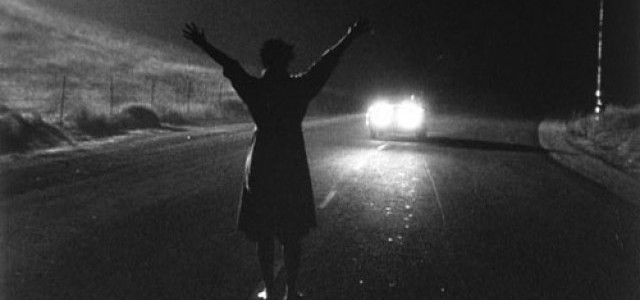
In the beginning/end of Kiss Me Deadly, Hammer is drugged, beaten, and driven off a cliff with his first lost blonde (Leachman), and maybe he's still dead at the bottom of a sandy ravine and the girls around him the Carnival of Souls reverse gender equivalent of the weird white skinned zombie guy with the crazy hair who follows Candace Hilligoss around. And maybe the big whatzit in the box is an atomic Skynet variation of the Hitchcockian Mcguffin grown suddenly aware of its abstract unimportance to the mise en scene and so deciding to change the game, swallows the universe whole and runs it backwards only in its guilty 'I can't believe I ate the whole thing' nightmares.

Now it all finally makes sense: here it is 2012 and the film 2012 is coming to TNT (my take on it here). The snake, having swallowed its own tail first, continues unknowingly along, its radius tightening, and only as it speeds up to the infinite point does memory finally catch up to its 'this is where we came in' crux apocalypse. Death is from here on out more a dawning awareness than a traumatizing finale, and a parting word to those who will be forced to watch the black hole close around us seems prudent. Thus, Christina Rosetti's (left) poem "Remember:"


  And afterwards remember, do not grieve:
         For if the darkness and corruption leave
         A vestige of the thoughts that once I had,
Better by far you should forget and smile

If we feel the final darkness closing around us, is it at all possible that we're remembering it rather than experiencing it now, and thus are immortal after all? Maybe we who will die in the coming floods will not our deaths remember but rather still live in a landlocked world where no further burgee cords and yacht club burgees unfurl but for the brief cocktail steward span that bridges sleep and death--that fluttering spasm of alertness; the forgotten hand that clutches once and having clutched drops its eternal bong --and watch will we instead as the blackened water's through the carpet soaked and gone? Soaked...

... and gone? As Mike Hammer says when giving up the key to the whatszit, "I didn't know... I didn't know..."

He didn't know he's been dead all along and the same girl twice has died with him in a drag race (left). As J.J. put it in Sweet Smell of Success, "You're dead son, get yourself buried." Mike Hammer didn't know he really was pulling a Lazarus Scotty Hilligoss Parker shuffle.

Right. Thing is, no one ever does.

So remember to "forget and smile" when the waters are rising higher than any hit count and our apocalypse year begins endlessly over with one January after the other, never reaching the dreaded December 21, 2012, all time slowing down like a black hole's infinite approach, remember what the fortune teller said when Lisa Simpson asked if there was any way to avoid her grim future, "No, but try to act surprised." All else is... Silencio... and those picky, tourist conqueror worms that just won't give it up... for Lana Del Rey!

Thursday, January 12, 2012

In praise of Red Queens


It's not until a really vital and vibrant myth envelopes you in its wings that you see just how wingless so many other myths are, the myths that get the lion's share of pop culture usage. 
--
And after some close examination I now know why... there's not enough red queens. There aren't enough wild women archetypes either. The only female archetypes we get are 'the anima' - the male fantasy girl, the poor little princess, i.e. female ego, the mother - homogenized into a selfless breast. When a negative female archeytpe does show up, she's either a shrill devouring mother, sexless and narcissistic -- or a ballbusting femme fatale.

But the red queen runs counter to all of these/
----
Myths and fairy tales are all rich with archetypes -- the shadow, the anima /animus, the wise old man, the wild man, the dark father, the evil queen, etc. but if you look at the most popular mythic franchises in Hollywood- Harry Potter, Star Wars, Lord of the Rings, the Marvel-verse you find plenty of all the others but no evil or neutral queens. Only the Narnia and Twilight series have evil queens, and the latter especially is given raspberries by the fanboys who proclaim the Rings-Potter-Star Wars trifecta as the best sci-fi / fantasy in Hollywood and Narnia a bunch of kiddie--and Twilight a bunch of girly--crap. Man, that's sexist. 99.9% of the characters in those three franchises you and everyone else likes are male; there's only two women in the entire Star Wars universe, and they're both 'good' princesses. The same is true with LOTR. It's even worse. The bitches if anywhere are all secondary, objectified or desexed and immaterial aside from being love objects, and certainly not morally ambivalent, beyond good and evil, as royalty must be, perforce.

We need more queens beyond good and evil, for it is there--beyond good and evil--all putr archetypal energies--yhe backbone of enduring myth--can be found. And the fantasy industry shows its nerdy, unlaid, apron-strung girlophobia by ignoring this archetype. Things get stale until a great evil queen finally shows up; when she does she's like a breath of fresh, beyond good and evil air.

Below is a list of red queens divided by archetypal role:
--

The (Primary / Devouring) Red Queen: 
Queen of Hearts - Alice in Wonderland
Victoria - Twilight
Maleficent - Maleficent
The White Witch  -Chronicles of Narnia
Mrs. Iselin - The Manchurian Candidate
Catherine the Great - The Scarlet Empress
The Great Tyrant - Barbarella 

Imperious in her whims, the primary red queen represents the unfulfilled potential of adulthood, when wealth and rank allow spoiled girls to sidestep full maturity and any accompanying humility. They are generally childless, preferring animal familiar lackeys--doting subservient cats, trolls, crows, ravens, mice, owls, or steely-eyed hawks. They are vengeful and reserve special loathing for prettier, younger, naive, innocent girls and young virile men who spurn their own often unseemly advances.


The Secondary Variation: The Little (sadisto-nymphonic) Princess

Salome - King of Kings 
Fah Lo Suee - Mask of Fu Manchu
Princess Aura - Flash Gordon
Scarlett O'Hara - Gone with the Wind
Cleopatra- Caesar and Cleopatra
Carmen Sternwood - The Big Sleep
Bunny - The Big Lebowski
Marylee Hadley - Written on the Wind
Drucilla - Buffy the Vampire Slayer
Tollea / Naja - Cobra Woman

As her father notes to Marlowe, Carmen is "still a little girl who likes to pull the wings off flies." These are nubile young wantons grown up in wealth and power, and--with all the percs of being gorgeous and young to boot--become egotistical monsters, untamed by the empathic development that results from having limits, perceiving one's own faults, and equating one's negative actions towards others with others' negative actions towards oneself. Given too much free time and parental indulgence they become egocentric hedonistic sadists, obsessed by the few things left that they can't have, i.e, 'principled' men who are in love with someone else (or--as with John the Baptist--an ideal). So Scarlett pursues Ashley for decades, obsessed, until she gets him, at which point she realizes he sucks, and throws him away and runs back to manly Rhett, who's figured out by now the only way to win Scarlett's love is to spurn it. Aura loves Flash, but largely no doubt because he loves Dale. If he were to turn around and confess his love back to Aura, she'd lose all interest; thus he does her a favor by giving her something to chase. Fah Lo Suee is the most unrepentant sadist and therefore the hottest.

These girls may be immature, vain, and sadistic but they're super sexy --they're far from under the thumb of their rich and largely absentee fathers. The hero is always a little tempted by their charms but he rises above it, which always pisses us off a little watching the film, at first. But if he did give in and fool around with her he'd be undeserving of our respect (and there's often a kind of secondary hero who is in love with them, such as the Sternberg chauffeur (unseen) in The Big Sleep, Hank in Night of the Iguana, or Prince Barin in Flash Gordon). That doesn't mean we--snug in the morally anonymous darkness of the audience--can't desire her, like Herod lusting after step-daughter Salome, knowing we'll never have to risk actually running into her at a party or some other location where our attraction might well be our undoing, leading her to toy with us like "the type of girl who still likes to pull the wings off flies."

Salome, mid-dance, in King of Kings (1961)

And if we do meet her in the real world, maybe our experience with her here in myth will be enough warning to save our lives, wallets, self-respect, families, and social liberties. We can only hope she doesn't come along while we're verging on a midlife crisis. She's more dangerous than a dozen motorcycles. 


The Tertiary Variation: Trickster
Julie Newmar as Catwoman - Batman (TV)
Rita Hayworth - Gilda
The Derevko Sisters - Alias
Mystique - X-Men
Catherine Trammel - Basic Instinct
Marlene Dietrich -everything
Suzy Kendall - Fraulein Doktor

She promises sex and delivers debt. She's whisked away by fate or duty on the day of your marriage ceremony and the next time you see her she says she's her evil twin. She takes your money and somehow you can't get mad at her because you know she doesn't really care about it--she's doing it for you in some Kafka-esque way. She is the embodiment of the trickster: intelligent, beyond good and evil, using her sex appeal as a lure but more for fun than sadism. She's too intelligent for that, keeping the eternal dance of fire and persona alive, or, as in Irena Derevko, a deeply embedded plan to save the earth, or keep herself amused. Catwoman for example is evil, but Batman loves her (and vice versa) and so each self-sabotages their efforts to kill or catch each other, or even to keep each other trapped. The chase is the thing. The agreement is unspoken but biding - no killing, for now, just elaborate traps that one may, with luck and thought, escape, to keep the game alive, while buying the other some time for a head start before the next encounter.


The Quarternary Variation: The Ancient/Young Woman
Ursula - Little Mermaid
The Evil Queen - Snow White and the Seven Dwarfs
She - She
The Three Sisters - Suspiria, Inferno
Elizabeth Bathory - The Countess, I Vampiri, Countess Dracula, etc.
Jessica Lange and Maid  - American Horror Story Season 1
The Red Queen (hologram) - Resident Evil series

She can be both young and old: the evil queen with her apple basket; Ursula turned young, with Ariel's voice; She before she steps into the fountain of youth one time too many; the hottie who rises from the bath in room 237 but is old and decaying by the time she reaches the door. The 'swindle' behind youth and beauty, the bait-and-switch of the midway, the genetic con job that lets you slip a marital ring around your nose while you're too distracted by the shiny cape to bolt and buck. 

If you're a woman, the queen is your mother, desperate to sabotage your maturity and somehow drain off your youthful bloom for herself.

Or it can even be you--from the illusory safety of the mirror-mirror on the wall--realizing your own beauty was just a framed shadow doomed to slow fade with the dawn's rising. 
Snap thy faceted selfies whilst ye can--
the velvet dark your wobbly setting--
and adjust your glasses prescription ever stronger 
to match the shrinking screen of your sharpening cell.

CLOSING:
In short, wise up punk-ass mainstream Hollywood! Don't be scared of the red queens! Help revive true myth, and breathe the salty air of your own mortal huskiness.


Why is Hollywood so afraid of these women? The catch-22 is that the men who write and create and approve these things are afraid of them, and the men who aren't are too fucked up and iconoclastic to do too much about it. The women meanwhile, are often not the best choices to depict them as they, for all their strength, are archetypes more from the male unconscious than the female. Often liberated female directors have conflicted attitudes towards these archetypes. They're either bound up in the idea they have to represent Woman and not archetypes, i.e. to become a slave of message-heavy realism, or if they dare to bring in archetypes, choose their own animus forces, i.e. to make complex portraits of men in action only from a more sex object and unknowable form (ala Hurt Locker) than most. The question is what will the future minority and female directors and writers create once they are no longer willing slaves to either one of their animuses -- the controlling paternal animus --the buzzkill authority that the female is never convinced to question as far its 'rightness - and the wild artistic animus, which perforce is bound towards the destructive and impulsive. In each case the risk is a kind on non-classic. On the one side, inert social message films, on the other, abstract and often shrill 'art.' 

There are a few geniuses who feminine mythic energy to the screen, Angela Carter, whose fairy tale adaptations and revisions ("The Bloody Chamber") inspired works such as Helene Cattet's Bluebeard and Neil Jordan's In the Company of Wolves. And Linda Woolverton, writer of Disney revisionisms ala Maleficent. 
Related Posts Plugin for WordPress, Blogger...