 |
| No eyes were harmed during production of this picture |
"Every professional performer I've ever seen always does the exact same thing in the exact same moment in everything they do.... They know when the audience is going to laugh and when it's going to get interested. What I like are things that are different every time. That's why I like amateur performers and bad performers--you can never tell what they'll do next." - Andy Warhol
"How does a girl that's braindead experience a violent emotion?" -- Dr. Anderson
Launched (presumably) as a belated Carrie / Patrick / House on Sorority Row cross-pollinated direct-to-video fading grindhouse flower, Lucio Fulci's 1987 opus Aenigma is secretly a deadpan stealth surrealist reverse jack-in-the-box. IF you BELIEVE. All the elements of those films whose box office success Fulci and his producers clearly hoped would trickle down are there: the naive innocent turned comatose vegetable; the vicious prank gone too far; the twisted, messy-haired mom; the supernatural one-by-one ironic vengeance. But rather spiral down in flames, hitting the ususal downbeats, spelunking occasional gory jewels into an otherwise bland narrative river, Fulci drains the water out, replaces it with ether, and throws those jewels right through the camera lens into the post-modern affect eyeball of the viewer (his favorite target). The result, as a horror film it's confusing, but as an artsy concept album with all the usual 'filler' scraped out, it's all peak weird moments, interspersed with a bunch of skips, jumps, and needle scratches. If something seems cliche and familiar, just look a little deeper. Calling it a Carrie / Patrick retread is like calling Buueil's Simon of the Desert a Passolini-esque biblical allegory or The Shining an old dark house mystery. You may have a hard time putting the difference into words the ways all the material is there but the banal narrative 'story' meaning has been erased, replaced with....well....an (a)enigma-- the deeper you look into it the more you realize how much deeper it goes. In not choosing an explanation, except that which one might glean from the evidence (order of shots, zooms, eye close-ups, etc..
It's genius born from post-modern accidental Brechtian affect. Stilted, canned dubbing gives the strangely off-kilter dialogue ("you prefer older men? / Let's put it this way: anything in pants") an almost Wooster Group-level post-modern affect: subverted expectations (using 'fake out' signifiers) flail against the electrified fence of Carlos Maira Cardios' sinister, mystery radio organ score. Meanwhile the set and setting reflect its Eastern-European milieu (filmed in Romania) and evoke my own 1987 college experience, at Syracuse University, a pleace where old world exteriors and cavernous hallways bump up against a nondescript world of grey/white concrete block dorms, classrooms, and galleries, spattered with posters and kids clad head-to-foot in gray college sweats (you could still smoke there, and serve wine at your art openings). In the oppressive anonymity of the interiors may remind adventurous viewers of Andrzej Zulawski's Possession. While that film focused more on insane, excellent hysteric-style acting, here the acting is almost anonymous, a combination of stilted, canned voices and onscreen actors that merge purely in an indulgent viewer's imagination. Rather than snicker and jeer, let the post-modern affect wash over us and we waken from the usual narrative hypnosis, exit the Platonic cave, stand in the cloud-covered sun and marvel at just how crudely fashioned are the puppets whose shadows used to wow us. In the end, like Joe Politano in The Matrix, we may decide to go back in to the cozy dark of the cavern and take a break from the merciless global warming sun of True Perception, but for now... agape jaws please. The AENIGMA has done its thing on you.
Casual film lovers may not like this enigmacsism (?) but for film addicts who've developed Cassandra-style abilities to predict every beat of a new movie they see, a weird 'off' movie like Aenigma--where the signifier and the signified, like a pair of amateur mid-air acrobats, never quite connect-- is exhilarating. To go back to the Warhol quote above, there's no way to anticipate what it will do next. That powerless Cassandra apprehension (i.e. the dread that sinks into a viewer's stomach when an innocent girl climbs into a strange older man's car) evaporates. Suddenly we have no dread of anything; we're too busy marveling at the discordant dubbing and odd details to even consider what will happen next. It's just like being a tourist in a strange land where you don't speak the language. You're too busy trying to navigate to worry yourself over the local political in-fighting.
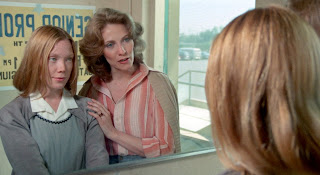
Shit, If you haven't seen it already I hope I didn't ruin it for you. I went in with really low expectations, which always helps. Know that even Fulci's fanbase aren't particularly fond of Aenigma, probably for the same reason I love it.
Confidentially, I like it way more than Carrie. For me Carrie (left), which I admit is the 'better' film, is one long mounting attack of Cassandra-style anxiety. Maybe if I had no idea what was going to happen next, and had good memories of high school, and hate William Katz's hair, but between the crazy/abusive mom and the rabid tampon-pelters at school, and then knowing the big prom date, her first chance at happiness, is going to end, it's just a stone drag. Also, it doesn't fit together: Piper Laurie is hammy to be repressed, Spacek is too pretty to be a wallflower, and the whole blood bucket prank has way too many moving parts for a gang hormone-crazed delinquents to engineer (it's more believable that they'd just throw some red paint on her lawn late some drunk Saturday night). And what's up with Amy Irving's character, who goes from convincing her boyfriend to ask Carrie to go to the prom so the prank can happen, to forgetting it's coming and basking in her good deed, to then noticing the bucket and trying to stop it? What? Did she forget or is she just covering her bases, trying to fool even us? Did De Palma forget how this whole prom queen thing got started? It still deserves its classic status, but who wants to see it 100 times and quote it at parties? Once or twice is enough. If it happens to be on HBO and the prom has already begun, I generally stick around. Otherwise, no thanks. I'm depressed enough already.
That's why Aenigma is sooo much better for being not as good. And moving things to college. The prank is more believable, easier to believably orchestrate, and it's successfully sprung and over in the first SIX MINUTES!
Don't believe me? Come along on this deep dive into...
 AENIGMA - THE FIRST SIX MINUTES
The first shot is a close-up on the words 'St. Mary's College - Boston' all in grey -- etched on a plaque or against a grey stone step. The camera pulls back to reveal a black-and-white photo of, presumably, the population (apparently) of said college--about 26 female students and teachers, standing arrayed on the stairs of an old building, flanked by stone lions. Horror fans of course instantly think of the last shot of The Shining, so presume most of the people in this picture are, or will soon be, dead, coupled to an evocation of lost innocence, enhanced by a a Picnic at Hanging Rock-esque wooden flute, mixing with the sound of chattering girls and a low drone like a flatline EKG crossed with the bell between class periods. So tragic.... we're feeling it. The loss of innocence, probably. So much promise...
But look closer: the girls are all unsmiling; their arms crossed, hands buried in their sleeves (as if in strait-jackets), looking into the camera with grim, set faces as if to warn the viewer not to enroll in this joyless academy. With these strange little details subliminally tweaking our perception, we begin to sense these girls are complicated. You can't call them innocent, or evil. We're not sure what even to call them, now. But then the camera zooms slowly towards one of the windows, so it begins to seem like we're sneaking in through a dorm window.
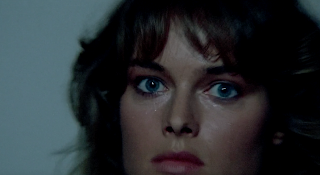
We suddenly jump cut from the slow zoom in on the window to a close-up of a girl's eye (
top image)- which then closes to receive a thick application of gold eye shadow. A Christopher Cross-esque lite FM style pop theme song starts. A male's dreamy high register croons "You've got a feeling / deep inside." We must be in a St. Mary's College dorm room. We pull back from the eye to see the face and black frizzy hair and straggly body of an insecure young brunette getting ready for her Cinderella debut, with a pair of playful blondes, one a girl, one a guy, doing fairy godmother duty. Clad all in white college sweats, like grinning angels, they smile and exchange glances with each other, holding up an array of nighties and underwear up against themselves while giving fake coy laughs and throwing them on the bed. The girl they're dressing is not smiling, She doesn't even look nervous. She's just standing there frozen; she seems totally blank as if not sure of what's going on. The credits come up in a cutesy font all lowercase. We hear almost no diegetic sound except their occasional muffled laughter as the song goes on.
It's a montage we've seen a hundred times: the familiar friends helping a girl try on clothes until she finds just the right look (usually as the song ends). At one point they look at an outfit, then each other, and shrug, cutely in unison, to indicate no, not this one. Finally, they nod in unison- the look is just right. Their Cinderella is ready for her--presumed--first big date. The song reaches a zenith of emotion and its chorus, "Falling head over heels / And I just can't stop."
 |
| it's spelled "meals"! |
In the mid-80s especially, those montages and tacky songs were everywhere, not yet recognized at the cliche they'd become. And if we've seen a few mid-80s rom-coms, we're bound to think we're about to see a treacly John Hughes coming-of-age prom-com. The only thing 'off' is the make-up she's wearing, but that only makes us presume we're watching some tacky European 80s version, and that the most we'll get as far as suspense is a nervous first kiss. Maybe some danger with a boy who won't take no for an answer, and then the geeky kid comes to her rescue. All the signifiers are there. We got our weary Cassandra picture in our mind, the plodding pic touching every boring base to get to the horrors we know are coming and "just can't stop" ( or speed up for that matter).
And yet, something feels very off. The brunette girl, small and gawky, is so stiff and awkward with such. blank expression she looks like a mannequin come only halfway to life, eyes showing she's desperately trying to move but can't quite work her limbs. She's wearing so much eyeliner and gold eye make-up and cheek rouge it's like she just crawled out of an 80s Egyptian disco. But that might be just us, our taste. Maybe the ancient Egyptian prostitute look was big in Romania (where this was filmed). My very first date ever, circa 1983, came out with me looking that bad and she was--come to think of it, Romanian (like this actress).
Intentional or not, it begins to dawn on us that our familiarity with cliches may be being nonchalantly used against us. Certainly there's no foreshadowing evidence to suspect foul play ahead. American producers would be irate - worrying they'd confuse the audience, and so fill this scene with ominous strings and evil glances. But Fulci gives us nary a shred of portent. We think we recognize a slightly evil look in her 'friend's' eyes but can't tell for sure.
The temptation of course is to accuse the film of being 'bad' since it's not giving us any expected signals we'd associate with a late-80s horror film, one given fairly bad marks even by the director's devotees. It's also not an 'art' film by a recognized genius like Lynch, Antonioni, or Polanski, so we can't be sure it deserves praise and admiration for the surplus of alienating affect.
It shouldn't matter. What matters is that our Cassandra of Troy precognitive anxiety and impatience is no longer oppressing us. When we can't recognize the sign posts we no longer feel we have to drive. We're safe out to to sea, totally lost, swirling around in the tributary between the river of genius and the ocean of boneheaded crap on an oarless raft. We can kick our feet up and let the wind be our tour guide.
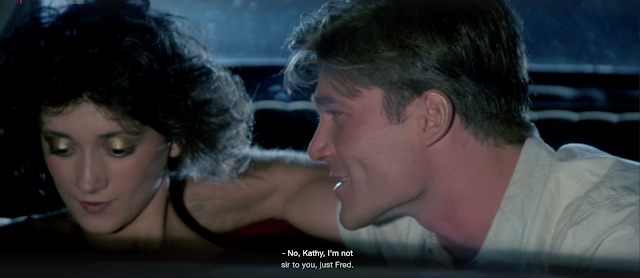
As the credits end, the music stops. The next shot starts with a sudden surge/stop of a car brake. The girl, we now learn is called Kathy (Milijana Zirojevic) is in the front seat with a handsome but evil looking older man named Fred (Riccardo Acerbi). It's pitch dark night outside, no streetlights or anything. We know where he's parking. She seems nervous, calling him by his surname, and 'sir'--making us assume he's her teacher or a doctor or something ("I'm not sir to you Kathy, Just Fred"). She mentions, voice trembling with shyness--that they were supposed to go dancing. He waves that away, "did you
really want to go dancing?"
Instead he basically attacks her, as Italian men in these movies tend to do when with a girl alone in a car.
We grit our teeth, prepared for the usual screaming and threatening, scratching and clothes ripping. The innocence of the last sequence, all that gussying up for the big date, now comes into place as a kind of brutal irony: it's Pretty in Pink turning into Bergman's Virgin Spring right out of the gate.
But--instead, Fulci's camera moves outside the car looking through the rear windshield, we hear her moan in ascent. She's into it!!
And she won't shut up about how into it she is ("I've dreamed about you so many times!")
It's now that the awful canned effect of the dubbing really hits us and we recoil, up out of the narrative moment and back into our seats. She starts a flow of moans mixed with nonstop babbling about how much she wants him. Unlike most people, she can't shut up and get in the moment, so neither can we. She goes on and on ("so big, so strong.") She's clearly inexperienced and very horny, and just doesn't know how to go about not revealing either thing too soon. She's already tipping her hand, as we--the sexually experienced--call it. We laugh at her because we're experienced enough to be quiet when fooling around. So now, once again, we have shifted our identification locus -- and we still don't quite know if any of this is supposed to be what we're feeling.
To sum up: we went from wistfully remembering our nervous first dates of the mid-80s, to amorphous anxiety on a naif's behalf (wondering if she's being set up to fail, or if the make-up woman is blind, or that caked on look was cool for 80s Romanian night life), to dreading her impending assault by an older Italian macho sleazebag, to shock and relief at her response, to post-modern shock due terrible dubbing to sneering at her annoying babble, all in the first five minutes.
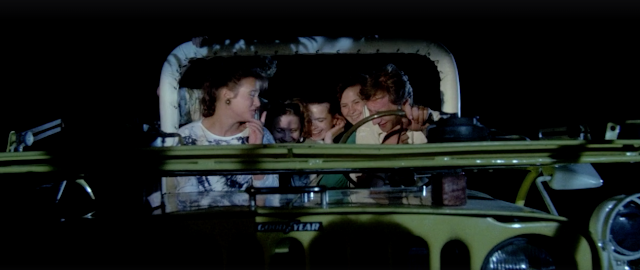
OK, now we find out why Fulci's camera was outside looking into the back window of Fred's car. Suddenly - we reverse shot to a row of cars parked hidden in the shadows just out of sight in the darkness. Fulci zooms up to the windshields of each one to find several fellow students laughing inside. We see the couple who dressed her during the song in one of the cars, too. We can't hear them through their windshields, but when we cut to inside their cars we still hear Kathy. Fulci moves to Fred's car to show a microphone pinned to his dashboard. We presume they're listening in on the shortwave radio, like they're at the drive-in.
The meta effect is instantaneous. We've come full circle on our identification with Kathy and now find ourselves implicated in the prank due to our laughing at her declarations uttered in that flat dubbing. We're one of the bad kids now, laughing at the terrible performance and Fred's car parked in the row in front of them and on the screen, both the viewer and the viewed.
In tricking us into laughing and sneering at Kathy and her naive babbling dub, Fulci has implicated us in the prank. We're part of the evil kid contingent. Fulci, you devil. What have you done to us?
Soon the kids start their engines. The row of sudden headlights blind her through the back window; Fred breaks the clinch and laughs in her face, sadistic mirthless, mocking (Remember, this is supposed to be her teacher). Horrified, she gets out and starts running into the darkness, illuminated in the slowly following car headlights like a Wake in Fright kangaroo, the kids leaning out of the windows, roaring with exaggerated evil glee...
With more of his strange, deadpan pacing, Fulci drags this chase out to the point of absurdity. We go from feeling embarrassed for her to just hoping she either turns around and stops looking behind her every few steps, or just gets hit by the car we know is inevitably coming. Instead, she keeps trying to run while looking over her shoulder, but it's hard to do that. The more she looks back, that the slower she runs. Fulci drags a series of shot/reverse shots of her running/looking back--illuminated in the headlights--to the evil kids in the row of pursuing cars, leaning out of the windows like college sweatshirt-clad Road Warrior stunt men, laughing with merry glee. Eventually her running kind of slows in with that voluminous red dress blowing in the breeze and her clumsy gait and bad make-up she evokes some kind of clumsy-footed flightless bird, her round eyes alive with a mix of fear and embarrassment.
Then, she finally runs out into the road and the path of a screeching car.

Ever the practical minimalist, Fulci knows there's no need for a shot of her body hitting the pavement (actually I'm sure he would have had one, in grisly detail, had his budget allowed or there been good Romanian FX artists handy); no need to cut to the horrified faces of her pursuers, nor capture the shocked look on the drivers' face. Nor show an ambulance, or the bad kids' cars all scattering after the crash, before the cops come; nor the one girl who wants to confess bullied into silence; the weary detective yawning knowingly; a passing motorist calling 911 while their spouse urges them not to get involved; the hit and run driver speeding away; ye olde patient POV gurney blasting through the ER doors flanked by EMTs, and so on. That's the genius of Italian cinema, of Fulci particularly, to use the stuff we've already seen somewhere else as part of its narrative weave (we might even have false memories of seeing these scenes in the film later) , sparing us the kind laborious exposition, connectivity and world-building someone like Richard Fleischer would use insist on. Instead we breathe a sigh of relief as Fulci's shot skips right to the respirator.
Within seconds of the hospital shot beginning, Kathy's EKG flatlines and a high-pitched monotone beams in over the soundtrack. Vibrating and piercing, it's as if the space between two realities is opening in the form of feedback squall. As the doctors talk next to her bed--their voices grow faint-- the camera switches to a fisheye POV hovering over her floating up and away from her bed.. up out through the window while a wave of ingenious overlapping whispers blend with hospital noises, sirens and EKGs make a disorienting soundscape. We hear amidst the muffled din, Kathy speak, saying"I don't want to die" over and over as her/our POV floats back in, out and up through the storage room above her bed, trough the roof of the building (a miniature obviously from some other movie as it looks like twin oil refinery tanks), and then over the miniature treetops and around the corner, the cardboard city line behind her aglow with 'distant' lights in the night). We begin to descend down to the school, where a new student just happens to be arriving in the school van, someone (presumably) easy to possess. Someone stunningly pretty and looking very wary. No one's going to dare set her up in a prank. Atop the steps, three stern looking matrons stand atop the steps, waiting, as if she's coming into a girl's reformatory; a few are girls looking balefully down at her from the tall windows above like ghosts.

And thus pass the first SIX MINUTES!
Carrie is still crying in the girl's locker room after her tampon pelting at six minutes (I checked). But Fulci has already pulled the big prank, had the tragic result, reversed our expectations five times, drawn us into meta-textual liberation, given us out of body experience, set up the rest of the movie. All without the events feeling rushed or confusing. Everything happens naturally, one action following the other. But every gram of dead space and familiar cliche is either pared away or turned back on itself.
-----
POST-META/MODERN AFFECT, FULCI-style:
The parallels with ghost and film watchers is always right there, in every movie, whether elaborated on (as in European art cinema) or ignored (America). The key to enjoying art films often rests on realizing this, and that the camera POV and soundscape are everything, that characters are often unspoken amnesiacs, adrift in strange worlds, that our sense of alienation is a result of post-modern intent rather than a sign the film isn't 'doing' what it should, i.e. hypnotizing into a cathartic response via an engaging narrative.
If, for example, the camera is following behind someone running through the park at dusk, in an art film (like Birth) it could evoke in us the feeling we're a ghost chasing after the runner; but in a non-art (most American) film, unless particular attention is called (via breathing noises, as in Halloween) the tracking just means the person we're identifying with/watching is running - so we're running. The camera POV is meant to be invisible. We're not identifying with the camera but the actor. In art films, we sense that while we can vicariously thrill to the events onscreen, we are, like a hungry ghost, forever shut outside of the image, able to access it only in fantasy. In non-art films, there is only fantasy. POV is meant to be invisible.
The trick to savoring the weirdness of Aenigma, and Fulci movies in general, is to read them as both high art and 'so bad they're good' at the same time. Taken as intentional affect, Kathy can be read as the desirous viewer, lusting after the 'hottest guy in the school", Fred. We late learn she followed him around a lot, annoying everyone, so they arranged the prank to put a stop to it. In her proletariat identity, it's clear Kathy is 'outside' the image even when she's onscreen. And it's clear too she's now in a coma because she wanted to literally be in the big picture. Her debut, her screen test is her big date with Fred. She blows it.
But you have to be onscreen, to open yourself up to the masses, to realize the awful downside: you're now open to all sorts of derision from the trolls and critics, and jeering idiots the world over. Unless you're an Adonis or a Perfect 10, someone's going to find something to laugh at about you; every incel nerd and slimeball can feel superior from the safety of their moms' basement. If your make-up is done by someone deliberately trying to sabotage you, like a friend of the rival for your part, you don't have a chance.
And thus, exposed and humiliated, Kathy is booed off the screen, shooed back into the cozy darkness, the anonymous audience, the sexually frustrated 'average' people.
But she never quite makes it back to her seat. The accident knocks her loose between screen and audience, fantasy and reality. Her body is trapped in the real, immobilized, but her spirit can now enter the fantasy and possess a girl who is hot and popular, who's sexually experienced, everything Kathy wanted to be but now never can, except by this hot proxy. On one plane she's a vegetable; on another, an avenging, horny spirit. That we know they're connected is because her comatose face still smiles or has an EKG spike when she kills her persecutors as a spirit, or gets it on as Eva.
Once we accept that we're basically seeing much of the movie through Kathy's eyes (or she's seeing through ours), the disconnect of the dubbing enhances the doubling and perception through another's eyes. I argued in a post post that if people have a problem with 'whitewash' casting of Scarlet Joannson as an Asian-eyes robot in Ghost in a Shell (which sadly has become a meme for Asian representation rather than being recognized the very well constructed and beautiful movie that is) they should watch it in a Korean or Japanese dub language track, so that the idea a Japanese/Korean woman is inside an white 'shell' would have greater meta resonance. Since in a way Aenigma is very similar to that film in basic premise (someone's ghost in another person's shell) the presence of the bad American dubbing - and the way an international cast of Italians, Romanians, and one American, are all supposed to be in Boston instead of Bucharest- finds a perfect metatextual justification for its sense of artificial dislocation.
Furthering the disconnect, one of the main reasons this movie rocks so much is the use of miniatures for her POV floating scenes. The roof of the hospital and fake skyline definitely have an air of a dream, of not quite being in a real world. None of it is convincing (why the hospital exterior is a twin refinery storage tower is never explained--though obviously because it was made for an earlier film), but damn is it endearing. And damn does it further our sense of dislocation, drifting from the diegetic reality of conventional film tropes like a balloon in the winds. Folksy and lovely in their analog playfulness, following the POV of Kathy's disembodied spirit over the train set-like cityscape is like digging William Cameron Menzies' miniatures and disembodied floating camera in Svengali (1931) or The Bat Whispers. (1929).
SEXY COLLEGE DIALOGUE DECONSTRUCTED: (Or The preceding scene proceeds successfully in setting up subsequent scenes exceedingly speedily)
Trying their best, a familiar roster of English dubbers from Italian film try their best to both match the lips of their characters and lend some finesse, failingly, to the corny 'sexy' dialogue, clearly written--almost mockingly--by repressed older Italian men trying to write for young American women in a style based on American films they've seen. The resulting combination is a kind of stylized, performative burlesque of savage female sexual aggression, ala John Waters or Russ Meyer, but with the slang and hysteria replaced by a kind of flat, straightforward, comic book-style lack of subtlety. Perhaps its Kathy's horny naiveté finding id-unleashing power via Eva's hot mess nymphomania ("you really prefer older men?" / "Let's put it this way, anything in pants") and the joy of being not the target of the girls' strident put-downs. With the canned flat dubbing making everything abstract, defensive answers to probing dour school mistresses questions are interrupted with sudden non sequiturs ("I had a breakdown, Ms. Jones. A mild nervous breakdown" /"Who's smoking!?"). The effect is sort of like every line was lifted carefully from some other American film and then spoken by someone who doesn't really understand the movie or the dialogue, and recorded out of sequence. No fully-fledged motif or plot rationale is able to come to completion. Something always interrupts, or steers things away. For example, when Eva first meets her new roommate Jennie she plops onto her bed and says rather strongly, "OK Jennie, let's get one thing straight. For me a successful year means making out with as many cute boys as possible" it sounds strange, starting out almost defensive and ending with a Happy Days-level declaration and forced giggle. It's such an odd switch from how that declaration began, it takes a few viewings to realize she's answering the cold declaration of the head mistress who's just deposited her into her new form room and, on her way out the door, coldly says "I hope you'll have a successful year." In other words, there's some motivations behind every seeming act of madness, which is why the whole thing survives such repeat viewings. Each line's meaning varies each time you see it. With such unconvincing inflection, the words are totally open to each viewer's projections.
The next day (or sometime) after the accident, Eva and the girls are in aerobics class, taught be Fred, and he says in his familiar voice (we've heard this dubbing artist in a million other Italian imports), measured out in a manner no one would ever talk like: "come on ladies, you don't want a fat ass to get in the way when you get with your boyfriends tonight," as he says this he slaps the ass of a student he's passing. She retorts in an equally measured voice, "I may have a fat ass but if you touch it again I'm gonna slap your face."
FAKE OUTS:
Eva, proving her sexual aggressive clout, feigns an injury after class to get Fred to come and massage it. Her new roommate, Jennie tries to warn her: "Fred can be a little.. dangerous," but Eva waves it away. "I mean it, Eva--he has a pretty
unhealthy reputation." "
Good," Eva snaps back, "so do I".
Again, Cassandra viewers may begin imagining Eva not realizing how much more unhealthy Fred is; that she was not warned needlessly.
But after all that build-up, this portent goes nowhere. Instead, the next scene is Fred in his darkened studio, primping before the mirror in his manly body stocking after hours while Mary, Kathy's mute, bug-eyed, possibly brain-damaged mother, who works as cleaning woman (we learn she got her daughter Kathy admitted to this otherwise prestigious school as a special favor) mops up in her drab Romanian frock, almost a mocking satire of his sexy expectations. Her straggly-haired presence is not conducive to his sexy plans or his Adonis reflection, so he rushes her out before she can even gather her bucket and mop. Yet no sooner as she left than he's worrying about her bucket which is left in the middle of the floor, cramping his sexy/unhealthy
feng shui. He moves it to the side, but after he looks into the mirror awhile, he finds it back where it was. ("Mary," he shouts, "your
bucket!")
Once again, none of this is bucket business is underlined or spelled out with cutaways or ominous cues. But we see Mary glower from around the corner and her pupils turn a digital colorized red. We get the feeling comeuppance is headed his way.


Mary, Kathy's muter "retarded" mother, "Crazy Mary" who works as the sole janitorial staff of the school, has sallow eyes and straggly hair, like her daughter, played by a Romanian actress, like the woman who plays Kathy, seems both otherworldly and totally earthbound, that drab dress and defeated but wild-eyed look common to Eastern European character actors, offset by a keen knowingness that makes the westernized pretty people seem especially vapid. As she's always mopping somewhere in earshot of whatever's going on, it takes awhile to notice her. There's no scene of her at the hospital - she gets no time off to visit her daughter's side - no one sends her condolences. She's an afterthought, at best. But though mute and supposedly a moron, she seems to know what's going on. The question is always what is the connection and who is doing the comeuppance spells, Mary or Kathy or Eva/Kathy? And why doesn't Mary notice Kathy is in Eva the first time, when serving her snails and hearing her talk about eating them in New Orleans (where Kathy and her mom are from, not Eva).
PAGING DR. ANDERSON
Doctor Robert ("Don't call me Bob") Anderson (Jared Martin, an American TV and Italian movie regular) is presiding over Kathy's case, and seems rather obsessed. He also called over to start ministering to Eva after she throws all Jennie's clothes on the floor and starts flogging her with a raincoat in a weirdly cut scene with mismatched eye lines, before passing out. Ever the scrupulous ethical-minded physician, he slyly shoots her up with, presumably, some really good drugs, causing her to wake up and start making out, rather forcibly, with him. Rather than gently rebuffing her, asking for a nurse to be present, and standing out of reach, he blushes and stammers, and looks behind him to make sure no one is watching. We're watching a man wrestle with the idea that it's one thing to make a pass at your patient, and another to merely not push her away when she latches onto you with rough kisses like a foxy lamprey.
Martin does this very well --(you see his face actually redden) and doesn't really protest beyond mentioning he's not in the "habit" of kissing his patients." Hah! A lot of professional men learn a lot about themselves when a hot young girl throws herself their way and they find themselves going along with it, outvoted by the 'little man', the willful girl, and thousands of years of evolution. In short, kissing his patients has now become a 'habit.' The next day she's waiting in his convertible when he gets out of the hospital. Rather than resist, he just drives off with her. After all, no sense arguing with a damaged hottie, especially if you're still young, virile and in an Italian movie in the mid-80s. These were still the days when sex was just sex, healthy, rewarding, free of the sleazy male aggression signifiers it would carry now.
As with all the strange things going on, these deft sleights of hand where it's up to us to form an opinion of our own, we never quite learn if Fulci feels we should find Robert's behavior as shocking as we do. The scene is played in a light screwball vein -- a handsome shy man and an aggressively sexual, unhinged young girl who won't take no for an answer - shades of Bringing Up Baby, Something Wild or the Nicolodi / Hemmings hook-up in Deep Red. And their strange trysting isn't even the subject of the film! It's not even commented on, not even the doctor's relatively cool fellow doctor bats an eye. It's incidental. As far as the film is concerned, we should be paying attention to his attempt at figuring out why Eva has Kathy's memories. And why Kathy's EKG spikes wildly whenever another murder happens next door. He doesn't see that Kathy smiles and giggles when getting it on with her handsome coma doctor via Eva as he's not there. Anderson thinks he can figure it out. We're too busy being thrilled, shocked, and in awe at his getting away with such an outrageous breach in ethics. We can wonder if Kathy developed a crush on him while he hovers over her in the ICU. That Kathy's end game for possessing Eva is more to seduce him rather than wiping out her enemies.

Sex, as it always is with Lucio, is a pretty savage affair. None of his best films have any kissing let alone sex. Aenigma has only one sex scene but it's all bathed in red lights against black backdrop, and glazed with sweat, and it quickly turns in a cannibal maenad nightmare. The rest of the sexy time we see is only heavy petting, along the 'second base' high-school type, reflecting--perhaps-- Kathy's arrested sexual development. Eva kisses him violently, hungrily. She's almost a rapist. But the sex happens only in his nightmares (at least as far as we see).
In between surrendering to her rough caresses, Dr. Robert continues his vain attempt to discover how or why Eva has Kathy's memories. He never thinks of bringing Eva into Kathy's room at the ICU to see what happens. Instead he tries to get her to play word association games. "Tell me the first thing to come into your head when I say.... 'Charles is a mystic.'" he says That leave us puzzled. The post-modern affect of the canned dubbing makes these surrealist digressions and mentions of Charles, whoever that is, uncanny. He's figured out Eva has Kathy's memories, regularly saying she's from New Orleans when Eva is from Boston, but that's the least interesting aspect of the film, except as a post-modern rationalization for the stilted dubbing. But we never see Eva even arrive outside the door for the date. It's like she disappears. Before anything can happen, Fred's reflection in the the dance studio mirror, presses its face, looking terrifyingly gleeful look in his eye--through the glass until it shatters sending shards flying in all directions as he lunges through to strangle himself. And there's Mary's bucket - right there again.
What's up with that mystical bucket, Charles?
The film gives us cues that it's "Crazy Mary" (she's mute but may be a witch) bumping off the people who put her daughter into her coma via her crazy magic. We see her eyes flash red as she stares balefully from around corners when she overhears someone talk disparagingly of her daughter, but we can't be sure if it's her or Kathy via Eva doing the strange magic deaths. There seems to be at least three different underlying culprits: does Kathy leave Eva to go facilitate these strange hallucination deaths as a disembodied, curtain rustling spirit or is it 'Crazy Mary' and her red eyes? Either way we never see Eva arrive at the door, making the death of Fred before Eva even comes kind of shocking - what was all that set-up for about his bad reputation?
 |
| Eva and Kathy presumably wrestle sexily for control |
The next day at class someone hears Eva call him a "bastard" for not answering his door, and another of the girl says "Did you say 'bastard'? You must be talking about Fred." But nothing more is said about whatever he's done to them in the past to earn that title. And then when they learn he's dead, they all cry and bemoan how unfair it is that Fred "kicked the bucket," and Kathy gets to still be alive in a coma and it's not the other way around. Meanwhile, the teacher seems indignant they'd interrupt the class; just because one of their teachers was just murdered. It's hard to imagine anyone being as casually cruel and callous as these people, making vicious fun of the mother of the girl they put in a coma when she's right there in earshot openly lamenting how unfair it is that the old-enough-to-know-better probably dangerous presumed rapist (that "unhealthy reputation") is dead while the innocent girl he pranked into a coma, gets to live on as a vegetable. And yet, thanks to the canned effect and the innuendo-free mania of the dialogue, the girls' callousness is so over-the-top it fails to cause any anger or shock in the viewer. Instead, it's kind of thrilling, the same way it would be in, say, a movie by Russ Meyer or John Waters. This bears no resemblance at all to our own high school and college memories, whatever they may be, as no one is this childlike and open about expressing their horrible inner pre-empathic emotions. There is no filter. Even in a coma, Kathy is still a bitch who deserves to die for the crime of trying to fit in, a greasy-rizzy-haired Romanian (Eastern Europe never discovered conditioner, apparently) trying to make it in a pretty Italian girl world.

Meanwhile, the choices of directions seem arbitrary, in the moment. Small toss-away lines are revisited, emphasized, foreshadowed, forgotten. There's a conversation between all the girls while they smoke a joint in the dorm room--one of them sneers that Crazy Mary is a "retard," so Kathy was the daughter of a retard. "But who'd want to get with a retard?" another girl says. "Another retard," is the reply ".... or worse!" It's just a toss-away line (and forgive me for repeating it) but suddenly Jenny gets worried about the "or worse."
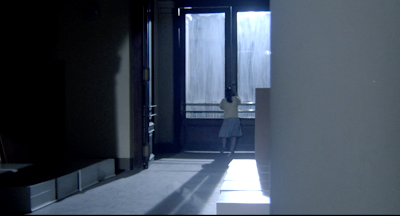 |
The huge Romanian buildings make the girls seem very small,
a reference to the high doorknobs in Suspiria?
|
"What did you mean by worse!?" ("I don't know," comes the reply, " but Miss Jones and Miss Fitzpatrick, and Mary lock themselves in her room and I've heard some really weird noises.") And at one point we hear chanting behind closed doors. And Mary's eyes regularly flash a tacky, digitized red when she's doing a witchy stare at a future victim, but the connection, if there's any, between her and Kathy and Eva and Ms. Jones and Ms. Fitzpatrick as far as the murders just hangs there, like the strange picture of the presumed school's founder, whose pursed lips and... curlers (?) beams down from the back wall. Fulci has all these signifiers laying around if the viewer wants to try and piece a familiar story together out of them, but he's already in the next room, so you may as well drop them and keep up.

Meanwhile, little details are thrown in to keep it interesting, especially at the museum where Eva tricks one of the girls into going after hours. Eva disappears leaving the girl scared as the art keeps changing from to reality - paintings of mass murder bleed (kind of sidewise? or at an angle? it's hard to get the orientation); a severed hand drops out of the painting; an anaconda slithers on the marble floor after Grace sees the marble snake at the feet of a statue; and then instead of Medusa's head in Perseus's hand it's Kathy, all made-up with the gold eye-makeup and hyper clown cheeks from the beginning, (actually, with all that stuff one, she looks like Michael Jackson--above, clearly they just smeared all that make-up from the opener on whatever head the Romanian prop guy had lying around ). Finally a Rodin thinker reaches out to strangle her in the crook of his elbow. Once again, Eva has vanished.
THE ARRIVAL OF MALE "AUTHORITY"
As the murders accrue, the police and school board insert themselves into the periphery of the flow, adding to the deadpan comical bipolar gear shifting. At Fred's studio the morning after his 'murder', the coroner bends down and puts a stethoscope to Fred's chest. After listening carefully for some time, he stands up, drops the stethoscope out of his ears, and diagnoses cause of death as a "heart attack."
Rather than wonder at the medical illogic of expecting to hear anything from a dead heart, the cop merely notes "the same thing happened to the guy who invented jogging." Meanwhile Dr. Robert has strange conversations with his nurse that remind you he was once in medical school ("she shouldn't have any brain activity," / "naturally.... She's... in a coma"). A mort par beaucoup d'escargots (a gross needlessly lengthy scene where that poor actress lay there with real snails crawling all over her face) is dismissed by the detective the next day as the girl suffocating herself with a pillow. Italian horror fans will instantly think of Kill Baby Kill, in which the spirit of a dead child is used by her psychic old mother to cause anyone who talks about her into killing themselves. Is that the origin of the Kathy-Mary connection? But that lead too goes nowhere. Since none of it is addressed, none of it is resolved, the meanings proliferate, wash ashore, then dissolve onto the sand or back into the mise-en-scene like waves.
 |
| Whenever Eva hooks up with the doctor, we see Kathy's satisfied coma smile |
The authority even washes onto Dr. Anderson and Eva's shores in an amusing fake-out scene that makes us wonder if we've overestimated the looseness of the time and place. There's a scene shortly after the montage of necking with Eva begins that we get a fake-out 'busted' from Ms. Jones, when she asks Dr. Robert to walk with her in confidential conference about Eva.
"She comes from an important family," says Ms. Jones, "You must understand, I must think of the reputation of the college."
We instantly feel his guilt/anxiety on his tomcat behalf, like the next words will be "so I therefore have to report to your unethical and amoral behavior to the medical review board." or at least "I insist you stop seeing her." Instead she asks him to discreetly take over her case personally, and to spend a lot of one-on-one time with her!
 " |
| She's all yours, doc |
Phew!
Literally, he's already on top of that, so we breathe a sigh of relief. But again, none of that is spelled out the way it would be in an American film. Even a Quentin Tarantino movie would underline and enhance this little moment, so even the squares had a chance to feel the dread and relief. But with Aenigma we're not even sure if Fulci notices it. It works, though, as yet another modernist fake-out, pulled off so deadpan it's easy to miss.
The next time Dr. Anderson encounters the head mistress is some unspecified day later when he comes to visit Eva at the school as always (he's even been conspicuously making out with her in her dorm room, like some college sophomore) Then, one day he cruises up to her dorm room door, whistling a happy tune, but the door is locked and Jennie is passing by. She informs him she's been sent away to a 'deluxe rest home" by her parents. It turns out they've been trying to call him but he's been out tooling around. Jennie seems like the adult in this exchange. Throughout the scenes of unethical dorm room necking, she's been there soberly doing homework, making Eva threaten her violently more than once.
Jennie is a true naif; when she smokes she holds it wrong, barely puffs then exhales in that cute way innocent girls do when trying to seem worldly. In sum, she seems both younger than the others in experience and looks and older in maturity.
But she's the Amy Irving moral compass.... about to spin out herself.

JENNIE TAKES EVA'S PLACE
And so begins a lovelorn voiceover from Eva to Dr. Anderson. We never see him reading it, but we do see as she writes it outside at a table on the asylum grounds, the hospital behind her, as indicated by a handful of men in white leaving a building. The scene is very familiar to anyone with movie-watching experience, though there's usually a nurse pushing an old man in a wheelchair around in the background, or a group of joggers entering and exiting the frame, the day's physical therapy. The letter continues, pining and yearning and fantasizing for him, and so when we see a gaggle of girls jogging in the park, we can't help but think, ah either they'll jog past her sitting at her table, or she'll jogging with them, as per the ususal rehabilitation montage; next we'll see her in a circle of chairs for group therapy, all while the letter voiceover continues. BUT though the joggers are there, and the letter is continuing, we're not seeing Eva anymore.
It's Jennie. We're not at the rest home at all! We're with the remaining bitches from St. Mary's, running through the park (their gym class probably, now that Fred's too dead to lead the aerobics) and back to the school van to get their backpacks and towels, to lay out on the grass. As the letter continues, ever increasing in its perturbed longing.
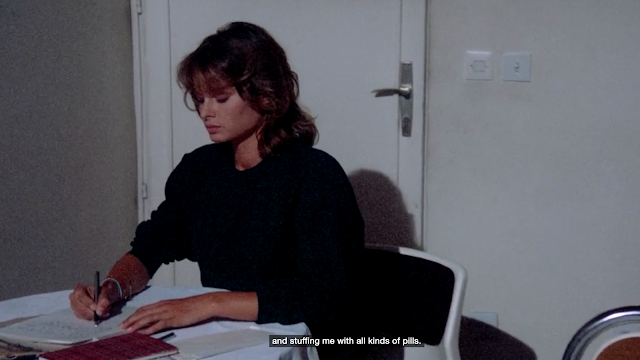
And lo and behold whose pulling up in his red convertible.... Dr. Robert Anderson, the focus of Eva's obsessive letter. He smiles and Jennie turns and smiles back, and runs up and climbs into his car, all while Eva's letter pours it on int he voiceover --making it seem like it's her getting into the car in her fantasy. We see her in her room at the asylum, like the dorms only narrower, the round outdoor table she was writing on earlier is now in there with her, tablecloth and all, making there, almost no room between her chair and the twin bed. It's a totally Bunuelian bit of surrealism that just streaks right by.
Eva's letter continue on, and the yearning and sexual hunger increases in its manic possessive intensity. The montage of romantic scenes (between Robert and Jennie) underneath it make a surreal contrast that comes into sense when we hear Eva threatening to remove any girl who steals him away.
What we find weird is that, yeah, Eva we could understand, especially if we once had or still have a yen for the damaged/insane hottie archetype (most iconically embodied by Angelina Jolie in Girl, Interrupted). But even for debauched older men, Jennie seems way too young and naive. Eva looked like she could be in her early 20s, and mature for age at that, but Jennie looks easily just 16. And their petting reflects this chaste Lemon Popsicle kind of romance: French kissing and hand holding is the order of the day, in theaters and in the convertible, the camera tracking in close. It's Eva describing passionate sex in her letter, it's Jennie doing a PG version in montage reality.
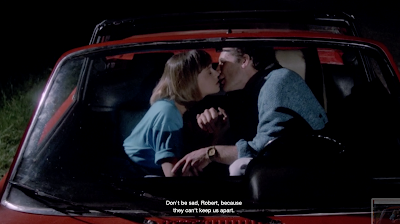
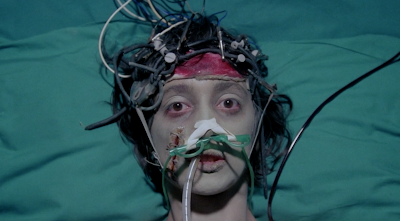
BUT THEN! The letter ends, the POV has zoomed up to them making out in the car (above) suddenly, the POV cuts to the hospital and zooms up to Kathy's eyes opening in her green sheeted ICU bed --only now she's not smiling; she looks heartbroken, those big saucer eyes betraying a kind of resigned hungover disappointment / Cut to a zoom up to Eva's eyes in her room, snapping open as well. It's like she's/they're only now realizing it's not them (Kathy / Eva) making out with Robert in her epistolary reverie, but Jennie in After School Special reality, a reality that excludes her. The meta POV angle comes kicking back in the way it did at the drive-in/prank. We may dream we're experiencing it, but it's via someone else now, not even the someone else we've been dreaming through.
Watching for the first time it takes us awhile to notice this switch. We're so used to the montage of physical therapy, group therapy, art therapy, under a letter-reading voiceover we don't think twice. Unless we're very good at remembering faces, we can't be sure Jennie is not Eva. The first time I saw it I was thinking that maybe the original actress playing Eva had to leave early, ala the girl in Bunuel's That Obscure Object of Desire. So he just replaced her and made it an artistic choice that two girls play one role.
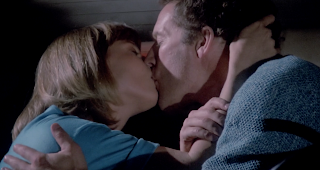
 |
This shot sequence, top to bottom, shows Fulci's genius with using quick edits to move the narrative along, with Eva's obsessive VO letter ending in a declaration he must be hers alone, ending as we slow zoom in on Robert and Jennie making out in his car / to Kathy's eyes bugged open in the hospital / to a zoom up to Eva's eyes flashing open -indicating Kathy's astral POV has noticed it's not her avatar with Robert but her avatar's goody two-shoes back-stabbing roommate. A smash cut to the sound of breaking glass as the organ swells / quick pan across a darkened exterior street finds Eva, cooly dressed in all black shirt and slacks, almost Bruce Lee in Enter the Dragon-cool, already snuck out and headed, obviously, back to the school. In order to understand this progression you have to take for granted that these aren't random shots but lead one to the other; as we're dealing with metaphysical high strangeness, like remote viewing, witchy magic, girl emotions, and betrayals. Nothing is ever spelled out in a Fulci film: we have to presume the order of the edits is telling a story, that each cut to a pair of eyes is seeing the previous image. So a cut to Kathy in her bed with eyes open, unsmiling, means she 'sees' and is not happy, then Eva 'sees' - the information hitting her with the zoom force of Kathy's thought. She's not only pissed but able to do something about it. Fulci spares us all the connectors and explanations and boom - we're out of an asylum we never even saw. Nope. Somewhere along the way, probably in a scene left on the editing room floor or x-ed out of the script, Robert has been 'consoled' by Eva's roommate --the tale as old as time. What is up with girl roommates always having to two time each other by sleeping with the other's boyfriend when he comes over and she's not there? Clearly it's happening at St. Mary's as well as with me up in Syracuse (twice!). |
Sure, we know the whole Jennie thing is in the film purely as a trigger for Eva/Kathy's homicidal jealousy. That's natural enough, but what's not is that it's never verbally commented on. Robert and Jennie barely even talk outside of the one scene in his office, when she needles him about the cot in his office in the following nonsensical exchange
Jennie: "Do you mean you never had a pretty patient, or nurse, on this bed?"
Dr. Robert: "So far, no." (they kiss)
Jennie: "But I'm not a patient or a nurse."
Dr. Robert: "Then you qualify."
They never even mention Eva. To them it's like Eva no longer exists, maybe she never did. But Kathy still does, and she's looking in from the TV monitor (maybe), perhaps her jealous spirit weighs on Jennie to the point she leaves, feeling like it's not right somehow. Only to turn around halfway and go back.
Back in the school, it's the dead of night in the school, Crazy Mary hears her daughter's disembodied voice in her head--a kind of echo of Carrie's in De Palma's film: "They all tricked me, mama! And all because I'm your daughter. The crazy maid's daughter, This is the first time we've heard Kathy's actual voice since those first six minutes with Fred. Mary knows instantly that she's standing there in the shadows, inside Eva (why hasn't she noticed Kathy's presence inside Eva sooner, such as when she served her snails?) Now Eva's eyes are glowing a soft red too, but softer and Mary's eyes seem softer red too, as if the red has disseminated between them kisses Eva's hands and speaks telepathically for the first time, ("My...child") but before she can continue (Lamberti does some great acting here just with her softening expression in a close-up, but her head cocks at sound of evil laughing, distracting Eva as it's the same laughter she heard during the prank. It's Grace and her boyfriend, (the grinning blonde couple who dressed Kathy up for her date with Fred) sneaking into the building. When we cut back to Eva's close-up she now is just radiating a mix of childlike hurt, embarrassment and confusion, as if reliving the prank all over again, her eyes narrow as if trying to nurse vindictive rage into being, but for the moment her mom reunion has softened her.
Still, we already more less know what's going to happen next. The curtains will rustle, some lame canned sexy dialogue will occur, and some people are going to lose their post-coital heads. Once again Mary and Eva are nowhere to be found - disappearing from mise-en-scene temporarily so they can engineer creative deaths in the ether. Is it one or both? Since this is the first time they've 'spoken' since her accident, I'd guess they weren't collaborating on these poetic deaths on the astral plane, but Fulci doesn't care to decide exactly who is engineering what.
 AENIGMA, you really are... an Enigma
OK, I'll end my deep dive here. The ending is kind of unsatisfactory--as if they realized time was up so just pulled the plug, so to speak. But it's always nice to see one of Fulci's space age morgues --all done up in honor of PHANTASM, maybe, the morgue as airport to the beyond, and there's a deep scalpel wound (at last!) and you can always keep the enigmatic Fulci kick alive by watching something like
House by the Cemetery (1981) or
Conquest (1983) or
The Devil's Honey (1986) after this.
In short (haha), I love Aenigma as much for what it leaves out as what it leaves in: there are no cliche'd young snickering horndog males (no boyfriend even gets a line of dialogue) there's really only two male main characters, a teacher and a doctor, and both are sleeping with students. There are no montages of time passing, no Boston travelogue B-roll filler, no pointless connecting scenes (arriving/departing, opening doors, no going to sleep, no engaging in predictable 'character development' and no predictable, bland orchestration. There isn't any 'norm' --if there is its used sardonically, ala the "Head over Heels" montage, so there's nothing to deviate from. There are no children or animals, no pointless tracking shots through asylums. No parents. Only two vehicles: Robert's red convertible, and the school van. The interiors are all old white Romanian architecture, cavernous with twin circular stars going up to a second floor balcony so students can gaze ruefully down at others. The museum is almost empty except for violent art; we never see any food except snails. And when Grace hallucinates the rows of beds on the ground floor, we realize this museum may be in the same building as the school with a few changes in set dressing (like an escalator instead of twin winding staircases) ditto the hospital, aside from the elevators and the cool morgue.
What it DOES have are bitchy, sex-crazed girls saying outrageously mean things in marvelously stilted dubbed voices while pretending they know how to smoke; Crazy Mary, her eyes glowing red while listening around corners as soon-to-be-dead students disparage her and her daughter; frowning school teachers irritated by the slightest display of emotional vulnerability or lack thereof; 80s-mandated aerobics; bait-and-switch fake-outs; Carlo Maria Cordio's slinky and spiraling organ score; the Menzies-evoking miniatures; Eva's savage Russ Meyer-style amok carnality; the usual creative Fulci death scenes; plenty of psychedelic WTF detours like blood raining sideways out of a painting; snails slowly suffocating a (presumably paralyzed) girl who wasn't paid enough (those are real snails!); the doctor and Fred with their never maligned or mentioned penchant for extracurricular student activities. Ain't that enough?
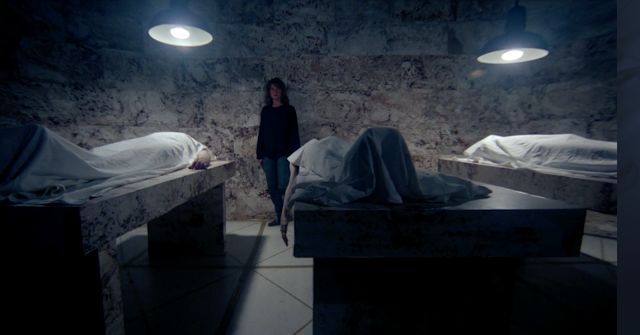
But it's the wealth of post-modern ambiguity is what really sells it. It's why you can see Aenigma over and over and never see the same film twice. We never know if any of these meanings I've just ascribed to it in this novel-length dissertation are intended or accidental. Like Schrodinger's cat-as long as it stays in the box--neither alive or dead, true or false, accident or intent, genius or stupidty--it's perfect, it's mythic, it's endlessly intriguing. On the other hand, if the box is opened and the cat is dead, i.e. Aenigma is a hack job inconsistent mess perfect to be hooted at during a drunk movie night but any subtext is BS, then what a short-sighted drag of an impression. Why even watch it? And if we open the box and know for sure the cat is alive, it's shuffled off behind the velvet rope of bourgeois respectability and can no longer be enjoyed as a 'so-bad-it's-good / WTF/ outsider gem of accidental Brechtianism.
But while still in the box, the cat neither alive nor dead, there can be no set response. No 'true' figuring out whether it's Mary and her coven or Eva/Kathy orchestrating the deaths. As a result, the beer-crushing bad movie lovin' plebes and the snifter bourgeois critics, each desperate to define themselves by their likes and dislikes, might not trust the ambiguity, i.e. they don't get that there's no "it" to get. Neither true or false is what true myth is all about. The 'could be' is what counts. Aenigma is like an eternal Xmas eve where morning never comes; or an alien or bigfoot documentary, as long as we don't know the answer, it stays relentlessly intriguing. Once all the meaning is ascribed, it's just a banal grey concrete, poster-covered dorm room mess, and aren't we all?
Hopefully you never read this.
FURTHER with FULCI


 Director Michael Almereyda proves himself quite adept at overlaying classic noir and Universal horror elements over familiar beats of black-and-white hipster downtown young people conversation, i.e. Jim Jarmusch peanut butter crashing into Todd Browning chocolate. Nadja have a great round of expository meet-cute dialogue that mixes poetry, exposition and dark humor, all mixed together rather marvelously if faux-pretentiously. You can get an idea of it in the following exchange at the bar: Nadja tells Lucy she wants to see her brother (Jared Harris!) even though h wants to destroy her.


 Man, like Night of Terror (1933), the filmmakers make full use of the temporarily lax production code to throw a lot of high weirdness into the mix. It would be a good enough old dark house movie just between Julia's morbid rantings, Pichel's lunatic laughter, the eerie expressionist graveyard across the street, and all the midnight creeping around. But then....here comes Tashman, grinning ecstatically when watching her husband get strangled. Oh! Oh, that Lilyan! Oh! what a gal!
 So, cops aside, all the men are easily seducible murderers, the women either bitter, manipulative, or dead. Only the homicide cop on the case, William Boyd, has any integrity or suspicion of Julia. She may have the other guys cowering, drooling, or at each other's throats, but Boyd rejects her advances with practiced ease. Still, he seems to admires her relentless confidence. He even admits--before hauling her away-- he's genuinely impressed.


