Wednesday, December 07, 2011
Bellamy the Deflowerer: THE WEDDING NIGHT (1935)
If you want to see the cruel extreme barbarism of the sudden implementation of the Catholic Legion of Decency's enforced production code (which overtook Hollywood in 1934), look no further than 1935's THE WEDDING NIGHT, starring Gary Cooper, Ralph Bellamy, and Anna Sten (the 'other' Garbo). It helps when considering the Christian backlash hooplah about the 'morning after' pill to see a film like this, and realize the extent of female subjugation in pre-industrial European culture, and the way it survives today in xtreme Catholicism, fundamentalist Islam and with some Mormons.
Ralph Bellamy with his wild hair, expertly applied peasant-stock eye-liner, and traditional Polish farmer garb actually gives Cooper a run for the money here in the god-like looks department. He's way too good looking to be so dumb, and what's this brood of crafty Polish tobacco farmers doing up in Connecticut in 1935, living next door to dissolute drunk writer Cooper's getaway lodge? Well, you can guess when Cooper's going to do when he dips those ink-lined lashes Sten's way.
See, Cooper's wife has stayed back in New York City, but Cooper moves up to the lodge, you know, for inspiration for his next book? Anna Sten and her family's provincial Polish culture is just the ticket, he thinks. The film thus sees the code mandate of 1934 as a property dividing line, between the home-grown social 'dissolution' of the post-WW1 Depression era of women's equality and hurrah for the next who dies, and a very fundamentalist old world patriarchy proletariat still thriving and yet to be smashed in Europe by the Nazis. Without that common enemy, those old-school Poles get mighty narrow-mined. Their dissolute neighbor next door is demonized as brutally as the Nazis would later do the Jews; meanwhile the property-greedy father and his obsession with land grabs hints at the outmoded values soon to be be read as the very reason for the barbarism inflicted upon them. As The farmer says to his daughter when she refuses to harness herself to the Bellamy plow, "stop making me hit you!"
Cooper's never been too convincing as a writer, but here he at least is convincing as a self-hating intellectual for whom literary 'research' has been the rationale for seducing women, book after book, so now he can't even remember whether the book is in service of the affair or vice versa (like a male Catherine Trammel) Sten is a fine actress and Sig Rumann is properly terrifying in an unusual role (for him). The code-enforced shock ending is of course that Sten must die, because her father pledged her to Bellamy, and was paid the dowry, and she refused to run away from the ceremony before saying "I do," which is the only proper thing for a bride standing on the lip of the 20th century. She blew it. That she loves Cooper instead but still goes through with the Bellamy wedding spells her death under the draconian rubrics of the code. But if she'd just run out to the car and driven off and grabbed Cooper and fled to the city before saying she did, well you could roll the credits right then. But the post-34 censor had his eye on adulterers, even if they'd been forced into a marriage that was only minutes old.
And so... in the post-34 world of Hollywood, once-free women starting dropping like flies. At least they had time to take long Garbo-esque death scenes, but there's a thin line between good death scenes and the bitter aftertaste of deaths being forced by a code no one making the film has any faith in. Religious censorship bleeds into the nature of the post-code era's stories -- where women marry even knowing it means their death, because marriage is the ultimate validation of woman, and then she may breed and create more Christians who can carry forth this fine, wretched, evil tradition of yoking the women to the Bellamies. Imagine the tale of Little Red Riding Hood if the Catholic Legion of Decency decided to update the story so that Red gets a chaperone through the woods, and the woodsman--her husband--regularly belittles her in a smirky way when she's caught talking to wolves. That wolf would be played by Cary Grant... the woodsman? That's right! It's no accident Bellamy is in THE WOLFMAN playing just such an impotent hunter.
To drive the point slamming home, the titular night of the film is a long wedding night for Sten and Bellamy at Rumann's house. Upstairs: Sten, joylessly, is being 'prepared' for deflowering by the glum matrons of the clan upstairs in her room. Downstairs Bellamy gets drunker and his cronies (and even Sten's father) encourage him to get up there and lay some pipe like they're the sloppy seconds-craving would-be-rapist brothers of the groom in Peckinpah's RIDE THE HIGH COUNTRY. The message is clear: the boys get to drink and goad each other on in lusty gang rape-tinged misogyny while the women, depressed and apathetic as if dressing a deer, prepare the next virgin for her code-sanctioned marital assault. Again, the message is that not only does marriage legitimize sex so you can have it right under your parents' roof, it frees you from the uncertainty of 'taking possession' of your spouse in copulation. In other words, she doesn't get to say no --only the dad does on her behalf. Even screaming for help they'll just laugh and roar below.
Fundamentalist Christian adages against a woman's right to choose her own mate seem barbaric to most free thinking people these days but after the WEDDING NIGHT you may understand its origins better. It's not really the fault of the Bellamy - he's not a bad guy. He's been led to expect he will get a wife handed to him via her father, and his confusion when it's otherwise is not his fault --empathy takes the ability to think outside one's own immediate social mores, which he is mentally unable to do. Though many conservatives are desperate to pass bills that would revert woman's rights back to the patriarchs, nowadays at least, they can't get very far. The best they can do is close an abortion clinic now and again as they lament the loss of their old property, the Fertile Womb, so squandered in the hands of its wasted young women owners.
So yeah, drooling sexual relatives are written into the rocks of Plymouth but when a sensitive poet soul like Sten's comes along, that kind of violent burlesque of socially controlled reproduction is shocking and un-American. It's one thing if the girl is plain and not very bright and maybe can't get a date on her own. But if she's a smart, poetic beauty, her assigned Bellamy will crush her like an orchid under the plow. When choosing between the Bellamy for life (in Albany, too!) vs. Gary Cooper for a just one weekend in Manhattan, is there any real choice? You got to grab Cooper.
The worst that can happen is he'll dump you and you'll wind up destitute and abandoned on the streets of the East Village, but that is nothing in comparison to being kept down on the farm under the yoke of Bellamy's unconscious, never-been-outside-of-the-box sense of entitlement. Just ask One-Eye: (see: Bob Hope Vs. The Canadian Svengalis).
Thus the Coopers and Grants are like missionaries of pre-code enlightenment, bringing hope to the dark areas of the New England tobacco belt. Now more than ever, we need to ridicule our Bellamies, ban the incoming burkas of our immigrants, and rescue Mormon girls before they're married to lecherous cult leaders, or mangled and castrated by hideous outmoded practices. I don't blame the Bellamies, or even the Rumanns --this is all they know. But the chain's gotta break somewhere. For too long our tall beautiful men and fast-thinking wabbits have held back, given the Bellamies and the Elmer Fudds the benefit of the doubt, presuming their old ways must have some merit. Our reward has been a trail of broken Stens. I say no more! Not one Sten, Bellamy! Not one Sten...
Monday, December 05, 2011
Gimme Cockaigne: MELANCHOLIA (2011)
"When life itself seems lunatic, who knows where madness lies? Perhaps to be too practical is madness. To surrender dreams—this may be madness. To seek treasure where there is only trash. Too much sanity may be madness. And maddest of all, to see life as it is and not as it should be." –Don QuixoteWhen true doomsday comes, perhaps the manic depressives and bi-polars amongst us will at last have an opportunity to shine in calm perfection while walking through slow motion rain. That seems to be the message of Lars Von Trier's latest, MELANCHOLIA (2011). Until then, alas, the ordinary madness of our civilization and all its unconscious munching, adherence to unexamined cultural mores, and slow death momentum, will have to be endured. Lars, I feel ya. But Jeeze. There are pills for that now!
MELANCHOLIA makes me nervous because I don't want to lose one of the best auteurs of our post-art house age and the film has the earmarks of a cinematic suicide note, a message from someone planning to be dead by the time you read it. His whole post-Dogme 95 life is flashing before our eyes and on some level he's reached the frontier from which no traveler returns. In order to keep going into the wilderness, for Lars is an explorer first and foremost, the film ceases to rim a frontier, but rather settles in and lets the frontier fall right upon it. It's a film about endurance, and the inability of some to handle normalcy vs. others to handle apocalypses. And Lars' star Kirsten Dunst, no longer the vampire child of Lestat, or the willowy cheerleader, has never seemed more Nordic. It's as if she's spent her life scowling through meaningless sex and animal fat-enriched meals solely to get to this part, solely to face this one vanishing point.
For in MELANCHOLIA, Von Trier dives headfirst into the same abyss that Terence Malick only wades up to his knees for THE TREE OF LIFE. There is no real comparison between the two other than their release dates, and ponderous linking of 2001-style classical music-scored outer space vistas. It's fun to compare them anyway: MELANCHOLIA, the tale of a woman's post-wedding depression coming to life in the form of a world-destroying planet, is the suicide note before to TREE OF LIFE's faded funeral notice after. TREE mourns my soon-deceased father but MELANCHOLIA mourns for me, and the son of my unborn son, and the ground beneath our unborn feet.
My girl and I saw the film this past Saturday night at the charmingly dilapidated Brooklyn Heights Cinema with its blaring, distorted speakers rumbling the seats with Wagner's aria to Tristan und Isolde as Kristen Dunst and company writhed in Bill Viola-style (see above) slowness. It was so loud I had to cover my ears. But rather than be the one to complain to the ticket taker, I tried my best to accept it. And then suddenly the music stopped. I missed it.
The 1st chapter of Lars' film is a long and expensive wedding for our melancholy heroine Justine (Dunst) over the course of which she flits with ecstasy before dissolving into a deep depression, winding up in the bathtub upstairs, refusing to come out. The sight of a distant star unnerves her. Soon she's telling off her boss (Stellan Skarsgard), losing her groom John (Alexander Skarsgard, insufferable as ever), sleeping with a kid on the 18th green, pissing off her sister Claire (Charlotte Gainsbourg) and her sister's rich husband John (Kiefer Sutherland), infuriating the wedding planner (a great Udo Kier) and drawing gasps from everyone but her loving drunk of a father (John Hurt) and psychotic mother (Charlotte Rampling), who makes the toast "I think marriage is a crock of shit."
Handheld Dogme verite style used to film weddings by now almost quaint: Demme's RACHEL GETTING MARRIED, Vinterberg's THE CELEBRATION, Baumbach's MARGOT AT THE WEDDING, have already been there. But unlike those affairs, LVT's is a picture of a cold planet bathed in warmth but unable to feel warm, and if you can survive the whiplash handheld camera nausea in these scenes, you can move on to the next course. The bride, however, won't be there as she's upstairs, nearly catatonic with ennui.
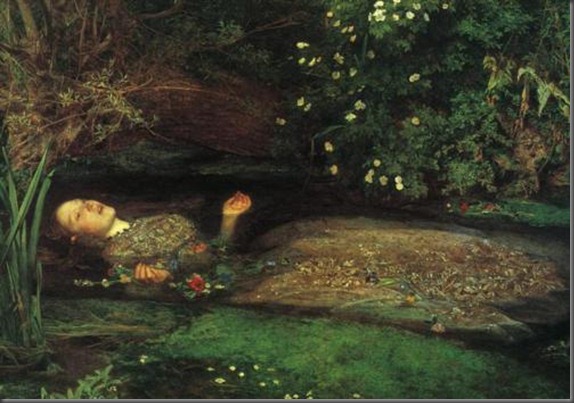
After some portions of the reception are over, Justine ducks into the library and changes the open art books on display from abstract geometrical shapes (put there no doubt by John as they reflect his dull patriarchal-modernist tastes) to archaic pictures of female suffering and/or death and peasant post-wedding debauchery. There's: "Land of Cockaine" and "Hunters in the Snow" by Bruegel; "Ophelia" by J.W. Waterhouse; and "After the Hunt" by Bogarde. As in DOGVILLE and ANTICHRIST, this book swap seems a full rejection of the flat, dull left-brained scientific rationalism championed by an insufferable materialist know-it-all in favor of a return to the mythic unconscious where every day is your last so you better get connected back to your Jungian roots, and hammered, before the whole tree of life goes up in flames.
John rejects such Dionysian nonsense outright, but his own left-brained thinking falls apart at every turn. Unable to to deal with the loss of his empirical toe-hold, deluding and denuding-- as DaFoe did in ANTICHRIST--via smug dismissal of Gainsbourg's intellectually eroticized 'feminine hysteria,' and the neglect of their co-owned horses. Dunst's depression is never fully explained so we naturally look for clues and there are plenty if you hate the fact that all that rich razzle dazzle, the 'very expensive' fairy tale wedding is the closest the dead patriarch of order and logic dares come in the direction of ritual, of 'myth' (outside of forbidden Masonic rites, etc). In going for high class in a materialist bourgeois competitive manner, this stuffy wedding becomes a control freak's dream and an awake aesthete's overload nightmare, where the more money spent the less fun it's possible to have. It's Bruegel land of plenty fairy tale overrun with linear edicts.
Cockaigne is a medieval mythical land of plenty, an imaginary place of extreme luxury and ease where physical comforts and pleasures are always immediately at hand and where the harshness of medieval peasant life does not exist. Specifically, in poems like The Land of Cockaigne, Cockaigne is a land of contraries, where all the restrictions of society are defied (abbots beaten by their monks), sexual liberty is open (nuns flipped over to show their bottoms), and food is plentiful... Writing about Cockaigne was a commonplace of Goliard verse. It represented both wish fulfillment and resentment at the strictures of asceticism and dearth (Wiki)
Pieter Bruegel the Elder's "Luilekkerland" ("The Land of Cockaigne"), 1567. Oil on panel.
![]() |
| Justine prefers dearth |
While we struggle to not get nauseous from whiplash shaky-cam, the heavy breathing Dogme sound keeps the wedding unbearably intimate: we hear every cut of the meat and every clang of cutlery on the china plates; every breath and wheeze from the gathered throng is amplified like we're tripping our faces off and boiling over in claustrophobic anxiety; trapped in this crowded dining room with all these acting actors talking over each other all at once like real people do in groups, it's as if the secret joy of the movies--avoiding having to talk to people and act civil--is corrupted, the meat and small talk tumbling out of the screen like the guts out of a rotten pumpkin.
At first we don't know why Justine is losing her grip, but we feel it's something to do with the oppressive worry of her sister ("Don't ruin this!") her brother-in-law John ("this cost a fortune") and the insane ravings of her mom. The wedding is a public de-pantsing of artistic success, wherein the best riches and opulence can be is thrown up as buffer against the onslaught of Lars'/Justine's depression, and it all crumbles like fairy dust.
It is only in Justine's subsequent sad melt-down and later ecstasy over the approaching doomsday that she blossoms. The planet is her true groom and its destruction her true union.
Seeing how each person in their group prepares for the end, I was reminded of my own strange exaltation on the day of 9/11, the acrid smell of the burning buildings in my nose as I went racing up deserted 2nd Avenue at midnight, brain thrilling that it might the world might end any moment. Any building might blow up at any time! I was alive for the first time in years, I was FREE of all my conceptions of self and the world around me. New York City was a ghost town at that hour. Not a car or soul on the street but me. Yet, I managed to grab the only train running, a single C-train that suddenly arrived at Brooklyn Heights as I went racing down the stairs, and to find one cab when I got off at 78th street (?) and me and the the cab driver were like the post-apocalypse, like ESCAPE FROM NEW YORK, map of the bridge! Hey! Hey! HEY!
I knew my exaltation was not 'proper' but also, later, learned I was not alone in feeling it, especially at the uptown AA meetings I attended in the weeks that followed. We had a lot of firemen and cops up there at those meetings and we felt their pain and grief at losing--roughly--half their number in a single day, but we, the non-responder/survivors, were strangely calm, more serene than we'd been in some time. We went to the movies never sure if the city would be there when we got out, thus comedies took on special import (ROCK STAR, ZOOLANDER, coming to mind).
In this apocalyptic moment, we AA people were at peace. Our constant existential dread, so useless in normal life, was suddenly the norm. Now that the world was blind, our impoverished vision made us royalty.
What’s madness but nobility of soul
At odds with circumstance? The day’s on fire!
I know the purity of pure despair,
My shadow pinned against a sweating wall.
That place among the rocks—is it a cave,
Or winding path? The edge is what I have.
At odds with circumstance? The day’s on fire!
I know the purity of pure despair,
My shadow pinned against a sweating wall.
That place among the rocks—is it a cave,
Or winding path? The edge is what I have.
–Theodore Roethke, “In a Dark Time”
John however, will have no such apocalyptic acceptance, and in the period after the wedding he belittles and dominates Claire in a vain effort to allay her anxiety about the approaching planet. In his bland pretense he resembles past Von Trier male characters of past films like Dogville and Antichrist, authority figure wannabes who do their best to dominate the women in the room but come off sad and impotent, wanting in the shadow of some dead patriarchal ideal that dominates both genders.
In TREE OF LIFE we saw the dawn of the earth, and the first vague gestures of compassion, leading up to some beach-side dream jazz heaven cast party. That's the kind of soiree Claire wants to have as the planet looms, a Cockaigne-style acceptance of the end through drink and song and togetherness. From her new husband's picture of an apple orchard he's bought for her, to 'rest' in, to the pebbles in the jar Udo Kier wants everyone to guess the number of--everything but the strange request to 'build caves' from the son, to return to Werner Herzog's CAVES OF FORGOTTEN DREAMS, perhaps, and to the mythic inner reality of Jungian archetypes of which we are the shadows on the Platonic walls-- is, in Justine's eyes, contemptible.
Von Trier shows that all the money in the bourgeois world of wealth and rationalism won't allay or abet this impending cloud, only Justine's resolutely transcendental delusion is some kind of salvation. Hers is the peace of the twisted. She is a herald, one of the women and men who have writhed backwards through time due to years of enduring the stale, hollow pleasures of Cockaigne. Like Jack in the 1920s New Years eve picture at the end of THE SHINING, Justine moves backwards into the representations of the past until she's as indestructible as the planet Melancholia itself. I hope Lars doesn't mean to follow her quite yet, though at this point he's running out of language, image, and time. Every new film shows a little less sand in the hourglass and MELANCHOLIA shows the hourglass itself breaking into slow motion splinters. Soon he will have nothing left but sand, unless...
May I suggest an Effexor + Wellbutrin + Neurontin cocktail, sir? It works wonders! Cockaigne is for suckers, as Bruegel and Lacan well knew. When life gives you only lemon orchards as far as the eye can see, no amount of lemonade-making can allay the soul-curling sourness. One must burn and run, even if there's nowhere to go but deeper into the ash crevasse.
POST-SCRIPT (12/7/12): As Justine gets out of the limo to head into the reception, she spots the incoming planet--still just a dot in the sky but she recognizes it--and five days after seeing the film it dawned on me that even so far away she recognizes it as our onrushing doom and her deliverance. So fuck it, she tells off her boss and dumps her groom. But isn't that what depression is all about? She doesn't bother to share her realization though, knowing perhaps that in the house of a coddling smugly bourgeois materialist like John it's useless to bring it up. Considering this, the film suddenly comes into sharper focus for me, so thought I'd add it!
Special Thanks to Jennifer Boyer,

Thursday, December 01, 2011
American Horror Hotel California Story
Mirrors on the ceiling, The pink champagne on ice
And she said 'we are all just prisoners here, of our own device'
And in the master's chambers, They gathered for the feast
The stab it with their steely knives,
But they just can't kill the beast - Eagles ("Hotel California")
And she said 'we are all just prisoners here, of our own device'
And in the master's chambers, They gathered for the feast
The stab it with their steely knives,
But they just can't kill the beast - Eagles ("Hotel California")
The Eagles' 1976 song "Hotel California" and the awesome new FX show, American Horror Story are two peas in a grisly pod--along with Kenneth Anger's book Hollywood Babylon--that circumscribe the broken longing of Los Angeles. Hearing it as a kid (I was nine when it debuted on the radio) the dark eroticism of the song carried a queasy black magick power. Whatever those L.A. people were doing, it was evil, dark, and underscored by a sexual longing I felt deep within my polymorphously perverse childhood soul.
The song's lyrics painted a grim portrait of what might be called the Land of Hungry Ghosts, the Buddhist hell where everyone is ravenous with hunger and cursed with tiny mouths at the end of long, painfully thin tube-like necks. "Stab it with their steely knives but they just can't kill the beast" might very well be an illusion to cocaine, with the knives being used for the flat ends to distribute coke bumps, but no amount of coke able to kill the beast, the jones for more that ever threatens to turn success and fame and endless groupies and booze and drugs into a living hell, as easy as a still drunk from the night before morning gradually grays into a cruel, blue condition. Worse than an average Christian hell, where one at least is allowed to suffer loudly and unabashedly, in the California hell one must act as if they are always having the time of their lives, for if they fail the whole scene could implode on them, the veil pulled away to see that the glitterati at your back porch Laurel Canyon party are all grungy ghosts who bought their way in with mountains of coke and are already telling everyone you're their best friend, and it's too late you already got rid of your wife and kid so you could party 24/7 - it's too late to admit the mistake, the blindness, so you just snort and shoot and drink more and hope to blot out the grisly alien demon look of your joneser entourage which has gradually, without you knowing when or how, become all strangers. As Lili Taylor said in Abel Ferrara's THE ADDICTION, "We drink to forget we're alcoholics. We seek relief from the addiciton, but the addiction is the only relief we can find." Or as Taiyu describes it in "Buddhism and Recovery:"
"In Buddhism there is a myth about a hell-realm populated by beings whose appetites exceed their capacity for satisfaction. Their stomachs are huge but their throats are tiny. No matter how much they try to eat, their hunger remains. In ancient India, they are called hungry ghosts. We call them alcoholics and drug addicts... We eat and drink and smoke and use and gamble and love and lust and shop and exercise and obsess about anything that resolves the sense of incompletion, imperfection, or suffering we find inside."
The Hungry Ghost blueprint fits perfectly over the great new TV series on F/X, American Horror Story, which indulges in the 'post-10 PM sex-and-violence' slot trend to weave a multi-generational yarn about a large haunted house in the heart of Los Angeles that's acted as a focal point for a whole history of Hollywood murders--from the Richard Speck nursing home to the Black Dahlia's killing floor. In this week's episode we have the haunted-looking Mena Suvari playing the 1947 murder victim Dahlia, whose history became an emblem of the evils of 'Hotel California,' the sun-baked sin city where slimy predators take advantage of pretty, starstruck youngsters as a matter of course. Here we learn the truth is far less lurid, just a cover-up by a shaky dentist after he dies in her chair from an allergic reaction to his gas. But that's par for the AH course -- all the sordid evils of our LA nocturne imagination are simultaneously more mundane and more supernatural than we could e'er imagine.
But imagine we do, here in the rest of America, wherefrom we view the kind of druggy, sex-saturated, fame-whoring lifestyle L.A. indulges in as a vacuous fantasy. Middle America has families to worry about, they don't have to worry about the despair of those whose vacuous rock and roll fantasies are realized. L.A. rock stars like the Eagles can actually get enough drugs and sex with their rock and roll that it it's a fantasy no longer, and so it no longer keeps the lonely terror at bay, and they realize that while they checked in any time they liked, they can never leave. Guitar solo! BrawnabreeEEeaoum brau-brewarrrooooomm-rip!
The Black Dahlia became the pin-up girl for those who'd tried to make the dream come true and almost died as a result, or were abducted into a cult, or whatever the hell happens to those too wide-eyed to notice all the vultures gathered for the feast. And there's a meta charge to the casting of Suvari since in past years she appeared to be under the spell of some kind of eating disorder in the wake of her sudden surge to fame via AMERICAN BEAUTY (1997). On a subsequent SNL appearance her wild eyes, bird-like mannerisms and darkened teeth, all indicated something just not right; she's come out of it super strong in recent years and has been active in pro-women's esteem-style causes. Luckily for us she was still able to capture the sense of needy desperation in her portrayal of the forlorn ghost of Janice Short last night, bringing a ghostly sexuality that is so needy it simultaneously arouses and spooks us.
The hungry ghost / sexual sacrifice on the tortuous wheel of insatiable lust motif permeates American Horror Story. It is so L.A., and the actors playing desperate Hollywood fortune seekers broken on the rocks of skeevy casting couches clearly tap into their own experiences before finding their footing. The house maid Moira (Frances Conroy) is a ghost who appears as a young hottie incarnation (Alexandra Breckenridge) of herself to desiring men - clouding their perceptions, exposing them to judgment from their daughters when they're seen fooling around with a woman old enough to be their grandmother in the library. We in the audience are forced into a very creepy realization by this one-two switch: all hot young women become old and unsexy eventually so our desire for their young flesh and revulsion toward the old is suddenly revealed as a kind of fever dream grab at immortality. And most of all, we're faced with the question what is more important - that our friends think the girl we're shagging is hot, but we find her hideous - or vice versa? We can't overestimate the idea that the value of beauty in women lies largely in our status amongst our peers for 'having' them. Even in bed with a goddess we may be doomed to savor it not, imagining only instead the high fives and admiration to come the next day amidst our inner circle, being anxious to get to that. In other words, even in the moment of our ultimate desire's realization we instinctively pull away -- already reflecting on what it will be like to have had our desire realized. And Lacan smiles knowingly at your disillusion. He shouts, "Now! Now take a look around you and see things as they really are!" But you are already staring at a hot chick sitting down to dinner in the master's chambers.... with the Eagles. Lucky bastards.
Last night's episode showed that this clouding can be broken through via a man who is able to refuse his desires for a purpose other than fear or guilt. In this case Dr. Ben Harmon (Dylan McDermott) is able to refuse not one but two seduction attempts that are created straight out of the Penthouse forum pages, and Ben--who we know from earlier episodes is pretty weak-willed and considers his sexual needs a priority over all else-- has good reason to act on his fantasies: his wife and daughter out of the house (we never see the daughter in the entire episode), and learning of his wife's infidelity as the perfect excuse.
That he does not, even with no strict moral impetus hanging over his neck, is what breaks the spell. Buddhists call this 'moksha' or the ability to transcend ego via the abandoning of the pursuit of pleasure and avoidance of pain, tedium, etc. The realization whatever we run from chases us and whatever we chase runs, therefore we find pain always hot on our heels and pleasure always just out of reach. Or as the Eagles song goes: "Some dance to remember, some dance to forget." And it's the same dance either way. The pain of remembrance exists only in relation to our resistance, just as pleasure exists largely in terms of its delay. Ben's big breakthrough this episode was a refusal of the hungry ghost appetite even though fear of being caught became no longer a factor. In other words, even with no witnesses and no possible reward for his asceticism, he chooses it anyway, and this is the only time it's ever worth a damn, for morality under the gun is only obsequiousness, itself a kind of sin. To thine own self be true, but is lust true?
That said, a lack of appetite for illusion has no place in haunted Los Angeles. The ghosts in his house, such as his ex-mistress student Hayden (Kate Mara), long and pine and remain trapped in perpetual hungry ghost longing. But on the other hand, they don't have to pay rent! They don't have to sleep, or eat, or go to work, or face rejection by the outside world. As the song goes "this may be heaven or this may be hell" and in Hotel California the difference is erased, just as the dance is both to remember and to forget. Either way we play it we can still hear the voices calling from far away, waking us up in the middle of the night, just to hear them say "thanks for coming in but I'm afraid we're looking for someone just a little bit younger."
Monday, November 28, 2011
THE BIG CUBE (1969) - Lana Turner and the Unscrupulous Doser
Acid has long been considered a safe, healthy, happy, spiritually freeing drug --at least by me in the late 1980s. But even then, as a mere sprat, I was conscientious and careful, ever aware of the mind-bending, never-ending roller coaster of terror that results from taking even a quarter-tab too much. This is not to mention the left-out feeling of boredom and missed opportunity that results from taking too little, which can lead to taking more before the first ones have kicked all the way in, bringing you from an enervating semi-glow to a terrifying descent in a flash.
A very, very powerful substance is our friend LSD: one drop can set your soul free to caper through inter-dimensional levels beyond time and space; two can make you god-like. Five drops and you better get sloppy drunk... fast --or, if no one can spare a Valium, you can always chug some Nyquil before the demons get you.
Imagine then, the danger when sending someone to heaven or hell all depends on the whims of an unscrupulous doser! The difference between 1-3 or 4-6 drops from a dropper, dispensed at a crowded beatnik bar; the person holding the dropper over your tongue is drunk, malicious, and mad at you for stealing his girl and knocking over his bong! He could send you to the psych ward just by squeezing a hair harder than usual.
![]() |
| Chakris advises his ant client on proper dosage |
Still, even the face-clawing demons can be 'an experience.' I remember one or two of my more depressed voyagers (the winters up at SU could be brutal) taking like half a sheet of blotter in a last ditch effort to break through the veil before the depression made them do something even more desperate (this being long before Prozac's popularity). Most who did this wound up hospitalized. Not me, though! I ended up watching Nightline on a goddamned crappy TV all night, no other channel tune-innable (we didn't have cable, or a VCR as yet), trapped in a black and white nightmare hell.. oh god, I can't even think about it. Like Scotty on the Vertigo ledge I feel like I'm still back there, stuck with Ted Koppel's voice as the same few stories played in endless loop through to dawn. Save me, Pamela Rogers!
![]() |
| Pamela Rogers (left) almost saves Lisa from being a stone drag |
All of which is a preface to the candy-colored opus of bargain basement glitz and 'now generation' posing known as THE BIG CUBE. An underrated camp classic from '69, year of Manson, it stars Lana Turner as a former Broadway star living the high life in a Mexico-L.A. hybrid with her new wealthy industrialist husband (Dan O'Herlihy) and his sheltered 'pure' stepdaughter Lisa (Karin Mossberg), who dresses like she's still 12 and heading to her first church social.
Lisa reacts not well to the new step-mom, and in a passive-aggressive moment of naivete even takes up with a smooth-talking med student played by George 'you came with your mouth / open' Chakris and his gang of former lovers, hairy clowns, and hipster pallies, including the sly and sinous Bibi (Pamela Rogers). The blog by Captive Wild Woman (from whom I cribbed many of these screenshots) loves Pamela Rogers in this film, and I totally dig she digs it:
Saving it all from becoming a big snore-fest is Pamela Rodgers as Bibi... I could never convey the fantastic bubble-brained delivery she strives to deliver so expertly. I LOVE all scenes featuring Bibi and only wish the entire movie revolved around her. (more)Alas, Bibi is only on the periphery, as the story has places to go, and people to drive crazy. Chakris' med student status apparently means he has unlimited access to commercial grade LSD and, since he uses it for evil, he's a dangerous mix of Manson and a SHAMPOO-style fortune climbing gigolo. LSD wasn't officially illegal until around '68 and before then was used quite successfully for all matter of psychiatric treatments (with great effect, making its banning the true crime), so at the time of the film it was no harder to get than, say, 4-Loco. And when the dad conveniently dies in an off-camera yachting accident the stage is set for the unscrupulous doser and Lisa to drive the already shaken Lana over the edge via a massive LSD infusion into her bedside Valium bottle.
An interesting comparison can be made between this film and the AIP title ANGEL, ANGEL DOWN WE GO! (1968), which also concerns a sheltered heiress getting too involved with the now generation and letting a charismatic young cult leader type convince her to arrange the death of her rich parents (Jennifer Jones fills the fading trophy / absentee mom role in ANGEL) and let his gang move into her mansion. ANGEL kind of loses momentum by the time it decides to critique materialism; CUBE ends up going the self-reflexive meta-epiphany Freud route (the only way to 'cure' Lana of her "strange affliction" is to write a play about her boating accident so she can make peace with her drowned husband).
The moments with Lana on acid are freaky enough, but the really scary moment is when Chakris spikes the drink of a guy he's annoyed with at the club--a big brawling bearded guy--who freaks out, starts tearing up the joint and is thrown out on the street raving like a foam-mouthed, face-clawing lunatic. As someone whose been there I had a lot of sympathy for this clown, though he was awfully annoying he didn't deserve that. No one does. If you've been there, good lord, you know what I mean. As I said earlier, taking the right dosage can be like being lifted up the ladder of your own evolution, while too much is like having the ladder shoved down your throat while Hell's full roster of demons climb up from it and peel your skin off and every kid who ever hurt you in grade school materializes like accusatory ghosts to laugh at your extreme skinless nakedness.
Acid in CUBE is, unfortunately, employed almost purely as a weapon, but like firearms maybe these drugs are too dangerous to be left to criminals. Legal, it could be diluted to the point where overdose would prove a difficult task. In the twilight world of schedule-one substances, however, it's a risk in the best of times. So... know your dealer, stay away from sleazy gigolo med students, and err on the side of prudence til your batch's strength is tested. Or you could just say no, but don't you want to see what Hell looks like before, you know... you move in?
Labels:
acid,
decadence,
drugs,
freaks,
George Chakris,
Lana Turner,
Love,
lsd,
medical,
melodrama,
Obama,
pscyhe
Subscribe to:
Posts (Atom)